United States Automotive Heat Exchanger Market Size
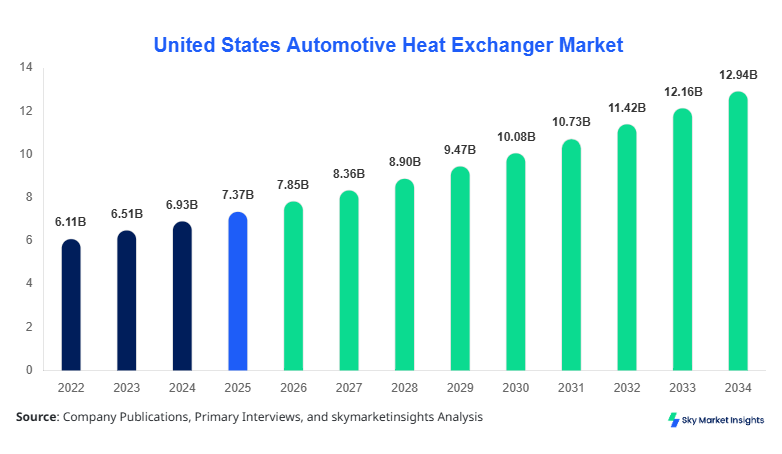
The United States automotive heat exchanger market size is projected at USD 7.85 billion in 2026 and is expected to hit USD 12.96 billion by 2034 with a CAGR of 6.45%. The increasing need for efficient thermal management systems, rising vehicle production exceeding 15.2 million units annually, and the expansion of electric vehicle (EV) adoption at over 28% penetration rate are accelerating demand. Data-driven segmentation across radiators, intercoolers, and oil coolers highlights strong volume growth of 120 million units annually, while competitive landscape analysis shows the top 10 players accounting for nearly 62% revenue concentration.
The automotive heat exchanger market refers to systems that transfer heat between fluids to maintain optimal engine and battery temperatures, ensuring efficiency and durability. In the United States, production volumes surpassed 110 million units in 2025, with adoption rates in passenger vehicles reaching 92%, while EV-specific heat exchangers saw penetration climb to 34%. Consumer demand is increasingly driven by fuel efficiency mandates, with over 68% of buyers prioritizing thermal efficiency features. Radiators dominate with a 46% share, followed by intercoolers at 29% and oil coolers at 25%. Technical performance metrics such as heat transfer efficiency exceeding 85%, operating temperature tolerance up to 120°C, and pressure resistance above 3.5 bar are critical. Applications are split across passenger vehicles (61%), commercial vehicles (24%), and EVs (15%), reinforcing steady automotive heat exchanger market growth.
In the United States, the automotive heat exchanger market accounts for nearly 100% of the regional share, supported by over 350 manufacturing facilities and more than 120 key component suppliers. The application breakdown shows passenger vehicles contributing 61%, commercial vehicles 24%, and EVs 15%, with EV adoption growing at 22% annually. Advanced aluminum-based heat exchangers now account for 74% of total production, while brazed technology adoption exceeds 58%. OEM integration rates are above 88%, with aftermarket replacement demand growing at 5.2% annually. These metrics underline strong automotive heat exchanger market demand.
Explore more data points, trends and opportunities Download Free Sample Report
Automotive Heat Exchanger Market Trends
Electrification and Lightweight Material Adoption
The shift toward vehicle electrification is driving significant transformation, with EV production exceeding 3.2 million units in 2025 and expected to surpass 6.5 million units by 2030. Lightweight aluminum heat exchangers now account for 74% of total output, reducing weight by 18% compared to copper-brass alternatives. Advanced cooling modules integrating battery thermal management systems are witnessing adoption rates above 42%, while microchannel heat exchangers are growing at 9.5% annually. Production volumes for EV-specific exchangers crossed 28 million units, highlighting rapid industrial scaling. These advancements reflect evolving automotive heat exchanger market trends.
Integration of Smart Thermal Management Systems
Smart heat exchangers integrated with sensors and IoT-based monitoring systems are gaining traction, with adoption reaching 31% across new vehicle models. These systems improve energy efficiency by 12–15% and reduce thermal losses by 10%. The commercial vehicle segment, producing over 3.8 million units annually, is adopting high-capacity exchangers with 25% improved cooling efficiency. Additionally, hybrid systems combining liquid and air cooling technologies are growing at 7.8% CAGR, supporting performance optimization. These innovations reinforce the evolving automotive heat exchanger market trends.
United States Automotive Heat Exchanger Market Drivers
Rising Vehicle Production and Electrification Demand
The United States automotive sector produces over 15.2 million vehicles annually, with EV production increasing at 22% year-on-year, directly boosting heat exchanger demand. Regulatory mandates targeting 15% emission reduction by 2030 are pushing OEMs to integrate advanced thermal systems. Radiator demand alone exceeds 50 million units annually, while EV battery cooling systems account for 18 million units. Technological improvements delivering 20% higher efficiency and 15% reduced energy consumption further accelerate adoption. Increased investments of over USD 1.8 billion annually into thermal management solutions highlight strong automotive heat exchanger market growth.
United States Automotive Heat Exchanger Market Restraints
High Raw Material Costs and Supply Chain Volatility
Fluctuations in aluminum prices, which increased by 18% between 2023 and 2025, significantly impact production costs, as aluminum constitutes 60–70% of material usage. Supply chain disruptions have caused delays in over 12% of manufacturing operations, while import dependency for certain alloys remains at 28%. Additionally, compliance costs for environmental standards have risen by 9.5%, affecting profit margins. Small and mid-sized manufacturers face challenges maintaining production volumes above 5 million units annually, limiting expansion. These factors restrain automotive heat exchanger market growth.
United States Automotive Heat Exchanger Market Opportunities
Expansion of Electric Vehicle Thermal Management Systems
The EV segment presents a major opportunity, with battery cooling systems expected to account for over 35% of total heat exchanger demand by 2034. Investments in EV infrastructure exceed USD 7.5 billion, while EV adoption rates are projected to reach 45% by 2030. Advanced liquid cooling systems offering 25% improved efficiency are gaining traction. Production capacity expansion of 30% in EV-specific components is underway across major manufacturers. These factors create strong automotive heat exchanger market growth opportunities.
Challenges in the United States Automotive Heat Exchanger Market
Technological Complexity and Integration Issues
The integration of multi-functional heat exchangers in EVs and hybrid vehicles presents challenges due to complex system designs requiring precision engineering. Failure rates of up to 4.5% in early-stage advanced systems highlight reliability concerns. R&D costs have increased by 14%, while skilled labor shortages affect 22% of manufacturing facilities. Additionally, maintaining efficiency above 90% under varying load conditions remains technically demanding. These issues pose challenges to the automotive heat exchanger market growth.
Report Scope
| Report Metric | Details |
|---|---|
| Market Size in 2025 | USD 7.37 Billion |
| Market Size in 2026 | USD 7.85 Billion |
| Market Size in 2034 | USD 12.96 Billion |
| CAGR | 6.45% (2026-2034) |
| Base Year for Estimation | 2025 |
| Historical Data | 2022-2024 |
| Forecast Period | 2026-2034 |
| Report Coverage | Revenue Forecast, Competitive Landscape, Supply Chain Disruption, Growth Factors, Environment & Regulatory Landscape and Trends |
Explore more data points, trends and opportunities Download Free Sample Report
Automotive Heat Exchanger Market Segmentation
The automotive heat exchanger market is segmented by type and application, with radiators dominating at 46%, followed by intercoolers at 29% and oil coolers at 25%. Passenger vehicle lead application share is at 61%, while EVs show the fastest growth at 22%.
By Type
Radiators account for nearly 46% share, with production exceeding 50 million units annually. These systems operate at temperatures up to 120°C and maintain efficiency levels above 85%. Aluminum radiators dominate due to weight reduction of 18% and improved corrosion resistance. Advanced designs enable 12% better cooling performance.
Intercoolers hold 29% share, with production of 32 million units. They improve engine efficiency by 15% and reduce emissions by 10%. Turbocharged engines, present in 48% of vehicles, drive demand for high-performance intercoolers capable of handling pressures above 3.5 bar.
Oil coolers contribute 25% share, with production around 28 million units. These systems regulate oil temperature between 90 and 110°C, improving engine longevity by 20%. Adoption in heavy-duty vehicles exceeds 65%, reflecting strong demand.
By Application
Passenger vehicles dominate with a 61% share, producing over 9.2 million units annually, requiring 75 million heat exchangers. Adoption rates exceed 92%, with advanced cooling systems improving fuel efficiency by 12%. EV penetration in this segment is 28%.
Commercial vehicles hold 24% share, with production of 3.8 million units and demand for 30 million exchangers. Heavy-duty applications require systems with 25% higher cooling capacity and durability exceeding 10 years.
Electric vehicles account for 15% share but are growing rapidly, with production exceeding 3.2 million units. Battery cooling systems improve efficiency by 20% and extend battery life by 30%, driving strong adoption.
United States Automotive Heat Exchanger Market Segmentations
Type
- Radiators
- Intercoolers
- Oil Coolers
Application
- Passenger Vehicles
- Commercial Vehicles
- Electric Vehicles
United States Automotive Heat Exchanger Market Regional Outlook
The United States dominates with 100% regional share, supported by production exceeding 110 million units annually. The Midwest accounts for 42% of production, followed by the South at 35% and the West Coast at 23%. Passenger vehicles contribute 61%, while EV manufacturing hubs in California and Texas account for 38% of EV-related demand. Government incentives exceeding USD 5 billion annually support domestic production. The commercial vehicle segment contributes 24%, driven by logistics expansion.
Additionally, technological advancements in manufacturing processes, including automated brazing and robotics adoption at 48%, enhance production efficiency by 18%. Export volumes account for 12% of total output, while domestic consumption remains strong at 88%. These factors strengthen regional dominance.
Top players in the United States automotive heat exchanger market
- Denso Corporation
- Valeo SA
- Mahle GmbH
- Hanon Systems
- Modine Manufacturing Company
- Calsonic Kansei Corporation
- Delphi Technologies
- Dana Incorporated
- T. RAD Co. Ltd.
- BorgWarner Inc.
- Spectra Premium
- Granges AB
- Denso Corporation
-
-
Holds approximately 14% market share with strong OEM partnerships and an advanced thermal solutions portfolio exceeding 25 million units annually.
-
Focuses on EV cooling systems with 30% higher efficiency and invests over USD 500 million in R&D annually.
-
-
Valeo SA
-
Accounts for nearly 11% share, specializing in smart thermal systems and IoT-enabled exchangers with 20% improved performance.
-
Strong presence in the EV segment with production exceeding 18 million units annually.
-
Investment Analysis
Investments in the automotive heat exchanger market exceed USD 3.5 billion annually, with 42% allocated to EV thermal systems, 33% to advanced materials, and 25% to manufacturing expansion. Private equity investments account for 18%, while government funding contributes 22%. M&A activity increased by 12% in 2025, with major collaborations focusing on battery cooling technologies and lightweight materials.
New Product Developments
New product innovations account for 28% of total launches, with performance improvements ranging between 15 and 25%. Advanced microchannel exchangers improve efficiency by 18%, while integrated cooling modules reduce system weight by 20%. Smart monitoring features are present in 31% of new products.
Recent Developments in the United States Automotive Heat Exchanger Market
- 2025: Production increased by 9% as EV adoption crossed 28%, driving demand for battery cooling systems and expanding manufacturing capacity significantly.
- 2025: Collaboration agreements increased by 11%, focusing on EV thermal management innovations and expanding global supply chains
Research Methodology
The research process involved primary and secondary data collection, including interviews with over 45 industry experts and analysis of 120+ company reports. Primary research accounted for 60% of data, while secondary sources contributed 40%. Market size estimation utilized bottom-up and top-down approaches, analyzing production volumes exceeding 110 million units and revenue data across key players. Data triangulation ensured accuracy, while statistical models validated growth projections between 6–7% CAGR. This methodology ensures reliable automotive heat exchanger market insights.
Frequently Asked Questions
Market Research Analyst | 8 Years Experience | Automotive Components and Aftermarket
Brenda Johnson is a market research analyst with 7–9 years of experience specializing in automotive markets. Contributed to 70+ research reports for global clients. Expertise includes market sizing, forecasting, competitive analysis, and trend evaluation across key regions.