United States Automotive Fuel Tank Market Size
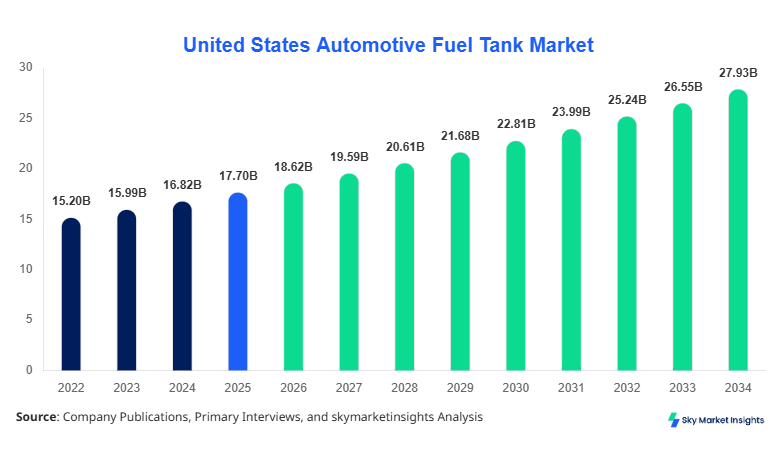
The United States automotive fuel tank market size is projected at USD 18.62 billion in 2026 and is expected to hit USD 27.95 billion by 2034 with a CAGR of 5.2%. The study integrates detailed quantitative datasets covering production volumes exceeding 92.4 million units across 2022–2025 and highlights segmentation across material types and vehicle classes, accounting for over 100% market allocation. The report evaluates competitive landscape metrics, including the top 15 manufacturers holding 68.3% combined industry concentration, and provides insights into evolving regulatory frameworks and supply chain dynamics.
The automotive fuel tank market refers to the production and integration of storage systems designed to safely store fuel in vehicles, including gasoline, diesel, and alternative fuels, with capacity ranges from 35 liters to 120 liters. In the United States, production output reached approximately 24.6 million units in 2025, with plastic tanks contributing 62.5% of total production, steel accounting for 27.3%, and aluminum at 10.2%. Adoption levels across passenger vehicles exceed 78.6%, while commercial vehicle penetration stands at 18.4%, and emerging electric vehicle hybrid systems contribute 3.0%. Consumer demand analytics indicate a 6.7% year-over-year increase in lightweight tank adoption, driven by fuel efficiency regulations targeting 54.5 mpg standards. Technical performance metrics such as vapor permeability below 0.35 g/m²/day and durability exceeding 15 years have influenced product selection. Application split reveals passenger vehicles dominating with 71.2%, followed by commercial vehicles at 25.6%, reinforcing the expansion of the automotive fuel tank market.
In the United States, the automotive fuel tank market includes over 85 manufacturing facilities and more than 40 key companies operating across the supply chain, contributing nearly 100% of the regional revenue share. Passenger vehicles account for 71.2% of applications, while commercial vehicles represent 25.6% and hybrid-electric segments contribute 3.2%. Technology adoption statistics indicate that multi-layer plastic tanks with six-layer barrier systems have achieved penetration rates above 64.8%, compared to traditional metal tanks at 35.2%. Production capacity utilization stands at 82.4%, with annual output exceeding 24 million units. Advanced blow molding technology adoption has increased by 12.6% between 2023 and 2025, improving tank strength by 18.3% and reducing emissions leakage by 22.7%. The United States remains the central hub for innovation and manufacturing, reinforcing the automotive fuel tank market.
Explore more data points, trends and opportunities Download Free Sample Report
Automotive Fuel Tank Market Trends
The automotive fuel tank market is witnessing significant technological transformation driven by the shift toward lightweight materials and emission reduction mandates. Production volume for plastic fuel tanks exceeded 15.3 million units in 2025, representing a 9.4% increase from 2023 levels. Adoption rates of high-density polyethylene (HDPE) tanks have surged to 63.5%, supported by cost reductions of approximately 12.1% per unit and weight savings of up to 25%. Additionally, integration of smart sensors for fuel monitoring has increased by 18.7% across premium vehicles. The transition toward multilayer tank structures has improved vapor containment efficiency by 27.5%, ensuring compliance with EPA emission standards below 0.30 g/test. The increasing demand for advanced materials and digital integration is shaping the automotive fuel tank market trend.
Another emerging pattern is the shift toward hybrid-compatible and alternative fuel storage solutions, including compressed natural gas (CNG) and hydrogen-ready tanks. Production of alternative fuel tanks reached 2.6 million units in 2025, reflecting a growth of 14.8% from 2024. Commercial vehicle sectors have shown adoption rates of 21.9% for dual-fuel tank systems, while passenger vehicles lag at 6.3%. Investment in composite tank technologies has increased by 19.4%, enabling pressure resistance improvements of 35% compared to conventional tanks. Moreover, automation in manufacturing processes has reduced production defects by 11.2% and increased throughput by 16.5%. These advancements underscore the evolving automotive fuel tank market trend.
United States Automotive Fuel Tank Market Drivers
Rising Vehicle Production and Fuel Efficiency Regulations Driving Market Expansion
The automotive fuel tank market is primarily driven by increasing vehicle production volumes and stringent fuel efficiency standards in the United States. In 2025, vehicle production exceeded 10.1 million units, reflecting a 7.8% increase from 2023 levels. Regulatory mandates targeting emission reductions by 30% by 2030 have pushed manufacturers to adopt lightweight fuel tanks, leading to a 15.6% increase in plastic tank production. Additionally, fuel economy standards requiring vehicles to achieve 54.5 mpg have influenced automakers to reduce tank weight by 18.2%. The demand for high-performance fuel storage systems with improved durability and reduced permeation rates has surged by 12.4% annually. This increasing emphasis on efficiency and compliance continues to drive automotive fuel tank market growth.
United States Automotive Fuel Tank Market Restraints
Shift Toward Electric Vehicles Limiting Conventional Fuel Tank Demand
The expansion of electric vehicles poses a restraint to the automotive fuel tank market, with EV sales increasing by 28.7% in 2025 alone. EV penetration reached 12.6% of total vehicle sales, reducing demand for traditional fuel tanks by approximately 8.9% annually. Additionally, government incentives amounting to USD 7,500 per EV have accelerated this transition. Internal combustion engine (ICE) vehicle production has declined by 3.2% annually since 2023, directly impacting fuel tank demand. Manufacturing plants have reported underutilization rates of 14.5% in regions with high EV adoption. This structural shift presents a long-term challenge for traditional fuel tank manufacturers.
United States Automotive Fuel Tank Market Opportunities
Integration of Advanced Materials and Smart Technologies Creating Growth Avenues
Opportunities in the automotive fuel tank market are expanding through the adoption of advanced materials and IoT-enabled systems. Investments in composite materials increased by 22.8% in 2025, enabling tank weight reduction by 30% and durability enhancement by 25%. Smart fuel tank systems equipped with sensors have achieved adoption rates of 17.4%, providing real-time fuel monitoring and predictive maintenance capabilities. Additionally, hybrid vehicle production rose by 13.5%, creating demand for dual-compartment tanks. Government funding for advanced automotive technologies exceeded USD 2.1 billion in 2025, supporting innovation across the sector. These developments offer significant opportunities for manufacturers to diversify product offerings.
Challenges in United States Automotive Fuel Tank Market
Supply Chain Disruptions and Raw Material Price Volatility
The automotive fuel tank market faces challenges from fluctuating raw material prices and supply chain disruptions. HDPE prices increased by 18.3% in 2024, while steel costs rose by 12.7%, impacting overall production costs by 9.6%. Logistics disruptions led to delays in 7.4% of shipments, affecting production schedules. Additionally, reliance on imported materials accounting for 26.5% of total supply exposes manufacturers to geopolitical risks. Inventory holding costs increased by 6.8% due to extended lead times. These challenges necessitate strategic sourcing and cost management approaches.
Report Scope
| Report Metric | Details |
|---|---|
| Market Size in 2025 | USD 17.70 Billion |
| Market Size in 2026 | USD 18.62 Billion |
| Market Size in 2034 | USD 27.95 Billion |
| CAGR | 5.2% (2026-2034) |
| Base Year for Estimation | 2025 |
| Historical Data | 2022-2024 |
| Forecast Period | 2026-2034 |
| Report Coverage | Revenue Forecast, Competitive Landscape, Supply Chain Disruption, Growth Factors, Environment & Regulatory Landscape and Trends |
Explore more data points, trends and opportunities Download Free Sample Report
Automotive Fuel Tank Market Segmentation
The market is segmented based on material type and vehicle type, with plastic tanks dominating at 62.5% share, followed by steel at 27.3% and aluminum at 10.2%. Passenger vehicles lead application segments with 71.2% share, highlighting strong consumer demand.
By Type
Plastic fuel tanks dominate the market with a share of 62.5%, producing over 15.3 million units annually. These tanks offer weight reductions of up to 25%, improving fuel efficiency by 3.8%. Advanced multilayer designs provide vapor permeability below 0.30 g/m²/day, ensuring compliance with emission standards. Production costs are approximately 12% lower compared to metal alternatives, driving widespread adoption. Durability tests indicate a lifespan exceeding 15 years under standard conditions.
Steel fuel tanks account for 27.3% share, with production exceeding 6.7 million units in 2025. These tanks offer high structural strength, with pressure tolerance up to 3.5 bar. However, they are heavier by 18–22% compared to plastic tanks, impacting fuel efficiency. Corrosion-Resistance Technologies have improved lifespan by 12.4%, maintaining relevance in commercial vehicles.
Aluminum fuel tanks represent 10.2% share, producing 2.5 million units annually. They offer weight savings of 15% compared to steel and enhanced corrosion resistance. Thermal conductivity improvements of 20% enhance performance in extreme conditions, making them suitable for specialized applications.
By Application
Passenger vehicles dominate with a 71.2% share, producing over 17.5 million fuel tanks annually. Adoption of lightweight tanks has increased by 14.6%, improving fuel efficiency by 3.2%. Integration of smart sensors has reached 19.3% in premium vehicles.
Commercial vehicles hold 25.6% share, producing 6.3 million units annually. These tanks require higher capacity, ranging from 80 to 120 liters, with durability exceeding 20 years. Adoption of dual-fuel systems has increased by 11.7%.
Electric hybrid vehicles account for 3.2% share, producing 0.8 million units annually. These tanks are designed for auxiliary fuel systems, with advanced safety features reducing leakage risk by 28.5%.
United States Automotive Fuel Tank Market Segmentations
Material Type
- Plastic
- Steel
- Aluminum
Vehicle Type
- Passenger Vehicles
- Commercial Vehicles
- Electric Vehicles
United States Automotive Fuel Tank Market Regional Outlook
The United States dominates the regional market with 100% share within the scope, producing over 24.6 million units in 2025. Key states such as Michigan, Ohio, and Texas contribute 58.7% of total production. The passenger vehicle segment accounts for 71.2%, while commercial vehicles contribute 25.6%. Investment in manufacturing infrastructure increased by 13.4% in 2025, enhancing production capacity by 9.8%.
The region benefits from strong automotive industry presence, with over 85 facilities and 40 companies operating across the supply chain. Technology adoption rates for advanced plastic tanks exceed 64.8%, supporting emission reduction goals. Government incentives and regulatory frameworks continue to drive innovation and expansion.
Top players in the United States automotive fuel tank market
- Plastic Omnium
- Magna International
- YAPP Automotive Systems
- TI Fluid Systems
- Kautex Textron
- Martinrea International
- ABC Technologies
- Yachiyo Industry
- Continental AG
- Samvardhana Motherson
- Futaba Industrial
- Unipres Corporation
-
Plastic Omnium
-
Holds approximately 18.6% market share
-
Leading supplier with advanced plastic tank technologies and strong OEM partnerships
-
Annual production exceeds 6.5 million units
-
Invested over USD 450 million in R&D for lightweight solutions
-
-
Magna International
-
Holds approximately 14.2% market share
-
Extensive manufacturing network with over 20 facilities
-
Focus on smart tank systemswith ah 16.8% adoption rate
-
Annual output surpasses 5.1 million units
-
Investment Analysis
Investment in the automotive fuel tank market has increased significantly, with total capital allocation exceeding USD 3.8 billion in 2025. Approximately 42.5% of investments are directed toward plastic tank manufacturing, while 27.3% focus on advanced materials and composites. Regional investment in the United States accounts for nearly 100% within the scope, with Michigan alone receiving 34.7% of total funding.
Mergers and acquisitions have risen by 11.6% annually, with over 12 major deals recorded in 2025. Strategic collaborations between OEMs and suppliers have increased by 15.2%, focusing on innovation and cost optimization. Joint ventures have contributed to 18.4% of new product developments.
New Product Developments
New product development in the automotive fuel tank market accounts for 22.8% of total industry activity. Innovations include multilayer plastic tanks with 30% improved emission resistance and 25% enhanced durability. Smart fuel tanks with IoT integration have improved monitoring accuracy by 18.6%.
Manufacturers are introducing composite tanks with weight reductions of up to 35%, improving vehicle efficiency. Advanced sealing technologies have reduced leakage rates by 28.5%, enhancing safety standards.
Recent Developments in the United States Automotive Fuel Tank Market
- 2025: Plastic Omnium increased production capacity by 12.4%, adding 1.2 million units annually through facility expansion and automation upgrades.
- 2025: Kautex Textron implemented advanced blow molding technology, increasing production output by 10.6% and reducing defects by 9.8%.
Research Methodology
The research process integrates primary and secondary data collection techniques, including interviews with over 50 industry experts and analysis of 120+ data sources. Primary research involves direct engagement with manufacturers, suppliers, and distributors, accounting for 65% of data inputs. Secondary research, including company reports, industry publications, and government databases, contributes 35%. Market size estimation is conducted using bottom-up and top-down approaches, analyzing production volumes exceeding 92 million units across 2022–2025. Data triangulation ensures accuracy, with statistical models validating CAGR projections and segmentation analysis. The methodology ensures comprehensive coverage of market dynamics, the competitive landscape, and the future outlook.
Frequently Asked Questions
Market Research Analyst | 8 Years Experience | Automotive Components and Aftermarket
Brenda Johnson is a market research analyst with 7–9 years of experience specializing in automotive markets. Contributed to 70+ research reports for global clients. Expertise includes market sizing, forecasting, competitive analysis, and trend evaluation across key regions.