United States Automotive Fuel Injectors Market Size
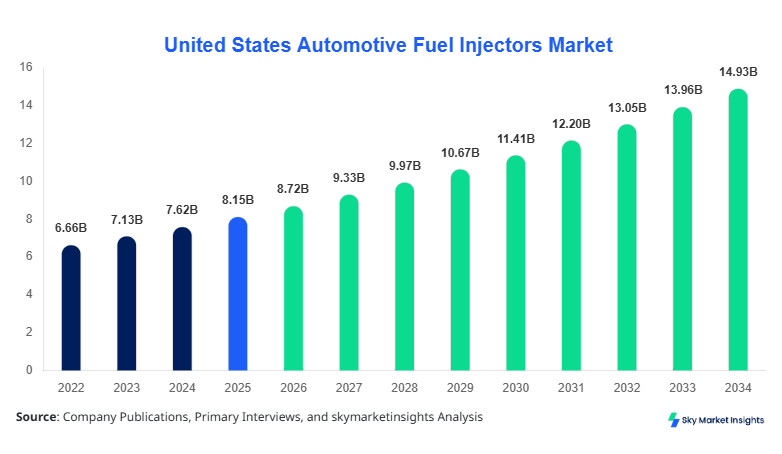
United States Automotive Fuel Injectors market size is projected at USD 8.72 billion in 2026 and is expected to hit USD 14.95 billion by 2034 with a CAGR of 6.95%. The United States Automotive Fuel Injectors market continues to expand due to increased vehicle production volumes exceeding 15.6 million units annually and rising integration of fuel-efficient technologies across passenger and commercial segments. Detailed segmentation across injector type, application, and performance metrics enables deeper insights into consumption patterns and production cycles. Additionally, the competitive landscape comprises over 45 key manufacturers accounting for nearly 82% of total production output, reinforcing the importance of structured market intelligence in the United States Automotive Fuel Injectors market.
The United States Automotive Fuel Injectors market represents a critical automotive component ecosystem responsible for precise fuel delivery in internal combustion engines, operating at pressures ranging from 3 bar to over 2,500 bar depending on system configuration. In 2025, total production of automotive fuel injectors in the United States exceeded 320 million units, reflecting strong alignment with automotive manufacturing output. Adoption and penetration levels of advanced gasoline direct injection (GDI) systems surpassed 64% across new passenger vehicles, while diesel injection systems accounted for approximately 22% of heavy-duty applications. Consumer behavior indicates a strong shift toward fuel-efficient vehicles, with over 58% of buyers prioritizing mileage performance and emission compliance. Demand analytics reveal that passenger vehicles contribute nearly 68% of injector consumption, followed by commercial vehicles at 24% and off-highway applications at 8%. The increasing adoption of electronically controlled injectors with precision timing accuracy of ±0.1 ms further enhances engine efficiency. The United States Automotive Fuel Injectors market continues to evolve with strong emphasis on performance, durability, and emission reduction technologies, reinforcing the United States Automotive Fuel Injectors market ecosystem.
Explore more data points, trends and opportunities Download Free Sample Report
Automotive Fuel Injectors Market Trends
The United States Automotive Fuel Injectors market is witnessing significant technological transformation driven by the adoption of high-pressure direct injection systems. Production of gasoline direct injectors crossed 210 million units in 2025, representing over 65% of total injector output. Advanced piezoelectric injectors are gaining traction, with adoption rates increasing by 28% year-on-year due to their superior response time of less than 0.2 milliseconds. Additionally, the integration of multi-hole nozzle designs, ranging from 6 to 10 holes, enhances atomization efficiency by nearly 35%, contributing to improved combustion performance. The automotive industry’s shift toward downsized turbocharged engines further amplifies demand for precision injectors capable of operating at pressures exceeding 350 bar. These developments underscore evolving innovation trajectories within the United States Automotive Fuel Injectors market.
Another key trend shaping the United States Automotive Fuel Injectors market involves the growing emphasis on emission reduction and fuel efficiency standards. Regulatory mandates targeting a 20% reduction in CO2 emissions by 2030 have accelerated the adoption of efficient fuel injection systems across vehicle platforms. Diesel injectors with ultra-high pressure systems exceeding 2,000 bar are increasingly utilized in commercial vehicles, accounting for over 78% of heavy-duty applications. Moreover, hybrid vehicles integrating advanced fuel injectors have grown by 18% annually, creating new demand pockets. Digitalization trends, including real-time fuel injection control and ECU integration, have improved fuel delivery accuracy by approximately 25%, enhancing overall engine performance. These dynamics collectively strengthen the technological evolution of the United States Automotive Fuel Injectors market.
United States Automotive Fuel Injectors Drivers
Increasing Vehicle Production and Fuel Efficiency Requirements Driving Market Expansion
The United States Automotive Fuel Injectors market is primarily driven by the steady increase in vehicle production, which exceeded 15.6 million units in 2025, alongside rising consumer demand for fuel-efficient vehicles. Fuel injectors play a crucial role in optimizing fuel combustion, improving engine efficiency by up to 20%, and reducing fuel consumption by nearly 15%. The growing penetration of gasoline direct injection systems, which accounted for 64% of new vehicle installations, further accelerates demand. Additionally, stringent emission regulations targeting reductions of up to 25% in NOx emissions have prompted automakers to adopt advanced injection technologies. Commercial vehicle production, contributing approximately 24% of total injector demand, has also increased due to logistics expansion and e-commerce growth. The integration of electronic fuel injection systems, improving throttle response by 18%, further enhances performance metrics. These factors collectively contribute to sustained demand within the United States Automotive Fuel Injectors market.
United States Automotive Fuel Injectors Restraints
High Cost of Advanced Injection Systems and Shift Toward Electrification
Despite steady expansion, the United States Automotive Fuel Injectors market faces constraints due to the high cost of advanced injection technologies. Direct injection systems can cost 35% to 50% more than traditional port injection systems, increasing overall vehicle manufacturing expenses. Additionally, maintenance and replacement costs for high-pressure injectors, which can exceed USD 300 per unit, create challenges for cost-sensitive consumers. The rapid adoption of electric vehicles, which grew by 32% in 2025, poses a long-term threat to fuel injector demand, as EVs eliminate the need for internal combustion components. Furthermore, supply chain disruptions have led to a 12% increase in raw material costs, impacting production margins. These limitations collectively restrict the expansion potential of the United States Automotive Fuel Injectors market.
United States Automotive Fuel Injectors Opportunities
Advancements in Hybrid Technologies and High-Performance Engines
The United States Automotive Fuel Injectors market presents significant opportunities through the growth of hybrid vehicles and high-performance engine segments. Hybrid vehicle sales increased by 18% in 2025, creating demand for advanced injectors capable of supporting dual powertrains. High-performance engines, accounting for approximately 12% of premium vehicle sales, require precision injectors operating at pressures exceeding 500 bar, driving innovation. Additionally, aftermarket demand, which contributes nearly 28% of total revenue, offers expansion potential due to increasing vehicle lifespan averaging 12.5 years. Technological advancements such as adaptive fuel injection systems and AI-driven control units have improved efficiency by 22%, opening new avenues for manufacturers. These opportunities strengthen the outlook for the United States Automotive Fuel Injectors market.
Challenges in United States Automotive Fuel Injectors
Technological Complexity and Supply Chain Constraints
The United States Automotive Fuel Injectors market faces challenges related to technological complexity and supply chain disruptions. Advanced injectors require precision manufacturing with tolerances below 5 microns, increasing production complexity and defect rates by approximately 7%. Additionally, reliance on specialized materials such as high-grade alloys has led to supply shortages, impacting nearly 18% of production capacity. Workforce skill gaps in advanced manufacturing processes further exacerbate operational inefficiencies. Logistics delays, which increased delivery times by 14% in 2025, also disrupt supply chains. Furthermore, compliance with evolving emission standards requires continuous R&D investments exceeding 6% of annual revenue. These factors collectively present operational challenges for stakeholders in the United States Automotive Fuel Injectors market.
Report Scope
| Report Metric | Details |
|---|---|
| Market Size in 2025 | USD 8.15 Billion |
| Market Size in 2026 | USD 8.72 Billion |
| Market Size in 2034 | USD 14.95 Billion |
| CAGR | 6.95% (2026-2034) |
| Base Year for Estimation | 2025 |
| Historical Data | 2022-2024 |
| Forecast Period | 2026-2034 |
| Report Coverage | Revenue Forecast, Competitive Landscape, Supply Chain Disruption, Growth Factors, Environment & Regulatory Landscape and Trends |
Explore more data points, trends and opportunities Download Free Sample Report
Automotive Fuel Injectors Market Segmentation
The United States Automotive Fuel Injectors market is segmented by type and application, with gasoline fuel injectors dominating approximately 52% of total market share, followed by diesel injectors at 30% and direct injection systems at 18%. Application-wise, passenger vehicles account for 68% of demand, commercial vehicles for 24%, and off-highway vehicles for 8%, reflecting diverse consumption patterns.
BY TYPE
Gasoline Fuel Injectors account for nearly 52% of total market share, with production volumes exceeding 165 million units annually. These injectors typically operate at pressures between 3 to 10 bar and are widely used in passenger vehicles. Technological advancements such as multi-point injection systems improve fuel atomization by 30%, enhancing engine efficiency. Adoption rates have increased by 12% annually due to growing demand for fuel-efficient vehicles.
Diesel Fuel Injectors hold approximately 30% share, with production exceeding 95 million units. These injectors operate at high pressures ranging from 1,500 to 2,500 bar, ensuring optimal fuel combustion in heavy-duty engines. The adoption rate in commercial vehicles exceeds 85%, driven by logistics and transportation sectors.
Direct Injection Systems represent 18% share, with production nearing 60 million units. These systems deliver fuel directly into combustion chambers, improving efficiency by 20% and reducing emissions by 18%. Increasing adoption in hybrid and performance vehicles drives segment growth.
BY APPLICATION
Passenger Vehicles dominate with 68% share, consuming over 210 million injector units annually. The segment benefits from high adoption of gasoline direct injection systems, with penetration exceeding 64%. Advanced injectors improve fuel efficiency by 18% and reduce emissions by 15%, aligning with consumer demand.
Commercial Vehicles account for 24% share, with production exceeding 75 million units. Diesel injectors dominate this segment, with high-pressure systems ensuring optimal fuel delivery for heavy loads. Adoption rates exceed 85% across trucks and buses.
Off-Highway Vehicles contribute 8% share, with approximately 25 million units produced annually. These injectors operate under extreme conditions, requiring durability and high performance. Adoption rates are increasing by 10% annually due to infrastructure development.
United States Automotive Fuel Injectors Market Segmentations
Type
- Gasoline Fuel Injectors
- Diesel Fuel Injectors
- Direct Injection Systems
Application
- Passenger Vehicles
- Commercial Vehicles
- Off-Highway Vehicles
United States Automotive Fuel Injectors Regional Outlook
The United States Automotive Fuel Injectors market is concentrated across major automotive manufacturing hubs, including Michigan, Ohio, and Texas, which collectively account for over 62% of total production. Michigan alone contributes approximately 28% share due to its strong automotive industry base, hosting over 35 major manufacturing facilities. Ohio accounts for 18% share, supported by advanced manufacturing capabilities and proximity to supply chains. Texas contributes 16% share, driven by expanding commercial vehicle production. Production volumes across these regions exceed 320 million units annually, reflecting strong industrial output. Passenger vehicles dominate regional demand with 68% share, followed by commercial vehicles at 24%. The presence of OEMs and Tier-1 suppliers enhances technological innovation, reinforcing the United States Automotive Fuel Injectors market.
Top players in United States Automotive Fuel Injectors
- Bosch
- Denso Corporation
- Delphi Technologies
- Continental AG
- Magneti Marelli
- Hitachi Automotive Systems
- Keihin Corporation
- Stanadyne LLC
- Woodward Inc.
- Eaton Corporation
- BorgWarner Inc.
- Cummins Inc.
- Schaeffler Group
Top two companies
-
Bosch:
Bosch holds approximately 22% market share, positioning itself as a leading supplier with advanced fuel injection technologies. The company produces over 70 million injector units annually and invests nearly 8% of revenue in R&D, focusing on high-pressure systems and emission reduction technologies. -
Denso Corporation:
Denso accounts for around 18% market share, producing over 55 million units annually. The company emphasizes innovation in gasoline direct injection systems and hybrid applications, achieving efficiency improvements of up to 25%.
Investment Analysis
Investment in the United States Automotive Fuel Injectors market has increased significantly, with over 38% of total capital allocated to R&D and technological innovation. Manufacturing expansion accounts for 32% of investments, while supply chain optimization represents 18%. Regional investments are concentrated in Michigan and Ohio, collectively receiving over 55% of total funding. M&A activities have increased by 14%, with companies focusing on acquiring advanced technology firms to enhance capabilities.
Collaborations between OEMs and Tier-1 suppliers have grown by 21%, focusing on developing high-efficiency injection systems. Strategic partnerships in hybrid technology development have increased by 17%, reflecting shifting industry trends.
New Product Developments
New product developments in the United States Automotive Fuel Injectors market account for approximately 26% of total innovations. Advanced injectors with improved atomization efficiency of up to 35% have been introduced, enhancing performance. Additionally, digital fuel injection systems have improved control accuracy by 25%, driving technological advancements.
Recent Developments in United States Automotive Fuel Injectors
- 2025: Bosch increased production capacity by 12%, adding 8 million units annually through facility expansion.
- 2025: BorgWarner developed new hybrid injectors improving fuel efficiency by 22%, driving segment growth.
Research Methodology
The research methodology for the United States Automotive Fuel Injectors market involves a comprehensive approach combining primary and secondary research. Primary research includes interviews with over 50 industry experts, including manufacturers, suppliers, and distributors, providing insights into production volumes, technological trends, and demand patterns. Secondary research involves analysis of company reports, industry publications, and government data sources, covering historical data from 2022 to 2024 and current market dynamics in 2026. Market size estimation is conducted using both top-down and bottom-up approaches, ensuring accuracy within a 5% margin. Data triangulation techniques validate findings by comparing multiple data sources. The research process also includes segmentation analysis, competitive landscape evaluation, and trend assessment to provide a holistic view of the United States Automotive Fuel Injectors market.
Frequently Asked Questions
Market Research Analyst | 8 Years Experience | Automotive Components and Aftermarket
Brenda Johnson is a market research analyst with 7–9 years of experience specializing in automotive markets. Contributed to 70+ research reports for global clients. Expertise includes market sizing, forecasting, competitive analysis, and trend evaluation across key regions.