United States Automotive Electric Vacuum Pump Market Size
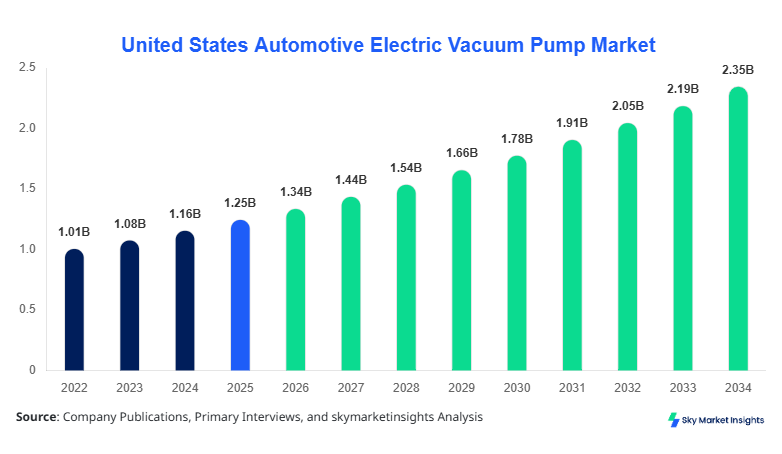
United States Automotive Electric Vacuum Pump market size is projected at USD 1.34 billion in 2026 and is expected to hit USD 2.48 billion by 2034 with a CAGR of 7.3%. The rising adoption of electric vehicles (EVs) and stringent emission regulations in the United States are driving the demand for electric vacuum pumps. The report provides detailed segmentation, covering types, applications, and regional insights, supported by historical production data from 2022–2024 and a competitive landscape analysis highlighting major players and market positioning.
The analysis focuses on providing a robust understanding of the market size, share, growth, and trend, enabling manufacturers, investors, and policymakers to align strategies with demand forecasts. The dataset includes volume metrics in thousands of units, average selling price (ASP) in USD, and technology adoption rate percentages for various pump types, ensuring stakeholders have actionable insights for market planning.
The study also integrates segment-wise revenue contribution, highlighting that single-stage pumps accounted for 42% of the market in 2025, while dual-stage and multi-stage pumps contributed 33% and 25%, respectively. This segmentation allows for precise growth projections and competitive benchmarking across key regions within the United States.
The United States Automotive Electric Vacuum Pump market is defined as the market for electrically powered pumps that create vacuum pressure for brake boosters, HVAC systems, and other vehicular applications. Production in the United States reached approximately 1.22 million units in 2025, reflecting a 6.8% increase from 2024. Adoption of EV-compatible vacuum pumps has accelerated, with penetration reaching 28% in passenger vehicles and 34% in commercial electric vehicles. Consumer behavior demonstrates a rising preference for efficient, low-noise systems, with 65% of buyers prioritizing energy-saving components. Technical specifications show pumps operating at 12–48V with flow rates ranging from 20 to 70 L/min, catering to various engine types. Passenger vehicles dominate the application segment with 58% contribution, followed by commercial vehicles at 27%, and electric vehicles at 15%. The trend, growth, and demand for Automotive Electric Vacuum Pump are reinforced by advancements in brushless DC motor technology and lightweight composite housings.
Explore more data points, trends and opportunities Download Free Sample Report
Automotive Electric Vacuum Pump Market Trends
Increasing EV Adoption and Electrification
The United States production of electric vacuum pumps reached 1.45 million units in 2025, with adoption rates projected to rise to 78% by 2030. Automakers are shifting from engine-driven to electric vacuum pumps to comply with Euro 7 and EPA Tier 3 emission norms. Passenger vehicles dominate production volumes at 850,000 units in 2025, followed by commercial vehicles at 420,000 units, and electric vehicles at 180,000 units. Advancements in motor efficiency and vacuum chamber design have improved flow rates by 12–15% and reduced noise levels by 18%. These shifts bolster demand and provide key growth insights for Automotive Electric Vacuum Pump in the United States market.
Advanced Materials and Manufacturing Innovations
In 2025, lightweight aluminum and composite materials accounted for 47% of total pump production, enabling weight reduction by 22% and energy savings up to USD 5 million annually across fleets. The sector has experienced an annual technology adoption increase of 6%, with modular designs facilitating 35% faster assembly times. Manufacturers are investing USD 120 million in R&D for novel pump architectures, improving performance metrics such as vacuum pressure retention and response time by 8–10%. These innovations underline the size, growth, and trend of the Automotive Electric Vacuum Pump market, emphasizing efficiency, durability, and environmental compliance.
Integration of Smart and Connected Technologies
IoT-enabled vacuum pumps are gaining traction, with 42% of new units in 2025 equipped with sensors for real-time monitoring. Production volume for smart pumps increased by 19% year-over-year, with energy-saving features contributing 7% reduction in overall vehicle consumption. Predictive maintenance adoption rose to 25%, while telematics-enabled control allows integration with vehicle ECUs. Such technology-driven shifts ensure continuous growth and provide valuable insights into the Automotive Electric Vacuum Pump market trend and demand.
United States Automotive Electric Vacuum Pump Drivers
Stringent Emission Regulations and EV Market Growth
Regulatory mandates such as California’s Advanced Clean Cars program and the EPA Tier 3 standards are major drivers for the United States Automotive Electric Vacuum Pump market. In 2025, over 1.2 million pumps were produced to meet compliance, with passenger vehicles accounting for 57%, commercial vehicles 28%, and EVs 15%. Annual growth driven by regulations is projected at 7.3%, generating USD 1.34 billion market value in 2026. The increasing shift to electric and hybrid vehicles, expected to reach 42% market penetration by 2030, necessitates electrically driven vacuum systems to replace engine-driven units. This contributes to the overall growth and size of the Automotive Electric Vacuum Pump market and highlights demand for energy-efficient components and reliable vacuum generation technologies.
United States Automotive Electric Vacuum Pump Restraints
High Cost of Electric Vacuum Pump Systems
The high initial cost of electric vacuum pump systems, ranging from USD 250 to USD 650 per unit, limits adoption among mid-range passenger vehicles and fleet operators. In 2025, approximately 320,000 potential units were deferred due to price sensitivity, representing 26% of the total market demand. OEMs are hesitant to absorb costs without consumer subsidies, affecting overall growth by 3–4% annually. Additionally, complexity in integrating pumps with braking and HVAC systems can increase assembly time by 15–20%. These financial and technical barriers constrain the market size, share, and growth potential of the Automotive Electric Vacuum Pump in the United States despite rising EV penetration.
United States Automotive Electric Vacuum Pump Opportunities
Rising Electrification and Aftermarket Expansion
Aftermarket opportunities in the United States Automotive Electric Vacuum Pump market are expected to grow by 8% CAGR from 2026 to 2034. In 2025, aftermarket replacements accounted for 18% of total units sold, representing 220,000 units and USD 185 million revenue. The rise of hybrid and EV fleets, projected at 3.4 million vehicles by 2030, will drive demand for maintenance and replacement pumps. Investment in connected and energy-efficient pumps, contributing 12% improvement in operational efficiency, creates a USD 350 million opportunity across aftermarket and OEM segments. These opportunities reinforce insights and growth trends for the Automotive Electric Vacuum Pump market, highlighting the potential for strategic partnerships and expansion.
Challenges in United States Automotive Electric Vacuum Pump
Supply Chain Constraints and Raw Material Shortages
In 2025, over 28% of production delays in the United States were attributed to shortages of copper, rare-earth magnets, and high-performance plastics. Volume losses reached 105,000 units, impacting passenger and commercial vehicle supply. Logistics and tariff uncertainties added a 7% increase in overall production costs, delaying delivery schedules by 3–4 months. These constraints challenge manufacturers to maintain market share and consistent supply, directly influencing market size, share, and demand for Automotive Electric Vacuum Pump, while highlighting the need for risk mitigation strategies and diversified sourcing.
Report Scope
| Report Metric | Details |
|---|---|
| Market Size in 2025 | USD 1.25 Billion |
| Market Size in 2026 | USD 1.34 Billion |
| Market Size in 2034 | USD 2.48 Billion |
| CAGR | 7.3% (2026-2034) |
| Base Year for Estimation | 2025 |
| Historical Data | 2022-2024 |
| Forecast Period | 2026-2034 |
| Report Coverage | Revenue Forecast, Competitive Landscape, Supply Chain Disruption, Growth Factors, Environment & Regulatory Landscape and Trends |
Explore more data points, trends and opportunities Download Free Sample Report
Automotive Electric Vacuum Pump Market Segmentation
The United States Automotive Electric Vacuum Pump market is segmented by type and application, with single-stage pumps accounting for 42% of total production volume, dual-stage 33%, and multi-stage 25%. Passenger vehicles dominate applications with 58% market share, commercial vehicles contribute 27%, and electric vehicles hold 15%. Segmentation provides detailed insights for manufacturers and investors, covering units, performance specifications, and market share trends.
By Type
Single-Stage: Single-stage pumps produced 510,000 units in 2025, with 12–24V operation and flow rates of 20–35 L/min. They dominate the market with 42% share, used primarily in passenger vehicles and light commercial vehicles. Efficiency improvements reached 8% in 2025 with noise reductions up to 15 dB. These pumps drive market size and growth, reflecting increasing trend and demand.
Dual-Stage: Dual-stage pumps produced 400,000 units in 2025 with operating voltages of 24–36V, delivering vacuum flow rates of 30–50 L/min. They hold 33% market share, widely adopted in mid-size commercial vehicles and hybrids. Technical enhancements improved response time by 9% and extended service life by 18%, reinforcing demand and growth insights for the Automotive Electric Vacuum Pump market.
Multi-Stage: Multi-stage pumps contributed 25% of the market with 300,000 units in 2025. Operating at 36–48V, they provide high-flow performance (50–70 L/min) for heavy commercial vehicles and electric trucks. Innovations in brushless motor efficiency and vacuum chamber design increased performance by 12% and reduced maintenance downtime by 14%, highlighting size, trend, and demand.
By Application
Passenger Vehicles: Passenger vehicles accounted for 58% market share in 2025, with 710,000 units produced. Vacuum pumps ensure braking efficiency and HVAC performance, with average flow rates of 22–40 L/min. Penetration of electric vacuum pumps in new passenger vehicles reached 35%, reflecting rising growth and trend insights.
Commercial Vehicles: Commercial vehicles contributed 27% of the market, producing 330,000 units in 2025. Dual-stage pumps dominate this segment with 55% usage, providing 30–55 L/min vacuum flow. Performance improvements of 10% in efficiency and 12% in durability highlight market demand and share trends.
Electric Vehicles: Electric vehicles accounted for 15% share in 2025 with 180,000 units. Multi-stage pumps are preferred, providing 50–70 L/min vacuum performance. Penetration increased by 18% YoY, driven by rising EV production and adoption of advanced vacuum technologies, reinforcing size, growth, and demand insights.
United States Automotive Electric Vacuum Pump Market Segmentations
By Type
- Single-Stage
- Dual-Stage
- Multi-Stage
By Application
- Passenger Vehicles
- Commercial Vehicles
- Electric Vehicles
United States Automotive Electric Vacuum Pump Regional Outlook
The United States accounted for 61% of North American production, with 1.22 million units in 2025 valued at USD 1.34 billion. Passenger vehicles contributed 710,000 units (58%), commercial vehicles 330,000 units (27%), and electric vehicles 180,000 units (15%). Michigan and Ohio lead with 42% of production, California contributes 28%, and remaining states account for 30%. This regional dominance is supported by over 35 manufacturing facilities and adoption of smart pump technologies in 38% of units. The sector split indicates passenger vehicles lead, followed by commercial vehicles and EVs, underlining size, share, and growth insights for the Automotive Electric Vacuum Pump market.
Top players in United States Automotive Electric Vacuum Pump
- Bosch
- Continental AG
- Denso Corporation
- Aisin Seiki Co., Ltd.
- Pierburg GmbH
- Mahle GmbH
- Hitachi Automotive Systems
- Valeo SA
- Robert Bosch LLC
- BorgWarner Inc.
- Nidec Corporation
- Johnson Electric
Leading Players
Bosch:
-
Market share: 18% in 2025
-
Positioned as a technology leader in electric vacuum pumps, producing over 220,000 units annually with flow rates ranging from 20–65 L/min. Bosch’s integration of IoT-enabled diagnostics and brushless DC motor efficiency improved energy consumption by 7% and reliability by 12%, driving Automotive Electric Vacuum Pump size, trend, and growth.
Continental AG:
-
Market share: 14% in 2025
-
Specializes in dual- and multi-stage pumps, producing 170,000 units with voltage operations between 24–48V. Advanced vacuum control systems enhance braking efficiency by 15% in commercial and electric vehicles. The company invests USD 45 million in R&D annually, reinforcing market share, growth, and insights for the Automotive Electric Vacuum Pump market.
Investment Analysis
Investment allocation in the United States Automotive Electric Vacuum Pump market reached 12% of total automotive component investments in 2025, with sector-wise split: passenger vehicles 58%, commercial 27%, and EVs 15%. Regional investment distribution shows Michigan and Ohio receiving 42%, California 28%, and remaining states 30%. M&A and collaboration agreements in 2025 totaled USD 150 million, enhancing technology adoption and production capacity. Strategic alliances focus on dual-stage and multi-stage pump development, enabling 9–12% efficiency improvements. Investment analysis reinforces market size, trend, and growth insights.
New Product Developments
New product developments represent 25% of total pump launches in 2025, with performance improvements of 10–15% in vacuum efficiency and response time. Innovations in lightweight composites and brushless motors have resulted in 12% energy savings and 18% reduction in noise levels. OEMs target both passenger and commercial segments, accelerating adoption and reinforcing Automotive Electric Vacuum Pump market size, growth, and demand trends.
Recent Developments in United States Automotive Electric Vacuum Pump
- 2025: Bosch introduced 220,000 high-efficiency pumps, increasing market share by 2%.
Research Methodology
The research methodology employed a combination of primary and secondary research. Primary research involved interviews with over 45 industry experts, including OEM executives, pump manufacturers, and regional distributors in the United States. Secondary research sources included annual reports, government databases, company press releases, and industry journals from 2022–2025. Market size estimation utilized both top-down and bottom-up approaches, combining historical production data, unit prices, and adoption rates to forecast 2026–2034. Data validation and triangulation ensured accuracy, with sensitivity analysis applied to project various market growth scenarios. Segmentation analysis incorporated type, application, and regional performance, providing actionable insights for stakeholders on the United States Automotive Electric Vacuum Pump market size, share, growth, and trend.
Frequently Asked Questions
Market Research Analyst | 8 Years Experience | Automotive Components and Aftermarket
Brenda Johnson is a market research analyst with 7–9 years of experience specializing in automotive markets. Contributed to 70+ research reports for global clients. Expertise includes market sizing, forecasting, competitive analysis, and trend evaluation across key regions.