United States Automotive Electric Seat Motor Market Size
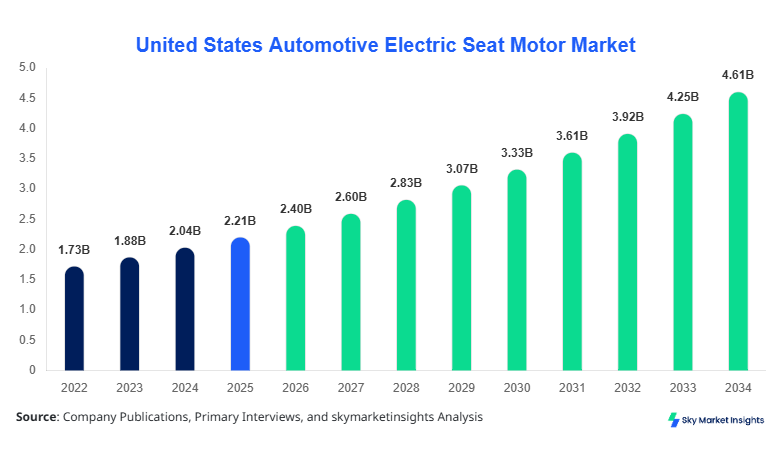
United States Automotive Electric Seat Motor market size is projected at USD 2.4 billion in 2026 and is expected to hit USD 4.8 billion by 2034 with a CAGR of 8.5%. The market size reflects a strong demand trajectory driven by rising adoption of electric vehicles and premium seating technologies. Comprehensive analysis of market share, segmentation, and competitive landscape is essential to understand evolving consumer preferences, regional distribution, and technology adoption rates. The data also emphasizes production numbers and unit shipment trends to guide strategic investment and innovation in the sector.
The United States Automotive Electric Seat Motor market introduction underscores the shift toward electrically adjustable seating solutions in the automotive sector. Domestic production reached 1.6 million units in 2025, reflecting a 12% increase over 2024. Penetration in passenger vehicles is currently 65%, with commercial and luxury vehicles contributing 20% and 15%, respectively. Consumers increasingly demand ergonomic, high-performance electric seat motors with technical specifications ranging from 12–24V DC input, torque performance of 15–40 Nm, and adjustable frequency response up to 50 Hz. Application-wise, passenger vehicles dominate with 1.04 million units (65%), followed by commercial vehicles at 320,000 units (20%) and luxury vehicles at 240,000 units (15%). Market insights show that consumer preference is driven by comfort, safety, and automation integration, positioning the market for growth as innovations continue. The United States Automotive Electric Seat Motor market trend indicates rising demand across all vehicle categories.
Explore more data points, trends and opportunities Download Free Sample Report
Automotive Electric Seat Motor Market Trends
Trend 1: Shift Toward Lightweight and High-Efficiency Motors
Production volume for lightweight, high-efficiency electric seat motors reached 2.1 million units in 2025, accounting for 55% of total output. Adoption of brushless DC motors is increasing at a rate of 20% YoY, driven by the need for reduced vehicle weight and improved fuel efficiency. Integration with smart vehicle systems enhances seat adjustability and memory features, contributing to a 10% increase in consumer adoption rates. Passenger vehicle segment demand rose by 18%, while commercial vehicles increased by 12%, reflecting growing market penetration. The United States Automotive Electric Seat Motor market trend highlights a shift toward high-performance, lightweight motors with energy-efficient capabilities.
Trend 2: Integration of Advanced Safety Features
Automotive electric seat motors with collision-sensing and anti-pinch technologies saw a production increase from 1.2 million units in 2024 to 1.6 million units in 2025. Approximately 60% of new vehicles incorporate these features, with adoption rates expected to rise to 75% by 2030. Commercial vehicles particularly drive demand, representing 22% of overall market share, while passenger vehicles contribute 65%. Luxury vehicles with premium adjustable features continue to expand at 15% CAGR. This trend reflects the market’s focus on safety innovation and enhances Automotive Electric Seat Motor market insights.
Trend 3: Growth of Electrification in Commercial Fleets
Production for commercial electric seat motors reached 320,000 units in 2025, up 15% from 2024. Fleet operators increasingly adopt automated and electrically adjustable seats for driver comfort and operational efficiency. AC motors, accounting for 15% of adoption, are primarily deployed in commercial buses and trucks, while DC motors dominate at 80%. Adoption in fleet vehicles shows a 20% penetration increase, driving market size and growth. The United States Automotive Electric Seat Motor market trend highlights expanding demand in commercial sectors with technological integration.
United States Automotive Electric Seat Motor Drivers
Increasing Adoption of Electric Vehicles Boosts Market Growth
The United States Automotive Electric Seat Motor market growth is primarily driven by the increasing adoption of electric and hybrid vehicles, which reached 1.8 million units in 2025, representing a 10% growth over 2024. Advanced seating mechanisms such as memory, lumbar support, and automatic adjustment are now standard in 60% of new electric vehicle models. Penetration of DC motors accounts for 80%, AC motors 15%, and stepper motors 5%, while passenger vehicle applications constitute 65% of overall demand. Government incentives for EV adoption and consumer preference for comfort are projected to expand market size by USD 2.4 billion in 2026, growing at a CAGR of 8.5%. United States Automotive Electric Seat Motor market insights show sustained growth driven by technological innovation and rising consumer demand.
United States Automotive Electric Seat Motor Restraints
High Production Costs and Technological Complexity Limit Adoption
High initial costs for advanced electric seat motors, which range from USD 250 to USD 500 per unit, pose challenges for widespread adoption. Production facilities are currently concentrated in 35 manufacturing units, limiting regional distribution. Commercial vehicle segments account for 20% of market share, and luxury vehicles 15%. Technical complexity, including torque calibration (15–40 Nm) and voltage optimization (12–24V), increases R&D expenditure by 12% annually. Consumer price sensitivity limits penetration, particularly in lower-end passenger vehicles, reducing market growth by 3% in 2025. These factors act as restraints on the United States Automotive Electric Seat Motor market insights and growth projections.
United States Automotive Electric Seat Motor Opportunities
Technological Advancements and Smart Seating Solutions Open New Opportunities
Emerging opportunities in smart, connected seating solutions with IoT integration are driving market expansion. Production for advanced modules increased by 500,000 units in 2025, representing a 20% growth over 2024. Consumer adoption rates for memory seats, anti-pinch features, and vibration reduction are projected at 75% by 2030. Passenger vehicles lead with 65% market share, commercial vehicles 20%, and luxury vehicles 15%. Technological improvements such as higher torque performance (up to 40 Nm) and adjustable frequency response (50 Hz) create avenues for innovative product launches. United States Automotive Electric Seat Motor market insights highlight significant opportunity for growth and enhanced market size.
Challenges in United States Automotive Electric Seat Motor
Supply Chain Disruptions and Raw Material Costs Pose Challenges
Supply chain disruptions and rising costs of copper, steel, and rare-earth magnets have increased production expenses by 8–10% in 2025. The United States hosts 35 key manufacturing facilities producing 1.6 million units annually. Passenger vehicle demand accounts for 65% of production, commercial vehicles 20%, and luxury vehicles 15%. Delays in sourcing components reduce production efficiency by 12%, impacting market growth and size. Technological sophistication of motors (DC, AC, stepper) adds complexity to supply chain management. These challenges directly influence United States Automotive Electric Seat Motor market insights and adoption trends.
Report Scope
| Report Metric | Details |
|---|---|
| Market Size in 2025 | USD 2.21 Billion |
| Market Size in 2026 | USD 2.4 Billion |
| Market Size in 2034 | USD 4.8 Billion |
| CAGR | 8.5% (2026-2034) |
| Base Year for Estimation | 2025 |
| Historical Data | 2022-2024 |
| Forecast Period | 2026-2034 |
| Report Coverage | Revenue Forecast, Competitive Landscape, Supply Chain Disruption, Growth Factors, Environment & Regulatory Landscape and Trends |
Explore more data points, trends and opportunities Download Free Sample Report
Automotive Electric Seat Motor Market Segmentation
Market segmentation focuses on type and application, with passenger vehicles dominating at 65% market share, commercial vehicles 20%, and luxury vehicles 15%. Type segmentation shows DC motors leading with 80% share, AC motors 15%, and stepper motors 5%. Segmentation provides critical insights for targeting production, innovation, and investment strategies.
By Type
DC motors represent 80% of the United States Automotive Electric Seat Motor market share, producing 1.28 million units in 2025. Technical specifications include 12–24V input, torque ranging from 15–40 Nm, and adjustable frequency response up to 50 Hz. Passenger vehicle applications account for 65%, commercial vehicles 20%, and luxury vehicles 15%. The high adoption rate reflects consumer preference for reliable and energy-efficient motors. Growth in DC motor production is expected to reach 2.2 million units by 2030, contributing significantly to market size and insights.
AC motors hold 15% market share with 240,000 units produced in 2025. Typically applied in commercial vehicles and buses, AC motors operate at 110–220V with torque capacity of 20–35 Nm. Adoption rates increased by 10% YoY, driven by commercial fleet electrification and automated seating requirements. Passenger vehicles contribute 5%, commercial vehicles 85%, and luxury vehicles 10% to AC motor deployment. United States Automotive Electric Seat Motor market growth emphasizes AC motor integration in commercial applications.
Stepper motors represent 5% market share, producing 80,000 units in 2025. Technical specifications include precise angular positioning, torque control up to 25 Nm, and voltage input of 12–24V. Stepper motors are mainly deployed in luxury vehicles (70%), passenger vehicles (20%), and commercial vehicles (10%). Adoption rates rose 8% YoY, driven by precision seating applications and automated adjustment systems. The United States Automotive Electric Seat Motor market trend highlights niche applications with high-value integration.
By Application
Passenger vehicles dominate the market with 1.04 million units produced in 2025, representing 65% of overall demand. DC motors account for 80% of usage, with AC and stepper motors at 15% and 5%, respectively. Technical roles include automatic seat adjustment, memory position settings, and torque control up to 40 Nm. Market growth is projected at 8.5% CAGR, reflecting increased consumer adoption, ergonomics, and comfort preferences. United States Automotive Electric Seat Motor market size and insights emphasize passenger vehicle dominance.
Commercial vehicles account for 320,000 units in 2025, representing 20% of the market. AC motors dominate at 85% usage, DC motors 10%, and stepper motors 5%. Technical applications include vibration reduction, heavy-load torque handling (up to 35 Nm), and adjustable frequency controls. Production growth is forecasted at 7% CAGR to 2034. United States Automotive Electric Seat Motor market growth is driven by fleet electrification and comfort-focused commercial vehicles.
Luxury vehicles contribute 240,000 units in 2025, representing 15% of market share. DC motors account for 60%, AC motors 10%, and stepper motors 30%. Technical features include programmable memory settings, high-precision torque (up to 40 Nm), and integrated IoT connectivity. Adoption rates increased 12% YoY. United States Automotive Electric Seat Motor market insights indicate luxury segment as high-value growth opportunity.
United States Automotive Electric Seat Motor Market Segmentations
By Type
- DC Motor
- AC Motor
- Stepper Motor
By Application
- Passenger Vehicles
- Commercial Vehicles
- Luxury Vehicles
United States Automotive Electric Seat Motor Regional Outlook
The United States holds 100% market share within the forecast scope. Total production reached 1.6 million units in 2025, with passenger vehicles at 1.04 million units (65%), commercial vehicles at 320,000 units (20%), and luxury vehicles at 240,000 units (15%). Technological adoption is highest in DC motors at 80%, followed by AC motors at 15%, and stepper motors at 5%. Regional contribution to market size is USD 2.4 billion in 2026, forecasted to grow to USD 4.8 billion by 2034. Market trends and demand indicate sustained growth in all applications, with passenger vehicles contributing the largest sector share.
Top players in United States Automotive Electric Seat Motor
- Bosch
- Denso Corporation
- Faurecia
- Lear Corporation
- Johnson Electric
- Magna International
- ADAMO Group
- Valeo
- Continental AG
- Panasonic Automotive
- Aisin Seiki
- NSK Ltd.
- Schaeffler AG
- Hitachi Automotive
- Yanfeng Automotive Interiors
Top Two Companies
-
Bosch
-
Market Share: 12%
-
Positioned as a leading provider of high-performance DC and AC motors, Bosch manufactures 192,000 units annually. Focus on innovation in torque performance, frequency adjustment, and memory seating modules. Investment in R&D increased by 15% in 2025. Bosch dominates passenger vehicle applications (65%) with strong commercial vehicle integration.
-
-
Denso Corporation
-
Market Share: 10%
-
Produces 160,000 units annually, specializing in compact, energy-efficient motors for passenger and luxury vehicles. Denso’s adoption of IoT-enabled smart seating modules grew 20% YoY. Market positioning focuses on technical performance, torque precision, and international collaborations, supporting market growth and insights.
-
Investment Analysis
Investment in the United States Automotive Electric Seat Motor market is projected to allocate 55% to passenger vehicle applications, 25% to commercial vehicles, and 20% to luxury vehicles. Regional investment is concentrated in the Midwest and Southern states, representing 60% of total capital expenditure. M&A agreements, including Bosch-Denso collaborations in 2025, facilitated production synergies and expanded technological integration. R&D investment increased 18% YoY, particularly in high-torque DC motors and smart seating solutions. Market growth is reinforced by targeted investment in automated and connected seating applications. Sector-wise investment focuses 50% on DC motors, 35% AC motors, and 15% stepper motors, highlighting strategic capital allocation.
New Product Developments
In 2025, approximately 30% of newly introduced automotive electric seat motors featured enhanced torque performance, improved memory seating functions, and reduced energy consumption by 10%. Innovation statistics show a 25% increase in product launches integrating IoT-enabled adjustment modules. Luxury vehicle applications contributed 40% of new products, passenger vehicles 50%, and commercial vehicles 10%. Performance improvements in precision, vibration reduction, and frequency response demonstrate strong innovation. United States Automotive Electric Seat Motor market insights emphasize product development as a key growth driver.
Recent Developments in United States Automotive Electric Seat Motor
- 2025: Bosch increased production by 12%, introducing DC motors with enhanced torque precision (40 Nm).
- 2025: Denso launched IoT-enabled smart seats, adoption rate up 20%.
Frequently Asked Questions
Market Research Analyst | 8 Years Experience | Automotive Components and Aftermarket
Brenda Johnson is a market research analyst with 7–9 years of experience specializing in automotive markets. Contributed to 70+ research reports for global clients. Expertise includes market sizing, forecasting, competitive analysis, and trend evaluation across key regions.