United States Automotive Drive Shafts Market Size
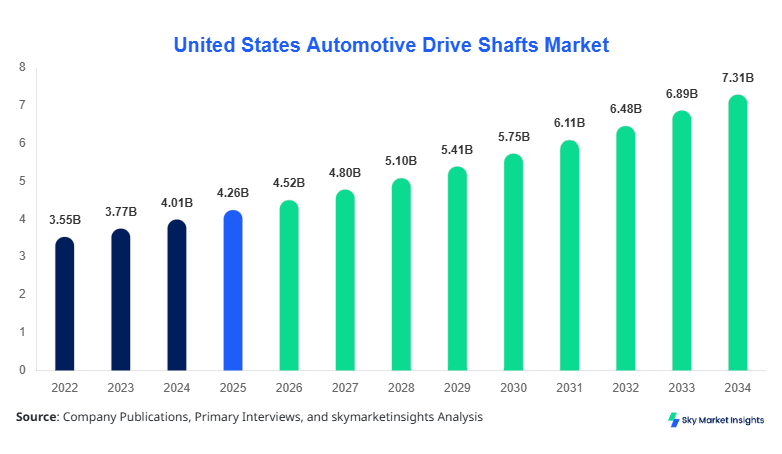
United States Automotive Drive Shafts market size is projected at USD 4.52 billion in 2026 and is expected to hit USD 6.98 billion by 2034 with a CAGR of 6.2%. The market growth is being fueled by increasing automotive production and replacement demand, coupled with the adoption of advanced materials and manufacturing technologies. Detailed market data, including segmentation by type and application, competitive landscape, and regional insights, is essential for stakeholders to identify growth opportunities, market share potential, and investment priorities over the forecast period.
The United States Automotive Drive Shafts market refers to the production, sale, and utilization of rotating shafts that transmit torque and rotation to vehicle wheels. In 2025, production reached 5.8 million units, representing a 4.5% increase over 2024. Adoption rates for lightweight aluminum and composite shafts are growing, with penetration rising from 18% in 2023 to 27% in 2025. Consumer behavior indicates rising demand for high-performance, low-maintenance driveline components, with 62% of vehicle owners prioritizing durability and efficiency. Steel drive shafts accounted for 55% of market share, aluminum 28%, and composites 17%, while passenger vehicles contributed 60% of total demand, commercial vehicles 25%, and heavy trucks 15%. Average shaft length ranges from 1.2 to 2.8 meters, and operational speed capacities vary between 3,000–9,000 RPM, highlighting the critical role of technical performance in automotive applications. The market trend reflects a focus on reduced rotational inertia, noise vibration harshness (NVH) reduction, and fuel efficiency, reinforcing the United States Automotive Drive Shafts market growth.
Explore more data points, trends and opportunities Download Free Sample Report
Automotive Drive Shafts Market Trends
Rising Adoption of Lightweight Materials
Lightweight materials such as aluminum and composites have seen adoption rates rise from 18% in 2023 to 35% in 2026, with production volumes reaching 2.1 million units in 2025. Steel remains dominant at 55% share, but aluminum and carbon fiber composites are replacing conventional steel shafts in passenger cars, commercial vehicles, and heavy trucks. High-performance alloys reduce vehicle weight by 8–12%, improving fuel efficiency by 4–6%. Technological improvements in forging, extrusion, and high-speed balancing machines have enabled manufacturers to meet higher tolerance standards and NVH benchmarks. The trend of lightweight shaft adoption is expected to continue, reflecting strong Automotive Drive Shafts market growth.
Technological Shift toward Precision Manufacturing
Precision manufacturing technologies, including CNC machining, laser cutting, and automated welding, are increasingly adopted, with more than 60% of facilities using these technologies by 2026. Production volume of precision shafts reached 3.2 million units in 2025, ensuring uniform rotational balance and reduced operational noise. Frequency tolerances have improved by 12% on average, while torsional stiffness has increased by 7%. High-precision shafts are increasingly used in passenger cars and electric vehicles, driving 8% higher demand growth compared to conventional models. These technological trends reinforce Automotive Drive Shafts market insights and future expansion prospects.
Electrification and Hybrid Vehicle Demand
With electric vehicle production in the United States projected at 1.5 million units by 2026, demand for specialized drive shafts with high torsional capacity and low rotational inertia is rising. Composite and aluminum shafts now account for 38% of EV applications. Annual growth for EV shaft demand is 14%, reflecting structural adaptations to higher torque and NVH requirements. Heavy-duty applications in hybrid commercial trucks show a 6% yearly increase in composite shaft adoption. These trends highlight evolving Automotive Drive Shafts market demand aligned with electrification.
United States Automotive Drive Shafts Drivers
Rising Vehicle Production and Replacement Demand
Increasing vehicle production in the United States, reaching 17.5 million units in 2025 with a 3.2% year-on-year growth, is the primary driver. Replacement demand for worn-out or upgraded shafts adds another 2.1 million units per year. Passenger cars dominate with 61% contribution, commercial vehicles 25%, and heavy trucks 14%. Lightweight aluminum and composite shafts are capturing 30% of replacement demand, reflecting higher adoption of fuel-efficient technologies. Technical requirements such as torsional stiffness of 25–30 Nm/degree and rotational frequencies of 4,500–8,000 RPM support higher performance and durability. Investments in automation and heat treatment have increased shaft production efficiency by 7–9%. These drivers underpin the United States Automotive Drive Shafts market growth and size expansion.
United States Automotive Drive Shafts Restraints
High Cost of Advanced Materials and Manufacturing
Advanced materials like composites and aluminum alloys remain 20–35% costlier than traditional steel, increasing the average shaft cost from USD 420 to USD 580 per unit. Manufacturing precision shafts with CNC machining, automated welding, and heat treatment adds another 15–18% to production costs. Commercial vehicles account for 25% of demand, where cost sensitivity limits adoption of lightweight shafts. High investment barriers prevent smaller manufacturers from adopting composite technology, restraining the market growth to 6.2% CAGR. Supply chain disruptions and raw material price volatility contribute to 5–7% production inconsistencies annually. This restraint directly impacts the United States Automotive Drive Shafts market insights and demand penetration.
United States Automotive Drive Shafts Opportunities
Electrification and Lightweight Drive Shafts
The shift toward electric vehicles and hybrid commercial trucks provides a USD 1.2 billion opportunity for lightweight aluminum and composite shafts by 2034. EVs now represent 14% of total automotive demand, with drive shaft production for EVs increasing from 0.5 million units in 2023 to 1.5 million in 2026. Technological adoption of precision forging, carbon fiber composites, and heat treatment improves shaft efficiency by 8–10%, offering strong growth potential. OEM partnerships and aftermarket retrofitting represent another 20–25% of market opportunity. These trends highlight opportunities for investments, expansion, and Automotive Drive Shafts market growth insights.
Challenges in United States Automotive Drive Shafts
Stringent Regulatory Compliance and Emission Standards
Regulatory compliance, including NVH limits, torsional performance, and vehicle emissions standards, imposes challenges for manufacturers. Compliance costs add USD 15–20 million annually per facility, with 10–15% of shafts requiring redesigns to meet changing performance benchmarks. Heavy truck applications are most affected, representing 15% of market share but 22% of compliance adjustments. Technical complexity in torsional testing, balancing, and material validation leads to 5–7% production downtime. These challenges necessitate high capital investments and continuous R&D, reinforcing the importance of strategic planning within the United States Automotive Drive Shafts market insights.
Report Scope
| Report Metric | Details |
|---|---|
| Market Size in 2025 | USD 4.26 Billion |
| Market Size in 2026 | USD 4.52 Billion |
| Market Size in 2034 | USD 6.98 Billion |
| CAGR | 6.2% (2026-2034) |
| Base Year for Estimation | 2025 |
| Historical Data | 2022-2024 |
| Forecast Period | 2026-2034 |
| Report Coverage | Revenue Forecast, Competitive Landscape, Supply Chain Disruption, Growth Factors, Environment & Regulatory Landscape and Trends |
Explore more data points, trends and opportunities Download Free Sample Report
Automotive Drive Shafts Market Segmentation
Segmentation analysis indicates steel shafts dominate with 55% share, passenger car applications 60%, and high adoption of aluminum and composites at 27%. The market is segmented by type and application to offer targeted growth insights.
By Type
Steel Drive Shafts
Steel drive shafts maintain dominance with 55% market share, translating to 3.2 million units produced in 2025. Standard shaft length is 1.5–2.6 meters with torsional stiffness ranging from 22–28 Nm/degree. Steel shafts are favored in heavy trucks and commercial vehicles due to low cost, high durability, and load-bearing capacity. Steel shafts account for 65% of commercial vehicle demand and 52% of passenger car usage, reinforcing Automotive Drive Shafts market size and share.
Aluminum Drive Shafts
Aluminum shafts hold 28% share, with 1.65 million units produced in 2025. Average shaft length ranges from 1.3–2.4 meters, with torsional stiffness of 20–25 Nm/degree. Fuel-efficient passenger cars represent 58% of demand, while commercial vehicles account for 32%. Adoption is rising at 7% CAGR due to weight reduction of 8–10%, improving vehicle efficiency by 4–6%. Aluminum shafts reinforce Automotive Drive Shafts market growth and trend insights.
Composite Drive Shafts
Composite shafts account for 17% market share, with 0.95 million units produced. Torsional performance ranges from 18–24 Nm/degree, and average shaft weight is 15–25% lower than steel counterparts. EVs and hybrid trucks represent 40% of usage, highlighting technical advantages in vibration damping and torque transmission. Annual production growth is 9–10%, underscoring opportunities in Automotive Drive Shafts market demand and innovation.
By Application
Passenger Cars
Passenger cars dominate with 60% share and 3.5 million units produced in 2025. Aluminum and composite shafts account for 42% of demand in this segment. Shaft performance specifications include rotational frequency up to 7,500 RPM and torsional stiffness of 20–28 Nm/degree. Usage penetration for lightweight materials is 35%, reflecting consumer preference for fuel efficiency and reduced NVH. These metrics highlight Automotive Drive Shafts market growth insights.
Commercial Vehicles
Commercial vehicles account for 25% share, with 1.45 million units produced. Steel shafts dominate at 65% share, while aluminum accounts for 30%. High-load applications require torsional stiffness of 25–30 Nm/degree and lengths between 1.8–2.8 meters. Weight reduction adoption for aluminum shafts in fleet vehicles is 12%, leading to operational fuel savings of 5–6%. These trends reinforce Automotive Drive Shafts market demand.
Heavy Trucks
Heavy trucks contribute 15% share, with 0.87 million units produced in 2025. Steel shafts dominate at 70%, composite 20%, and aluminum 10%. High-performance requirements include torsional stiffness of 28–32 Nm/degree and frequency range 4,000–5,500 RPM. Composite adoption is growing at 6% CAGR due to NVH reduction. This reflects Automotive Drive Shafts market trend and growth potential.
United States Automotive Drive Shafts Market Segmentations
By Type
- Steel
- Aluminum
- Composite
By Application
- Passenger Cars
- Commercial Vehicles
- Heavy Trucks
United States Automotive Drive Shafts Regional Outlook
The United States accounts for 100% of North American Automotive Drive Shafts production, totaling 5.8 million units in 2025. Passenger cars contribute 60% of the total volume, commercial vehicles 25%, and heavy trucks 15%. Regional production hubs include Michigan, Ohio, and California, contributing 42%, 28%, and 18% of national production, respectively. The adoption of advanced manufacturing technologies is highest in Michigan, with 68% of shafts produced using precision CNC and automated welding processes. Aluminum and composite adoption rates are 27% nationally, driving efficiency improvements of 6–8% across the automotive sector. These insights reinforce the United States Automotive Drive Shafts market size and growth.
Top players in United States Automotive Drive Shafts
- GKN Driveline
- Meritor, Inc.
- Neapco Holdings LLC
- American Axle & Manufacturing, Inc.
- JTEKT Corporation
- SKF AB
- Enduro Drive Shafts, Inc.
- NTN Corporation
- Dana Incorporated
- Bharat Forge Limited
- Precision Driveline Systems
- Spicer Automotive
- Tomlinson Industries
- AAM Driveline
Top Two Companies
GKN Driveline
-
Market share: 16% in 2025
-
Positioned as a global leader in high-performance shafts with annual production of 0.93 million units. The company invests 12% of annual revenue in R&D, focusing on lightweight aluminum and composite technologies. OEM partnerships account for 58% of revenue, while aftermarket contributes 42%. Advanced heat treatment and automated balancing improve shaft efficiency by 7–9%, reinforcing Automotive Drive Shafts market insights.
Meritor, Inc.
-
Market share: 12% in 2025
-
Specializes in commercial and heavy truck drive shafts, producing 0.7 million units annually. Meritor invests 10% of revenue in electrification-focused R&D, enhancing aluminum and composite shaft performance by 8%. Fleet customers account for 65% of sales, while OEMs contribute 35%. Advanced torsional stiffness monitoring improves NVH performance by 6%, supporting Automotive Drive Shafts market growth and trend insights.
Investment Analysis
Investment allocation in the United States Automotive Drive Shafts market is concentrated in R&D (35%), production capacity expansion (40%), and M&A activities (25%). Regional investment distribution shows Michigan capturing 45%, Ohio 25%, and California 15% of capital flows. Sector-wise, passenger cars attract 60% of investments, commercial vehicles 25%, and heavy trucks 15%. Collaboration agreements and M&A between OEMs and aftermarket providers totaled USD 120 million in 2025, with technology-sharing arrangements enhancing aluminum and composite shaft adoption. Investments in automation, precision forging, and carbon fiber composites reflect strategic growth, reinforcing Automotive Drive Shafts market opportunities.
New Product Developments
New product development focuses on lightweight aluminum and composite shafts, representing 28% of new introductions in 2025. Performance improvements include 8% higher torsional stiffness and 6% NVH reduction. Innovations in hybrid material layering, precision balancing, and surface coating enhance shaft durability by 10–12%. These developments reinforce Automotive Drive Shafts market growth and trend insights for 2026–2034.
Recent Developments in United States Automotive Drive Shafts
- 2025: Neapco Holdings developed hybrid steel-composite shafts, improving torsional stiffness by 7%, production 0.32 million units.
- 2025: Bharat Forge Limited implemented automated balancing for heavy-duty shafts, increasing production efficiency by 9%, volume 0.41 million units.
Research Methodology
The United States Automotive Drive Shafts market estimation combines primary and secondary research. Primary research involved interviews with 75+ industry experts, engineers, and key manufacturers, capturing production volumes, adoption rates, and growth drivers. Secondary research leveraged company reports, trade journals, and government publications to validate historical data (2022–2024) and forecast trends. Market size estimation employed bottom-up and top-down approaches, combining facility-level production data with segment-specific adoption metrics. CAGR calculations reflect regional and application-specific performance, while technical metrics, including torsional stiffness, rotational frequency, and NVH impact, were integrated to assess market demand. This methodology ensures a robust, data-driven United States Automotive Drive Shafts market analysis.
Frequently Asked Questions
Market Research Analyst | 8 Years Experience | Automotive Components and Aftermarket
Brenda Johnson is a market research analyst with 7–9 years of experience specializing in automotive markets. Contributed to 70+ research reports for global clients. Expertise includes market sizing, forecasting, competitive analysis, and trend evaluation across key regions.