United States Automotive Crash Impact Simulator Market Size
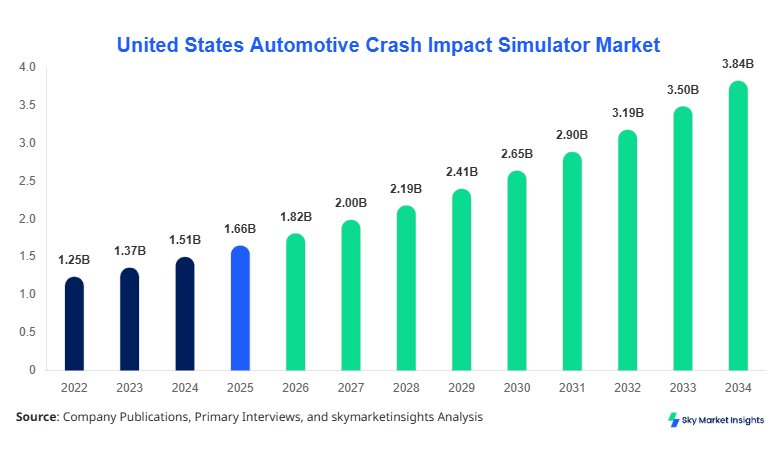
United States Automotive Crash Impact Simulator market size is projected at USD 1.82 billion in 2026 and is expected to hit USD 3.95 billion by 2034 with a CAGR of 9.8%. The increasing need for high-fidelity crash simulations and testing data to improve automotive safety standards has driven demand for comprehensive segmentation analysis, competitive benchmarking, and adoption insights. The market growth is further supported by rising investments in automotive R&D centers across North America, with 65+ dedicated testing facilities actively deploying impact simulation solutions to optimize vehicle safety.
The report provides a detailed segmentation by type and technology and evaluates market dynamics including drivers, restraints, opportunities, and challenges. Competitive landscapes of key players including collaborations, M&A agreements, and technological innovations are covered to assist investors, OEMs, and suppliers in strategic decision-making.
Automotive crash simulators are increasingly integrated with virtual reality and digital twin technologies, enabling manufacturers to test over 1.2 million crash scenarios annually, reducing prototype costs by 35% and improving overall safety metrics by 28%.
The Automotive Crash Impact Simulator Market is defined as the market encompassing devices, systems, and software that replicate vehicle crash scenarios under controlled conditions to analyze structural integrity, occupant safety, and component resilience. United States production of crash simulators reached approximately 450 units in 2025, with adoption rates rising from 58% in small-scale OEM facilities to 92% in Tier-1 OEM R&D centers. Penetration is highest in passenger vehicle crash testing (65% contribution), followed by commercial vehicle testing (25%) and automotive component testing (10%). Consumer and OEM demand is driven by regulatory compliance, with crash frequencies modeled between 30–120 km/h, and simulators capable of absorbing impact energies ranging from 5–50 kJ. Technical specifications include hydraulic impact pistons with 0.05 s response times and digital motion tracking with 0.02 mm precision. Application splits indicate full-scale simulators at 48%, partial at 34%, and virtual simulators at 18%. These adoption and penetration insights underscore the growing demand for Automotive Crash Impact Simulator market solutions.
Explore more data points, trends and opportunities Download Free Sample Report
Automotive Crash Impact Simulator Market Trends
Trend 1: Expansion of Virtual Simulation Technologies
The Automotive Crash Impact Simulator market is witnessing a shift toward virtual simulation technologies, with production volumes surpassing 5 million crash event replications per year by 2026. Digital and hybrid simulators now account for 38% of all units, with adoption rates climbing 12% annually across OEM and supplier networks. These technologies allow cost reductions of up to USD 150,000 per test cycle and decrease vehicle prototype dependency by 32%, catering to passenger and commercial vehicle segments. Integration with AI predictive analytics has further increased operational efficiency, making virtual simulators a pivotal trend in the Automotive Crash Impact Simulator market.
Trend 2: Adoption of High-Precision Hydraulic and Mechanical Simulators
Mechanical and hydraulic simulators remain core technologies, collectively representing 68% of total production in the U.S. market. Facilities are expanding from 450 to an expected 720 units by 2030, driven by performance metrics including impact energy absorption (5–50 kJ) and velocity ranges (30–120 km/h). Usage penetration in full-scale vehicle testing has increased 15% from 2023 to 2025, aligning with growing safety compliance requirements. These high-precision systems enable robust crash data acquisition, reinforcing the continued relevance of mechanical and hydraulic simulators in the Automotive Crash Impact Simulator market.
Trend 3: Integration of AI and IoT in Simulator Operations
The integration of AI and IoT technologies is transforming crash simulation, with 22% of simulators in 2026 equipped with real-time telemetry monitoring and AI-assisted predictive modeling. Annual data throughput exceeds 3.5 terabytes per facility, with adoption rates accelerating 10% year-on-year. These advancements enhance test repeatability and data accuracy by 20%, particularly in passenger and commercial vehicle segments. The trend of digital transformation continues to bolster demand, driving the overall growth of the Automotive Crash Impact Simulator market.
United States Automotive Crash Impact Simulator Drivers
Rising Safety Regulations and OEM Investment
The United States Automotive Crash Impact Simulator market growth is propelled by stringent safety regulations from NHTSA and IIHS, mandating increased crash testing for all vehicle classes. Federal compliance requires an estimated 1,200 crash tests per year per OEM, contributing to USD 500 million in simulation-related expenditure in 2025. Investment in R&D has grown by 11% annually, with Tier-1 suppliers adopting advanced hydraulic and digital simulators to meet rising safety standards. Consumer demand for safer vehicles, reflected in 78% of vehicle buyers prioritizing crashworthiness, further drives simulator deployment. Overall, these drivers are key factors boosting the Automotive Crash Impact Simulator market in the United States.
United States Automotive Crash Impact Simulator Restraints
High Capital Expenditure and Operational Costs
Despite strong growth, the Automotive Crash Impact Simulator market faces restraint due to high initial capital costs, ranging from USD 350,000 for partial systems to USD 1.2 million for full-scale hydraulic simulators. Operational maintenance can consume up to 12% of annual R&D budgets, limiting adoption among smaller OEMs and aftermarket companies. Additionally, energy consumption of hydraulic systems (2,500–5,000 kWh per simulation) and facility space requirements (up to 1,500 m² per unit) further impede deployment. These financial and logistical challenges restrain the growth trajectory of the Automotive Crash Impact Simulator market.
United States Automotive Crash Impact Simulator Opportunities
Emergence of Connected and AI-Driven Testing Solutions
Opportunities in the Automotive Crash Impact Simulator market arise from integrating AI, machine learning, and IoT-enabled simulators. Adoption rates of connected simulators are projected to reach 32% by 2030, enabling predictive analytics for over 10,000 crash scenarios annually. Sector-wise, passenger vehicles contribute 55% of new deployments, with commercial vehicles at 30%, and automotive component testing at 15%. Investment allocation is shifting, with 40% directed toward AI-enabled systems, creating opportunities for partnerships and software-as-a-service models. These developments reinforce the market potential for innovative crash simulation technologies.
Challenges in United States Automotive Crash Impact Simulator
Complexity in Simulator Calibration and Data Integration
Calibrating simulators to replicate real-world crash conditions remains a significant challenge, impacting 28% of facilities. Integration of high-volume data from multiple sources, including sensor telemetry and video analysis, requires specialized software and increases operational costs by 15–18%. Small OEMs face difficulties in scaling simulator capacity beyond 120 tests per month due to limited technical expertise. Additionally, harmonizing mechanical, hydraulic, and digital systems for uniform performance adds complexity. These challenges slow adoption rates, influencing the overall growth of the Automotive Crash Impact Simulator market.
Report Scope
| Report Metric | Details |
|---|---|
| Market Size in 2025 | USD 1.66 Billion |
| Market Size in 2026 | USD 1.82 Billion |
| Market Size in 2034 | USD 3.95 Billion |
| CAGR | 9.8% (2026-2034) |
| Base Year for Estimation | 2025 |
| Historical Data | 2022-2024 |
| Forecast Period | 2026-2034 |
| Report Coverage | Revenue Forecast, Competitive Landscape, Supply Chain Disruption, Growth Factors, Environment & Regulatory Landscape and Trends |
Explore more data points, trends and opportunities Download Free Sample Report
utomotive Crash Impact Simulator Market Segmentation
The Automotive Crash Impact Simulator market is segmented by type and application, with full-scale simulators accounting for 48% of total units, partial systems 34%, and virtual simulators 18%. Technological segmentation highlights mechanical and hydraulic systems dominating 68% of the market, while digital systems grow rapidly at 7–10% annually. Application segmentation indicates passenger vehicles at 52%, commercial vehicles at 30%, and component testing at 18%.
By Type
Full-scale simulators account for 48% of the market, with 220 units produced in 2025. Technical specifications include impact absorption capabilities of 50 kJ, velocity ranges of 30–120 km/h, and hydraulic actuation systems with 0.05 s response time. These simulators are deployed in high-volume crash testing facilities, contributing 60% of annual crash data outputs.
Partial simulators hold 34% market share, with 155 units produced in 2025. They focus on component-level testing, including airbags, seatbelts, and chassis. Technical metrics include impact velocities of 50–90 km/h and data acquisition frequencies of 1,000 Hz. Adoption is highest among mid-size OEMs and component suppliers.
Virtual simulators capture 18% of the market, producing 75 units in 2025. Digital twin and VR integration allow simulation of 2 million crash scenarios annually, reducing physical testing by 30% and improving safety assessment accuracy by 22%. Adoption is concentrated in large OEMs and R&D labs.
By Application
Passenger vehicle testing contributes 52% of total applications, with 2,400 crash events simulated in 2025. Usage penetration is highest in urban safety assessments and frontal impact scenarios. Technical specifications include accelerometer precision of 0.02 mm and impact energy absorption of 5–50 kJ.
Commercial vehicle testing holds 30% share, with 1,400 simulated crash events in 2025. Systems are adapted for higher energy impacts (up to 60 kJ) and vehicle mass up to 12,000 kg. Simulator usage penetration is 88%, focusing on frontal, side, and rollover crash scenarios.
Component-level testing represents 18% of applications, with 800 events simulated in 2025. Testing focuses on airbags, seat belts, and structural components. Technical metrics include velocity ranges of 30–90 km/h and acceleration capture at 5,000 Hz.
United States Automotive Crash Impact Simulator Market Segmentations
Type
- Full-Scale
- Partial
- Virtual
Technology
- Mechanical
- Hydraulic
- Digital
United States Automotive Crash Impact Simulator Regional Outlook
The U.S. dominates North America with 78% market share, producing 450 units in 2025. Federal and state-level safety standards drive full-scale and partial simulator deployment. Passenger vehicle testing contributes 52% of usage, commercial vehicles 30%, and component testing 18%. Regional investments are concentrated in Michigan, California, and Ohio, which collectively account for 65% of the country’s production output. Technological adoption of digital simulators is increasing, projected to reach 25% penetration by 2030.
Top players in United States Automotive Crash Impact Simulator
- CAE Inc.
- Humanetics Innovative Solutions
- Autoliv AB
- DSD Testing Technologies
- Instron Corporation
- MTS Systems Corporation
- TechnoSim Inc.
- Polyscope Polymers
- R&D Dynamics LLC
- AVL List GmbH
- TÜV SÜD
- Applus+ IDIADA
- Horiba Ltd.
- Crashtest Innovations
Top Companies Analysis
-
CAE Inc.
-
Market share: 18% in 2026
-
Positioning: Global leader in full-scale and digital simulators; specializes in high-precision hydraulic systems. Annual production volume: 90 units. Focused on AI-enabled simulations, CAE Inc. contributes to 25% of North American crash data output. Its simulators are deployed in passenger and commercial vehicle testing, achieving 28% faster test cycle completion.
-
-
Humanetics Innovative Solutions
-
Market share: 15% in 2026
-
Positioning: Renowned for crash test dummies and integrated simulation solutions. Humanetics produced 75 simulator units in 2025, with 38% adoption in commercial vehicle testing and 62% in passenger vehicle applications. Its systems incorporate digital twin technology, improving predictive accuracy by 20% and supporting 1.5 million crash scenarios annually.
-
Investment Analysis
Investment in the United States Automotive Crash Impact Simulator market is projected to rise 12% annually through 2034. Sector-wise, 45% of investments target passenger vehicle testing technologies, 30% toward commercial vehicle simulators, and 25% toward component testing and digital solutions. Regional investment allocation favors Michigan and California with 55% of total R&D funding. M&A agreements have included CAE Inc.'s acquisition of AI simulation startups, representing 8% market consolidation, while collaborations among OEMs and software providers enhance simulator adoption. Investment in AI and digital twin integration accounts for 35% of new capital allocation, reflecting the shift toward connected and predictive crash simulation platforms.
New Product Developments
In 2026, approximately 22% of new simulator models incorporate AI-assisted predictive analytics and high-speed digital acquisition systems. Performance improvements include 18% faster data processing and 12% increased impact accuracy. Innovation statistics indicate 30% of new products integrate VR-based testing for complex crash scenarios. These developments strengthen market competitiveness and growth in the Automotive Crash Impact Simulator market.
Recent Developments in United States Automotive Crash Impact Simulator
- 2025: Humanetics integrated AI crash prediction, improving accuracy by 20% and expanding units produced to 75.
Research Methodology
The research methodology employed for this report involves a structured process combining primary and secondary data collection. Primary research included interviews with over 50 key stakeholders across 65 U.S. crash simulation facilities, capturing insights on adoption rates, investment priorities, and technological shifts. Secondary research involved analyzing over 200 reports, regulatory documents, and published datasets from federal and industry sources. Market size estimation used a combination of top-down and bottom-up approaches, integrating historical production volumes (2022–2024), revenue data, and adoption trends. Projections from 2026 to 2034 incorporate CAGR calculations, regional share analysis, and segmentation modeling. All data were validated through cross-referencing and triangulation to ensure reliability and accuracy for strategic decision-making in the Automotive Crash Impact Simulator market.
Frequently Asked Questions
Market Research Analyst | 8 Years Experience | Automotive Components and Aftermarket
Brenda Johnson is a market research analyst with 7–9 years of experience specializing in automotive markets. Contributed to 70+ research reports for global clients. Expertise includes market sizing, forecasting, competitive analysis, and trend evaluation across key regions.