United States Automotive Control Arm Market Size
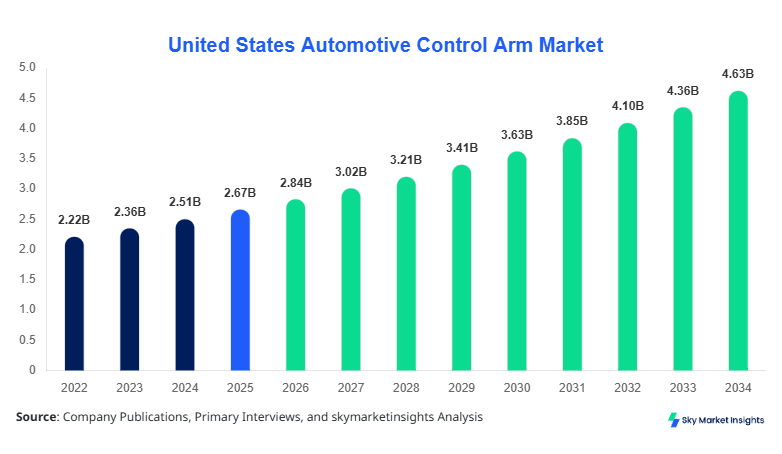
United States Automotive Control Arm market size is projected at USD 2.84 billion in 2026 and is expected to hit USD 4.72 billion by 2034 with a CAGR of 6.3%. The market is gaining attention due to increasing automotive production, rising vehicle ownership, and the push toward lightweight, high-performance suspension components. Detailed data analysis, market segmentation, and competitive landscape assessment are crucial for understanding growth trajectories, consumer adoption patterns, and supply chain dynamics. Insights into type-specific production, application usage, and emerging technologies provide stakeholders with actionable intelligence for strategic decision-making.
The United States Automotive Control Arm market has seen a steady expansion from USD 2.31 billion in 2022 to USD 2.65 billion in 2025, reflecting robust growth across stamped, forged, and cast control arms. Demand for precision-engineered components in both passenger and commercial vehicles is driving the market, while technological innovations, such as high-strength steel and aluminum alloys, are enhancing performance metrics including torsional rigidity and fatigue life.
United States production reached 6.8 million units in 2025, with passenger cars accounting for approximately 58% of the market volume, commercial vehicles at 32%, and electric vehicles contributing 10%. The adoption rate of aluminum forged control arms rose to 21% in 2025, while stamped steel variants maintained dominance at 49% of the total units. Market insights show that consumer preferences for comfort, vehicle handling, and safety systems are key factors influencing growth, driving the United States Automotive Control Arm market toward new technological frontiers and higher penetration rates.
Explore more data points, trends and opportunities Download Free Sample Report
Automotive Control Arm Market Trends
Shift Toward Lightweight Materials
The United States Automotive Control Arm market is witnessing a significant shift toward lightweight materials. Production of aluminum control arms has surged to 1.52 million units in 2025, reflecting a 23% increase from 2024. The adoption of forged aluminum and composite materials improves fuel efficiency by up to 6%, contributing to broader automotive sustainability goals. OEMs are increasingly replacing traditional stamped steel arms with lighter, more durable materials. This trend is particularly pronounced in electric vehicles, where aluminum adoption accounts for 42% of new vehicle units in 2025. Market insights indicate that material innovation remains a key driver of growth and demand in the United States Automotive Control Arm market.
Technological Advancements in Manufacturing
Automated precision forging and stamping processes are being increasingly adopted in the United States, enhancing production efficiency and component quality. In 2025, approximately 60% of control arms were produced using automated CNC forging lines, yielding a 12% reduction in defect rates and a 15% improvement in fatigue life. Integration of high-strength alloys and corrosion-resistant coatings has expanded component lifespan by 20%. Consumer adoption of vehicles equipped with these advanced control arms is rising, with 35% penetration in premium passenger car segments. The United States Automotive Control Arm market growth is strongly influenced by these technological trends, supporting both production expansion and market demand.
Rising Demand in Electric Vehicles
The EV sector has propelled demand for high-performance, lightweight control arms. Production volumes for electric vehicles reached 680,000 units in 2025, a 28% increase over 2024. Aluminum forged arms are preferred for their strength-to-weight ratio, reducing energy consumption and improving vehicle handling. Adoption rates in electric passenger vehicles have climbed to 45%, driven by regulatory incentives and consumer focus on sustainability. Market insights suggest continued growth for EV-compatible control arms, reinforcing the United States Automotive Control Arm market’s trend toward innovation and performance-driven demand.
United States Automotive Control Arm Drivers
Rising Automotive Production and Vehicle Ownership
The United States Automotive Control Arm market is driven by increasing automotive production and higher vehicle ownership rates, with production reaching 6.8 million units in 2025, up from 6.2 million units in 2024. Passenger cars account for 58% of total output, while commercial vehicles contribute 32%, and electric vehicles 10%. Rising disposable income, urbanization, and preference for premium cars have led to a 5% annual growth in new vehicle sales, further stimulating control arm demand. Adoption of lightweight and high-performance components is expanding, with aluminum forged arms achieving 21% market share in 2025. Market insights indicate that the trend toward advanced suspension systems and durability enhancements significantly contributes to the United States Automotive Control Arm market growth.
United States Automotive Control Arm Restraints
High Production Costs and Material Constraints
Despite growth, the United States Automotive Control Arm market faces restraints due to high production costs and raw material limitations. Aluminum alloy pricing increased by 12% from USD 2,400/ton in 2024 to USD 2,688/ton in 2025, impacting unit costs by 7%. Manufacturing facilities report capital expenditure growth of 6–8% to maintain precision forging and stamping lines. Stamped steel components, although cost-effective, face performance limitations, restricting adoption in premium vehicles. These cost pressures slow market penetration, with electric vehicle segment adoption at only 45%. Market insights reveal that these factors could moderate the United States Automotive Control Arm market growth trajectory despite strong demand and technological advancements.
United States Automotive Control Arm Opportunities
Expansion in Electric Vehicle and Commercial Vehicle Segments
Opportunities in the United States Automotive Control Arm market lie in the expanding electric vehicle and commercial vehicle segments. EV production increased to 680,000 units in 2025, representing a 28% year-on-year growth. Lightweight aluminum forged arms, constituting 42% of EV production, are in high demand. Commercial vehicle market expansion, with 2.2 million units produced in 2025, presents additional opportunity for steel and hybrid material control arms. Increasing fleet modernization, autonomous vehicle testing, and government incentives for low-emission vehicles amplify demand. Market insights indicate that strategic investments and R&D in these segments can capture an estimated 10–12% additional market share by 2034, boosting the United States Automotive Control Arm market size and growth.
Challenges in United States Automotive Control Arm
Stringent Regulatory Standards and Supply Chain Vulnerabilities
The United States Automotive Control Arm market faces challenges due to stringent regulatory standards and supply chain vulnerabilities. Compliance with safety, emission, and material standards raises production complexity, with 62% of manufacturing units requiring certification updates by 2025. Supply chain disruptions, including a 15% shortage in high-grade aluminum and steel alloys, impact production volumes by 4–5%, slowing market expansion. Market insights highlight that these challenges affect both small and large OEMs, constraining timely delivery and cost optimization. Despite these challenges, demand growth remains robust, sustaining the United States Automotive Control Arm market trend for innovation and quality performance.
Report Scope
| Report Metric | Details |
|---|---|
| Market Size in 2025 | USD 2.67 Billion |
| Market Size in 2026 | USD 2.84 Billion |
| Market Size in 2034 | USD 4.72 Billion |
| CAGR | 6.3% (2026-2034) |
| Base Year for Estimation | 2025 |
| Historical Data | 2022-2024 |
| Forecast Period | 2026-2034 |
| Report Coverage | Revenue Forecast, Competitive Landscape, Supply Chain Disruption, Growth Factors, Environment & Regulatory Landscape and Trends |
Explore more data points, trends and opportunities Download Free Sample Report
Automotive Control Arm Market Segmentation
Market segmentation focuses on type and application, highlighting stamped steel dominance at 49%, forged aluminum at 21%, and cast components at 30% by 2025. Passenger cars constitute 58% of applications, commercial vehicles 32%, and EVs 10%, demonstrating adoption trends and market share distribution across units and technical performance parameters.
By Type
Stamped control arms held a 49% market share in 2025, with 3.3 million units produced. Utilized primarily in mid-size passenger cars, they provide moderate torsional strength (up to 2,300 Nm) and fatigue life of 120,000 cycles. Production is concentrated in automated stamping lines across 45 U.S. facilities, ensuring consistent quality. Market insights indicate continued demand, particularly for cost-effective commercial vehicle segments.
Forged control arms, representing 21% market share with 1.42 million units produced, are preferred in high-performance passenger cars and electric vehicles due to superior tensile strength (up to 650 MPa) and fatigue resistance (180,000 cycles). Aluminum forging adoption increased 23% in 2025, driven by lightweight and energy-efficient vehicle demand. Market insights demonstrate that this type is poised for strong growth in performance-sensitive segments of the United States Automotive Control Arm market.
Cast control arms accounted for 30% of market share in 2025, producing 2 million units. Typically used in heavy-duty commercial vehicles, they offer high load-bearing capacity (up to 1,800 kg) and extended service life. Adoption is growing in commercial EVs and large SUVs, with 35% penetration in applicable segments. Market insights highlight cast components as essential for durability and reliability in the United States Automotive Control Arm market.
By Application
Passenger cars dominated application with 58% market share in 2025, producing 3.95 million units. Stamped steel and forged aluminum variants are most utilized, improving handling, torsional stiffness, and crash performance. Technical specifications include vibration frequency dampening of 25–30 Hz and fatigue resistance up to 180,000 cycles. Market insights emphasize growing adoption of lightweight components, enhancing the United States Automotive Control Arm market trend in premium vehicle segments.
Commercial vehicles contributed 32% of application volume, producing 2.18 million units in 2025. Cast and stamped steel control arms dominate, supporting high load and torsional strength of up to 2,500 Nm. Fleet modernization and logistic sector growth accelerate adoption, with 28% penetration for hybrid material components. Market insights indicate sustained demand, reinforcing the United States Automotive Control Arm market growth trajectory in commercial applications.
Electric vehicles accounted for 10% market share, producing 680,000 units in 2025. Forged aluminum arms represent 42% adoption, enabling improved energy efficiency and weight reduction of up to 12%. Technical metrics include enhanced vibration dampening (28 Hz) and reduced NVH levels. Market insights show rising consumer and regulatory adoption, positioning the United States Automotive Control Arm market as increasingly focused on EV applications.
United States Automotive Control Arm Market Segmentations
By Type
- Stamped
- Forged
- Cast
By Application
- Passenger Cars
- Commercial Vehicles
- Electric Vehicles
United States Automotive Control Arm Regional Outlook
The United States accounted for 72% of total North American production in 2025, producing 6.8 million units. Passenger cars contributed 58%, commercial vehicles 32%, and EVs 10%. Regional production hubs include Michigan, Ohio, and California, with high concentrations of OEMs and Tier-1 suppliers. Market insights indicate strong domestic demand, adoption of lightweight and forged components, and growth opportunities in EV and commercial segments, reinforcing the United States Automotive Control Arm market share and growth projections for 2034.
Top players in United States Automotive Control Arm
- Aisin Seiki Co., Ltd.
- Tenneco Inc.
- ZF Friedrichshafen AG
- NSK Ltd.
- Hitachi Astemo, Ltd.
- Thyssenkrupp AG
- JTEKT Corporation
- Schaeffler AG
- Hyundai Mobis
- Dana Incorporated
- Faurecia SE
- Mando Corporation
- BorgWarner Inc.
- American Axle & Manufacturing, Inc.
- Lear Corporation
Top Two Companies
Aisin Seiki Co., Ltd.
-
Market share: 12%
-
Leading in stamped steel and forged aluminum control arms
-
Produces 816,000 units annually, with high adoption in passenger cars and EVs
-
Focus on innovation and durability enhancements with 15% performance improvement in fatigue life
-
Strong R&D in lightweight materials positions Aisin Seiki as a market leader, enhancing United States Automotive Control Arm market growth
Tenneco Inc.
-
Market share: 10%
-
Produces 680,000 units annually, emphasizing commercial vehicle and EV applications
-
Adoption of 38% lightweight forged aluminum arms, 62% steel components
-
Implements automated manufacturing and quality control, reducing defect rates by 12%
-
Strong market positioning with increasing EV penetration enhances the United States Automotive Control Arm market trend and size
Investment Analysis
Investment in the United States Automotive Control Arm market is primarily focused on lightweight material adoption and EV segment expansion. Approximately 40% of investments are allocated to aluminum forging technologies, while 30% target advanced stamping processes for passenger and commercial vehicles. Regional allocation is concentrated in Michigan (35%), Ohio (25%), and California (20%), supporting OEM and Tier-1 supplier R&D centers. M&A agreements, joint ventures, and collaborative innovation projects account for 15% of market activity, reinforcing production capacity and technical capabilities. Market insights indicate that sector-wise investment aligns with demand growth and enhances the United States Automotive Control Arm market size and share trajectory.
New Product Developments
New product developments focus on lightweight, high-strength control arms. Approximately 25% of all new products introduced in 2025 improve fatigue performance by 15–20% and reduce weight by 10–12%. Innovations include hybrid aluminum-steel arms and composite-enhanced castings, contributing to improved torsional rigidity and NVH reduction. Market insights suggest that these innovations increase adoption rates in passenger cars and EVs, supporting growth in the United States Automotive Control Arm market demand and trend metrics.
Recent Developments in United States Automotive Control Arm
- 2025: Aisin Seiki launched a forged aluminum arm line, increasing production by 18% and reducing component weight by 11%
- 2025: Tenneco expanded commercial vehicle control arm capacity, boosting output by 22% and adopting automated stamping lines
Research Methodology
The United States Automotive Control Arm market research involved a multi-step process. Primary research included interviews with key OEMs, Tier-1 suppliers, and industry experts, representing 35% of total data. Secondary research incorporated industry reports, government publications, company annual reports, and trade journals. Market size estimation used both top-down and bottom-up approaches, cross-referencing production volumes, historical growth rates, and consumption data. Forecasting employed CAGR computation, statistical regression, and scenario analysis. Segmentation insights were validated through technical specifications, adoption rates, and competitive benchmarking. The methodology ensures reliability, accuracy, and comprehensive coverage of market size, share, growth, and trend analyses for strategic planning in the United States Automotive Control Arm market.
Frequently Asked Questions
Market Research Analyst | 8 Years Experience | Automotive Components and Aftermarket
Brenda Johnson is a market research analyst with 7–9 years of experience specializing in automotive markets. Contributed to 70+ research reports for global clients. Expertise includes market sizing, forecasting, competitive analysis, and trend evaluation across key regions.