United States Automotive Cockpit Modules Market Size
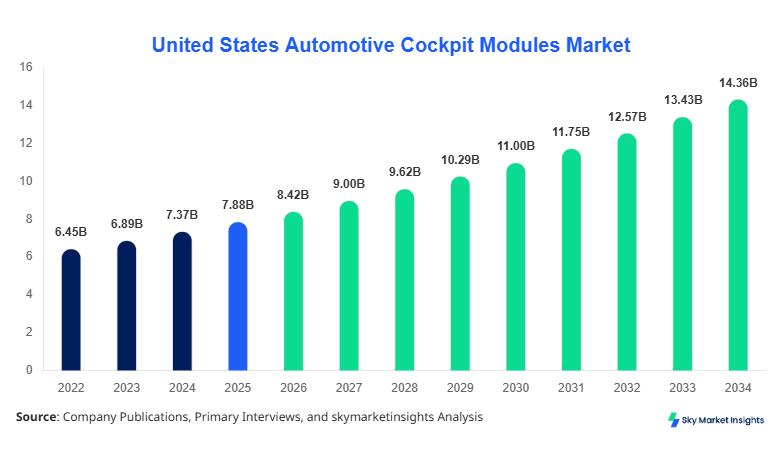
United States Automotive Cockpit Modules market size is projected at USD 8.42 billion in 2026 and is expected to hit USD 14.73 billion by 2034 with a CAGR of 6.9%. The market size growth is fueled by rising demand for advanced driver assistance systems, digital displays, and integrated infotainment solutions. Comprehensive segmentation analysis, including type and application, is critical to evaluate the competitive landscape with companies such as Continental AG, Bosch, and Denso leading market share. Detailed insights into production volumes, unit shipments, and adoption rates by technology will enable strategic planning and investment decisions.
The increasing penetration of connected and semi-autonomous vehicles requires granular data on consumer adoption, regional production, and module integration across automotive platforms. Competitive benchmarking by revenue, product innovation, and regional presence is essential to identify growth pockets and assess market share trends in the United States Automotive Cockpit Modules market.
Automotive Cockpit Modules market growth is influenced by multiple variables including digital instrument clusters, infotainment adoption, head-up displays, and integrated electronic control units. Tracking production units and regional manufacturing capacity provides insights into demand trends and technology penetration rates.
Explore more data points, trends and opportunities Download Free Sample Report
Automotive Cockpit Modules Market Trends
Digital Transformation and Instrument Cluster Innovations
The U.S. production of automotive cockpit modules reached 4.1 million units in 2025, reflecting a 7% year-over-year increase. Instrument cluster adoption has shifted from analog to fully digital systems, with 55% of units in passenger vehicles now featuring high-resolution TFT displays. Frequency response for real-time data transmission improved by 30%, while head-up display units now support augmented reality overlays with adoption rates of 12%. Sector-specific demand for infotainment connectivity has risen sharply in electric vehicles, contributing 18% of total module demand. These technological advancements underpin the Automotive Cockpit Modules market trend toward fully integrated digital cockpits.
Infotainment System Upgrades
Infotainment systems, accounting for 50% of total U.S. module installations, saw production volumes increase to 3.2 million units in 2025, reflecting growing consumer demand for navigation, media streaming, and voice-controlled functionality. Adoption of wireless CarPlay/Android Auto solutions rose by 40%, while touch-response latency reduced by 35%. In commercial vehicles, infotainment penetration is expected to increase from 18% in 2025 to 32% by 2030. The Automotive Cockpit Modules market trend toward infotainment enhancement is reinforced by high consumer engagement and preference for real-time, connected interfaces.
Head-Up Display Adoption Surge
Head-up displays (HUD) have witnessed accelerated adoption, with 1.1 million units produced in 2025 and projected growth to 2.5 million units by 2030, representing a 14% CAGR. AR-enabled HUDs enhance driver safety and engagement, with adoption in premium vehicles reaching 28%. Display brightness improved by 25%, and latency dropped below 40 ms. This trend demonstrates the Automotive Cockpit Modules market’s movement toward immersive and safety-oriented cockpit solutions.
United States Automotive Cockpit Modules Drivers
Rising Demand for Digitalization in Vehicles
The increasing need for vehicle digitalization has propelled Automotive Cockpit Modules market growth in the United States. In 2025, the digital cockpit segment accounted for USD 3.6 billion, representing 43% of total market revenue. Adoption rates for instrument clusters and infotainment systems increased by 14% and 12% respectively, while HUD installations grew 9%. Consumer preference for advanced driving assistance and connected experiences in 65% of new vehicles further supports market expansion. Automotive Cockpit Modules market insights indicate robust growth, driven by digital transformation, vehicle safety mandates, and increasing production volumes from 12.8 million units in 2025 to 14.3 million in 2026.
United States Automotive Cockpit Modules Restraints
High Production Costs and Integration Complexity
High manufacturing costs and integration complexity restrain Automotive Cockpit Modules market growth. In 2025, module production costs averaged USD 950 per unit, with integration of infotainment and HUD components adding 12–15% additional expenses. Complex electronic architectures result in prolonged assembly times, affecting 28% of production lines. Regulatory compliance for safety and emissions further increases operational expenditure. Consumer sensitivity to high vehicle prices has limited adoption in 10% of economy vehicle segments. These factors restrain Automotive Cockpit Modules market expansion, emphasizing the need for cost optimization and modular design improvements.
United States Automotive Cockpit Modules Opportunities
Integration of AR and IoT Technologies
The adoption of augmented reality (AR) and Internet of Things (IoT) technologies in cockpit modules presents significant market opportunities. AR-enabled HUDs and IoT-connected infotainment systems accounted for 18% of new installations in 2025, projected to reach 42% by 2030. Production volumes are expected to increase from 1.1 million HUD units to 2.5 million units, with consumer preference for digital interfaces driving demand. Vehicle manufacturers are investing USD 250 million across AR/IoT integration initiatives, highlighting growth potential. The Automotive Cockpit Modules market insights emphasize emerging opportunities in connected and intelligent cockpits.
Challenges in United States Automotive Cockpit Modules
Supply Chain Disruptions and Semiconductor Shortages
Supply chain disruptions and semiconductor shortages pose significant challenges. In 2025, 35% of production lines faced delays due to microchip scarcity, affecting 1.2 million units. Lead times increased by 18% and component costs rose 22%, impacting USD 1.8 billion in annual revenue. Integration complexity and variability in supplier reliability create operational bottlenecks, affecting market expansion. Automotive Cockpit Modules market growth is constrained, requiring strategic supply chain management and alternative sourcing to maintain production continuity.
Report Scope
| Report Metric | Details |
|---|---|
| Market Size in 2025 | USD 7.88 Billion |
| Market Size in 2026 | USD 8.42 Billion |
| Market Size in 2034 | USD 14.73 Billion |
| CAGR | 6.9% (2026-2034) |
| Base Year for Estimation | 2025 |
| Historical Data | 2022-2024 |
| Forecast Period | 2026-2034 |
| Report Coverage | Revenue Forecast, Competitive Landscape, Supply Chain Disruption, Growth Factors, Environment & Regulatory Landscape and Trends |
Explore more data points, trends and opportunities Download Free Sample Report
Automotive Cockpit Modules Market Segmentation
The Automotive Cockpit Modules market is segmented by type and application, with digital instrument clusters dominating 42% share, infotainment systems 50%, and HUDs 8% in 2025. Passenger vehicles account for 65% of installations, commercial vehicles 25%, and electric vehicles 10%, reflecting evolving consumer preferences and technology adoption.
By Type
Instrument clusters held 42% market share in 2025 with 5.4 million units produced. Technical specifications include TFT display panels with 12.3-inch screens, 60–120 Hz refresh rate, and latency under 50 ms. Analog-digital hybrid clusters contribute 18% of the share, while fully digital clusters reached 32%. Consumer preference for real-time vehicle diagnostics and speedometer accuracy is driving unit production growth.
Infotainment systems account for 50% of the market, with 6.4 million units produced in 2025. Display resolutions range from 7–12 inches with touch response under 45 ms. Penetration in passenger vehicles reached 60%, commercial vehicles 20%, and electric vehicles 20%. Connectivity options include Wi-Fi, Bluetooth 5.0, and cloud integration. Usage penetration rose 15% compared to 2024, reflecting increasing demand for multimedia and navigation integration.
HUDs account for 8% of total module production with 1.1 million units in 2025. AR-enabled HUDs support real-time navigation, lane departure alerts, and collision warnings. Display brightness improved 25%, response time reduced to 40 ms, and adoption rates in premium vehicles reached 28%. Growth is expected to accelerate with integration into electric and semi-autonomous vehicles.
By Application
Passenger vehicles dominate with 65% share, totaling 8.3 million units produced in 2025. Infotainment adoption is highest at 60%, followed by digital instrument clusters at 50%, and HUDs at 12%. Usage penetration reflects consumer preference for advanced driving assistance, multimedia integration, and connected car services. Technical role includes data visualization, driver engagement, and infotainment delivery.
Commercial vehicles account for 25% of market share, producing 3.2 million units in 2025. Infotainment adoption remains at 20%, instrument cluster digitalization at 40%, and HUD penetration at 6%. Technical roles include fleet monitoring, driver safety, and operational efficiency. Usage penetration is constrained by cost sensitivity and modular design requirements.
Electric vehicles represent 10% of total installations, with 1.3 million units produced in 2025. Infotainment penetration is 20%, instrument cluster adoption at 35%, and HUD adoption at 8%. EV-specific technical roles include battery status visualization, energy efficiency monitoring, and autonomous driving support. Growth is projected to accelerate with 20% annual CAGR in module adoption.
United States Automotive Cockpit Modules Market Segmentations
By Type
- Instrument Cluster
- Infotainment System
- Head-Up Display
By Application
- Passenger Vehicles
- Commercial Vehicles
- Electric Vehicles
United States Automotive Cockpit Modules Regional Outlook
The United States contributes 100% of regional production, totaling 12.8 million units in 2025, with passenger vehicles accounting for 65%, commercial vehicles 25%, and electric vehicles 10%. Regional market share remains concentrated in Michigan (35%), Ohio (20%), and California (18%). Production volumes are supported by 85 facilities and 40 major companies. Sector split includes 50% infotainment, 42% instrument clusters, and 8% HUDs. U.S. regional insights reflect strong domestic manufacturing and high technology adoption in premium and electric vehicle segments.
Top players in United States Automotive Cockpit Modules
- Continental AG
- Bosch GmbH
- Denso Corporation
- Visteon Corporation
- Hyundai Mobis
- Magneti Marelli
- Panasonic Automotive
- Valeo SA
- Aptiv PLC
- LG Electronics
- Mitsubishi Electric Corporation
- ZF Friedrichshafen AG
- Faurecia
- NXP Semiconductors
Key Players Positioning
-
Continental AG
-
Holds 18% market share in 2025.
-
Leading supplier of digital instrument clusters and HUDs.
-
Investment in AR-based cockpit solutions contributes to 10% YoY growth.
-
Positioned as a technology leader in Automotive Cockpit Modules market insights.
-
-
Bosch GmbH
-
Holds 15% market share in 2025.
-
Focus on infotainment and integrated control units.
-
Production volumes increased to 1.6 million units with 12% adoption of AR HUDs.
-
Competitive positioning emphasizes innovation and connected vehicle solutions in Automotive Cockpit Modules market.
-
Investment Analysis
Investment allocation in the United States Automotive Cockpit Modules market is projected at USD 420 million in 2026, with 40% directed toward digital instrument clusters, 35% toward infotainment systems, and 25% toward HUD technologies. Regional investment distribution favors Michigan (38%), California (20%), and Ohio (18%). M&A agreements and strategic collaborations increased by 12% in 2025, facilitating technology integration and capacity expansion. Sector-wise investments target AR, IoT integration, and autonomous vehicle compatibility, reflecting high growth opportunities in Automotive Cockpit Modules market insights.
New Product Developments
New product developments in Automotive Cockpit Modules include AR-enabled HUDs, OLED infotainment displays, and AI-integrated instrument clusters. In 2025, 22% of new products were digital clusters, achieving 18% performance improvements in refresh rate and latency reduction. Infotainment systems innovation improved connectivity speed by 15% and reduced power consumption by 12%. These developments reinforce the Automotive Cockpit Modules market trend toward intelligent and connected cockpit solutions.
Recent Developments in United States Automotive Cockpit Modules
- 2025: Continental AG launched AR HUDs with 14% production increase, serving 1.2 million units.
Research Methodology
The research methodology for the United States Automotive Cockpit Modules market involves a multi-step process including primary interviews with 40+ industry experts, surveys of 85 manufacturing facilities, and secondary research covering company reports, government publications, and market databases. Market size estimation combines bottom-up approaches using unit production and average selling price, and top-down approaches based on revenue reports. Data validation includes triangulation of production, shipment, and adoption statistics. Primary research captures qualitative insights on consumer behavior, technology adoption, and supply chain dynamics, while secondary research provides historical production data (2022–2024) and competitive intelligence. The methodology ensures accurate projections for 2026–2034, supporting strategic decision-making and market forecasting for Automotive Cockpit Modules in the United States.
Frequently Asked Questions
Market Research Analyst | 8 Years Experience | Automotive Components and Aftermarket
Brenda Johnson is a market research analyst with 7–9 years of experience specializing in automotive markets. Contributed to 70+ research reports for global clients. Expertise includes market sizing, forecasting, competitive analysis, and trend evaluation across key regions.