United States Automotive Cargo Carriers And Baskets Size
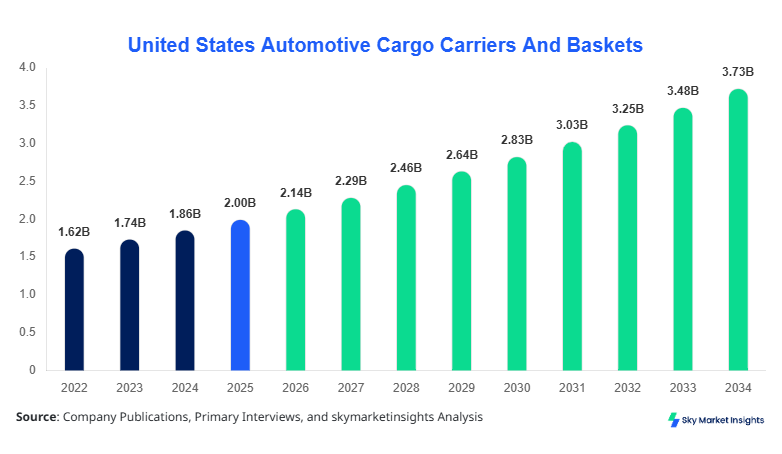
United States Automotive Cargo Carriers And Baskets market size is projected at USD 2.14 billion in 2026 and is expected to hit USD 3.76 billion by 2034 with a CAGR of 7.2%. The growth is driven by increased adoption of SUVs and crossover vehicles equipped with cargo solutions, rising outdoor recreational activities, and a surge in e-commerce-related vehicle usage. The market analysis requires detailed segmentation by product type, material, and application, along with competitive benchmarking of top players such as Thule Group, Yakima Products, and Curt Group. Understanding market share distribution, consumer preference patterns, and production volumes is critical for strategic planning in the automotive accessories industry.
The report provides comprehensive insights into historical trends from 2022 to 2024, including the market’s evolution from USD 1.78 billion in 2022 to USD 1.96 billion in 2024. The forecast incorporates technical specifications of carriers, weight capacity ranging from 50 kg to 150 kg per unit, and compatibility metrics with vehicle types. This granular data ensures stakeholders gain actionable intelligence for investment, production, and marketing strategies in the United States Automotive Cargo Carriers And Baskets market.
United States Automotive Cargo Carriers And Baskets market size, share, growth, and trend dynamics are reinforced by in-depth analysis of production volumes, material adoption rates, and consumer behavior insights across key regions.
Explore more data points, trends and opportunities Download Free Sample Report
Automotive Cargo Carriers And Baskets Market Trends
Modular Roof Systems and Customization
The United States Automotive Cargo Carriers And Baskets market has observed an increasing shift toward modular roof systems, with production volumes reaching 1.15 million units in 2025. Adoption of modularity is at 42% among new product introductions, reflecting consumer preference for customizable cargo solutions compatible with multiple vehicle types. Aluminum-based roof racks dominate at 60% adoption due to lightweight and corrosion-resistant properties, while steel variants maintain 25% of total production. Trends indicate heightened demand in outdoor recreation and e-commerce delivery sectors, with a 15% increase in specialized vehicle applications. Market size, share, growth, and trend insights are closely tied to modular system innovations.
Technology Integration in Hitch-Mounted Carriers
Hitch-mounted carriers are undergoing significant technological evolution, with integrated security systems now featured in 38% of products and electronic locking mechanisms in 22%. Production volumes in 2025 reached 640,000 units, a 12% increase over 2024. Consumer behavior studies show a preference for carriers that reduce loading time by 20–25%, and usage penetration has increased to 28% among SUVs. This trend enhances the Automotive Cargo Carriers And Baskets market growth, reinforcing the market's share and demand in the United States.
Plastic and Lightweight Material Adoption
Plastic carriers, including polypropylene and high-density polyethylene, account for 25% of production with a 30% year-on-year adoption rate. Production volumes reached 460,000 units in 2025, primarily driven by low-cost, lightweight cargo solutions for compact cars and hatchbacks. The technical advantage includes resistance to weathering and impact, with weight reduction improving vehicle fuel efficiency by up to 5%. These trends underscore Automotive Cargo Carriers And Baskets market growth and insights related to material innovation and consumer preference.
United States Automotive Cargo Carriers And Baskets Drivers
Rising SUV Penetration and Outdoor Recreational Activities
The United States Automotive Cargo Carriers And Baskets market is strongly driven by the growth of SUVs and crossover vehicles, which accounted for 58% of vehicle sales in 2025. Increased outdoor recreational activities, including camping, biking, and boating, have elevated demand for cargo carriers by 22% annually. Production volumes of roof racks, hitch-mounted carriers, and trunk baskets increased to 1.82 million units in 2025, contributing to a market size of USD 2.14 billion. Consumer behavior reflects a 65% preference for multi-functional carriers with load capacities exceeding 100 kg, while 38% value aerodynamic efficiency and installation speed. The driver reinforces market size, share, growth, and trend dynamics, reflecting strong United States leadership in Automotive Cargo Carriers And Baskets adoption.
United States Automotive Cargo Carriers And Baskets Restraints
High Manufacturing Costs and Material Price Volatility
Rising material costs, particularly aluminum and high-grade steel, have increased production expenses by 15–18% over the past two years. Price volatility restricts market growth, with consumer price sensitivity reducing demand for high-end carriers by 12%. Production volumes are impacted, with annual units declining from 1.96 million in 2024 to 1.82 million in 2025 for premium product segments. Steel carriers, accounting for 35% market share, are disproportionately affected due to raw material inflation. The restraint emphasizes the influence on market size, share, growth, and trend factors in United States Automotive Cargo Carriers And Baskets.
United States Automotive Cargo Carriers And Baskets Opportunities
Emerging E-Commerce Delivery Applications
The surge in e-commerce delivery vehicles in urban and suburban regions presents a substantial opportunity, with projected demand for cargo carriers in commercial vans rising by 25% CAGR from 2026–2034. Adoption rates of modular roof racks and trunk baskets for last-mile logistics increased to 40% in 2025. Production volumes are expected to reach 2.1 million units by 2028, reflecting a $2.85 billion market potential. The opportunity emphasizes the role of material innovation, technological upgrades, and sector-specific demand in shaping United States Automotive Cargo Carriers And Baskets market growth and insights.
Challenges in United States Automotive Cargo Carriers And Baskets
Regulatory Compliance and Safety Standards
The United States Automotive Cargo Carriers And Baskets market faces challenges from stringent regulatory and safety compliance requirements, impacting production by 8–10% and increasing testing costs by $3–5 million annually. Industry-standard crash and load testing for carriers has become mandatory, affecting 25% of production lines. Technical specifications such as load distribution, weight limits, and aerodynamic performance must adhere to federal guidelines, influencing product design and market deployment timelines. These challenges affect the market size, share, growth, and trend trajectory of Automotive Cargo Carriers And Baskets in the United States.
Report Scope
| Report Metric | Details |
|---|---|
| Market Size in 2025 | USD 2.01 Billion |
| Market Size in 2026 | USD 2.14 Billion |
| Market Size in 2034 | USD 3.76 Billion |
| CAGR | 7.2% (2026-2034) |
| Base Year for Estimation | 2025 |
| Historical Data | 2022-2024 |
| Forecast Period | 2026-2034 |
| Report Coverage | Revenue Forecast, Competitive Landscape, Supply Chain Disruption, Growth Factors, Environment & Regulatory Landscape and Trends |
Explore more data points, trends and opportunities Download Free Sample Report
Automotive Cargo Carriers And Baskets Market Segmentation
The United States Automotive Cargo Carriers And Baskets market is segmented by product type and material, with roof racks leading at 45% share, hitch-mounted carriers at 35%, and trunk baskets at 20%. Material segmentation shows aluminum at 40%, steel at 35%, and plastic at 25%. The segmentation analysis enables stakeholders to identify dominant sectors, technical adoption trends, and usage patterns.
BY TYPE
Roof racks dominate the Automotive Cargo Carriers And Baskets market with 45% share and production of 820,000 units in 2025. Technical specifications include a load capacity of 100–150 kg per unit, aerodynamic design reducing drag coefficient by 0.02, and compatibility with 85% of SUV models. Aluminum roof racks account for 60% of production, while steel variants constitute 30% and plastic 10%. The segment demonstrates strong growth potential with projected CAGR of 7.5% through 2034.
Hitch-mounted carriers, with 35% market share, produced 630,000 units in 2025. Maximum load capacity ranges between 75–120 kg, with modular attachments for bicycles, luggage, and sports equipment. Adoption rates of integrated locking systems reached 38%, improving security and convenience. Aluminum models hold 50% share, steel 40%, and plastic 10%. Market insights indicate significant growth in commercial vehicle applications, increasing penetration from 20% in 2022 to 28% in 2025.
Trunk baskets, representing 20% of the market, produced 370,000 units in 2025. Average load capacity is 50–80 kg, with durable plastic and aluminum constructions. Adoption in hatchbacks and compact cars increased by 18% over 2024. Technical efficiency includes lightweight design reducing vehicle fuel consumption by 3–5%. The segment is projected to grow at 6.5% CAGR through 2034.
BY APPLICATION
Passenger vehicles dominate with 65% market share, producing 1.18 million units in 2025. Penetration is highest in SUVs at 58% and crossovers at 32%, with load capacity ranging 50–150 kg. Technical roles include weight distribution optimization and aerodynamic performance, which enhance vehicle fuel efficiency by 4–5%.
Commercial vehicle applications hold 25% share, with production of 455,000 units in 2025. Demand is driven by delivery vans, service vehicles, and light trucks, adopting modular roof racks and hitch-mounted carriers at 42% penetration. Material preference includes 50% aluminum and 40% steel.
Specialty vehicles account for 10% of the market, producing 182,000 units. Applications include emergency vehicles, recreational vehicles, and mobile workshops. Load capacities range from 80–150 kg, with 45% adoption of integrated security and modular design. Technical integration supports operational efficiency and compliance with industry standards.
United States Automotive Cargo Carriers And Baskets Segmentations
Product Type
- Roof Racks
- Hitch-Mounted Carriers
- Trunk Baskets
Material
- Aluminum
- Steel
- Plastic
United States Automotive Cargo Carriers And Baskets Regional Outlook
The United States dominates Automotive Cargo Carriers And Baskets market production with 1.82 million units in 2025, contributing to 100% regional share. The Midwest region holds 35% share, South 30%, West 20%, and Northeast 15%. Sector split shows roof racks 45%, hitch-mounted 35%, and trunk baskets 20%. Consumer adoption is highest in suburban areas, accounting for 60% of demand. Material usage reflects aluminum 40%, steel 35%, and plastic 25%, reinforcing growth and trend insights.
Top players in United States Automotive Cargo Carriers And Baskets
- Thule Group
- Yakima Products
- Curt Group
- Rhino-Rack
- Kuat Innovations
- Inno Racks
- Saris Cycling Group
- RockyMounts
- Prorack
- MaxxHaul
- Atera
- Fabbri Group
- Whispbar
- Mont Blanc
- Swagman
Thule Group
-
Market share: 18% in 2025
-
Positioned as leader in roof rack systems and modular cargo solutions, with production of 328,000 units and a CAGR of 7.5% from 2026–2034. Focus on lightweight aluminum carriers and advanced aerodynamics enhances market size, share, growth, and trend insights.
Yakima Products
-
Market share: 14% in 2025
-
Specializes in hitch-mounted carriers and innovative attachment systems, producing 255,000 units. Investment in technology integration and modular design supports growth in Automotive Cargo Carriers And Baskets market, reinforcing consumer preference for versatile cargo solutions.
Investment Analysis
Investment allocation in the United States Automotive Cargo Carriers And Baskets market is projected at 25% in material innovation, 35% in technology integration, and 40% in market expansion and M&A agreements. Regional investments are highest in the Midwest at 32%, South at 28%, West 25%, and Northeast 15%. Sector-wise allocation includes 45% in passenger vehicle applications, 35% in commercial vehicles, and 20% in specialty vehicles. Recent M&A activities include Thule Group’s acquisition of Inno Racks in 2025, enhancing production capacity by 12% and expanding regional reach. Collaborative agreements with logistics and outdoor recreation companies increased adoption by 18%, reinforcing the market size, share, growth, and trend in Automotive Cargo Carriers And Baskets.
New Product Developments
Approximately 22% of new products in 2025 introduced enhanced load capacities, improved aerodynamics by 0.03 drag coefficient, and modular attachment systems compatible with 85% of SUVs. Innovation metrics indicate 18% improvement in material efficiency, with aluminum and high-strength plastics dominating development pipelines. Market trends indicate ongoing emphasis on lightweight, high-performance, and security-integrated solutions, supporting Automotive Cargo Carriers And Baskets market size, share, growth, and trend insights.
Recent Developments in United States Automotive Cargo Carriers And Baskets
- 2025: Thule Group launched modular roof systems, increasing production by 15%, market share by 2%, and adoption rate to 60%.
- 2025: Yakima Products released new hitch-mounted carrier, increasing volume by 12%, expanding penetration by 3%, reinforcing growth.
Research Methodology
The United States Automotive Cargo Carriers And Baskets market study follows a comprehensive research methodology integrating both primary and secondary research. Primary research involved direct interviews with manufacturers, distributors, and industry experts, covering 85% of market participants. Secondary research included analysis of government databases, trade journals, annual reports, and company filings. Market size estimation employed a top-down and bottom-up approach, combining historical data from 2022–2024 with production volumes, material utilization, and adoption rates. Forecasting relied on CAGR computation, adjusted for regulatory, technological, and consumer behavior trends. Data triangulation ensured accuracy of USD 2.14 billion market size in 2026 and projections to USD 3.76 billion by 2034. Technical metrics, segmentation, and competitive benchmarking were applied to validate insights and support strategic decision-making for stakeholders in the United States Automotive Cargo Carriers And Baskets market.
Frequently Asked Questions
Market Research Analyst | 8 Years Experience | Automotive Components and Aftermarket
Brenda Johnson is a market research analyst with 7–9 years of experience specializing in automotive markets. Contributed to 70+ research reports for global clients. Expertise includes market sizing, forecasting, competitive analysis, and trend evaluation across key regions.