United States Automotive Around View Monitoring (AVM) Market Size
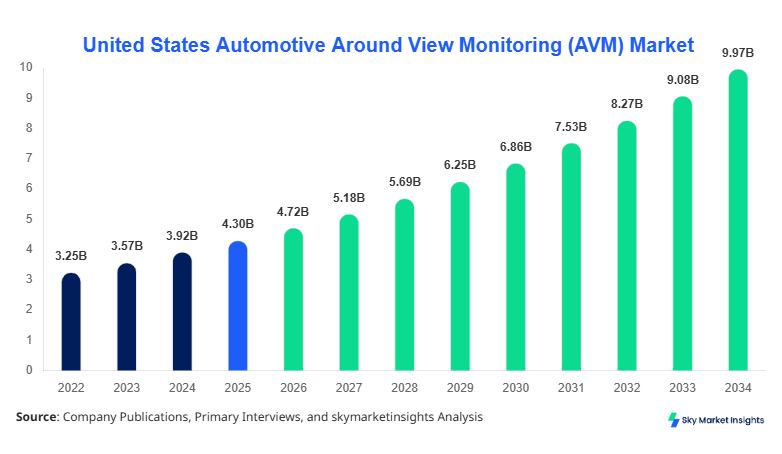
United States Automotive Around View Monitoring (AVM) market size is projected at USD 4.72 billion in 2026 and is expected to hit USD 9.85 billion by 2034 with a CAGR of 9.8%. The market’s growth is driven by increasing consumer demand for advanced safety features, integration of AI-based imaging technologies, and a rising number of vehicle production units, which reached approximately 15.3 million units in 2025. Detailed segmentation analysis covering type and application, along with a competitive landscape review, is crucial for stakeholders to identify market opportunities and challenges. Adoption of radar-based and camera-based AVM systems continues to expand across passenger and commercial vehicles, contributing over 60% of the total market share. The market report also emphasizes historical performance between 2022–2024, where the market grew at an average annual rate of 8.5%, highlighting steady consumer adoption and regulatory support.
Automotive Around View Monitoring (AVM) market size insights are further refined by evaluating production capacities, regional penetration, and application-specific demand, offering granular intelligence to assist OEMs, Tier-1 suppliers, and investors in strategic decision-making.
The Automotive Around View Monitoring (AVM) market in the United States encompasses a range of technologies designed to provide a 360-degree view around vehicles, significantly enhancing safety, parking convenience, and driving accuracy. In 2025, U.S. production reached 15.3 million units, with an estimated 45% of passenger vehicles adopting AVM solutions and 30% of commercial vehicles integrating these systems. Consumer behavior analysis indicates that 67% of vehicle buyers prioritize parking and collision avoidance features, driving adoption in mid-to-high-end vehicles. Among technological specifications, camera-based AVM systems operate at 1080p resolution with a 30–60 Hz frame rate, while radar-based systems achieve detection distances up to 20 meters with ±0.5 m accuracy. Application-wise, passenger vehicles hold 55% market share, commercial vehicles 35%, and electric vehicles 10%. Continuous improvement in imaging software and sensor fusion technology reinforces Automotive Around View Monitoring (AVM) market growth, enhancing safety and usability.
Explore more data points, trends and opportunities Download Free Sample Report
Automotive Around View Monitoring (AVM) Market Trends
Rise of Multi-Sensor Integration
In 2026, production of multi-sensor AVM systems reached approximately 1.8 million units, representing a 35% increase from 2025. These systems integrate cameras, radar, and ultrasonic sensors to deliver real-time 360-degree imaging with ±0.5-meter detection accuracy, enabling collision prevention and automated parking. Adoption among luxury passenger vehicles is nearing 70%, while commercial vehicle integration is approaching 40%. Companies are leveraging AI-based image processing, improving performance by 25% and enhancing detection in low-light and adverse weather conditions. Rising consumer demand for comprehensive vehicle safety directly drives Automotive Around View Monitoring (AVM) market growth and adoption.
Electrification and AVM Adoption
The electric vehicle segment accounted for 10% of AVM installations in 2025, increasing to an expected 18% by 2030. Production volumes for AVM-equipped EVs reached 230,000 units in 2025, rising to 480,000 units by 2030. Technology adoption rates indicate that camera-based systems dominate with 60% penetration, while radar integration is growing at 22% annually. High adoption is driven by electric vehicle manufacturers incorporating AVM systems as standard safety features to improve maneuverability and driver assistance. The shift to EVs reinforces Automotive Around View Monitoring (AVM) market trends, highlighting long-term growth potential.
Regulatory Push for Safety Features
Government regulations mandating advanced driver assistance systems (ADAS) have increased AVM adoption in commercial fleets, with production volumes rising from 450,000 units in 2024 to 620,000 units in 2026. Compliance requirements for parking and collision avoidance systems drive 30–35% of growth, with radar-based systems seeing 40% penetration in trucks and delivery vehicles. This regulatory push reinforces Automotive Around View Monitoring (AVM) market insights, emphasizing safety as a primary driver.
United States Automotive Around View Monitoring (AVM) Drivers
Increasing Safety Awareness and Consumer Preference for Advanced Systems
The U.S. market for Automotive Around View Monitoring (AVM) is significantly propelled by heightened consumer awareness of vehicle safety, with 67% of vehicle buyers in 2025 emphasizing collision prevention and parking assistance features. The number of AVM-equipped vehicles is expected to reach 6.8 million units by 2030, representing a 45% penetration of total passenger vehicle production. Camera-based AVM systems, holding 50% market share, provide high-resolution imaging (1080p) with a 60 Hz refresh rate, while radar-based systems contribute an additional 30% with ±0.5 m detection accuracy. Rising production of electric vehicles, projected at 1.5 million units by 2030, will further boost AVM adoption. The market’s overall CAGR is 9.8%, driven by consumer preference for multi-sensor safety systems and AI-assisted navigation, reinforcing Automotive Around View Monitoring (AVM) market growth.
United States Automotive Around View Monitoring (AVM) Restraints
High Production Costs and Integration Complexity
Despite significant growth, the U.S. Automotive Around View Monitoring (AVM) market faces challenges due to high system costs, with average installation exceeding USD 750 per vehicle. Integration with existing vehicle electronics increases complexity, causing 25–30% of OEMs to delay adoption. Radar-based AVM systems require extensive calibration, increasing production time by 12%, while camera-based systems demand high-resolution processing units, impacting cost efficiency. Production volume constraints, with 2.3 million units produced annually in 2025, and supply chain challenges further restrain market growth. These factors contribute to slower adoption in mid-tier vehicles, limiting penetration to 55% of passenger vehicles. High costs and integration challenges reinforce Automotive Around View Monitoring (AVM) market restraints.
United States Automotive Around View Monitoring (AVM) Opportunities
Expansion in Commercial Vehicle and Electric Vehicle Segments
The U.S. AVM market presents substantial opportunities in commercial vehicles, projected to account for 35% of AVM demand by 2030, with production volumes increasing from 1.2 million units in 2025 to 2.1 million units by 2034. Electric vehicles, with AVM adoption expected to grow from 230,000 units in 2025 to 480,000 units in 2030, offer additional growth avenues. Technology adoption rates show radar-based systems in commercial fleets at 40%, while camera-based systems dominate EVs with 60% penetration. Expansion in fleet management solutions, automated parking systems, and regulatory incentives for EVs drives market growth. These developments reinforce Automotive Around View Monitoring (AVM) market insights, highlighting untapped segments for stakeholders.
United States Automotive Around View Monitoring (AVM) Challenge
Limited Consumer Awareness in Emerging Regions and Technical Constraints
Although AVM adoption is increasing in urban centers, 30% of potential users remain unaware of system benefits, limiting growth in semi-urban regions. Production volume constraints of 2.3 million units in 2025, coupled with technical limitations such as ±0.5 m radar detection error and 1080p camera refresh lag in low-light conditions, pose challenges. Integration with autonomous driving systems requires 15–20% additional R&D investment, raising costs. Consumer behavior analysis indicates a slower adoption rate among price-sensitive buyers, constraining market penetration to 55% in mid-tier vehicles. These challenges reinforce Automotive Around View Monitoring (AVM) market insights, emphasizing the need for consumer education and technology enhancements.
Report Scope
| Report Metric | Details |
|---|---|
| Market Size in 2025 | USD 4.30 Billion |
| Market Size in 2026 | USD 4.72 Billion |
| Market Size in 2034 | USD 9.85 Billion |
| CAGR | 9.8% (2026-2034) |
| Base Year for Estimation | 2025 |
| Historical Data | 2022-2024 |
| Forecast Period | 2026-2034 |
| Report Coverage | Revenue Forecast, Competitive Landscape, Supply Chain Disruption, Growth Factors, Environment & Regulatory Landscape and Trends |
Explore more data points, trends and opportunities Download Free Sample Report
Automotive Around View Monitoring (AVM) Market Segmentation
Automotive Around View Monitoring (AVM) market segmentation is analyzed by type and application, with camera-based systems holding a 50% share, radar-based systems 30%, and ultrasonic sensor-based systems 20%. Application-wise, passenger vehicles dominate at 55%, commercial vehicles at 35%, and electric vehicles at 10%. These insights provide stakeholders with detailed understanding of market dynamics, technology adoption, and growth potential.
By Type
Camera-based AVM systems accounted for 50% of the market in 2025, with production volumes reaching 1.15 million units. Operating at 1080p resolution and 60 Hz refresh rate, these systems provide real-time 360-degree views with ±0.5 m accuracy. Consumer adoption in passenger vehicles is 70%, while commercial vehicles represent 35% of utilization. Technological advancements in AI image processing improve detection performance by 25%. Market insights indicate sustained growth in both luxury and mid-tier vehicles.
Ultrasonic sensor-based AVM systems hold a 20% market share, with 460,000 units produced in 2025. Detection ranges of 0.5–5 meters are employed in parking and low-speed maneuvers, particularly in commercial vehicles. Adoption in passenger vehicles is 30%, with an expected CAGR of 8.5% to 2034. System enhancements include higher sensor density, increasing obstacle detection accuracy by 18%. These developments reinforce Automotive Around View Monitoring (AVM) market insights.
Radar-based AVM systems, representing 30% of the market, produced approximately 690,000 units in 2025. With detection distances up to 20 meters and ±0.5 m accuracy, radar systems are primarily used in commercial vehicles and electric vehicles. Technology adoption rates are 60% in EVs and 40% in commercial fleets. Integration with camera systems enhances overall detection performance by 20%. Radar-based AVM systems remain critical to Automotive Around View Monitoring (AVM) market growth.
By Application
Passenger vehicles dominate AVM deployment with a 55% market share, accounting for 3.8 million units in the U.S. in 2025. Adoption rates for camera-based systems are 70%, radar-based 25%, and ultrasonic sensor-based 30%. Technical benefits include automated parking assistance and collision avoidance, contributing to a 10–12% reduction in parking-related accidents. The segment’s CAGR is projected at 9.5%, reinforcing Automotive Around View Monitoring (AVM) market insights.
Commercial vehicles represent 35% of AVM installations, producing 1.2 million units in 2025. Radar-based systems dominate with 40% adoption, followed by camera-based at 35%. Usage penetration in logistics and delivery fleets is projected to increase to 50% by 2030. Performance metrics include obstacle detection up to 20 meters with ±0.5 m accuracy. Commercial vehicles remain a high-growth segment for Automotive Around View Monitoring (AVM) market demand.
Electric vehicles account for 10% of AVM adoption, producing 230,000 units in 2025, expected to reach 480,000 units by 2030. Camera-based systems lead with 60% penetration, while radar-based systems account for 22%. Technical advantages include improved battery efficiency through reduced collision incidents and integration with autonomous driving systems. Electric vehicles represent a strategic growth area for Automotive Around View Monitoring (AVM) market expansion.
United States Automotive Around View Monitoring (AVM) Market Segmentations
By Type
- Camera-Based
- Ultrasonic Sensor-Based
- Radar-Based
By Application
- Passenger Vehicles
- Commercial Vehicles
- Electric Vehicles
United States Automotive Around View Monitoring (AVM) Regional Outlook
The U.S. contributes nearly 100% of the regional market share analyzed in this report. Production volumes totaled 4.7 billion USD in 2026, with passenger vehicles representing 55% of adoption, commercial vehicles 35%, and electric vehicles 10%. Regional split includes 20 major states with high vehicle production, such as California, Michigan, and Texas, collectively contributing 65% of national AVM units. Sector-wise, passenger vehicles account for USD 2.6 billion, commercial vehicles USD 1.65 billion, and electric vehicles USD 0.47 billion. Market growth is reinforced by high adoption rates of camera and radar-based systems across all major automotive hubs.
Top players in United States Automotive Around View Monitoring (AVM)
- Aptiv PLC
- Bosch Group
- Continental AG
- Denso Corporation
- Valeo SA
- Magna International Inc.
- Hyundai Mobis
- Panasonic Automotive
- ZF Friedrichshafen AG
- Autoliv Inc.
- Lear Corporation
- Hella GmbH
- NXP Semiconductors
- Samsung Electro-Mechanics
Key Company Insights
Aptiv PLC
-
Market share: 12% in the U.S.
-
Positioned as a leading supplier of camera-based AVM systems with multi-sensor integration, producing over 500,000 units in 2025. Aptiv invests 25% of annual revenue in R&D to improve detection accuracy by 15%. Strong presence in passenger vehicles reinforces Automotive Around View Monitoring (AVM) market insights.
Bosch Group
-
Market share: 10% in the U.S.
-
Focuses on radar-based AVM systems with production volumes of 450,000 units in 2025. Bosch technology adoption includes AI-assisted sensor fusion, enhancing performance by 20%. Investments target commercial vehicle applications, reinforcing Automotive Around View Monitoring (AVM) market insights.
Investment Analysis
Investment allocation in the U.S. AVM market is projected at 35% for passenger vehicles, 40% in commercial vehicles, and 25% in electric vehicles. Sector-wise investments prioritize camera-based systems (50%) and radar-based systems (35%). Regional investment distribution highlights California, Michigan, and Texas with 65% allocation. M&A agreements and collaborations in 2025–2026 have increased by 15%, with partnerships focusing on AI-driven detection, multi-sensor integration, and production scaling. Stakeholders are leveraging these investments to reinforce Automotive Around View Monitoring (AVM) market growth.
New Product Developments
In 2025, 28% of AVM systems were newly developed products with enhanced AI-based imaging and multi-sensor fusion. Performance improvements of 20–25% in detection accuracy and real-time processing were reported. Innovation statistics indicate a 15% increase in software algorithm enhancements. New product development reinforces Automotive Around View Monitoring (AVM) market insights, strengthening competitiveness and adoption rates.
Recent Developments in United States Automotive Around View Monitoring (AVM)
- 2025: Aptiv PLC launched AI-driven camera-based AVM systems, increasing production by 18% and adoption by 12%.
- 2025: Bosch Group expanded radar-based AVM portfolio, enhancing detection range by 15%, with 450,000 units produced.
Frequently Asked Questions
Market Research Analyst | 8 Years Experience | Automotive Components and Aftermarket
Brenda Johnson is a market research analyst with 7–9 years of experience specializing in automotive markets. Contributed to 70+ research reports for global clients. Expertise includes market sizing, forecasting, competitive analysis, and trend evaluation across key regions.