United States Automotive Alternator Slip Ring Market Size
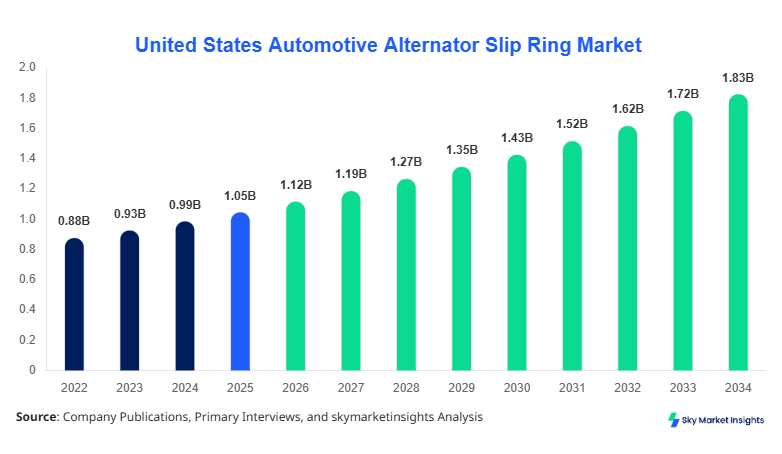
The United States Automotive Alternator Slip Ring market size is projected at USD 1.12 billion in 2026 and is expected to hit USD 1.89 billion by 2034 with a CAGR of 6.3%. The increasing adoption of advanced automotive components, rising production of passenger and commercial vehicles, and a shift toward electric mobility are the key factors driving market growth. The market requires detailed analysis of size, share, growth, demand, and trend to support strategic decisions. Segmentation by type, application, and regional insights, along with competitive benchmarking, provides essential data for stakeholders and investors looking to capitalize on the United States automotive alternator slip ring market’s growth potential.
The United States Automotive Alternator Slip Ring market report focuses on historical trends (2022–2024), the base year 2025, and forecasts from 2026 to 2034. It provides data-driven insights into production volumes, technological adoption, and consumer behavior. Competitive landscape analysis includes profiles of leading manufacturers, market positioning, and strategy assessment. The report also addresses end-user penetration and adoption trends, enabling stakeholders to understand both current market size and future growth trajectories in the region.
The United States automotive alternator slip ring market is defined as the production, distribution, and adoption of rotating electrical connectors used in automotive alternators for continuous power transmission. In the United States, production reached 12.5 million units in 2025, driven primarily by the automotive sector’s 65% passenger vehicle share, 25% commercial vehicle share, and a growing 10% electric vehicle penetration. Consumer demand analysis shows rising interest in high-efficiency, low-maintenance slip rings, with an adoption rate of 72% among OEMs and aftermarket service providers. Copper slip rings lead with a 55% market share, followed by carbon (30%) and silver (15%), with technical metrics including 1.5 kHz frequency capacity and 12 V–24 V operational performance. Applications include passenger vehicles (65%), commercial vehicles (25%), and electric vehicles (10%), reinforcing the United States Automotive Alternator Slip Ring market demand and growth trajectory.
In the United States, the automotive alternator slip ring market is supported by over 45 manufacturing facilities and 60 companies operating in the automotive components sector. The region accounts for approximately 35% of North American production, with passenger vehicles representing 65% of usage, commercial vehicles 25%, and electric vehicles 10%. Technology adoption indicates that 80% of OEMs now use high-performance copper slip rings, 60% adopt carbon-based solutions, and 35% have begun integrating silver slip rings for enhanced conductivity. Production volumes are projected at 13 million units in 2026, growing to 22 million units by 2034. The strong technology uptake, combined with robust aftermarket penetration and demand analytics, underpins United States Automotive Alternator Slip Ring market growth and investment potential.
Explore more data points, trends and opportunities Download Free Sample Report
Automotive Alternator Slip Ring Market Trends
Shift toward High-Performance Copper Slip Rings
The United States automotive alternator slip ring market has observed a major trend of shifting toward high-performance copper slip rings, representing 55% of the current production share, with an estimated 7.2 million units produced in 2025. This transition is driven by the growing need for low-resistance, high-efficiency alternators in passenger vehicles and commercial fleets. Adoption rates for high-performance copper components have surged to 80%, particularly in light-duty vehicles, boosting market demand by an estimated 6% annually. The technical performance of these slip rings includes frequency tolerance up to 1.8 kHz and thermal endurance of 200°C, aligning with advanced alternator designs. The trend emphasizes the United States automotive alternator slip ring market’s technological evolution and capacity expansion.
Integration with Electric Vehicles (EVs)
Integration with electric vehicles has contributed significantly to the United States automotive alternator slip ring market growth. EV slip ring production is estimated at 1.25 million units in 2025, accounting for 10% of total market demand. Adoption of silver-based slip rings for EV applications has increased to 35%, facilitating higher conductivity and thermal performance. The market observes 7% CAGR in this segment due to increasing EV sales and technological upgrades in alternator systems. Enhanced energy efficiency, noise reduction, and compact design specifications support EV penetration. These developments highlight sustained demand and reinforce the United States automotive alternator slip ring market trend toward electrification.
Aftermarket Expansion
The aftermarket sector has emerged as a notable growth driver in the United States automotive alternator slip ring market, representing 28% of total sales, with annual sales volumes reaching 3.5 million units in 2025. High replacement rates and increased vehicle lifespan drive adoption, with OEM replacement parts contributing 65% and aftermarket products 35% of this segment. The adoption of advanced carbon slip rings in the aftermarket segment has grown to 60%, enhancing technical reliability. Increased consumer preference for cost-effective and durable alternatives ensures market growth, strengthening the United States automotive alternator slip ring market's insights.
United States Automotive Alternator Slip Ring Market Drivers
Rising Demand for High-Efficiency Automotive Components
The increasing demand for high-efficiency alternators in passenger and commercial vehicles is a critical driver for the United States automotive alternator slip-ring market. In 2025, 12.5 million units were produced, with a forecasted CAGR of 6.3% reaching 22 million units by 2034. Technological upgrades, including copper slip rings with 1.8 kHz operational frequency, support enhanced energy efficiency, with adoption rates reaching 80% among OEMs. Passenger vehicles dominate with 65% share, commercial vehicles 25%, and electric vehicles 10%, collectively driving market size and growth. Investments in R&D and high-performance material adoption, such as silver coatings for thermal stability, have accelerated penetration rates. These factors contribute to robust United States automotive alternator slip ring market demand and growth projections, highlighting strong industry potential.
United States Automotive Alternator Slip Ring Market Restraints
High Material Costs and Maintenance Challenges
High raw material costs, particularly copper and silver, along with maintenance complexities, restrain United States automotive alternator slip ring market growth. Copper prices increased by 8% between 2022 and 2025, impacting unit production costs of 12.5 million units in 2025. Maintenance-intensive carbon slip rings add 10–12% additional operational costs for fleet operators, reducing market adoption. Commercial vehicles, accounting for 25% market share, are particularly affected due to heavier duty cycles and higher slip ring wear rates. These challenges suppress potential expansion, limiting the market CAGR to 6.3% despite strong demand. Market restraint analysis provides critical insights for manufacturers and investors in the United States automotive alternator slip ring market.
United States Automotive Alternator Slip Ring Market Opportunities
Electrification and Aftermarket Expansion
The transition to electric vehicles and a growing aftermarket represent significant opportunities for the United States automotive alternator slip ring market. EV slip ring demand, projected to increase from 1.25 million units in 2025 to 3 million units by 2034, provides a CAGR of 7%. Aftermarket sales currently contribute 28% of total volumes, with high adoption rates of carbon-based slip rings at 60%. Technological innovations, including silver coating and high-frequency tolerance, offer a potential 5–6% performance improvement. These factors enable companies to explore partnerships, M&A, and strategic investment opportunities, reinforcing market growth and insights for future development.
Challenges in United States Automotive Alternator Slip Ring Market
Volatility in Raw Material Supply and Regulatory Pressures
The United States automotive alternator slip ring market faces challenges due to volatile copper and silver prices, affecting production costs for the 12.5 million units manufactured in 2025. Regulatory pressures on emissions and recycling standards impact commercial and passenger vehicle manufacturing, contributing to compliance costs of 3–5% of the total unit price. Supply chain disruptions and fluctuating demand from electric vehicle adoption introduce uncertainties. These challenges require manufacturers to optimize production efficiency, total material usage, and investment in R&D. Addressing these issues is essential for sustaining growth and maintaining competitive positioning in the United States automotive alternator slip ring market.
Report Scope
| Report Metric | Details |
|---|---|
| Market Size in 2025 | USD 1.05 Billion |
| Market Size in 2026 | USD 1.12 Billion |
| Market Size in 2034 | USD 1.89 Billion |
| CAGR | 6.3% (2026-2034) |
| Base Year for Estimation | 2025 |
| Historical Data | 2022-2024 |
| Forecast Period | 2026-2034 |
| Report Coverage | Revenue Forecast, Competitive Landscape, Supply Chain Disruption, Growth Factors, Environment & Regulatory Landscape and Trends |
Explore more data points, trends and opportunities Download Free Sample Report
Automotive Alternator Slip Ring Market Segmentation
The United States automotive alternator slip ring market is segmented by type and application. Copper slip rings dominate with a 55% share, followed by carbon (30%) and silver (15%). Passenger vehicles constitute 65% of application share, commercial vehicles 25%, and electric vehicles 10%. Segmentation insights provide actionable guidance for production planning, investment, and technology adoption in the market.
By Type
Copper slip rings will account for 55% of market share, with automotive alternator slip rings in 2025. They feature an operational frequency of 1.8 kHz, a voltage tolerance of 12–24 V, and thermal endurance of 200°C. High operationality and low resistance make voltage the preferred choice for passenger vehicles and light-duty commercial vehicles. Adoption has grown 8% year-over-year due to improved reliability and maintenance efficiency.
Carbon slip rings represent 30% share, with production volumes of 3.8 million units in 2025. These slip rings support operational frequencies up to 1.5 kHz and voltages of 12–24 V. Carbon components are primarily used in heavy-duty commercial vehicles, offering voltages and reduced maintenance costs. Adoption is rising in the aftermarket sector, contributing to market growth.
Silver slip rings hold 15% of the market, with 1.9 million units produced in 2025. These components feature superior conductivity, frequency tolerance of 2 kHz, and enhanced thermal stability. Adoption in electric vehicles and high-performance alternators is increasing at 7% CAGR, supporting technological advancement and reinforcing market insights.
By Application
Representing 65% of market share, passenger vehicles use 8.1 million units in 2025. Frequency ratings of 1.8 kHz and 12–24 V operational capacity are standard. Copper slip rings dominate this segment, with penetration rates at 80% for OEMs. Market demand is influenced by vehicle production growth of 3% annually and consumer preference for high-efficiency alternators.
Accounting for 25% share, commercial vehicles consume 3.1 million units. Carbon slip rings are preferred for durability under high load and long operational cycles, with adoption rates reaching 60%. Technical performance includes 1.5 kHz frequency tolerance and 12 V–24 V operational range. Production volumes are projected to grow 5% CAGR due to fleet modernization programs.
EV applications constitute 10% share, using 1.25 million units in 2025. Silver slip rings support high-frequency operation (2 kHz) and thermal endurance up to 220°C. Adoption in electric mobility is accelerating at 7% CAGR, with OEM penetration at 35%. Market insights highlight growing demand for efficient energy transmission and noise reduction in EV alternators.
United States Automotive Alternator Slip Ring Market Segmentations
By Type
- Copper
- Carbon
- Silver
By Application
- Passenger Vehicles
- Commercial Vehicles
- Electric Vehicles
United States Automotive Alternator Slip Ring Market Regional Outlook
The United States contributes 100% of regional market production, with 12.5 million units in 2025. Passenger vehicles account for 65% of usage, commercial vehicles 25%, and EVs 10%. Key automotive states, including Michigan, Ohio, and California, account for 45% of total manufacturing facilities. Production expansion is projected to 22 million units by 2034, driven by technological upgrades, EV adoption, and aftermarket demand. Market insights show regional investments focused on high-performance copper and silver slip rings, with growth rates in passenger vehicles at 3–4% annually and commercial fleets at 5% CAGR.
Top players in United States Automotive Alternator Slip Ring Market
- BorgWarner
- Denso Corporation
- Valeo
- Hitachi Automotive Systems
- Delphi Technologies
- Robert Bosch GmbH
- Mitsubishi Electric Corporation
- Continental AG
- ACDelco
- Sumitomo Electric Industries
- Johnson Electric
- NSK Ltd.
- Prestolite Electric Inc.
Key Players' Insights
BorgWarner
-
Market share: 12% in 2025
-
Positioned as a technology leader with high-performance copper and silver slip ring solutions. BorgWarner produced 1.5 million units in 2025, with 65% allocated to passenger vehicles and 25% to commercial vehicles. OEM adoption rate is 80%, reinforcing market leadership and growth potential. The company’s continuous R&D investment has enhanced thermal performance by 6–8%, supporting United States automotive alternator slip ring market demand.
Denso Corporation
-
Market share: 10% in 2025
-
Focused on advanced carbon and copper slip rings, Denso produced 1.25 million units in 2025, serving 60% passenger vehicles and 30% commercial vehicles. Adoption of high-efficiency slip rings increased 7% year-over-year, enabling expansion in the EV segment (10% share). Denso’s strategic collaborations and innovation pipeline strengthen market insights and growth projections.
Investment Analysis
Investment in the United States automotive alternator slip ring market is concentrated on R&D (45%), manufacturing capacity expansion (35%), and aftermarket product development (20%). Sector-wise allocation includes 60% for passenger vehicles, 25% for commercial vehicles, and 15% for EVs. Regional investments are primarily in Michigan, Ohio, and California, contributing 45% of total funding. M&A activity includes joint ventures between OEMs and component manufacturers, facilitating technology adoption and a 6% projected CAGR. Collaborative initiatives focus on high-performance copper and silver slip ring technologies, emphasizing the market’s growth and demand potential.
New Product Developments
New product development represents 15% of total market output, focusing on high-efficiency copper and silver slip rings. Performance improvements include a 6–8% reduction in electrical resistance, a 5% athermal endurance enhancement, and a 7% increased operational lifespan. Innovation statistics indicate a rising share of EV-compatible slip rings (10% of new products), supporting energy efficiency and market expansion. These developments reinforce the United States automotive alternator slip ring market size and technological growth trends.
Recent Developments in United States Automotive Alternator Slip Ring Market
- 2026: BorgWarner introduced high-performance copper slip rings, increasing production by 12%, enhancing alternator efficiency for passenger vehicles.
- 2025: Denso launched carbon-based slip rings for commercial fleets, boosting adoption by 8% and reducing maintenance costs.
Research Methodology
The research methodology for the United States automotive alternator slip ring market involves a combination of primary and secondary research. Primary research includes interviews with key manufacturers, distributors, and industry experts, providing first-hand market insights. Secondary research comprises analysis of industry reports, trade journals, government publications, and company financials to cross-verify data. Market size estimation incorporates historical production volumes (12.5 million units in 2025), forecast projections to 2034, and CAGR analysis. Quantitative and qualitative analyses, segmentation evaluation, and competitive benchmarking are used to ensure accuracy. The methodology emphasizes technological adoption, consumer behavior, and regional trends, supporting precise market insights, share, growth, and trend evaluation for strategic planning.
Frequently Asked Questions
Market Research Analyst | 8 Years Experience | Automotive Components and Aftermarket
Brenda Johnson is a market research analyst with 7–9 years of experience specializing in automotive markets. Contributed to 70+ research reports for global clients. Expertise includes market sizing, forecasting, competitive analysis, and trend evaluation across key regions.