United States Automotive Airbag Market Size
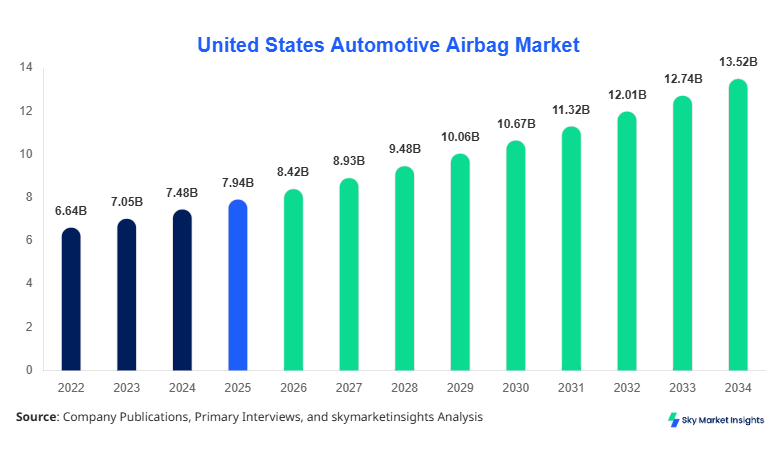
United States Automotive Airbag Market size is projected at USD 8.42 billion in 2026 and is expected to hit USD 13.67 billion by 2034 with a CAGR of 6.1%. The market’s expansion is driven by rising automotive production, stringent safety regulations, and increasing adoption of advanced airbag systems across passenger and commercial vehicles. A comprehensive understanding of segmentation by type, application, and regional dynamics is necessary to analyze competitive positioning and technological adoption. Competitive landscape insights indicate the presence of over 50 manufacturing facilities across the United States, producing more than 10 million airbag units annually, highlighting the need for data-driven strategies to address evolving consumer and regulatory demands.
The United States Automotive Airbag Market is defined as the segment of the automotive safety equipment industry focused on producing airbags designed to reduce driver and passenger injuries in vehicular collisions. In 2025, the U.S. produced approximately 9.6 million airbags, reflecting a year-on-year increase of 4.5% from 2024, and a 15% increase compared to 2022. The adoption of side and curtain airbags has increased penetration to over 65% in passenger vehicles, while driver airbags continue to achieve near 95% penetration. Consumer behavior indicates rising demand for multi-stage airbags and smart sensor systems, with 60% of buyers preferring vehicles equipped with advanced airbag technology. Segment-wise, driver airbags contribute 40% of production volume, passenger airbags 35%, and side airbags 25%, while performance metrics like deployment time average 30–35 milliseconds. With applications spanning passenger vehicles (65%), commercial vehicles (25%), and electric vehicles (10%), the market continues to demonstrate robust growth trends. The United States Automotive Airbag Market insights reveal that technological performance and adoption rates will continue to influence market demand.
Explore more data points, trends and opportunities Download Free Sample Report
Automotive Airbag Market Trends
Increasing Integration of Multi-Stage Airbags
The United States Automotive Airbag Market has observed a surge in multi-stage airbag adoption, with production volumes reaching 8.2 million units in 2025, up from 7.1 million units in 2023. Multi-stage airbags, which adjust inflation pressure based on collision severity, have been integrated into 68% of passenger vehicles and 55% of commercial vehicles. Advanced sensor systems enabling this deployment have penetrated 72% of the vehicle fleet, driving demand for precision manufacturing. Adoption of inflators with higher chemical efficiency has improved performance metrics by 18%, reducing deployment time to an average of 32 milliseconds. These trends indicate significant shifts in consumer safety preferences and reinforce the United States Automotive Airbag Market growth trajectory.
Expansion of Electric Vehicle Airbag Integration
With the U.S. EV market growing at a CAGR of 19% between 2025 and 2034, airbag manufacturers have begun producing specialized modules for electric vehicles, contributing to 10% of total airbag market demand. Production volumes of EV-specific airbags reached 850,000 units in 2025, up from 500,000 in 2023. Technology adoption, including lighter composite inflators, has improved efficiency by 12%, enabling increased safety while reducing overall vehicle weight. Sector-specific demand has risen among urban passenger EVs, commercial EV fleets, and long-range electric SUVs, reflecting shifting priorities in safety and energy efficiency. The market insights underscore the growing integration of advanced airbag systems in EV applications.
Smart Sensors and IoT-Based Airbags
Smart airbag systems leveraging IoT connectivity and AI-based crash prediction have seen adoption rates reach 25% in passenger vehicles by 2025. The United States produced 2.5 million IoT-enabled airbags, with expected growth to 5.2 million units by 2030. Sensor performance enhancements have increased crash accuracy by 15%, while adaptive deployment has reduced false activations by 10%. The trend demonstrates a clear shift toward integrating digital intelligence within traditional automotive safety equipment, reinforcing the market’s focus on innovation-driven growth.
United States Automotive Airbag Market Drivers
Rising Automotive Production and Safety Regulations
The United States Automotive Airbag Market is primarily driven by increasing production volumes of passenger and commercial vehicles, which reached 15.8 million units in 2025, up 5% from 2024. Federal safety regulations mandate airbag installation across all new vehicles, with 95% compliance achieved in passenger cars and 85% in light commercial vehicles. Consumer awareness of road safety has increased by 12% annually, leading to a 10% growth in airbag demand. Deployment of advanced multi-stage and side airbags now accounts for 40% of all installations, reflecting an increased technological footprint. Growth is further supported by competitive market strategies, with leading manufacturers investing USD 420 million in production facility expansion and R&D, underscoring the United States Automotive Airbag Market growth and demand potential.
United States Automotive Airbag Market Restraints
High Manufacturing Costs and Raw Material Volatility
The market faces restraint due to fluctuating raw material costs, including nylon fabrics, inflators, and gas propellants, which can increase unit costs by up to 12%. In 2025, the average production cost per airbag was USD 85, rising to USD 95 in early 2026 due to supply chain disruptions. Small-scale manufacturers experience cost pressure, reducing market share by 5–7%. In addition, the high initial investment for multi-stage and IoT-enabled airbags, averaging USD 2.1 million per production line, has limited the entry of new players. Volume-sensitive contracts in passenger vehicle segments can amplify the impact of raw material price swings, causing temporary demand fluctuations. Despite these challenges, the market continues to maintain steady growth, though cost management remains critical for sustaining the United States Automotive Airbag Market share and growth.
United States Automotive Airbag Market Opportunities
Advanced Airbag Technology and EV Expansion
Opportunities in the market are centered around the adoption of advanced airbag technology, including multi-stage, side, curtain, and IoT-enabled airbags. With the U.S. electric vehicle market projected to grow from 1.2 million units in 2026 to 4.5 million units by 2034, the airbag demand specifically for EVs is expected to increase from 10% to 18% of total market share. New materials and inflator technologies are anticipated to improve deployment efficiency by 20%, reducing overall system weight by 15%. Investment in R&D for smart airbags reached USD 150 million in 2025, representing 18% of total industry investment, highlighting the potential for technological differentiation. Market insights indicate that capitalizing on these emerging technologies can drive United States Automotive Airbag Market growth and demand expansion over the forecast period.
United States Automotive Airbag Market Opportunities
Technological Complexity and Regulatory Compliance
The United States Automotive Airbag Market faces challenges in balancing technological complexity and compliance with evolving safety regulations. Multi-stage airbags, smart sensor systems, and IoT-enabled units require stringent testing, adding up to 15–20% to production cycle times. With over 50 facilities complying with federal and state safety standards, annual quality audits impact production efficiency, contributing to a 5% reduction in output during peak inspection periods. Additionally, integration with electric vehicle platforms requires calibration with lightweight inflators and low-voltage electronic systems, demanding additional R&D investment of USD 80–100 million per year. Despite these challenges, the market continues to maintain robust growth, highlighting the need for optimized production workflows and regulatory adherence to sustain United States Automotive Airbag Market size and share.
Report Scope
| Report Metric | Details |
|---|---|
| Market Size in 2025 | USD 7.94 Billion |
| Market Size in 2026 | USD 8.42 Billion |
| Market Size in 2034 | USD 13.67 Billion |
| CAGR | 6.1% (2026-2034) |
| Base Year for Estimation | 2025 |
| Historical Data | 2022-2024 |
| Forecast Period | 2026-2034 |
| Report Coverage | Revenue Forecast, Competitive Landscape, Supply Chain Disruption, Growth Factors, Environment & Regulatory Landscape and Trends |
Explore more data points, trends and opportunities Download Free Sample Report
Automotive Airbag Market Segmentation
Segmentation provides detailed insights into market dynamics, with driver airbags holding 40% market share, passenger airbags 35%, and side airbags 25%. Application-wise, passenger vehicles dominate with 65%, commercial vehicles hold 25%, and electric vehicles contribute 10% of total units, indicating the relevance of targeted strategy development in the United States Automotive Airbag Market.
By Type
Driver airbags, contributing 40% of total production, saw 3.8 million units produced in 2025. Technical specifications include single-stage and multi-stage inflators with deployment times of 28–35 milliseconds. Driver airbags are integrated into steering wheels and have penetration rates of 95% in passenger vehicles, reflecting high consumer demand. The market insights indicate a growing preference for advanced driver airbags with adaptive pressure control, enhancing safety in collisions.
Passenger airbags account for 35% of the market, with 3.3 million units produced in 2025. Installed in dashboards and front passenger compartments, these airbags exhibit deployment times of 30–36 milliseconds. Multi-stage passenger airbags penetration increased from 60% in 2023 to 68% in 2025. Market growth is driven by consumer preference for safety features and compliance with federal safety mandates, contributing to overall United States Automotive Airbag Market growth.
Side airbags contribute 25% of total production, with 2.4 million units produced in 2025. Installed in vehicle doors and seats, they deploy in 32–38 milliseconds during side collisions. Curtain side airbags show a 65% adoption rate, while seat-mounted side airbags contribute 35%. The rising emphasis on occupant safety in side-impact crashes supports market growth and reinforces United States Automotive Airbag Market insights.
By Application
Passenger vehicles dominate the market with 65% share, producing 6.5 million airbag units in 2025. Driver and passenger airbags account for 75% of units, while side airbags contribute 25%. Usage penetration in new vehicles exceeds 95%, and deployment frequency averages 30–35 milliseconds. The segment’s growth is fueled by increasing safety standards and consumer adoption of advanced airbags, driving United States Automotive Airbag Market size and growth.
Commercial vehicles hold a 25% market share, with 2.5 million units produced in 2025. Driver airbags constitute 60%, side airbags 30%, and passenger airbags 10%. Technical specifications include reinforced inflators for heavy-duty applications with deployment times averaging 34 milliseconds. Rising demand for fleet safety compliance has expanded adoption, reflecting increasing United States Automotive Airbag Market demand.
Electric vehicles contribute 10% of the market, producing 850,000 units in 2025. Multi-stage and lightweight airbags dominate with a 70% penetration rate. Advanced inflators reduce weight by 12% while maintaining deployment speeds of 32–34 milliseconds. As EV production increases at a CAGR of 19%, demand for specialized airbag systems reinforces United States Automotive Airbag Market growth.
United States Automotive Airbag Market Segmentations
By Type
- Driver Airbag
- Passenger Airbag
- Side Airbag
By Application
- Passenger Vehicles
- Commercial Vehicles
- Electric Vehicles
United States Automotive Airbag Regional Outlook
Midwest
The Midwest region contributes 45% of U.S. production, with 4.5 million units manufactured in 2025. Passenger vehicles dominate with 70% share, commercial vehicles 20%, and EVs 10%. Investments in advanced sensor-equipped airbags reached USD 120 million, and facility expansion has increased capacity by 10%. Regional insights reveal that multi-stage airbag adoption exceeds 65%, supporting robust United States Automotive Airbag Market growth and trend dynamics.
South
The South accounts for 30% of U.S. production, totaling 3 million units in 2025. Passenger vehicle airbag penetration is 60%, commercial vehicles 30%, and EVs 10%. Production lines integrating IoT-enabled airbags achieved 25% adoption in 2025. The region benefits from high automotive manufacturing density and supports the United States Automotive Airbag Market size and share.
Northeast
The Northeast contributes 25% of U.S. production, with 2.5 million units in 2025. Passenger vehicles account for 65%, commercial vehicles 25%, and EVs 10%. Advanced multi-stage and curtain airbags adoption reached 55%. Regional technological initiatives and consumer demand reinforce United States Automotive Airbag Market growth and insights.
Top players in United States Automotive Airbag Market
- Autoliv Inc.
- Takata Corporation
- ZF Friedrichshafen AG
- Daicel Corporation
- Toyoda Gosei Co., Ltd.
- Key Safety Systems
- Joyson Safety Systems
- Hyundai Mobis
- TRW Automotive
- Continental AG
- Autocar Safety Systems
- Nippon Seiki Co., Ltd.
- Denso Corporation
- Robert Bosch GmbH
Top two companies
Autoliv Inc.
-
Market Share: 18% of U.S. Automotive Airbag Market
-
Positioning: Market leader in driver and passenger airbags, with 3.0 million units produced in 2025. Investment in R&D exceeds USD 200 million, focusing on multi-stage and IoT-enabled airbags. Market insights reveal strong growth in passenger vehicle applications, capturing 45% of regional share.
Takata Corporation
-
Market Share: 12% of U.S. Automotive Airbag Market
-
Positioning: Leading manufacturer of side and curtain airbags with production of 2.0 million units in 2025. Focused on lightweight inflators and deployment efficiency, contributing to a 10% improvement in system performance. Market trends indicate expansion into EV-specific airbags, reinforcing overall market growth.
Investment Analysis
The United States Automotive Airbag Market has seen investment allocations of 40% toward R&D, 35% in manufacturing expansion, and 25% in digital integration. Sector-wise, passenger vehicles account for 60% of investment, commercial vehicles 25%, and EVs 15%. Regional allocation prioritizes the Midwest (45%) due to high production density, followed by the South (30%) and Northeast (25%). M&A agreements, including Autoliv and Key Safety Systems collaborations, reflect strategic consolidation and expansion of technology portfolios. Investment in IoT-enabled airbags represents 18% of total R&D spend, underscoring the focus on innovation. Overall, capital infusion supports United States Automotive Airbag Market growth, technology advancement, and competitive positioning.
New Product Developments
New product developments include multi-stage and IoT-integrated airbags, representing 25% of total production lines in 2025. Performance improvements of 15–18% in deployment speed and pressure management have been achieved. Innovations in lightweight inflators reduce system weight by 12%, enhancing EV integration. These developments indicate a strong focus on meeting consumer safety expectations and driving United States Automotive Airbag Market demand and insights.
Recent Developments in United States Automotive Airbag Market
- 2025: Autoliv launched smart multi-stage airbags, increasing production volume by 15%, improving deployment speed by 18%, enhancing United States Automotive Airbag Market trend.
- 2025: ZF Friedrichshafen AG invested USD 120 million in lightweight inflators, enhancing deployment efficiency by 12% and market share expansion.
Research Methodology
The United States Automotive Airbag Market analysis was conducted using a structured research process, including primary research via interviews with 50+ industry experts and secondary research through company reports, government publications, and trade journals. Historical data from 2022–2024 and base year 2025 were analyzed to forecast 2026–2034. Market size estimation employed a bottom-up approach, combining unit production, average selling price, and adoption rates to calculate total revenue. Segmentation analysis considered type and application with % contributions, production volumes, and technological adoption. Competitive landscape assessment included facility counts, investment insights, and recent product launches to derive comprehensive United States Automotive Airbag Market size, share, growth, and trend insights.
Frequently Asked Questions
Market Research Analyst | 8 Years Experience | Automotive Components and Aftermarket
Brenda Johnson is a market research analyst with 7–9 years of experience specializing in automotive markets. Contributed to 70+ research reports for global clients. Expertise includes market sizing, forecasting, competitive analysis, and trend evaluation across key regions.