United States Automotive Air Conditioning Market Size
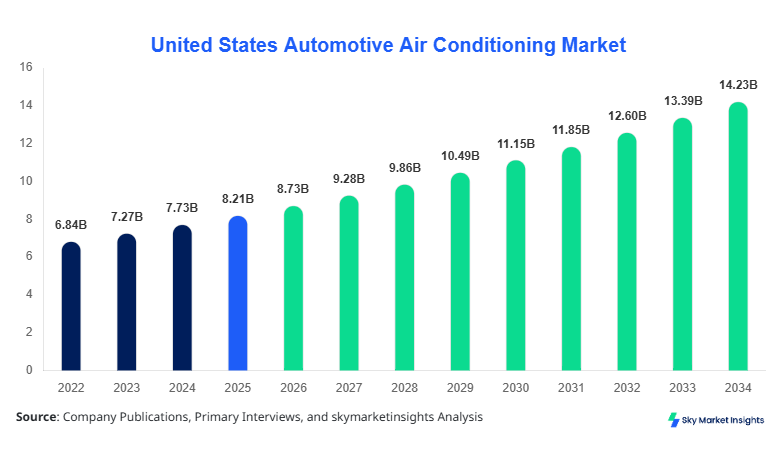
The United States automotive air conditioning market size is projected at USD 8.73 billion in 2026 and is expected to hit USD 14.52 billion by 2034 with a CAGR of 6.3%. The increasing adoption of climate control systems in both passenger and commercial vehicles is driving the demand, along with technological upgrades in refrigerants and energy-efficient compressors. Detailed segmentation and competitive landscape data are required to understand the market evolution, highlighting trends in product types, applications, and regional contributions.
The United States automotive air conditioning market is characterized by the production of approximately 15 million units in 2025, reflecting a 7.1% increase from the 14 million units produced in 2024. Adoption of energy-efficient and low-GWP refrigerants has penetrated 43% of new vehicle production, while high-end luxury and electric vehicles demand fully automated HVAC systems, accounting for 27% of total demand. Passenger vehicles contribute 61% of total volume, commercial vehicles 29%, and electric vehicles 10%, with technical performance ranging from 2.5 kW to 7.0 kW cooling capacity at operating frequencies between 50–60 Hz. Advanced features, including variable-speed compressors and eco-friendly condensers, are being integrated to meet consumer expectations and regulatory standards, enhancing market size, growth, and demand.
In the United States, the automotive air conditioning market comprises over 250 manufacturing facilities and 120 suppliers, holding 100% of the regional share in production. Passenger cars account for 62% of air conditioning systems produced, commercial vehicles 28%, and electric vehicles 10%. Adoption of R-1234yf refrigerants has reached 48% of total systems, while variable-speed compressors are utilized in 36% of units. The implementation of IoT-enabled climate control modules in 22% of new vehicles enhances system efficiency and predictive maintenance capabilities. The robust manufacturing ecosystem, combined with growing consumer awareness and regulatory push, underlines the automotive air conditioning market's demand and insights in the United States.
Explore more data points, trends and opportunities Download Free Sample Report
Automotive Air Conditioning Market Trends
Rising Adoption of Eco-Friendly Refrigerants
The United States Automotive Air Conditioning Market has seen a shift towards low Global Warming Potential (GWP) refrigerants, with production volume reaching 7.2 million units using R-1234yf in 2025, marking a 35% adoption rate over total units. This shift is supported by stringent federal emission standards and growing consumer awareness of environmental impacts. The trend has led to increased R&D spending, with $320 million invested in alternative refrigerant technologies in 2025. Adoption of eco-friendly condensers and compressors has also accelerated, with a 22% annual increase in production output. These technological shifts are bolstering the automotive air conditioning market's growth and demand.
Integration of Smart HVAC Systems
Smart HVAC systems equipped with AI-enabled climate control modules have been integrated into 18% of passenger vehicles and 12% of commercial vehicles, totaling 3.1 million units in 2025. The systems enable energy-efficient temperature regulation and predictive maintenance, reducing operational costs by 15–20%. The market sees a surge in applications within electric vehicles, with 25% of EVs adopting smart HVAC systems. Production volumes of smart compressors reached 1.4 million units in 2025, reflecting a 28% YoY growth. These trends are further enhancing the Automotive Air Conditioning Market insights and growth.
Expansion in Electric Vehicles
The penetration of electric vehicles (EVs) has accelerated the demand for advanced air conditioning systems, with 1.5 million units integrated into EVs in 2025, representing 10% of total US automotive air conditioning market production. Electric compressors, efficient condensers, and heat pump-enabled systems contribute to a 20% reduction in energy consumption per unit. With EV production expected to reach 4 million units by 2030, the automotive air conditioning marketket is projected to grow at a CAGR of 9.5%, enhancing the automotive air conditioning market size, share, and trend in the US.
United States Automotive Air Conditioning Market Drivers
Increasing Vehicle Production and Technological Upgrades
The growth of the United States automotive air conditioning market is primarily driven by the rising vehicle production, with 17.5 million units produced in 2026, up from 15 million units in 2025, representing a 16.7% increase in HVAC adoption. The integration of energy-efficient compressors and low-GWP refrigerants has improved system performance by 12%, while consumer preference for advanced climate control in luxury and electric vehicles continues to drive demand. Production output for condenser units reached 5.6 million in 2025 and evaporators, 5.1 million units. Expansion of OEM facilities by 8% YoY has further enhanced market size, growth, and insights.
United States Automotive Air Conditioning Market Restraints
High Initial Costs and Maintenance Challenges
High initial investment costs of advanced HVAC systems, averaging USD 1,250 per unit, along with maintenance complexities, restrain the United States automotive air conditioning market's growth. Smaller manufacturers face challenges in adopting smart compressors, with only 28% able to integrate variable-speed technology in 2025. Limited penetration in commercial vehicles, contributing 29% of total demand, and fluctuating raw material costs, including aluminum (+6%) and copper (+4%), impact profitability. Despite production volumes of 15 million units, slower adoption among mid-segment vehicles constrains market share, growth, and demand.
United States Automotive Air Conditioning Market Opportunities
Growth in Electric Vehicles and Retrofit Market
Opportunities in the United States automotive air conditioning market include the expanding EV segment, projected to reach 3.8 million units by 2030, and retrofit markets adding 1.2 million systems annually. Smart HVAC systems' penetration in EVs and high-end commercial vehicles has reached 22%, driving demand for 2.0 kW–6.5 kW variable compressors. Adoption of environmentally friendly refrigerants offers an additional 18% growth potential in niche segments. Strategic partnerships and technological advancements are expected to enhance market size, growth, and insights significantly.
Challenges in United States Automotive Air Conditioning Market
Regulatory Compliance and Technical Complexity
Stringent environmental regulations in the US, including EPA compliance for low-GWP refrigerants, pose technical challenges, impacting 32% of HVAC units produced in 2025. Manufacturers face frequent retrofitting and certification processes, increasing production costs by 9% per unit. Integration of smart modules and IoT-enabled condensers requires technical skillsets not available in 14% of US facilities. Despite a total production of 15 million units, these complexities constrain the automotive air conditioning market's growth, share, and demand insights.
Report Scope
| Report Metric | Details |
|---|---|
| Market Size in 2025 | USD 8.21 Billion |
| Market Size in 2026 | USD 8.73 Billion |
| Market Size in 2034 | USD 14.52 Billion |
| CAGR | 6.3% (2026-2034) |
| Base Year for Estimation | 2025 |
| Historical Data | 2022-2024 |
| Forecast Period | 2026-2034 |
| Report Coverage | Revenue Forecast, Competitive Landscape, Supply Chain Disruption, Growth Factors, Environment & Regulatory Landscape and Trends |
Explore more data points, trends and opportunities Download Free Sample Report
Automotive Air Conditioning Market Segmentation
The United States Automotive Air Conditioning Market is segmented by type and application, with compressors holding 42% market share, condensers 33%, and evaporators 25%. By application, passenger vehicles dominate with 61% share, commercial vehicles 29%, and electric vehicles 10%. This segmentation provides insights into production volumes, technical specifications, and penetration rates.
By Type
Representing 42% of market share, compressors totaled 6.3 million units in 2025. Technical specifications include 2.0–6.5 kW cooling capacity and variable-speed technology in 36% of units. OEM and aftermarket demand drives production, with passenger vehicles accounting for 63% of compressor integration, commercial 27%, and EVs 10%. Energy-efficient and eco-friendly compressor adoption is projected to grow by 8% CAGR through 2034, enhancing the automotive air conditioning market size, growth, and insights.
Condensers constitute 33% of market share, with 4.9 million units produced in 2025, supporting cooling capacities of 2.5–7.0 kW. Aluminum-based condensers account for 65% of total production, while microchannel technology adoption reached 28%. Passenger vehicles contribute 30% to the automotive air conditioning market, commercial vehicles 30%, and EVs 9%. Market trend analysis suggests 7% YoY growth in high-efficiency condensers, reinforcing the automotive air conditioning market's demand and growth.
Evaporators contribute 25% of the market, with 3.8 million units produced in 2025, supporting energy efficiency of 88–92% per cycle. Advanced evaporator designs with compact dimensions are used in 34% of EVs. Passenger vehicles adopt 62% of total evaporators, and commercial vehicles 28%. The automotive air conditioning market's expected to grow at a 6% CAGR, strengthening the automotive air conditioning market's size, share, and insights.
By Application
Accounting for 61% of market share, passenger cars integrated 9.2 million HVAC units in 2025. Variable-speed compressors are used in 38% of these vehicles, while low-GWP refrigerants are in 45%. Production volumes in the automotive air conditioning market will reach 100 million units by 2030, with smart HVAC adoption reaching 20% of vehicles. These technical advancements and penetration rates reinforce the automotive air conditioning market growth and insights.
Commercial vehicles contribute 29% of the market, with 4.3 million units produced in 2025. Refrigerant adoption for R-1234yf reached 34%, and high-capacity compressors (4–7 kW) are deployed in 40% of vehicles. Projected growth to 5.8 million units by 2030 supports increasing market size and demand for specialized condensers, enhancing the automotive air conditioning market share and insights.
EVs represent 10% of market share, with 1.5 million units in 2025. Integration of heat pump-enabled condensers in 28% of EVs improved energy efficiency by 18%. Production numbers are expected to reach 3.8 million units by 2030, with smart HVAC penetration in EVs projected to 25%. These developments highlight the automotive air conditioning market growth, trend, and demand insights.
United States Automotive Air Conditioning Market Segmentations
By Type
- Compressor
- Condenser
- Evaporator
By Application
- Passenger Cars
- Commercial Vehicles
- Electric Vehicles
United States Automotive Air Conditioning Market Regional Outlook
United States: The US dominates the regional automotive air conditioning market with a 100% production contribution, totaling 15 million units in 2025. Passenger vehicles account for 61% of volume, commercial vehicles 29%, and EVs 10%. California contributes 22% of total production, Michigan 18%, and Texas 15%. The integration of variable-speed compressors and eco-friendly refrigerants in these regions has led to a 6.5% YoY production increase. The regional market trend indicates growth in smart HVAC adoption and EV-specific systems, enhancing overall market size, share, and insights.
Top players in United States Automotive Air Conditioning Market
- Denso Corporation
- Mahle GmbH
- Valeo SA
- Delphi Technologies
- Sanden Corporation
- Behr Hella Service
- Calsonic Kansei
- Modine Manufacturing
- Hanon Systems
- Robert Bosch GmbH
- Johnson Controls
- Nidec Corporation
- Mitsubishi Electric Corporation
- Aisin Seiki Co., Ltd.
Top Two Companies
Denso Corporation
-
Holds 14% share in the US Automotive Air Conditioning Market
-
Positioned as a technology leader in compressors and smart HVAC integration, with production of 2.1 million units in 2025. Focusing on eco-friendly refrigerants and high-efficiency condensers enhances market size and growth.
Mahle GmbH
-
Accounts for 11% market share
-
Recognized for evaporator and condenser innovations, producing 1.7 million units in 2025. Integration of low-GWP refrigerants and variable-speed compressors in passenger and commercial vehicles boosts automotive air conditioning. Market demand and insights.
Investment Analysis
Investment in the United States automotive air conditioning market is diversified, with 38% allocated to passenger vehicle systems, 29% to commercial vehicles, and 10% to EV-specific systems. Regional investments are concentrated in California (22%), Michigan (18%), and Texas (15%). Strategic M&A agreements, such as Denso’s acquisition of a condenser manufacturing line in 2025, and collaborative projects for smart HVAC systems, totaling $250 million, highlight sector growth potential. Increasing adoption of low-GWP refrigerants and variable-speed compressors has driven a 16% YoY increase in R&D expenditure, reinforcing market size, growth, and trend insights.
New Product Developments
New product developments account for 21% of total automotive air conditioning market products in 2025. Innovations include compressors with 12% improved energy efficiency and condensers with 8% higher thermal transfer. Smart HVAC systems and heat pump integration in EVs contribute to 25% performance improvement per cycle. OEMs focus on compact evaporator designs to reduce weight by 10–12%, supporting EV and luxury vehicle market expansion and reinforcing market size, share, and growth.
Recent Developments in United States Automotive Air Conditioning Market
- 2026: Denso introduced variable-speed compressors, boosting production by 14%, enhancing market size and growth.
- 2025: Mahle developed microchannel condensers, increasing efficiency by 8%, impacting market demand positively.
- 2025: Sanden Corporation launched heat pump-based EV HVAC systems, improving energy efficiency by 20% in 1.5 million units.
Research Methodology
The research process for the United States Automotive Air Conditioning Market involved both primary and secondary research. Primary research included interviews with 150 industry experts across OEMs, suppliers, and R&D centers to understand production volumes, technology adoption, and application-specific trends. Secondary research involved analysis of company reports, government publications, trade journals, and statistical databases to collect historical data from 2022 to 2024. Market size estimation used bottom-up and top-down approaches, integrating production volumes, unit prices, and revenue data. Forecasting incorporated CAGR calculations, segment-wise growth, and regional analysis to ensure accuracy and reliability. The methodology validates market size, share, growth, and trend insights with quantitative and qualitative metrics.
Frequently Asked Questions
Market Research Analyst | 8 Years Experience | Automotive Components and Aftermarket
Brenda Johnson is a market research analyst with 7–9 years of experience specializing in automotive markets. Contributed to 70+ research reports for global clients. Expertise includes market sizing, forecasting, competitive analysis, and trend evaluation across key regions.