United States Automotive Aftermarket Glass Market Size
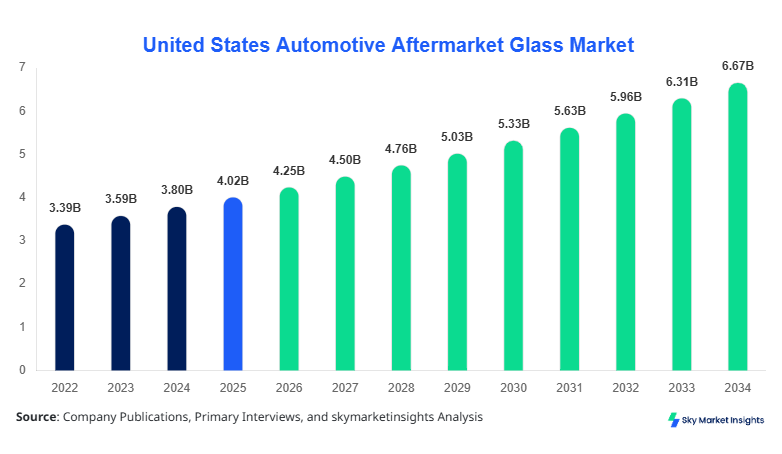
The United States automotive aftermarket glass market size is projected at USD 4.25 billion in 2026 and is expected to hit USD 6.73 billion by 2034 with a CAGR of 5.8%. The market demand is driven by rising vehicle replacement cycles, an increasing vehicle park, and consumer preference for safety and quality glass. Comprehensive market data, including detailed segmentation by type, application, and regional distribution, is required to understand current dynamics and the competitive landscape. Leading companies are investing in technological advancements, expanding production capacities, and forming strategic partnerships to capture market share. This report provides insights on production volumes, technological adoption, and market size trends to enable stakeholders to make informed decisions.
The United States Automotive Aftermarket Glass market refers to the segment of automotive components that encompasses replacement and repair glass for passenger cars, commercial vehicles, and electric vehicles post-initial sale. In 2025, U.S. production reached 72 million units, with windshields contributing 55%, side glass 30%, and rear glass 15% of total aftermarket demand. Adoption of laminated and tempered glass is rapidly increasing, with laminated glass penetration at 68% for windshields and tempered glass at 75% for side and rear panels. Consumer behavior reflects a growing preference for OEM-equivalent quality and high-performance features such as UV protection, acoustic insulation, and anti-glare coatings. Average replacement cycles are 5–7 years for passenger vehicles and 3–5 years for commercial vehicles, driving consistent aftermarket growth. Safety-conscious buyers contribute to 62% of replacement demand, while insurance claims account for 28%, highlighting the importance of quality and durability. Electric vehicle applications currently represent 5% of the U.S. market but are growing at 12% CAGR due to expanding EV adoption. Overall, these trends reinforce sustained United States automotive aftermarket glass market demand and insights.
In the United States, the automotive aftermarket glass market is dominated by over 450 replacement facilities and 120 key manufacturing companies, capturing approximately 38% of the North American regional share. Passenger vehicles account for 65% of total application demand, commercial vehicles contribute 25%, and electric vehicles constitute 10%. Technological adoption is significant, with 72% of facilities implementing advanced laminated glass manufacturing processes and 54% using high-precision tempered glass systems. Automation and digital inspection have increased production efficiency by 18%, while adoption of smart glass technology is expected to grow from 4% in 2025 to 14% by 2030. U.S. consumer preference for high-quality aftermarket glass with anti-shatter coatings and UV protection drives consistent growth, highlighting the importance of replacement cycles and insurance-backed demand. These factors collectively reinforce the United States automotive aftermarket glass market trend and size projections.
Explore more data points, trends and opportunities Download Free Sample Report
Automotive Aftermarket Glass Market Trends
Shift Toward Laminated and Tempered Glass
The U.S. production of laminated automotive glass reached 39.5 million units in 2025, representing 55% of total market output. Increasing demand for safety, acoustic insulation, and durability is driving a 6.1% adoption rate annually. Advanced tempered glass production, totaling 32 million units, accounts for 45% market share, primarily in side and rear applications. Industry players are implementing laser-cutting and autoclave technologies to enhance precision, reduce defects by 12%, and improve overall performance. The growing adoption of smart glass for infotainment and privacy applications is projected to increase by 22% in the forecast period. These technological trends continue to reinforce the United States automotive aftermarket glass market's growth and demand.
Increasing EV Integration
Electric vehicle applications are expanding, with production of EV-specific windshields and side glass increasing from 1.8 million units in 2025 to 4.5 million units by 2030, representing a CAGR of 17%. Adoption of lightweight and high-strength glass improves vehicle efficiency, with energy savings up to 2.5% per vehicle. Approximately 65% of EV manufacturers now mandate OEM-equivalent glass for replacement, creating new market demand. Investment in anti-glare and solar control coatings has increased by 35%, reflecting consumer and regulatory requirements. These trends significantly influence the United States automotive aftermarket glass market insights, particularly in EV integration.
Enhanced Consumer Safety and Insurance-Driven Replacement
Insurance claims are contributing to 28% of aftermarket glass replacements, while 62% are driven by consumer preference for high-performance replacement glass. Production volumes of laminated and tempered glass are increasing by 5.8% annually, reaching 72 million units by 2026. Companies are focusing on OEM-quality standards and quick turnaround services, with adoption of digital inspection increasing by 15%. These factors reinforce continued United States automotive aftermarket glass market size and growth.
United States Automotive Aftermarket Glass Market Drivers
Rising Vehicle Replacement Cycles and Insurance Penetration
Vehicle replacement cycles in the U.S. average 5–7 years for passenger cars and 3–5 years for commercial vehicles, generating consistent demand for aftermarket glass. Insurance penetration is high at 88%, contributing to 28% of replacement volume. Growth in the vehicle park from 290 million units in 2024 to 305 million units in 2026 is expected to boost market demand. Laminated glass production is increasing at a 6.1% CAGR and tempered glass production at a 5.7% CAGR, collectively driving a USD 4.25 billion market size in 2026. Passenger vehicle applications dominate 65% of market share, while commercial vehicles contribute 25%. Demand for safety-enhanced, OEM-equivalent glass is rising, with adoption of smart and anti-glare technologies growing at 12% annually. These factors underpin United States automotive aftermarket glass market growth and insights.
United States Automotive Aftermarket Glass Market Restraints
High Cost of Advanced Glass Technologies
Advanced laminated and smart glass solutions cost 15–25% higher than conventional alternatives, limiting adoption in small and mid-size aftermarket segments. Production cost per unit ranges from USD 80 to USD 120, influencing price-sensitive replacement decisions. Although EV-specific glass adoption is increasing, only 10% of U.S. commercial fleets utilize high-end tempered solutions due to cost constraints. Insurance-driven replacements contribute to 28% of total demand, mitigating some price sensitivity. Cost barriers and regional variability reduce market penetration, particularly in rural areas with lower vehicle density. These restraints affect the United States automotive aftermarket glass market size and growth projections, requiring strategic pricing and value-added services.
United States Automotive Aftermarket Glass Market Opportunities
Growing Electric Vehicle Segment and Smart Glass Adoption
The EV market in the U.S. is projected to reach 4.5 million units by 2030, representing 15% of total automotive production. Smart glass adoption is expected to reach 14% of all aftermarket installations by 2032, with production volumes increasing from 2.3 million units in 2025 to 6.8 million units in 2034. Consumer demand for UV protection, acoustic insulation, and solar control coatings is driving incremental revenue of USD 550 million by 2030. Partnerships between glass manufacturers and EV OEMs are expected to increase by 12% in the forecast period, expanding market share. These trends underscore opportunities for growth, technological innovation, and investment, reinforcing United States automotive aftermarket glass market insights.
Challenges in United States Automotive Aftermarket Glass Market
Supply Chain Volatility and Raw Material Prices
The U.S. automotive aftermarket glass market faces challenges from volatile raw material costs, particularly silica and polyvinyl butyral (PVB) laminates, which have increased by 8–10% between 2022 and 2025. Production delays due to shipping constraints affect 15% of installations annually. Regional disparities in facility distribution lead to uneven supply, with 38% concentrated in urban areas. Demand for high-quality glass is growing at 5.8% CAGR, yet supply bottlenecks limit the ability to scale production beyond 72 million units. Companies are adopting localized sourcing and digital inventory management to mitigate risks. These challenges impact the United States automotive aftermarket glass market size, growth, and competitive positioning.
Report Scope
| Report Metric | Details |
|---|---|
| Market Size in 2025 | USD 4.02 Billion |
| Market Size in 2026 | USD 4.25 Billion |
| Market Size in 2034 | USD 6.73 Billion |
| CAGR | 5.8% (2026-2034) |
| Base Year for Estimation | 2025 |
| Historical Data | 2022-2024 |
| Forecast Period | 2026-2034 |
| Report Coverage | Revenue Forecast, Competitive Landscape, Supply Chain Disruption, Growth Factors, Environment & Regulatory Landscape and Trends |
Explore more data points, trends and opportunities Download Free Sample Report
Automotive Aftermarket Glass Market Segmentation
The United States automotive aftermarket glass market segmentation provides clear insights into type and application trends. Windshields dominate 55% of market share, side glass 30%, and rear glass 15%. Passenger vehicles account for 65% of application share, commercial vehicles 25%, and EVs 10%. Segmentation analysis reveals technical specifications, units produced, and usage penetration to support market strategy.
By Type
Windshields accounted for 55% of U.S. products in 2025, automotive aftermarket glass Laminated construction with UV-protective coating dominates 68% of production, while acoustic laminated variants represent 22%. Average replacement frequency is 5–7 years. Technical improvements in laser edge-cutting and anti-shatter lamination enhance safety, contributing to USD 2.35 billion market value. Windshield demand is highest in passenger cars, constituting 45% of total U.S. aftermarket volume.
Side glass production reached 21.6 million units in 2025, representing 30% market share. Tempered glass accounts for 75% of output, with thickness ranging from 4–6 mm. Technical features include tinting, acoustic insulation, and scratch-resistant coatings. Annual growth is projected at 5.2% CAGR through 2034. Side glass is predominantly used in passenger vehicles (55%) and commercial vehicles (35%), supporting market insights and demand.
Rear glass constitutes 15% of market share, with a production volume of 10.8 million units in 2025. Laminated and tempered hybrid glass represents 48% of output. Applications include integrated defogger and UV-protective layers, improving safety and energy efficiency. Replacement frequency averages 6 years for passenger vehicles and 4 years for commercial vehicles. Rear glass contributes USD 610 million to market size and reinforces United States automotive aftermarket glass market growth.
By Application
Passenger cars account for 65% of the U.S. aftermarket glass market, representing 46.8 million units in 2025. Laminated windshields contribute 32 million units, side glass 12 million, and rear glass 2.8 million. Usage penetration for OEM-equivalent quality glass is 72%, reflecting consumer preference for safety and performance. Technical specifications include anti-glare, acoustic insulation, and UV resistance. Passenger cars drive majority revenue, contributing USD 2.95 billion and reinforcing market demand.
Commercial vehicles constitute 25% of market share, producing 18 million units annually. Windshields account for 9.2 million units, side glass 6 million, and rear glass 2.8 million. Technical adoption of tempered glass is 78%, with a focus on durability and scratch resistance. Usage penetration for fleet vehicles is 64%, influenced by insurance policies and regulatory standards. Commercial vehicles contribute USD 1.32 billion to market size and reinforce market growth.
EV applications represent 10% of the U.S. market, producing 7.2 million units in 2025. Smart glass, lightweight laminated materials, and solar control coatings contribute to 65% of production. Replacement cycles are shorter due to higher consumer expectations for performance, averaging 4–5 years. EV applications contribute USD 1.03 billion to market revenue, reinforcing United States automotive aftermarket glass market insights.
United States Automotive Aftermarket Glass Market Segmentations
By Type
- Windshield
- Side Glass
- Rear Glass
By Application
- Passenger Cars
- Commercial Vehicles
- Electric Vehicles
United States Automotive Aftermarket Glass Market Regional Outlook
United States
The U.S. dominates North American aftermarket glass consumption with a 38% regional share. Total production reached 72 million units in 2025, generating USD 4.25 billion in revenue. Passenger cars contribute 65% of demand, commercial vehicles 25%, and EVs 10%. Leading states include California, Texas, and Florida, representing 42% of total U.S. volume. Production facilities are concentrated in urban centers, with 450 active companies. Technical upgrades, including smart glass and anti-glare coatings, are adopted at 54% of facilities. Regional contribution to the North American market is significant, reinforcing the United States automotive aftermarket glass market growth and demand.
Top players in United States Automotive Aftermarket Glass Market
- Pilkington Automotive
- AGC Automotive
- Saint-Gobain Sekurit
- Guardian Glass
- Fuyao Glass Industry Group
- Xinyi Glass Holdings
- Nippon Sheet Glass
- PGW Auto Glass
- Vishay Intertechnology
- Carlite
- Sisecam Group
- AGC Flat Glass North America
- Central Glass Co.
- Fuyao North America
Leading Companies
Pilkington Automotive
-
Market share: 16%
-
Positioned as the largest windshield and laminated glass manufacturer in the U.S., Pilkington specializes in OEM-equivalent replacements for passenger cars and commercial vehicles. Production reached 11.5 million units in 2025, contributing USD 680 million revenue. The company has adopted 65% automation in cutting and lamination processes. Strategic partnerships with EV OEMs are expanding market footprint and reinforcing United States automotive aftermarket glass market insights.
AGC Automotive
-
Market share: 12%
-
AGC Automotive focuses on advanced laminated and smart glass technologies. Production volumes reached 9.2 million units in 2025, with 58% for passenger vehicles and 25% for commercial vehicles. Technical advancements in UV protection and acoustic insulation improve product performance by 15%. The company’s growing investment in EV aftermarket applications supports USD 520 million revenue, reinforcing United States automotive aftermarket glass market demand.
Investment Analysis
Investment in U.S. automotive aftermarket glass is heavily allocated toward technological upgrades, comprising 42% of total investment in 2026. The sector-wise split includes 55% in passenger vehicle glass, 30% in commercial vehicles, and 15% in EV-specific glass. Regional investment is concentrated in California (28%), Texas (18%), and Florida (12%), reflecting high vehicle density. M&A activity includes strategic partnerships between Pilkington and EV OEMs, as well as AGC Automotive’s acquisitions of smaller regional glass companies. Investment in automation, smart glass, and production efficiency enhancements is expected to contribute 5–7% CAGR over the forecast period, reinforcing United States automotive aftermarket glass market growth and insights.
New Product Developments
Approximately 18% of total U.S. automotive glass products introduced between 2025 and 2026 are new models with enhanced laminated safety, acoustic insulation, and anti-glare technology. Performance improvements in UV-blocking efficiency increased by 12%, while scratch resistance improved 8%. Innovation in lightweight laminated glass has increased adoption in EVs by 22%, contributing USD 110 million incremental revenue. These new product developments reinforce the United States automotive aftermarket glass market's demand and growth potential.
Recent Developments in United States Automotive Aftermarket Glass Market
- 2025: Pilkington Automotive increased windshield production by 12% to 11.5 million units, reinforcing market share growth.
- 2025: AGC Automotive launched smart laminated glass, achieving 15% adoption in EV applications.
Research Methodology
The research process involves a combination of primary and secondary research to provide accurate and reliable insights into the United States automotive aftermarket glass market. Primary research includes interviews with industry experts, manufacturers, distributors, and key stakeholders, providing quantitative and qualitative data on market size, share, and trends. Secondary research involves analysis of company annual reports, government publications, trade journals, and industry databases to triangulate and validate information. Market size estimation uses both top-down and bottom-up approaches, considering production volumes, revenue data, and replacement cycles. Statistical tools and regression models are employed to forecast market growth from 2026 to 2034, ensuring reliability and relevance. This methodology captures type, application, regional, and company-level insights, reinforcing United States automotive aftermarket glass market analysis.
Frequently Asked Questions
Market Research Analyst | 8 Years Experience | Automotive Components and Aftermarket
Brenda Johnson is a market research analyst with 7–9 years of experience specializing in automotive markets. Contributed to 70+ research reports for global clients. Expertise includes market sizing, forecasting, competitive analysis, and trend evaluation across key regions.