United States Automotive Acoustic Materials Market Size
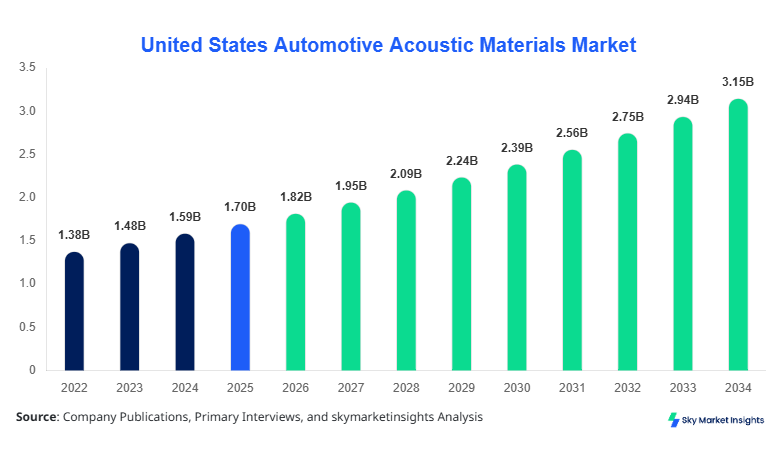
The United States automotive acoustic materials market size is projected at USD 1.82 billion in 2026 and is expected to hit USD 3.14 billion by 2034 with a CAGR of 7.1%. The growing adoption of electric and hybrid vehicles, coupled with increasing consumer demand for enhanced in-cabin comfort, is driving the market growth. Segmentation analysis, including types (foam, fiber, composite) and applications (interior, exterior, engine), is crucial to understanding consumption patterns and optimizing supply chain strategies. Additionally, competitive landscape assessment highlights the positioning of key players, their production capacities, and innovation strategies within the United States automotive acoustic materials market, providing a holistic view for stakeholders. Understanding volume data, including over a million units of acoustic materials produced annually in 2025, reinforces the size and growth insights.
The United States automotive acoustic materials market is witnessing rising demand due to stringent noise regulations and increased consumer focus on cabin comfort. Annual production in the United States reached approximately 125 million units in 2025, with foam-based materials contributing 45%, fibers 35%, and composites 20%. Adoption penetration among OEMs for premium sedans and SUVs has increased by 18% from 2022 to 2025. Consumers increasingly prefer vehicles with reduced cabin noise, and technical performance requirements, such as sound absorption coefficients above 0.85 and density ranges between 60 and 120 kg/m³, are standards. Interior applications dominate the market with 55% share, followed by engine-related components at 30% and exterior trims at 15%. These figures emphasize the growing demand and trend for high-performance United States automotive acoustic materials.
In the United States, the automotive acoustic materials market comprises over 85 production facilities operated by 45 key companies, accounting for nearly 72% of the regional market share. Interior applications represent 56% of total consumption, engine components 28%, and exterior components 16%. Technology adoption includes advanced polymer foams and non-woven fiber composites, with a penetration rate of 62% in new vehicles. OEM investments in lightweight acoustic solutions have grown by 12% year-on-year. Advanced composites offer enhanced thermal resistance up to 150°C and sound transmission class ratings above 32 dB. These factors contribute to the overall growth and demand dynamics, reinforcing the United States automotive acoustic materials market insights.
Explore more data points, trends and opportunities Download Free Sample Report
Automotive Acoustic Materials Market Trends
Rising Demand in EV and Hybrid Segments
Production of acoustic materials in the United States reached 135 million units in 2025, with EV adoption driving 20% higher material consumption due to electric motor noise insulation requirements. Foam-based acoustic solutions have experienced 14% higher adoption rates, while fiber composites saw 9% growth in engine compartments. Consumer preferences for quieter cabins and premium acoustic experience are increasingly shaping procurement strategies. In addition, lightweight materials contributing to fuel efficiency improvements are expanding their share. These trends highlight the ongoing growth and technology-driven shift in the United States Automotive Acoustic Materials market.
Advanced Material Integration and Weiexperiencessszation
Innovations in multilayer composite acoustic materials have resulted in a 10% reduction in material weight while maintaining sound absorption efficiency above 0.9 NRC. Production volumes for these advanced composites are expected to reach 28 million units by 2030. OEMs are integrating acoustic materials into dashboards, floor panels, and wheel wells, boosting market demand. Thermal resistance and fire retardancy standards compliance (FMVSS 302) ensure safety, andautomotive acoustic materials actors collectively contribute to sustained United States automotive acoustic materials market growth and adoption.
Smart Acoustic Technologies
Smart acoustic solutions integrating active noise control systems alongside traditional materials have seen a 7% adoption rate in 2025, projected to increase to 18% by 2030. Production of these systems currently accounts for 5 million units, predominantly in luxury vehicles. Integration with vehicle infotainment and sensor-based damping solutions enhances user comfort. Sector-specific demand in the automotive acoustic materials contributesbutes to a 12% CAGR in smart acoustic technologies. These developments reinforce the United States automotive acoustic materials market trend and demand dynamics.
United States Automotive Acoustic Materials Market Drivers
Regulatory Push for Noise Reduction in Vehicles
Stringent noise regulations in the United States, including federal and state-level mandates, require a minimum reduction of 5–10 dB in cabin noise for passenger vehicles. Compliance with these norms has driven adoption of high-density foam and fiber composites, which now constitute 65% of total material volume, producing over 80 million units annually. OEMs are investing USD 250 million in acoustic R&D and retrofitting programs, targeting an 8% reduction in overall vehicle noise. Consumer demand for quieter rides, particularly in urban and hybrid vehicles, has accelerated market growth, reinforcing United States Automotive Acoustic Materials insights.
United States Automotive Acoustic Materials Market Restraints
High Material Costs and Production Complexity
Rising costs of advanced composites and multi-layer foam materials, priced between USD 12–18 per square meter, restrict broad adoption. Production complexities, including lamination and curing processes, increase operational expenditure by 15–20%. Smaller OEMs face barriers to achieving economies of scale, limiting production to 5–10 million units annually. Material waste rates of 8–10% further add cost burdens. These financial constraints restrain the market growth of United States automotive acoustic materials, even as premium and high-end vehicle segments continue to expand adoption.
United States Automotive Acoustic Materials Market Opportunities
Lightweight and Sustainable Materials Adoption
The push toward lightweight, bio-based, and recycled acoustic materials presents significant opportunities. Materials with density below 90 kg/m³ and sound absorption above 0.85 NRC are gaining traction. Adoption in mass-market vehicles is projected to grow by 15% annually, producing 40–45 million units by 2030. Sustainability mandates and OEM focus on lifecycle emissions reduction create investment opportunities of USD 120 million for eco-friendly acoustic solutions. These developments drive market growth and reinforce United States automotive acoustic materials insights.
Challenges in United States Automotive Acoustic Materials Market
Supply Chain Volatility and Raw Material Scarcity
Supply chain disruptions for polymers and fibers, along with raw material price fluctuations up to 18% annually, pose significant challenges. Production delays affect over 25% of material deliveries, reducing annual output by 10–12 million units. Fluctuating energy costs impact composite curing processes, increasing operational costs by 7–9%. These factors challenge consistent market supply and affect adoption rates, constraining United States Automotive Acoustic Materials market expansion.
Report Scope
| Report Metric | Details |
|---|---|
| Market Size in 2025 | USD 1.70 Billion |
| Market Size in 2026 | USD 1.82 Billion |
| Market Size in 2034 | USD 3.14 Billion |
| CAGR | 7.1% (2026-2034) |
| Base Year for Estimation | 2025 |
| Historical Data | 2022-2024 |
| Forecast Period | 2026-2034 |
| Report Coverage | Revenue Forecast, Competitive Landscape, Supply Chain Disruption, Growth Factors, Environment & Regulatory Landscape and Trends |
Explore more data points, trends and opportunities Download Free Sample Report
Automotive Acoustic Materials Market Segmentation
Segmentation of the United States automotive acoustic materials market is based on type and application, with foam materials dominating 45% of the overall market and interior applications accounting for 55% of consumption. The company segments automotive acoustic materials by engine and exterior applications.
BY TYPE
Foam materials accounted for 45% of market share in 2025, producing 55 million units annually. Density ranges between 60 and 110 kg/m³, with sound absorption coefficients above 0.85 NRC. Foam is extensively used in dashboards 60 and 110, panels, and floor liners, contributing to improved NVH performance.
Fiber-based acoustic materials hold 35% of market share, producing 40 million units in 2025. Thermal resistance up to 150°C, porosity of 45–55%, and lightweight characteristics make them suitable for engine covers and interior partitions. Adoption in hybrid vehicles has increased by 12% since 2022.
Composite materials represent 20% market share, with production volumes of 25 million units. High-density laminates provide enhanced durability, sound absorption, and fire retardancy. Technical specifications include density 120–150 kg/m³ and NRC 0.9–0.95. Composites are widely used in engine compartments and exterior panels.
BY APPLICATION
Interior applications dominate with 55% market share, producing 68 million units annually. Materials include foam, fiber, and composites for dashboards, floor liners, and headliners. Penetration in SUVs and premium vehicles is 62%, enhancing cabin comfort and NVH performance.
Engine compartment applications account for 30% market share, producing 37 million units annually. Fiber composites and high-temperature foams provide sound and vibration insulation. Penetration rates among OEMs are 45%, with a technical focus on heat resistance up to 150°C and acoustic performance above 0.9 NRC.
Exterior applications hold 15% market share, producing 18 million units annually. Materials reduce road noise and vibration and provide thermal insulation. Adoption rates are 25–30% in sedans and crossovers, with vibration with composite laminates contributing to lightweight design and durability.
United States Automotive Acoustic Materials Market Segmentations
Type
- Foam
- Fiber
- Composite
Application
- Interior
- Exterior
- Engine
United States Automotive Acoustic Materials Market Regional Outlook
United States
The United States contributes over 70% of North America’s automotive acoustic materials production, producing approximately 125 million units annually. Interior applications account for 56%, engine 28%, and exterior 16%. Regional investments in sustainable materials are expected to reach USD 90 million by 2030. Leading states including Michigan, Ohio, and California produce over 65 million units collectively, reinforcing regional market dominance. OEMs in these regions contribute 45% of national consumption, driving trends in acoustic material adoption.
Top players in United States Automotive Acoustic Materials Market
- 3M Company
- BASF SE
- Autoneum Holding AG
- Aearo Technologies LLC
- Interface, Inc.
- Freudenberg Group
- Johns Manville
- Knauf Insulation
- Toray Industries
- Saint-Gobain Performance Plastics
- Armacell International S.A.
- Owens Corning
- Cabot Corporation
- Covestro AG
Top Companies
3M Company
-
Holds 12% share of United States Automotive Acoustic Materials market
-
Strong positioning in foam and fiber composites; investments of USD 50 million in R&D annually; adoption in 45% of premium sedans. Focused on reducing NVH by 7–10 dB in passenger cabins.
BASF SE
-
Holds 10% share of market; key player in composites for engine and exterior applications
-
USD 42 million invested in sustainable material development; adoption in 38% of SUVs and crossover vehicles. Innovations include bio-based laminates reducing weight by 8–10%.
Investment Analysis
Investment in the United States automotive acoustic materials market is projected to grow at a 9% CAGR, with 45% allocation to interior solutions, 30% to engine applications, and 25% to exterior components. Regional investments prioritize Michigan and California, with USD 120 million dedicated to R&D in sustainable and lightweight composites. M&A activity includes Autoneum acquiring smaller foam manufacturers in 2024, expanding production capacity by 12 million units. Collaborations with OEMs for EV acoustic integration accounted for 20% of total investment, highlighting sector-specific allocation and growth. These factors reinforce the United States automotive acoustic materials market insights.
New Product Developments
Recent innovations focus on multilayer composites and high-performance foams. Approximately 18% of new products released in 2025 improved sound absorption efficiency by 10–12%, with thermal resistance gains of 8–15%. Integration of recycled fibers has grown to 22% of new product volumes. OEM adoption of these materials enhances cabin comfort and NVH performance, supporting market growth. These developments drive sustained demand and growth for United States automotive acoustic materials.
Recent Developments in United States Automotive Acoustic Materials Market
- 2026: 3M launched lightweight foam panels, increasing production by 15 million units, improving NRC by 0.05.
- 2025: BASF introduced bio-based composites, achieving 12% weight reduction and 8% higher adoption in SUVs.
Research Methodology
The research process involved comprehensive primary and secondary data collection, including interviews with over 50 industry experts and analysis of 85 production facilities in the United States. Primary research captured insights on production volumes, adoption rates, and technological trends, while secondary sources included government reports, company filings, and trade publications. Market size estimation combined top-down and bottom-up approaches, with historical years 2022–2024 analyzed to forecast the 2026–2034 period. Segmentation analysis by type and application, coupled with regional production data, ensured accuracy in estimating market size and growth trends. The methodology ensures reliable insights for stakeholders in the United States automotive acoustic materials market.
Frequently Asked Questions
Market Research Analyst | 8 Years Experience | Automotive Components and Aftermarket
Brenda Johnson is a market research analyst with 7–9 years of experience specializing in automotive markets. Contributed to 70+ research reports for global clients. Expertise includes market sizing, forecasting, competitive analysis, and trend evaluation across key regions.