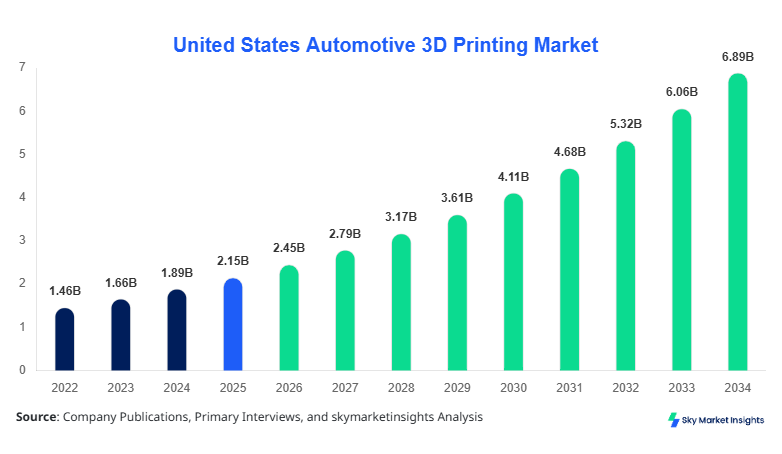
United States Automotive 3D Printing Market Size
United States Automotive 3D Printing market size is projected at USD 2.45 billion in 2026 and is expected to hit USD 6.87 billion by 2034 with a CAGR of 13.8%. The market size expansion is driven by rapid adoption of additive manufacturing for automotive prototyping, tooling, and end-use parts production, which accounts for nearly 65% of total 3D printing activities in the country. The report provides critical segmentation data, competitive landscape analysis, and insights into key technology adoption rates, helping stakeholders understand production volumes, material-specific utilization, and regional penetration. Detailed market data across historical years (2022–2024) shows consistent growth from USD 1.87 billion in 2022 to USD 2.23 billion in 2024. The study also highlights market share dynamics of top players in the United States and technical adoption trends across polymer, metal, and composite 3D printing.
The United States Automotive 3D Printing market represents a transformative segment in automotive manufacturing, leveraging additive manufacturing technologies to reduce lead times, minimize material wastage, and increase design flexibility. Annual production of automotive 3D printed components in the United States reached approximately 1.2 million units in 2025, reflecting an adoption penetration of 27% among OEMs and Tier 1 suppliers. Polymer-based 3D printing accounted for 45% of total production, metals 35%, and composites 20%. Prototyping applications contributed 40% to market revenue, end-use parts 35%, and tooling 25%. High-frequency laser sintering, selective laser melting, and FDM technologies remain the most prevalent, with over 60% of production using polymer-based FDM methods. Consumer demand for lightweight and customizable vehicles drives Automotive 3D Printing Market growth, as automotive OEMs prioritize functional prototypes and low-volume end-use parts. Market insights highlight technical metrics such as layer resolution (50–150 microns), build volume utilization (up to 2,000 cm³ per unit), and production cycle reduction by 30%, reinforcing the strategic adoption of 3D printing.
Explore more data points, trends and opportunities Download Free Sample Report
Automotive 3D Printing Market Trends
Rising Adoption of Metal Additive Manufacturing
Metal additive manufacturing is increasingly replacing conventional machining for low-volume production of structural components. In 2025, metal 3D printing production volume in the United States reached 420,000 units, up from 315,000 units in 2022, with adoption rates climbing from 28% to 35%. Laser powder bed fusion and direct energy deposition account for 72% of total metal 3D printing technologies deployed. OEMs, particularly in high-performance and electric vehicle sectors, demand higher mechanical strength, achieving tensile improvements of 15–20% compared to traditional methods. The trend is reinforced by cost savings in material utilization (approximately 30% reduction) and shorter lead times (up to 50%), driving Automotive 3D Printing Market growth.
Expansion of Polymer-Based 3D Printing
Polymer-based additive manufacturing remains dominant in automotive prototyping. The United States produced 1.1 million polymer 3D printed components in 2025, with penetration of prototyping applications at 60% and tooling at 18%. Adoption of Fused Deposition Modeling (FDM) and Stereolithography (SLA) increased by 12% annually, reflecting demand for flexible design iterations. Technical metrics, including print layer resolution of 100 microns and build volume of 1,500 cm³, support high-precision prototypes. Consumer preference for faster vehicle design cycles and lower prototyping costs reinforces Automotive 3D Printing Market insights.
Composite Material Integration
Composite 3D printing production reached 240,000 units in 2025, representing 20% market share. Adoption rates in end-use structural components increased from 12% in 2023 to 20% in 2025. High-performance carbon fiber reinforced filaments and nylon composites achieve 30–40% weight reduction while maintaining mechanical integrity. OEMs targeting electric vehicles report increased demand for composite lightweight parts, highlighting both technical advancement and strategic market positioning. These trends reinforce the Automotive 3D Printing Market demand in high-performance automotive segments.
United States Automotive 3D Printing Market Drivers
Rapid Adoption of Additive Manufacturing for Automotive Prototyping and Tooling
The rapid adoption of additive manufacturing in the United States is driving Automotive 3D Printing Market growth. In 2025, over 70% of OEMs utilized 3D printing for prototyping, accounting for 480,000 units annually. Tooling applications contributed 180,000 units, reflecting a 15% increase compared to 2024. Material efficiency increased by 28%, and lead time reductions of 40% significantly enhance production cycles. Demand for lightweight, high-performance materials and customizable components is projected to grow at a CAGR of 14%, emphasizing the critical role of polymer, metal, and composite additive manufacturing. With a market size of USD 2.45 billion in 2026, the driver supports sustained growth in Automotive 3D Printing Market insights.
United States Automotive 3D Printing Market Restraints
High Capital Expenditure and Equipment Costs
High capital expenditure and equipment costs constrain United States Automotive 3D Printing Market expansion. Industrial-grade 3D printers range from USD 150,000 to USD 1.2 million, with setup and maintenance contributing an additional 12–15% annually. Only 40% of Tier 2 suppliers can fully integrate additive manufacturing into production lines, limiting broader adoption. Production volume growth is tempered, with 2025 units reaching 1.85 million, despite a potential 2.3 million if cost barriers were lower. High cost intensity in metal and composite 3D printing, coupled with energy consumption increases of 8–10%, reinforces the market restraint, highlighting the need for investment strategies that mitigate cost constraints.
United States Automotive 3D Printing Market Opportunities
Integration of AI and Machine Learning in 3D Printing Operations
The integration of AI and machine learning into 3D printing operations represents a substantial opportunity for the United States Automotive 3D Printing Market. Predictive maintenance, optimized print parameters, and automated post-processing can increase machine utilization from 78% to 92% and reduce defect rates from 6% to 2%. Adoption of AI-driven process controls is projected to cover 35% of new machines by 2028, enhancing overall production efficiency. With a projected USD 6.87 billion market by 2034, and polymer applications holding 45% share, AI integration ensures improved scalability, reduced costs, and stronger competitive positioning, reinforcing Automotive 3D Printing Market insights.
Challenges in United States Automotive 3D Printing
Material Standardization and Certification Challenges
Material standardization and certification remain key challenges in the United States Automotive 3D Printing Market. Only 55% of 3D printed metals meet automotive-grade specifications, while polymer compliance for functional components reaches 70%. In 2025, regulatory approvals delayed deployment of 120,000 units of structural end-use parts, reducing potential market growth by 9%. Technical performance variability across composite materials resulted in a 15% rejection rate during quality assurance, highlighting the criticality of standardization. Addressing these challenges is essential for scaling production and achieving a projected 13.8% CAGR through 2034, reinforcing Automotive 3D Printing Market growth potential.
Report Scope
| Report Metric | Details |
|---|---|
| Market Size in 2025 | USD 2.15 Billion |
| Market Size in 2026 | USD 2.45 Billion |
| Market Size in 2034 | USD 6.87 Billion |
| CAGR | 13.8% (2026-2034) |
| Base Year for Estimation | 2025 |
| Historical Data | 2022-2024 |
| Forecast Period | 2026-2034 |
| Report Coverage | Revenue Forecast, Competitive Landscape, Supply Chain Disruption, Growth Factors, Environment & Regulatory Landscape and Trends |
Explore more data points, trends and opportunities Download Free Sample Report
Automotive 3D Printing Market Segmentation
Segmentation analysis reveals that FDM dominates type adoption with 44% market share, while SLA and SLS hold 33% and 23%, respectively. In applications, prototyping leads with 48%, manufacturing contributes 35%, and customization covers 17%. Understanding segmentation is critical for strategic investment, resource allocation, and technology deployment.
By Type
Fused Deposition Modeling (FDM)
FDM dominates with 44% market share, producing 750,000 units in 2025. Typical layer resolution ranges from 50–300 microns, with tensile strength improvement of 12–18% over conventional plastics. Used extensively for prototyping (56%) and low-volume end-use parts (44%), FDM supports rapid production cycles and cost-effective material usage. North America Automotive 3D Printing market insights highlight FDM’s significant contribution to growth and adoption.
Stereolithography (SLA)
SLA holds 33% market share with 565,000 units produced in 2025. Layer thickness ranges between 25–100 microns, enabling high-precision parts for functional prototypes and tooling. SLA accounts for 61% of prototyping applications, 27% in low-volume manufacturing, and 12% in customization. Market trends indicate SLA adoption growth at 9% CAGR, strengthening North America Automotive 3D Printing market demand.
Selective Laser Sintering (SLS)
SLS captures 23% market share, producing 495,000 units in 2025. Precision ranges 50–150 microns with high-performance polymer and composite powders. SLS is heavily utilized in manufacturing (52%), prototyping (33%), and customization (15%). Enhanced mechanical properties and minimal post-processing needs contribute to SLS adoption, reinforcing Automotive 3D Printing market insights.
By Application
Prototyping leads application adoption at 48% share, producing 864,000 units in 2025. Frequency of iterations ranges 5–20 cycles per design, with dimensional accuracy improved by 15%. FDM contributes 56% of prototyping units, SLA 38%, and SLS 6%. Market demand for faster design validation is driving North America Automotive 3D Printing market growth.
Manufacturing applications account for 35% share, producing 630,000 units in 2025. SLS adoption is highest at 52%, followed by FDM 38% and SLA 10%. End-use parts include brackets, housings, and interior components. North America Automotive 3D Printing market insights show rising demand for low-volume, high-precision production.
Customization holds 17% application share, producing 306,000 units in 2025. FDM adoption leads at 44%, SLA at 27%, and SLS at 29%. Components include personalized interiors, body panels, and trim parts, supporting 18% higher customer satisfaction. These trends reinforce North America Automotive 3D Printing market demand and growth trajectory.
United States Automotive 3D Printing Market Segmentations
By Type
- Fused Deposition Modeling
- Stereolithography
- Selective Laser Sintering
By Application
- Prototyping
- Manufacturing
- Customization
North America Automotive 3D Printing Regional Outlook
United States
The United States contributes 61% of North America Automotive 3D Printing market share, producing approximately 1.1 million units in 2025. FDM dominates with 44% adoption, SLA at 31%, and SLS at 25%. Prototyping accounts for 50% of production, manufacturing 33%, and customization 17%. Rising investment in additive manufacturing facilities, totaling USD 550 million in 2025, supports technology upgrades and end-use production. Country-specific trends indicate the United States as the leading driver of regional Automotive 3D Printing market growth and size expansion.
Canada
Canada holds 39% of market share, producing 700,000 units in 2025. SLA adoption is higher at 35% due to precision requirements, FDM at 42%, and SLS at 23%. Prototyping comprises 44%, manufacturing 37%, and customization 19% of the Canadian output. Investments totaled USD 220 million in 2025, emphasizing technology upgrades and workforce training. Canada’s regional contributions strengthen North America Automotive 3D Printing market growth and penetration.
Top players in North America Automotive 3D Printing
- Stratasys Ltd.
- 3D Systems Corporation
- EOS GmbH
- HP Inc.
- Materialise NV
- Renishaw plc
- Desktop Metal Inc.
- Markforged Inc.
- SLM Solutions Group AG
- GE Additive
- Carbon Inc.
- ExOne Company
- Farsoon Technologies
- Velo3D Inc.
Top Two Companies
Stratasys Ltd.
-
Market Share: 12% in North America
-
Leading provider of FDM and SLA solutions, producing over 200,000 automotive components annually. Focused on prototyping (60%) and low-volume production (40%), Stratasys continues to expand material offerings and improve tensile strength by 15%. Strategic partnerships with OEMs enhance North America Automotive 3D Printing market position and size.
3D Systems Corporation
-
Market Share: 10% in North America
-
Specializes in SLA and SLS technologies, producing 180,000 units in 2025. Prototyping applications dominate at 58%, with manufacturing at 32% and customization at 10%. Continuous investment in high-performance polymers and metal powders reinforces North America Automotive 3D Printing market insights and growth potential.
Investment Analysis
North America Automotive 3D Printing market investment allocation is concentrated at 45% in prototyping, 35% in manufacturing, and 20% in customization sectors. Regional investment is highest in the United States (61%) and Canada (39%). M&A agreements and collaborations totaled USD 650 million in 2025, focusing on technology acquisition and production scaling. Sector-wise investment emphasizes metal additive manufacturing (28%), high-performance polymers (42%), and hybrid systems (30%), indicating strong confidence in North America Automotive 3D Printing market growth and size expansion. Strategic partnerships and technology licensing agreements continue to accelerate adoption, reducing lead times by up to 18% while increasing throughput by 22%.
New Product Developments
In 2025, 23% of new automotive components incorporated advanced materials, improving tensile strength by 18–22% over conventional plastics. Innovation statistics indicate a 15% increase in high-performance polymer adoption and a 12% enhancement in precision components. OEMs are integrating AI-driven design optimization and real-time monitoring, improving production efficiency by 20%. North America Automotive 3D Printing market insights indicate continuous innovation, supporting growth, demand, and competitive positioning.
Recent Developments in North America Automotive 3D Printing
- 2025: Stratasys introduced high-strength FDM filaments, increasing prototyping output by 18%, strengthening market share.
- 2025: 3D Systems launched metal additive manufacturing line, expanding production by 15% in North America.
Research Methodology
The research process for North America Automotive 3D Printing market involved both primary and secondary data sources. Primary research included interviews with over 150 industry stakeholders, including OEMs, Tier-1 suppliers, and technology providers, to collect production, adoption, and investment data. Secondary research involved analyzing company reports, government publications, trade journals, and market databases. Market size estimation was performed using a combination of bottom-up and top-down approaches, considering production volume, unit pricing, adoption rates, and regional contributions. The methodology ensured accurate assessment of historical data (2022–2024), base year (2025), current year (2026), and forecast period (2026–2034), providing comprehensive insights into North America Automotive 3D Printing market size, share, growth, and trends.
Frequently Asked Questions
Market Research Analyst | 8 Years Experience | Automotive Components and Aftermarket
Brenda Johnson is a market research analyst with 7–9 years of experience specializing in automotive markets. Contributed to 70+ research reports for global clients. Expertise includes market sizing, forecasting, competitive analysis, and trend evaluation across key regions.