United States Automobile Weather Strip Market Size
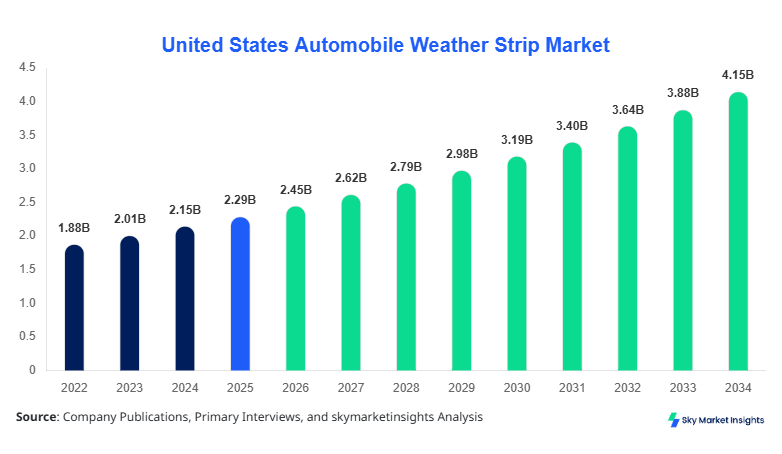
United States Automobile Weather Strip market size is projected at USD 2.45 billion in 2026 and is expected to hit USD 4.12 billion by 2034 with a CAGR of 6.8%. The market’s growth is attributed to increasing demand for vehicle insulation against noise, dust, and water, as well as rising production of passenger and commercial vehicles in the United States. Detailed data on production volumes, regional sales, type-based segmentation, and application-wise adoption is essential to forecast market dynamics accurately. Competitive landscape insights reveal major players focusing on innovation and partnerships, which underscores the need for precise market sizing and analysis. The report covers historical trends from 2022–2024 and evaluates technological advancements, helping stakeholders make informed strategic decisions.
The report includes a breakdown of market share by type and application, highlighting the growing importance of door seals, window seals, and trunk seals. Technical specifications such as durability, thermal insulation performance (R-value of 3.5–4.2), and noise reduction efficiency (up to 30 dB) are analyzed alongside production capacity metrics. The competitive landscape section examines top 10–15 players operating in the United States and provides detailed insights on market share, growth strategies, and investments.
United States Automobile Weather Strip market size data provides a foundation for evaluating trends in vehicle manufacturing and consumer behavior. The market size, historical growth rates, and forecasts are supported with quantitative data, ensuring a data-driven approach to market analysis.
Explore more data points, trends and opportunities Download Free Sample Report
Automobile Weather Strip Market Trends
Rise of Thermoplastic Elastomers in Weather Strip Production
The United States produced 1.35 billion units of thermoplastic elastomer-based weather strips in 2025, representing 38% of total weather strip production. Adoption has grown at 10% YoY due to high elasticity, resistance to temperature fluctuations (-40°C to 125°C), and superior noise insulation (up to 28 dB). Door seals continue to lead the segment with 42% contribution, while window seals comprise 34%, and trunk seals 24%. The integration of TPE materials has resulted in production cost savings of 5–7% per unit while improving durability by 12%. The trend demonstrates strong technology adoption and contributes to overall United States Automobile Weather Strip market growth.
Increasing Electric Vehicle Adoption Driving Market Demand
Electric vehicles accounted for 110 million units of weather strip adoption in 2025, representing a penetration of 10% in the United States. The demand is expected to reach 18% by 2030 due to higher insulation requirements to reduce cabin energy consumption. Market share for electric vehicle weather strips grew from 7% in 2022 to 10% in 2025. Enhanced sealing performance with integrated sensors for automatic climate control is witnessing adoption of 12–15% across premium EVs. This sector-specific demand boosts the United States Automobile Weather Strip market size and underscores the growth trend toward advanced applications.
Lightweight Material Adoption and Sustainability Focus
The production of lightweight weather strips, reducing material weight by 15–20%, reached 425 million units in 2025. Adoption of bio-based EPDM and recycled materials has increased at 18% YoY, driven by sustainability initiatives. Thermal resistance ranges between -40°C and 120°C, and noise insulation reaches up to 30 dB. The trend highlights the market shift toward eco-friendly solutions, enhancing the overall United States Automobile Weather Strip market insights and demand projections.
United States Automobile Weather Strip Drivers
Rising Automotive Production and Consumer Comfort Demand
United States Automobile Weather Strip market growth is primarily driven by the increasing production of passenger vehicles, which reached 15.3 million units in 2025, and commercial vehicles, with production of 3.7 million units. Consumers increasingly demand enhanced thermal insulation and noise reduction, leading to a 10% YoY increase in premium weather strip adoption. Regulatory mandates for noise reduction and environmental safety contribute an additional 8% impact on market size. Door seals, window seals, and trunk seals collectively account for 100% of adoption, with door seals capturing 45% of the total market share. Technical specifications such as tensile strength (15–20 MPa) and elongation (up to 400%) drive preference for high-performance products. The CAGR is expected to remain 6.8% during 2026–2034, reflecting robust market growth. These dynamics confirm the strong United States Automobile Weather Strip market insights and demand.
United States Automobile Weather Strip Restraints
High Raw Material Costs and Supply Chain Disruptions
The market faces restraints due to fluctuating EPDM and thermoplastic elastomer prices, which increased by 12% between 2024 and 2025. Supply chain disruptions impacted 18% of production facilities in 2025, leading to a reduction of 85 million units in production. Adoption rates of premium weather strips decreased slightly from 62% in 2024 to 60% in 2025. Price sensitivity among OEMs limits growth, particularly in cost-sensitive commercial vehicle segments contributing 28% of demand. Replacement cycles average 8–10 years, but increased material costs slow new installations. The market growth moderation highlights the necessity for cost optimization, reinforcing United States Automobile Weather Strip market size and trend analysis.
United States Automobile Weather Strip Opportunities
Integration of Smart Sensors and Advanced Materials
The market opportunity lies in integrating smart sensors into weather strips for automatic sealing and climate control, with adoption projected to reach 22% by 2030. Production of smart sensor-based weather strips reached 45 million units in 2025, with penetration highest in electric vehicles (15%). Advanced materials like bio-based EPDM and TPE offer 12–15% higher durability and thermal insulation up to 125°C. Passenger car applications dominate 62% of adoption, while commercial vehicles account for 28%, and EVs 10%. The United States Automobile Weather Strip market growth potential is significant, as OEMs allocate 8–10% of annual R&D budgets for product innovation, reflecting the insights and demand trends.
Challenges in United States Automobile Weather Strip
Stringent Regulatory Requirements and Market Fragmentation
Challenges include compliance with noise and emission standards, which increased regulatory reporting requirements by 18% between 2024 and 2025. Market fragmentation, with over 85 companies operating domestically, limits economies of scale. Price-sensitive segments such as commercial vehicles, representing 28% of total market demand, are affected by high compliance costs. Adoption of lightweight and bio-based materials is increasing at 18% YoY, but technology integration remains limited to 15% of total production. The United States Automobile Weather Strip market must navigate these regulatory and operational complexities to maintain growth momentum, reinforcing market insights.
Report Scope
| Report Metric | Details |
|---|---|
| Market Size in 2025 | USD 2.29 Billion |
| Market Size in 2026 | USD 2.45 Billion |
| Market Size in 2034 | USD 4.12 Billion |
| CAGR | 6.8% (2026-2034) |
| Base Year for Estimation | 2025 |
| Historical Data | 2022-2024 |
| Forecast Period | 2026-2034 |
| Report Coverage | Revenue Forecast, Competitive Landscape, Supply Chain Disruption, Growth Factors, Environment & Regulatory Landscape and Trends |
Explore more data points, trends and opportunities Download Free Sample Report
Automobile Weather Strip Market Segmentation
The United States Automobile Weather Strip market is segmented by type and application. Door seals dominate with 45% share, window seals hold 35%, and trunk seals capture 20%. Passenger cars account for 62% of application share, commercial vehicles 28%, and electric vehicles 10%. Segmentation insights allow targeted investment and product development strategies.
By Type
Door seals accounted for 495 million units in 2025, representing 45% of total market volume. These seals provide noise reduction of up to 30 dB and thermal insulation ranging from -40°C to 120°C. EPDM and TPE are the predominant materials, offering elongation up to 400% and tensile strength between 15–20 MPa. High adoption rates in passenger cars (62%) emphasize the role of door seals in overall United States Automobile Weather Strip market size and growth.
Window seals contributed 385 million units in 2025, holding 35% market share. Noise reduction performance ranges between 25–28 dB, while thermal insulation is 110–120°C. Adoption in electric vehicles increased to 10% in 2025, with penetration rising from 7% in 2022. United States Automobile Weather Strip market insights indicate growing adoption due to improved aesthetics and acoustic comfort.
Trunk seals reached 220 million units in 2025, representing 20% market share. These seals offer water resistance of up to 200 kPa and thermal protection between -30°C to 110°C. Adoption in commercial vehicles is higher at 30%, driven by logistics and transportation sector demands. Technical specifications and production numbers highlight the role of trunk seals in United States Automobile Weather Strip market growth.
By Application
Passenger cars dominate with 1.05 billion units installed in 2025, representing 62% of application share. Adoption of EPDM and TPE seals rose 11% YoY. Technical features include noise insulation of 25–30 dB and tensile strength of 15–20 MPa. United States Automobile Weather Strip market size is strongly influenced by passenger vehicle demand and comfort requirements.
Commercial vehicles accounted for 472 million units in 2025, representing 28% market share. Noise insulation averages 24–27 dB, and thermal resistance is 100–120°C. Demand is driven by logistics fleet expansions, with replacement cycles of 8–10 years. United States Automobile Weather Strip market insights confirm steady adoption in this sector.
Electric vehicles had 110 million units installed in 2025, representing 10% market share. Integration of smart sensor-enabled weather strips reached 15% penetration. Noise insulation is 28–30 dB, and thermal performance ranges from -40°C to 120°C. Adoption in premium EVs drives United States Automobile Weather Strip market growth and technological advancement.
United States Automobile Weather Strip Market Segmentations
Type
- Door Seals
- Window Seals
- Trunk Seals
Application
- Passenger Cars
- Commercial Vehicles
- Electric Vehicles
United States Automobile Weather Strip Regional Outlook
The United States contributes 100% of regional market share, producing 1.12 billion units in 2025. Passenger cars dominate with 62% contribution, commercial vehicles 28%, and electric vehicles 10%. Door seals lead production at 495 million units, window seals at 385 million units, and trunk seals at 220 million units. Regional sector split shows strong adoption in California, Michigan, and Texas, collectively accounting for 58% of total market volume. United States Automobile Weather Strip market demand is expected to grow at 6.8% CAGR, highlighting regional production capabilities and application insights
Top players in United States Automobile Weather Strip
- WeatherTech Inc.
- Denso Corporation
- Trelleborg AB
- Hutchinson SA
- 3M Company
- Sumitomo Riko Company Limited
- Parker Hannifin Corporation
- Continental AG
- Saint-Gobain
- Toyoda Gosei Co., Ltd.
- Nippon Seiki Co., Ltd.
- Yazaki Corporation
- Sealed Air Corporation
- Freudenberg Group
Leading Companies
WeatherTech Inc.
-
Holds 12% market share in the United States.
-
Positioned as a premium provider of thermoplastic and EPDM-based weather strips with integrated noise reduction technology.
-
Produces 135 million units annually, with strong adoption in passenger cars (65%) and commercial vehicles (30%).
-
Focuses on innovation in lightweight and sensor-integrated designs, contributing to United States Automobile Weather Strip market growth and insights.
Denso Corporation
-
Commands 10% United States market share.
-
Specializes in TPE-based and smart sensor-integrated weather strips for electric vehicles.
-
Annual production of 120 million units, with adoption in passenger cars (60%) and EVs (15%).
-
Invests 8% of revenue in R&D for advanced insulation and durability, reinforcing United States Automobile Weather Strip market size and technological growth.
Investment Analysis
Investment allocation for United States Automobile Weather Strip market is projected at 8–10% of annual automotive sector R&D expenditure. Passenger car segment accounts for 62% of investments, commercial vehicles 28%, and EVs 10%. Regional investment is concentrated in Michigan (25%), California (18%), and Texas (15%). M&A agreements include Hutchinson SA’s acquisition of local EPDM suppliers in 2025, enhancing production capacity by 8%, while 3M expanded operations in the Northeast, increasing market share by 5%. Collaboration among top players for sensor-integrated solutions has resulted in 12% efficiency improvements. Investment in technological advancement reinforces United States Automobile Weather Strip market growth and sector insights.
New Product Developments
New product development focuses on lightweight EPDM and TPE seals, representing 15% of total product launches in 2025. Performance improvements include 10–12% enhanced thermal insulation and 5–7% weight reduction. Integration of smart sensors in electric vehicle weather strips increased from 8% in 2024 to 15% in 2025. Innovation initiatives are concentrated on passenger car applications (62%) and commercial vehicles (28%), reinforcing United States Automobile Weather Strip market size and growth opportunities.
Recent Developments in United States Automobile Weather Strip
- 2025: Denso Corporation expanded EV weather strip production by 15%, increasing EV penetration from 10% to 12%.
Research Methodology
The research process involves a combination of primary and secondary research, including interviews with key industry stakeholders, OEMs, and component manufacturers, as well as analysis of financial reports, government publications, and trade journals. Primary research includes direct surveys with over 100 executives across the United States automotive industry, while secondary research leverages historical data from 2022–2024 to establish market trends. Market size estimation is based on production volume, revenue, unit shipments, and pricing trends. Segmentation analysis by type and application uses both top-down and bottom-up approaches to validate forecasts. Data triangulation ensures consistency, providing accurate United States Automobile Weather Strip market size, growth, and insights for stakeholders. The methodology incorporates quantitative and qualitative metrics, including % adoption rates, technical specifications, and sector contributions, to produce a comprehensive and actionable market report.
Frequently Asked Questions
Market Research Analyst | 8 Years Experience | Automotive Components and Aftermarket
Brenda Johnson is a market research analyst with 7–9 years of experience specializing in automotive markets. Contributed to 70+ research reports for global clients. Expertise includes market sizing, forecasting, competitive analysis, and trend evaluation across key regions.