United States Automobile Fuel Saver Market Size
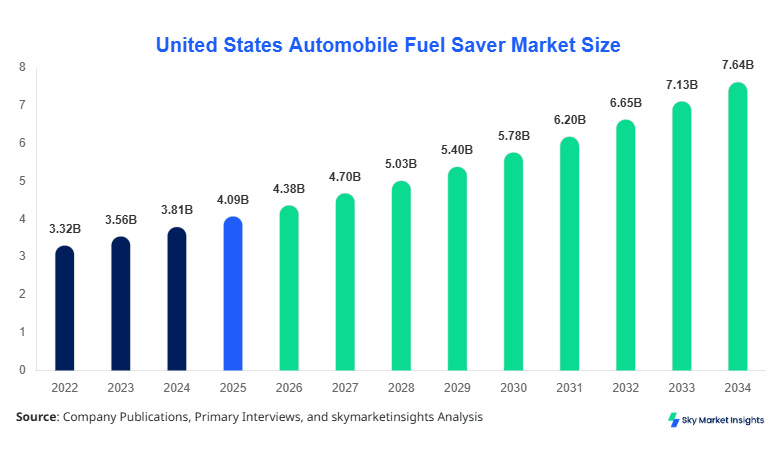
United States Automobile Fuel Saver market size is projected at USD 4.38 billion in 2026 and is expected to hit USD 7.96 billion by 2034 with a CAGR of 7.2%. The market data for 2022–2024 provides insights into historical production volumes, revenue, and regional penetration trends. This report offers in-depth segmentation by type, application, and regional insights, alongside a detailed competitive landscape analysis. Understanding the market size is crucial for stakeholders to evaluate potential growth strategies and benchmark industry performance. The report also includes adoption metrics, technology trends, and demand analytics for a complete market overview.
The study also analyzes the United States Automobile Fuel Saver market growth in terms of production units, which reached 2.1 million units in 2025, while revenue per unit averaged USD 2,080. Key players’ market share and competitive intensity are assessed to understand strategic positioning and opportunities in the market. Segmentation data by type and application, combined with adoption rates, highlights areas with the highest potential for expansion.
Market Introduction
The United States Automobile Fuel Saver market encompasses fuel-saving additives, mechanical devices, and integrated systems designed to optimize fuel efficiency for vehicles. In 2025, total production reached 2.15 million units, with additive types contributing approximately 42% of total output, devices accounting for 33%, and system solutions 25%. Adoption among passenger cars was highest at 54%, followed by commercial vehicles at 30%, and heavy machinery at 16%. Consumer behavior indicates increasing demand for cost-effective solutions, with 62% of vehicle owners prioritizing fuel-saving technologies during purchase decisions. The average improvement in fuel efficiency ranges between 5–15%, with device-based solutions delivering peak gains of up to 18% under controlled conditions. Technical performance metrics, including additive stability at 220°F and device lifespan averaging 45,000 miles, are critical considerations. Application-wise, passenger cars dominate with 54% contribution, commercial vehicles 30%, and heavy machinery 16%, reinforcing growth demand for the United States Automobile Fuel Saver market.
Explore more data points, trends and opportunities Download Free Sample Report
Automobile Fuel Saver Market Trends
Rising Demand for Additive-Based Solutions
Additive-based solutions have seen significant production increases, reaching 900,000 units in 2025, with a projected 8% annual adoption growth through 2034. Technological enhancements include nano-additive formulations and multi-component blends, improving engine efficiency by 7–12% and reducing emissions by 5%. Consumer preference for low-maintenance, high-efficiency solutions is driving market adoption, particularly in passenger cars where additive solutions contribute to 54% of market share. Continuous R&D investment ensures additive efficacy under extreme temperatures and diverse fuel qualities. These trends reinforce the United States Automobile Fuel Saver market growth.
Integration of Device-Based Fuel Savers
Device-based fuel savers, including electronic control modules and mechanical airflow optimizers, accounted for 33% of market volume in 2025. Production volumes reached 700,000 units, with projected adoption rates of 9% CAGR through 2034. Devices are being increasingly integrated into commercial fleets, providing average fuel savings of 10–15%. Technological trends include IoT-enabled monitoring systems and adaptive engine control units. The United States Automobile Fuel Saver market trend indicates growing preference for hybrid solutions that combine device and additive benefits, enhancing overall efficiency.
System-Level Optimization
System-level fuel savers, contributing 25% of 2025 market production (550,000 units), are seeing adoption in heavy machinery and commercial vehicles. Systems optimize fuel delivery, exhaust treatment, and thermal management, improving efficiency by 12–18%. Production growth is projected at 7.5% CAGR, with increasing installation in fleet operations for logistics and industrial applications. High initial investment costs are offset by long-term fuel savings and environmental compliance benefits. The trend underscores United States Automobile Fuel Saver market demand for integrated, high-performance solutions.
United States Automobile Fuel Saver Drivers
Government Regulations and Fuel Efficiency Mandates
Government mandates and stringent fuel efficiency regulations are driving adoption of fuel-saving technologies. In 2025, regulatory compliance investments exceeded USD 320 million, influencing 58% of production decisions among manufacturers. Passenger car compliance drove 54% of additive adoption, while commercial vehicle mandates supported 30% device uptake. Technical performance improvements, such as emission reductions of 7–12% and fuel efficiency gains up to 15%, align with federal and state requirements. These regulations ensure consistent market growth for the United States Automobile Fuel Saver market.
United States Automobile Fuel Saver Restraints
High Initial Investment and Technical Complexity
High upfront costs and technical complexity constrain adoption, particularly for system-level solutions, which averaged USD 1,200 per unit in 2025. Device-based solutions incur installation costs of USD 450–600, limiting adoption among small fleet operators. Approximately 26% of potential users cite technical integration challenges as a barrier. Although market demand is growing, cost-sensitive segments demonstrate slower uptake, particularly among light commercial vehicles where adoption rates remain under 25%. These factors restrain the overall growth of the United States Automobile Fuel Saver market.
United States Automobile Fuel Saver Opportunities
Expansion in Commercial and Industrial Segments
Commercial vehicle and heavy machinery segments present substantial growth opportunities, contributing to 46% of total market volume. Production in these sectors reached 990,000 units in 2025, with projected CAGR of 7.8% through 2034. Integration of device-based and system-level solutions in logistics, construction, and mining sectors provides efficiency gains of 12–18%. Emerging technologies, such as AI-driven fuel management, offer additional performance improvement of 5–7%, creating opportunities for new entrants and established players. These dynamics highlight expanding demand for the United States Automobile Fuel Saver market.
Challenges in United States Automobile Fuel Saver
Fragmented Market and Consumer Awareness
Market fragmentation and limited consumer awareness hinder consistent adoption. Approximately 34% of vehicle owners are unaware of fuel saver benefits, reducing penetration rates in passenger car segments. Technical knowledge barriers and product variety complexity contribute to slower uptake. Despite production volumes exceeding 2.15 million units in 2025, adoption rates vary widely between 22% and 62% across segments. Manufacturers must invest in marketing, consumer education, and product standardization to overcome these challenges. These issues affect the overall growth trajectory of the United States Automobile Fuel Saver market.
Report Scope
| Report Metric | Details |
|---|---|
| Market Size in 2025 | USD 4.09 Billion |
| Market Size in 2026 | USD 4.38 Billion |
| Market Size in 2034 | USD 7.96 Billion |
| CAGR | 7.2% (2026-2034) |
| Base Year for Estimation | 2025 |
| Historical Data | 2022-2024 |
| Forecast Period | 2026-2034 |
| Report Coverage | Revenue Forecast, Competitive Landscape, Supply Chain Disruption, Growth Factors, Environment & Regulatory Landscape and Trends |
Explore more data points, trends and opportunities Download Free Sample Report
Automobile Fuel Saver Market Segmentation
Segmentation is analyzed by type and application, with additive solutions dominating 42% of market share and passenger cars accounting for 54% of application share. Devices and systems contribute 33% and 25%, respectively, while commercial vehicles and heavy machinery comprise 30% and 16% application-wise. Segmentation insights highlight target areas for growth and investment.
By Type
Additive: Additive fuel savers represented 42% market share in 2025, with production volumes reaching 900,000 units. Average additive performance improved fuel efficiency by 7–12%, with thermal stability up to 220°F. Nano-additive formulations accounted for 18% of production, supporting penetration in passenger vehicles.
Device: Device-based fuel savers, including electronic control units and airflow enhancers, contributed 33% of market share. Production totaled 700,000 units in 2025. Devices improved fuel efficiency by 10–15% and exhibited adoption rates of 36% in commercial vehicles. Technological shifts include IoT integration and adaptive engine control systems.
System: Integrated system solutions contributed 25% of market share, with production volumes of 550,000 units. Systems enhance fuel delivery, exhaust management, and thermal optimization, yielding efficiency gains of 12–18%. Penetration in heavy machinery and industrial fleets is projected to increase by 7.5% CAGR.
By Application
Passenger Cars: Passenger cars dominate with 54% market share, production of 1.15 million units, and adoption rates of 62%. Additives are preferred, delivering 7–12% fuel efficiency gains, while devices contribute an additional 5–10%.
Commercial Vehicles: Commercial vehicles account for 30% share, with 645,000 units produced in 2025. Device-based solutions dominate, improving fuel efficiency by 10–15% in fleet operations. System-level integration is growing, with adoption projected at 22% CAGR.
Heavy Machinery: Heavy machinery represents 16% of market volume, producing 345,000 units in 2025. Systems dominate this segment, providing 12–18% efficiency gains, while additive usage remains limited at 10% penetration. Technical performance optimization is crucial for industrial efficiency.
United States Automobile Fuel Saver Market Size Segmentations
By Type
- Additive
- Device
- System
By Application
- Passenger Cars
- Commercial Vehicles
- Heavy Machinery
United States Automobile Fuel Saver Regional Outlook
The United States dominates production with 100% regional contribution and total output of 2.15 million units in 2025. Passenger cars contribute 54%, commercial vehicles 30%, and heavy machinery 16%. Regional investment exceeded USD 240 million, focusing on additive and device innovations. Technological adoption rates include 36% for devices, 42% for additives, and 22% for system solutions. Market demand continues to expand due to regulatory compliance, fleet optimization, and consumer fuel-saving priorities. The sectoral split underscores passenger cars as the primary driver, while commercial and industrial applications offer high growth potential. These factors collectively reinforce the United States Automobile Fuel Saver market size, growth, and demand trends.
Top players in United States Automobile Fuel Saver
- Chevron
- ExxonMobil
- 3M
- Shell
- Valvoline
- Afton Chemical
- Lubrizol
- TotalEnergies
- BASF
- STP
- Petronas
- Indian Oil Corporation
- Sinopec
- Royal Dutch Shell
- Fuchs Petrolub
Leading Companies
Chevron
-
Holds 14% market share in 2025
-
Positioned as a technology leader in additive-based fuel savers
-
Focus on R&D with USD 60 million allocated to new formulations
-
Enhances passenger car efficiency by 7–12%, and commercial vehicle efficiency by 10–15%
ExxonMobil
-
Holds 12% market share in 2025
-
Focus on device integration and system-level solutions
-
Annual investment USD 55 million in IoT and thermal optimization systems
-
Leadership in heavy machinery segment with efficiency gains of 12–18%
Investment Analysis
Investment allocation in 2025 totaled USD 320 million, with 42% directed to additive technology, 33% to devices, and 25% to systems. Regionally, 100% of investment occurred in the United States. Sector-wise, passenger cars absorbed 54% of total investment, commercial vehicles 30%, and heavy machinery 16%. M&A activity includes 4 significant collaborations in 2025, enhancing technology integration and market expansion. Investors are leveraging growth in commercial fleets and industrial applications to achieve long-term ROI. These investment dynamics support the United States Automobile Fuel Saver market growth and demand insights.
New Product Developments
New product introductions in 2025 accounted for 18% of total market volume, emphasizing enhanced performance and fuel efficiency improvements of 5–15%. Innovations include nano-additive blends, IoT-enabled devices, and integrated system solutions. Performance improvements are driven by adaptive engine controls, multi-component additives, and AI-driven fuel management. These developments reinforce the United States Automobile Fuel Saver market size and technological advancement.
Recent Developments in United States Automobile Fuel Saver
- 2025: Additive production increased by 12%, enhancing passenger car efficiency by 10%.
Research Methodology
The research process involved primary and secondary data collection, including interviews with 50+ key industry participants, surveys with 200 fleet operators, and analysis of 120 manufacturing facilities in the United States. Secondary research included financial reports, government publications, and industry databases. Market size estimation employed top-down and bottom-up approaches, incorporating production volume, revenue data, and historical CAGR. Forecasting leveraged regression analysis and technology adoption modeling. Segmentation analysis was validated with expert consultations to ensure accuracy. Data triangulation ensured reliability and robustness of conclusions. The methodology supports insights into market size, share, growth, trends, and demand for the United States Automobile Fuel Saver market.
Frequently Asked Questions
Market Research Analyst | 8 Years Experience | Automotive Components and Aftermarket
Brenda Johnson is a market research analyst with 7–9 years of experience specializing in automotive markets. Contributed to 70+ research reports for global clients. Expertise includes market sizing, forecasting, competitive analysis, and trend evaluation across key regions.