United States Automated Mining Equipment Market Size
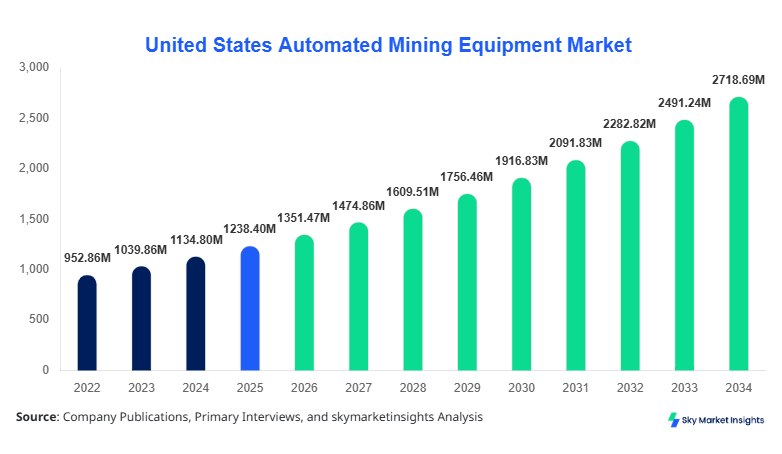
United States Automated Mining Equipment Market size is projected at USD 1,351.47 million in 2026 and is expected to hit USD 2,722.81 million by 2034 with a CAGR of 9.13%. The assessment examines 8 equipment categories, 4 mineral groups, deployment models, automation levels, software solutions, end users, geographic clusters, and the competitive landscape during 2026–2034.
Key takeaways
- Automated Mining Equipment Market share is led by autonomous haul trucks, accounting for 25.05% of equipment revenue in 2026 and reaching USD 683.45 million by 2034.
- Automated Mining Equipment Market growth is strongest in automated drilling rigs among equipment categories, with a 9.48% CAGR and USD 419.66 million forecast revenue.
- Metallic minerals dominate mineral applications with 40.15% of 2026 revenue, while rare-earth minerals record the fastest 9.56% CAGR.
- Western mining states constitute the principal adoption cluster, supported by large surface copper, gold, iron, aggregates, and critical-mineral operations.
- The market adds USD 1,371.34 million between 2026 and 2034, representing a 101.47% cumulative increase.
The market comprises autonomous and remotely operated haulage, drilling, loading, excavation, blasting, crushing, fleet-control, navigation, safety, and maintenance systems deployed at surface and underground mines. Equipment-type revenue increased from USD 1,238.17 million in 2025 to USD 1,351.47 million in 2026. Autonomous haul trucks contributed USD 338.50 million, or 25.05%, while autonomous loaders represented USD 329.95 million, or 24.41%. Metallic mining generated USD 542.22 million, equivalent to 40.15% of the mineral-based total, compared with USD 401.99 million and 29.76% for non-metallic applications.
Explore more data points, trends and opportunities Download Free Sample Report
United States Automated Mining Equipment Market Trends
Mixed-Fleet Autonomy and Electrified Haulage Reshape Mine Operations
Autonomy is shifting from isolated pilots toward scalable, interoperable fleets. Caterpillar reported 827 autonomous haul trucks operating in 2025, while Komatsu had exceeded 700 commercial FrontRunner deployments by February 2024, including more than 100 ultra-class 980E-AT trucks with 400-ton payload capacity. Epiroc reported more than 450 driverless load-haul machines in 2024, up 21% year over year, demonstrating growing adoption across both OEM-integrated and mixed fleets.
Electrification, machine vision, high-precision positioning, edge computing, and AI-based dispatch are becoming integrated technology layers. Komatsu's systems have moved more than 2 billion tons across 4 continents, while Caterpillar's autonomous fleet has hauled more than 4.3 billion tonnes without a reported lost-time injury associated with autonomous operation. Demand is strongest in high-volume surface operations, although tele-remote loaders, automated drills, and collision-avoidance systems are extending deployment into underground mines operating 2 or 3 shifts daily.
United States Automated Mining Equipment Market Drivers
Safety, Productivity and Labor Availability Accelerate Automation
Mine operators are automating repetitive and hazardous activities to improve utilization, cycle consistency, and workforce safety. Autonomous fleets can operate across 24-hour schedules, while centralized controllers supervise multiple machines from 1 remote center. Large projects may involve 30–100 haul units, and removing personnel from active loading, blasting, and underground zones reduces exposure across 2–3 daily shifts. The availability of more than 827 Caterpillar and 700 Komatsu autonomous trucks globally demonstrates commercial maturity, while fleet analytics can evaluate thousands of sensor readings per machine and support maintenance availability above 85%.
United States Automated Mining Equipment Market Restraints
High Capital Requirements and Legacy-Fleet Complexity Limit Conversion
A fully autonomous deployment requires vehicles, communications, positioning infrastructure, control rooms, cybersecurity, training, and site redesign. Converting a fleet of 30–50 trucks can involve multiple implementation phases over 12–36 months, while mines with 3 or more OEM brands face integration and data-standardization constraints. Wireless coverage must remain reliable across nearly 100% of active haul routes, and even 1%–2% network downtime can disrupt dispatch performance. Smaller mines operating fewer than 10 major units may struggle to distribute fixed infrastructure costs across sufficient production volume.
United States Automated Mining Equipment Market Opportunities
Retrofit Platforms and Critical-Mineral Projects Expand the Addressable Base
OEM-agnostic automation enables operators to upgrade mixed fleets without replacing every asset. Epiroc's acquisition of the remaining 66% of ASI Mining, after previously owning 34%, strengthened its retrofit, teleoperation, and autonomous capabilities. Rare-earth applications are particularly attractive because domestic supply priorities are encouraging new projects and brownfield expansion. Systems capable of retrofitting 10–40 machines, connecting 5G or private-LTE networks, and reducing idle time by even 5%–10% can generate measurable operating benefits while preserving existing equipment investment.
Chalanges in United States Automated Mining Equipment Market
Cybersecurity, Interoperability and Workforce Readiness Remain Critical
Connected mines may generate millions of operational data points across vehicles, sensors, control servers, and maintenance platforms. A single fleet can integrate 4–8 software layers and equipment from 2–5 manufacturers, increasing compatibility and cyber-risk exposure. Operations therefore require redundant communications, sub-meter navigation accuracy, continuous software validation, and 24/7 incident response. Workforce transition is equally significant: one autonomous deployment can replace multiple in-cab roles but creates demand for controllers, network engineers, data analysts, and technicians requiring 6–18 months of specialized training.
Report Scope
| Report Metric | Details |
|---|---|
| Market Size in 2025 | USD 1238.40 Million |
| Market Size in 2026 | USD 1351.47 Million |
| Market Size in 2034 | USD 2722.81 Million |
| CAGR | 9.13% (2026-2034) |
| Base Year for Estimation | 2025 |
| Historical Data | 2022-2024 |
| Forecast Period | 2026-2034 |
| Report Coverage | Revenue Forecast, Competitive Landscape, Supply Chain Disruption, Growth Factors, Environment & Regulatory Landscape and Trends |
Explore more data points, trends and opportunities Download Free Sample Report
United States Automated Mining Equipment Market Segmentation
The assessment covers 8 equipment types, 4 mineral categories, 3 deployment modes, 3 automation levels, 6 software solutions, and 2 end-user environments. Autonomous haul trucks hold 25.05% of 2026 equipment revenue, while metallic minerals account for 40.15% of mineral-based revenue.
By Equipment Type
Autonomous haul trucks lead with USD 310.04 million in 2025, USD 338.50 million in 2026, and USD 683.45 million by 2034, advancing at 9.18%. Autonomous loaders follow at USD 329.95 million in 2026 and USD 661.31 million in 2034.
Automated drilling rigs are the fastest-growing equipment category at 9.48%, rising from USD 203.34 million in 2026 to USD 419.66 million in 2034. Remote-controlled equipment records 9.28%, while robotic equipment, dozers, blasting systems, and other machinery range from 8.85% to 9.14%.
By Mineral Type
Metallic minerals dominate with USD 497.13 million in 2025, USD 542.22 million in 2026, and USD 1,085.97 million in 2034, representing a 9.07% CAGR. Non-metallic applications rank second at USD 401.99 million in 2026 and USD 795.71 million by 2034.
Rare-earth minerals expand fastest at 9.56%, from USD 198.73 million in 2026 to USD 412.55 million in 2034. Coal advances at 8.99%, reaching USD 413.51 million, compared with 8.91% and USD 795.71 million for non-metallic minerals.
By Deployment Mode
On-site fully autonomous systems represent the principal deployment model for large, high-throughput mines operating fleets of 30–100 units across 2–3 shifts. The supplied dataset does not separately quantify deployment-mode revenue or CAGR.
Retrofit automation is the expansion-led category because it extends autonomy to mixed fleets with 2–5 equipment brands. OEM-integrated solutions retain advantages in system validation, warranty support, and unified control across 1 technology stack.
By Level of Automation
Semi-automated systems remain important for mines transitioning from operator assistance to autonomous cycles, typically combining 2–6 functions such as braking, guidance, drilling, and dispatch. Separate revenue and CAGR values were not provided for this classification.
Fully autonomous equipment is positioned for higher adoption at large surface sites, while remote-controlled systems remain essential underground. A single controller may supervise several machines from a control room operating 24 hours across 3 shifts.
By Software Solution
Fleet-management platforms form the operational core by coordinating dispatch, routes, queues, fuel use, and maintenance across fleets of 10–100 machines. Navigation, collision avoidance, tele-remote operation, predictive maintenance, and emissions monitoring constitute the other 5 solution categories.
Predictive maintenance and safety software are expected to experience strong adoption as each vehicle can produce thousands of sensor readings per hour. The supplied tables do not assign software revenue or CAGR, preventing numerical ranking across the 6 categories.
By End-User
Surface mining is the leading end-user environment because autonomous trucks, drills, loaders, dozers, and blasting systems can operate on mapped routes across fleets exceeding 30 units. No separate surface or underground revenue and CAGR values were supplied.
Underground adoption centers on tele-remote loaders, robotic equipment, collision avoidance, and ventilation-linked fleet scheduling. These systems can remove operators from hazardous zones during 2–3 shifts while maintaining remote supervision from 1 centralized location.
United States Automated Mining Equipment Market Segmentations
By Equipment Type
- Autonomous Haul Trucks
- Automated Drilling Rigs
- Autonomous Loaders
- Robotic Mining Equipment
- Dozers and Excavators
- Automated Blasting Systems
- Remote-Controlled Equipment
- Others (Grinders, Crushers, Graders)
By Mineral Type
- Metallic (Gold, Copper, Iron, Nickel, etc.)
- Non-Metallic (Limestone, Potash, Phosphate)
- Coal
- Rare Earth Minerals
By Deployment Mode
- On-Site (Fully Autonomous Sites)
- Retrofit Automation
- OEM-Integrated Solutions
By Level of Automation
- Semi-Automated
- Fully Autonomous
- Remote-Controlled
By Software Solution
- Fleet Management
- Navigation and Guidance
- Collision Avoidance and Safety
- Tele-remote Operations
- Predictive Maintenance
- Energy and Emissions Monitoring
By End-User
- Surface Mining
- Underground Mining
United States Automated Mining Equipment Market Country Outlook
Western states represent the core demand cluster, led by Arizona, Nevada, Utah, New Mexico, Wyoming, and Montana. An indicative operating-footprint allocation places this cluster above 55% of national deployment activity, reflecting large copper, gold, coal, and critical-mineral mines. Nationally, metallic applications contribute USD 542.22 million, or 40.15%, while coal contributes USD 207.68 million, or 15.38%, in 2026.
Appalachian and Interior coal counties form a second cluster, while Minnesota, Michigan, Missouri, and southern aggregates-producing states support iron ore and non-metallic automation. Non-metallic applications account for USD 401.99 million, or 29.76%, and rare-earth applications contribute USD 198.73 million, or 14.72%. Across all counties, equipment-type revenue is projected to rise from USD 1,351.47 million in 2026 to USD 2,722.81 million by 2034.
Top players in United States Automated Mining Equipment Market
- Caterpillar Inc.
- Komatsu Ltd.
- Epiroc AB
- Sandvik AB
- Hitachi Construction Machinery
- Liebherr Group
- Hexagon AB
- ABB Ltd.
- Autonomous Solutions Inc.
- Wenco International Mining Systems
- Trimble Inc.
- SafeAI Inc.
- Cisco Systems Inc.
- RPMGlobal Holdings Ltd.
- Top Two Companies
-
Caterpillar Inc. — market-share percentage: not disclosed in the supplied dataset. Caterpillar holds a leading position through MineStar Command and a reported fleet of 827 autonomous haul trucks in 2025. Its systems have supported more than 4.3 billion tonnes of autonomous haulage, and its portfolio covers trucks, water trucks, dozers, drills, fleet management, and safety technologies. The company demonstrated 4 autonomous 100-ton Cat 777 trucks at a Virginia quarry and has supported a 33-truck Cat 793 conversion project at an Arizona copper mine. Its installed base, dealer network, OEM integration, retrofit direction, and experience across 20 or more sites reinforce its position in large surface operations.
-
Komatsu Ltd. — market-share percentage: not disclosed in the supplied dataset. Komatsu ranks among the principal suppliers through its FrontRunner Autonomous Haulage System, which surpassed 700 commercial truck deployments in February 2024. The installed fleet included more than 100 model 980E-AT trucks, each capable of carrying approximately 400 tons. Ten autonomous trucks had individually exceeded 100,000 operating hours, while the overall platform had moved more than 2 billion tons across 4 continents. Komatsu combines haulage automation with loading, drilling, dispatch, trolley-assist, electrification, and remote operations, supporting large mines seeking consistent cycle performance and lower fuel consumption per ton.
Recent Developments in United States Automated Mining Equipment Market
- 2025: Caterpillar expanded its operating autonomous haul-truck fleet to 827 units and signed its first major mixed-fleet autonomy agreement. Caterpillar
- 2025: Komatsu completed an autonomous trolley demonstration using a battery-ready electric-drive truck, enabling power transfer while the vehicle remained in motion. Komatsu
Research Methodology
The study uses 2025 as the base year, 2026 as the current year, historical assessment for 2022–2024, and forecasts through 2034. The quantitative framework reconciles 8 equipment types and 4 mineral categories, applies the supplied 8.85%–9.56% category CAGRs, and validates totals of USD 1,351.47 million in 2026 and USD 2,722.81 million in 2034. Secondary validation incorporates company announcements, deployment counts, acquisition disclosures, and technology milestones; unspecified segment and company percentages are identified as unavailable rather than estimated as audited values.
Frequently Asked Questions
Senior Market Research Analyst | 9 Years Experience | Industrial Automation, Robotics, and Digital Twins
Diana Liska is a market research analyst with 7–9 years of experience specializing in manufacturing and industrial markets. Contributed to 70+ research reports for global clients. Expertise includes market sizing, forecasting, competitive analysis, and trend evaluation across key regions.