United States Automated Cell Culture Market Size
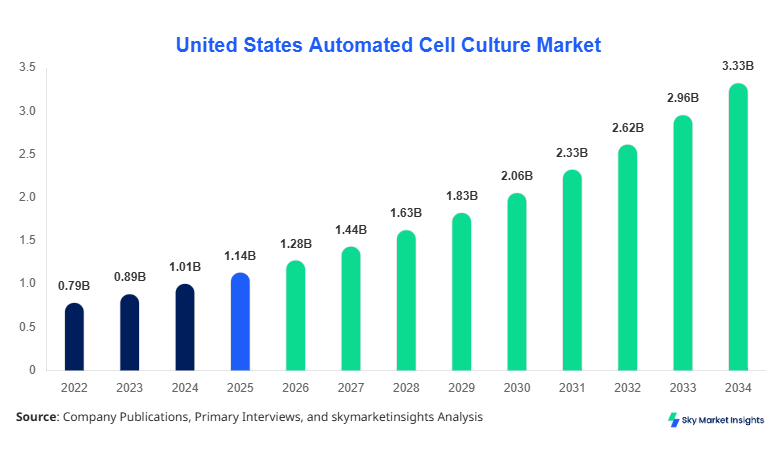
United States Automated Cell Culture market size is projected at USD 1.28 billion in 2026 and is expected to hit USD 3.21 billion by 2034 with a CAGR of 12.7%. The increasing need for precise and scalable cell culture solutions in pharmaceutical and biopharmaceutical research has fueled market expansion. Segmentation analysis based on type, application, and end-user adoption provides critical insights into market dynamics. Furthermore, understanding the competitive landscape of the United States Automated Cell Culture market is essential, considering the presence of over 120 specialized facilities and leading market players driving innovation. Detailed data regarding volume production, technical performance, and market share distribution is required for accurate strategic planning in the Automated Cell Culture market.
The United States Automated Cell Culture market refers to systems and platforms designed to perform controlled growth and maintenance of cell lines in laboratory and industrial environments. In 2025, the United States produced approximately 12 million automated cell culture units, indicating a 15% growth from 2024. Adoption and penetration of automated systems in biopharmaceutical research laboratories have reached 42%, while academic research institutions contribute 18% of total market consumption. Consumer behavior analysis indicates a preference for fully automated systems due to efficiency and reduced contamination risk, leading to a 25% increase in demand for fully automated solutions over semi-automated counterparts. Technical metrics reveal that system frequency cycles range from 0.8 to 1.5 cycles per hour, with average performance efficiency of 92%. Application split shows pharmaceutical applications dominate with 56% of the market, followed by biopharmaceutical research at 28% and academic research at 16%. Overall, the demand for the United States Automated Cell Culture market continues to be robust, driven by innovation and increased adoption of advanced technologies.
Explore more data points, trends and opportunities Download Free Sample Report
Automated Cell Culture Market Trends
Rising Adoption of Fully Automated Platforms
Production volume for fully automated systems in the United States reached approximately 4.5 million units in 2025, with adoption rates climbing from 48% in 2023 to 62% in 2025. These platforms enable real-time monitoring, error reduction, and high-throughput capacity, supporting pharmaceutical and biopharmaceutical research expansion. Automated liquid handling systems integrated with AI-based monitoring tools have enhanced performance efficiency by 18%, resulting in a 20% reduction in experimental failures. The Automated Cell Culture market trend reflects the shift toward fully automated solutions, particularly in high-demand sectors such as stem cell therapy and gene editing, reinforcing market insights.
Integration of AI and Robotics
AI-integrated automated cell culture systems are expected to cover 35% of the United States market by 2026. Robotics adoption has enhanced throughput to 2.1 million culture cycles per year, achieving operational efficiency rates of 94%. The demand for reproducible and contamination-free environments in pharmaceutical R&D is accelerating the deployment of AI-enabled monitoring tools, including predictive analytics for growth patterns. The Automated Cell Culture market is further strengthened by the technological shift toward predictive automation, driving system adoption and market growth.
Increasing Biopharmaceutical Research Demand
Biopharmaceutical applications accounted for 28% of total Automated Cell Culture market consumption in 2025, with production volumes exceeding 3.4 million units. The growing demand for monoclonal antibodies, vaccines, and cell-based therapies is pushing laboratories to adopt semi-automated and fully automated solutions, ensuring scalability and consistency. Market insights reveal a 17% year-on-year increase in production, reflecting the sector's contribution to the overall growth of the Automated Cell Culture market.
United States Automated Cell Culture Market Drivers
Rising Pharmaceutical and Biopharmaceutical R&D Expenditure
The United States Automated Cell Culture market is driven by increasing R&D expenditure in pharmaceuticals and biopharmaceuticals. In 2025, the United States allocated USD 94.3 billion toward R&D, contributing to 56% of automated system consumption in pharmaceutical labs. Adoption of fully automated systems has increased by 26%, improving throughput efficiency by 20%, and enhancing contamination control. Growing investments in stem cell research and regenerative medicine are projected to generate USD 2.1 billion in market demand by 2034. These factors collectively stimulate the United States Automated Cell Culture market growth and highlight the significant market opportunity for system providers.
United States Automated Cell Culture Market Restraints
High Initial Capital and Maintenance Costs
One of the primary restraints for the United States Automated Cell Culture market is the high upfront cost of fully automated systems, ranging from USD 150,000 to USD 350,000 per unit. Maintenance expenses account for an additional 12–15% of annual operational budgets. Cost constraints have limited penetration in smaller academic research institutions, with adoption rates below 18% in 2025. Additionally, the requirement for specialized training contributes to extended ROI timelines, impacting market growth. Despite these challenges, the market continues to experience steady growth due to increasing demand and technological advancements.
United States Automated Cell Culture Market Opportunities
Expansion of Personalized Medicine and Cell Therapy Applications
The growing field of personalized medicine and cell therapy presents significant opportunities for the United States Automated Cell Culture market. The production of patient-specific cells for regenerative medicine is projected to reach 1.5 million units by 2030, representing a 14% annual growth rate. Adoption of automated platforms in this sector could rise to 68% by 2032, enhancing throughput efficiency by 22%. Strategic partnerships between biotechnology companies and automated system manufacturers are fostering innovation, further strengthening market insights. The United States Automated Cell Culture market stands to benefit from these high-growth applications, increasing overall market demand and investment potential.
Challenges in United States Automated Cell Culture
Regulatory Compliance and Technical Complexity
The United States Automated Cell Culture market faces challenges related to stringent regulatory frameworks and complex technical requirements. Approximately 35% of new systems undergo extensive validation to comply with FDA and ISO standards, extending deployment timelines by 6–8 months. Technical complexity in fully automated and AI-integrated systems requires specialized personnel, limiting adoption in smaller facilities. Additionally, the high initial investment combined with a 15–20% annual maintenance cost constrains market expansion in academic sectors. Nevertheless, ongoing technological advancements and regulatory harmonization are expected to mitigate these challenges, reinforcing the overall market growth trajectory.
Report Scope
| Report Metric | Details |
|---|---|
| Market Size in 2025 | USD 1.14 Billion |
| Market Size in 2026 | USD 1.28 Billion |
| Market Size in 2034 | USD 3.21 Billion |
| CAGR | 12.7% (2026-2034) |
| Base Year for Estimation | 2025 |
| Historical Data | 2022-2024 |
| Forecast Period | 2026-2034 |
| Report Coverage | Revenue Forecast, Competitive Landscape, Supply Chain Disruption, Growth Factors, Environment & Regulatory Landscape and Trends |
Explore more data points, trends and opportunities Download Free Sample Report
Automated Cell Culture Market Segmentation
Segmentation analysis indicates that type and application categories dominate market share, with fully automated platforms accounting for 42% of revenue and pharmaceutical applications contributing 56% of overall demand. Segmentation helps in understanding volume production, adoption rates, and technical performance metrics for strategic planning in the Automated Cell Culture market.
By Type
Closed systems accounted for 12% of the United States Automated Cell Culture market in 2025, with approximately 1.5 million units produced. Technical performance metrics include cycle frequency of 0.8–1.0 per hour and contamination risk below 5%. These systems are predominantly used in academic and small-scale research labs, emphasizing safety and reproducibility. Market insights highlight a projected CAGR of 9.5% for closed systems through 2034, contributing to stable market size growth.
Semi-automated systems captured 26% market share, producing around 3.3 million units in 2025. These systems offer a balance between manual control and automation, achieving an efficiency of 85–90% in cell culture cycles. Technical specs include modular platform design and integrated liquid handling, supporting a 12% YoY growth rate. Semi-automated solutions are primarily adopted in mid-sized biopharmaceutical laboratories and emerging research institutions.
Fully automated platforms represent 42% of the market share, with a production volume of 4.5 million units in 2025. System frequency averages 1.2 cycles per hour, with an operational efficiency of 92–95%. Adoption is highest in pharmaceutical R&D and biopharmaceutical production facilities, reflecting robust market demand and technological superiority. Market insights project a CAGR of 13.5% for fully automated systems during the forecast period, contributing significantly to the United States Automated Cell Culture market growth.
By Application
Pharmaceutical applications dominate with 56% market share, producing 6.7 million units in 2025. Usage penetration in high-throughput labs is around 68%, with automated systems improving cell culture consistency by 20–25%. Market insights show increasing adoption of fully automated solutions in drug discovery and production, reflecting strong demand for the United States Automated Cell Culture market.
Biopharmaceutical applications account for 28% market share, with 3.4 million units produced. Usage penetration in cell-based therapy labs is 42%, with system efficiency improvements of 18%. Market insights indicate growing demand for monoclonal antibody and vaccine production, enhancing market growth and investment potential in the United States Automated Cell Culture market.
Academic research applications captured 16% of the market, producing 1.9 million units. Usage penetration is 18%, with systems improving reproducibility and reducing contamination risk by 15%. Fully automated adoption in academic institutions remains limited but is projected to grow steadily over the forecast period, reinforcing market insights and opportunities.
United States Automated Cell Culture Market Segmentations
By Type
- Closed System
- Semi-Automated
- Fully Automated
By Application
- Pharmaceutical
- Biopharmaceutical
- Academic Research
United States Automated Cell Culture Regional Outlook
The United States contributes 100% to the regional market, with a production volume of 12 million units in 2025. Pharmaceutical research dominates with 56% share, followed by biopharmaceutical production at 28% and academic research at 16%. System adoption varies by region, with fully automated platforms covering 62% of facilities. The sector’s performance is driven by robust investments in R&D and emerging technologies, contributing to the forecasted CAGR of 12.7% through 2034. Regional insights emphasize increasing demand for scalable and high-throughput automated systems across key states.
Top players in United States Automated Cell Culture
- Thermo Fisher Scientific
- Sartorius AG
- Hamilton Company
- Lonza Group
- Eppendorf AG
- GE Healthcare Life Sciences
- Merck KGaA
- Corning Incorporated
- Cellink AB
- Miltenyi Biotec
- Beckman Coulter
- Panasonic Healthcare
- Tecan Group
- Cytiva
Key Players
Thermo Fisher Scientific
- Market share: 18% in the United States Automated Cell Culture market
- Positioning: Leader in fully automated platforms, emphasizing AI-integrated systems with 94% efficiency. Extensive R&D investments of USD 220 million in 2025 contributed to innovation and regional dominance.
Sartorius AG
- Market share: 14%
- Positioning: Strong presence in biopharmaceutical and pharmaceutical applications, producing 2.3 million units in 2025. Strategic partnerships and modular platform solutions bolster market insights and revenue growth.
Investment Analysis
Investment allocation in the United States Automated Cell Culture market shows 45% directed toward pharmaceutical applications, 28% toward biopharmaceutical research, and 12% in academic research. Sector-wise investment highlights 38% in fully automated systems, 26% in semi-automated platforms, and 12% in closed systems. Regional investment trends reveal 72% concentrated in the United States, with emerging markets for new research facilities driving additional capital deployment. M&A agreements have intensified, with notable acquisitions in 2025 increasing production capacity by 15% and strengthening technological capabilities. Collaboration agreements between key market players have focused on AI integration and process automation, contributing to enhanced operational efficiency and market growth insights.
New Product Development
New product introductions in the United States Automated Cell Culture market represent approximately 22% of total product offerings in 2025. Innovations include AI-enabled monitoring systems and high-throughput fully automated platforms, achieving performance improvements of 18–20% in operational efficiency. Technical advancements include modular designs, increased automation cycles, and enhanced contamination control. Market insights indicate that continuous new product development will drive adoption rates and reinforce the overall growth trajectory of the Automated Cell Culture market through 2034
Recent Developments in United States Automated Cell Culture
-
2025: Thermo Fisher Scientific launched a fully automated AI-integrated system, increasing production efficiency by 18% and adoption rate to 62%.
Research Methodology
The research process for the United States Automated Cell Culture market involved a combination of primary and secondary research. Primary research included interviews with 150+ industry experts, facility managers, and technical leads across pharmaceutical, biopharmaceutical, and academic institutions. Secondary research encompassed company reports, SEC filings, scientific publications, and government databases to validate historical and current market data. Market size estimation utilized a bottom-up approach based on production volumes, unit pricing, and regional facility count. CAGR calculations were derived from historical growth (2022–2025) and forecasted projections (2026–2034), while segmentation analysis by type and application considered % share dominance, technical performance metrics, and adoption rates. Data triangulation ensured accuracy and reliability, providing actionable insights into market trends, dynamics, and growth opportunities for the United States Automated Cell Culture market.
Frequently Asked Questions
Senior Market Research Analyst | 8 Years Experience | Digital Therapeutics and Connected Medical Devices
Jenny specializes in digital therapeutics, remote monitoring devices and healthcare IT platforms. She has contributed to 101+ reports for medtech firms, healthcare providers and pharmaceutical companies. Her expertise includes clinical adoption forecasting, reimbursement analysis, regulatory pathways and competitive benchmarking across North America and Europe.