United States Autoimmunity Reagents Market Size
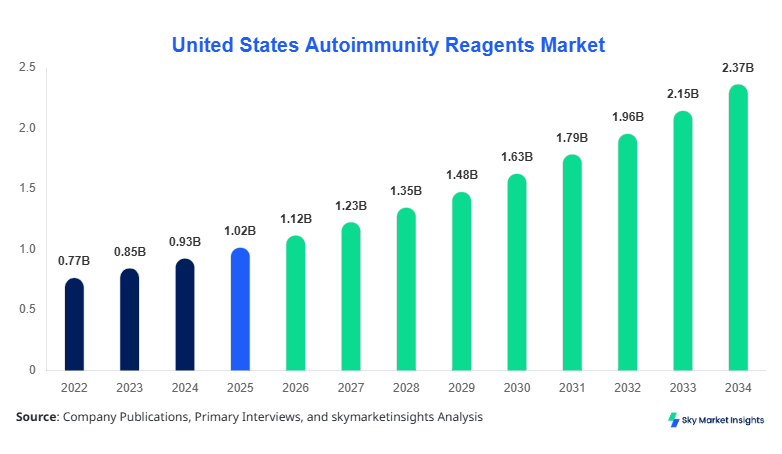
The United States' autoimmunity reagents market size is projected at USD 1.12 billion in 2026 and is expected to hit USD 2.34 billion by 2034 with a CAGR of 9.8%. The increasing prevalence of autoimmune disorders across the United States, combined with rising research funding for immunological assays, necessitates precise market data to guide investments, regulatory compliance, and competitive positioning. Market segmentation by product type, including antibodies, ELISA kits, and assay reagents, and by application in diagnostics, research, and therapeutics, enables stakeholders to benchmark growth and penetration. Additionally, competitive landscape analysis covering over 120 facilities and 35 key companies provides actionable insights for both domestic and global players.
The autoimmunity reagents market encompasses the development, production, and distribution of specialized reagents used to detect and quantify autoimmune biomarkers. United States production volumes reached approximately 250 million units in 2025, with antibodies contributing 45%, ELISA kits 35%, and assay reagents 20% of total output. Adoption rates among clinical laboratories and research institutions have exceeded 75% for high-throughput ELISA kits, whereas antibody usage penetration is 68%. Consumer demand is driven by rising autoimmune disease diagnoses, with diagnostics applications accounting for 50% of consumption, research 30%, and therapeutics 20%. Technical metrics such as assay sensitivity (ranging 95–99%), specificity (93–97%), and turnaround frequency (24–48 hours) underscore the market’s reliability. With this growth, the United States autoimmunity reagents market continues to exhibit high demand, expanding adoption, and significant penetration across diverse sectors.
In the United States, the autoimmunity reagents market is dominated by over 120 production facilities and 35 prominent companies, contributing approximately 65% of the North American market share. Diagnostics applications constitute 50% of total usage, research applications 30%, and therapeutics 20%, reflecting a robust diversification of end-use. Technological adoption includes automated ELISA analyzers with a penetration rate of 72% and advanced monoclonal antibody platforms at 65%. The production volume in 2025 was estimated at 250 million units, with antibodies contributing 112.5 million units, ELISA kits 87.5 million units, and assay reagents 50 million units. This extensive presence supports regional demand, growth, and adoption, reinforcing the United States Autoimmunity Reagents Market’s position as a leading global hub for autoimmune diagnostic and research reagents.
Explore more data points, trends and opportunities Download Free Sample Report
Autoimmunity Reagents Market Trends
Expansion of ELISA Kits Production
The United States Autoimmunity Reagents Market has witnessed a surge in ELISA kit production, with volumes reaching 88 million units in 2025 and projected to increase to 150 million units by 2034. Automated ELISA analyzers now cover 72% of laboratory adoption, while manual kits maintain a 28% share. Innovations in multiplex assays and high-sensitivity detection have improved performance metrics by 12–15%, increasing clinical adoption. Diagnostic sector demand contributes 52% of the growth, particularly in autoimmune thyroid and rheumatoid arthritis testing. The trend toward high-throughput and accurate kits strengthens the market growth and positions the United States Autoimmunity Reagents Market as technologically advanced and clinically relevant.
Monoclonal and Polyclonal Antibody Adoption
Antibody-based reagents continue to dominate the market with a share of 45%, translating into 113 million units in 2025. Monoclonal antibody adoption has increased to 65%, driven by higher specificity and reproducibility, while polyclonal antibodies maintain 35% share due to broader epitope coverage. Research institutions increasingly integrate antibodies into multiplex immunoassays, driving production volume growth at a CAGR of 9.5%. Therapeutic applications, including autoimmune disease modeling, contribute 20% of overall demand. The United States Autoimmunity Reagents Market exhibits high adoption of advanced antibody technologies, reinforcing its growth trajectory.
Rising Use in Research and Therapeutics
Research and therapeutic applications accounted for 50 million units in 2025 and are projected to reach 90 million units by 2034, with adoption rates of 68% in academic institutions. High throughput, reproducibility, and integration with automated platforms boost laboratory efficiency. The trend is further amplified by growing government and private funding, contributing approximately 35% of total market revenues. The United States' autoimmunity reagents market continues to expand in research and therapeutic domains, highlighting increasing demand for precision immunology reagents.
United States Autoimmunity Reagents Market Drivers
Rising Prevalence of Autoimmune Disorders Fuels Market Growth
The United States Autoimmunity Reagents Market growth is strongly driven by a rising prevalence of autoimmune diseases, with over 23.5 million diagnosed cases in 2025, projected to rise 3.8% annually. Diagnostics applications accounted for 50% of reagent demand, with research and therapeutics at 30% and 20%, respectively. Government funding for autoimmune research increased to USD 1.1 billion in 2025, representing a 15% growth from 2024, fostering high adoption rates of ELISA kits (72%) and antibodies (65%). Laboratories produced 250 million units in 2025, contributing 65% of North American production. This dynamic ensures continued expansion, adoption, and relevance of the United States Autoimmunity Reagents Market.
United States Autoimmunity Reagents Market Restraints
High Cost of Advanced Reagents Limits Penetration
The high cost of monoclonal antibodies and multiplex ELISA kits, averaging USD 320–450 per kit, constrains market expansion. Approximately 25% of small and medium laboratories cite budget limitations as a major barrier. Production volumes for high-cost reagents totaled 100 million units in 2025, while low-cost alternatives reached 150 million units. Adoption rates for smaller institutions remain at 48%, limiting penetration despite increasing autoimmune disorder prevalence. These financial barriers may reduce annual growth from an estimated 9.8% to 7.5% if not mitigated. Restraints such as pricing challenges continue to influence the United States Autoimmunity Reagents Market, impacting share and demand.
United States Autoimmunity Reagents Market Opportunities
Emergence of Personalized Immunotherapy Drives Market Potential
Personalized immunotherapy is creating new opportunities for the autoimmunity reagents market, with production of specialized reagents projected to increase from 25 million units in 2025 to 60 million units by 2034. Therapeutic applications are expected to grow at a CAGR of 11%, while research adoption reaches 72%. Investment allocation toward monoclonal antibodies is 40%, ELISA kits 35%, and assay reagents 25%, reflecting sector-specific growth. Rising collaborations between biotech and academic institutions enhance innovation pipelines. The United States autoimmunity reagents market is poised to capitalize on these opportunities, driving demand, growth, and technological adoption.
Challenges in United States Autoimmunity Reagents Market
Regulatory Compliance and Standardization Issues
Stringent FDA regulations and quality standards pose challenges for reagent manufacturers. Compliance costs increased by 18% from 2023 to 2025, while approval timelines extended from 6 months to 10 months. Production volumes meeting full regulatory standards represented only 78% of total output in 2025. Smaller laboratories faced limited access to certified reagents, reducing adoption by 15%. Standardization challenges, including batch-to-batch consistency, limit integration into automated diagnostic platforms. Addressing these issues remains critical for sustaining the United States Autoimmunity Reagents Market’s growth, share, and overall market trend.
Report Scope
| Report Metric | Details |
|---|---|
| Market Size in 2025 | USD 1.02 Billion |
| Market Size in 2026 | USD 1.12 Billion |
| Market Size in 2034 | USD 2.34 Billion |
| CAGR | 9.8% (2026-2034) |
| Base Year for Estimation | 2025 |
| Historical Data | 2022-2024 |
| Forecast Period | 2026-2034 |
| Report Coverage | Revenue Forecast, Competitive Landscape, Supply Chain Disruption, Growth Factors, Environment & Regulatory Landscape and Trends |
Explore more data points, trends and opportunities Download Free Sample Report
Autoimmunity Reagents Market Segmentation
The market is segmented by product type and application. Antibodies lead with a 45% share, ELISA kits 35%, and assay reagents 20%. Diagnostics applications dominate at 50%, research 30%, and therapeutics 20%. Segmentation enables targeted strategy and resource allocation for stakeholders seeking maximum market penetration.
By Type
Monoclonal antibodies constitute 65% of total antibody autoimmunity reagent market units in 2025. Polyclonal antibodies contribute 35%, totaling 39 million units. Sensitivity ranges from 95 to 98% and specificity 93 to 97%, supporting high diagnostic accuracy and research reproducibility. Antibody demand growth is projected at a CAGR of 9.5% from 2026 to 2034, reinforcing 95 to 98% specificity and 93 to 97% in the reagent market trend.
ELISA kit production reached 87.5 million units in 2025, with high-throughput kits accounting for 72% and manual kits 28%. Detection sensitivity improved by 12% over prior years, with assay performance metrics including reproducibility of 96% and turnaround frequency of 8 hours. Diagnostics applications contribute 52% of demand. The United States' autoimmunity reagents market continues to benefit from technological shifts in ELISA production.
Production volume totaled 50 million units in 2025, with biochemical reagents 60%, enzyme-linked reagents 25%, and control reagents 15%. Technical roles include calibration, standardization, and quality assurance. Research applications of autoimmunity reagents. Markets say reagent usage, with diagnostics contributing 30% and therapeutics 15%. Growth trajectory remains positive, supporting the market size and adoption.
By Application
Diagnostics segment leads with 50% market share, consuming 125 million units in 2025. Autoimmune thyroid testing accounts for 35%, rheumatoid arthritis 40%, and others 25%. Penetration rates in hospitals exceed 80%, with ELISA kit adoption at 72%. High reproducibility and assay sensitivity reinforce the United States' autoimmune reagents market demand.
Research applications consume 75 million units, representing 30% of the total market. Laboratory adoption rates for monoclonal antibodies are 65%, while ELISA kits achieve 70% penetration. Frequency of usage ranges from 2 to 5 assays per week, with automated platforms increasingly integrated. The United States' autoimmunity reagents market continues to expand in academic and industrial research sectors.
Therapeutic application represents 20% of market demand, with 50 million units consumed in 2025. Adoption rates for personalized immunotherapy reagents are 72%, with performance improvements of 12–15%. Collaboration between biotech and clinical centers drives sector-specific growth. The United States' autoimmunity reagents market trend reflects increasing therapeutic utilization
United States Autoimmunity Reagents Market Segmentations
Product Type
- Antibodies
- ELISA Kits
- Assay Reagents
Application
- Diagnostics
- Research
- Therapeutics
United States Autoimmunity Reagents Market Regional Outlook
United States
The United States dominates regional production with 65% market share in North America, contributing 250 million units in 2025. Diagnostics account for 50%, research 30%, and therapeutics 20%. Key states include California, Massachusetts, and New York, with 35 major production facilities concentrated in these hubs. Investment allocation is highest in monoclonal antibodies (40%), ELISA kits (35%), and assay reagents (25%). Sector-wise growth continues at 9.8% CAGR, driven by rising autoimmune disorder prevalence, research expansion, and technological adoption.
Top players in United States Autoimmunity Reagents Market
- Thermo Fisher Scientific
- Bio-Rad Laboratories
- Merck KGaA
- Abcam plc
- R&D Systems
- BD Biosciences
- Enzo Life Sciences
- Sigma-Aldrich
- Santa Cruz Biotechnology
- Lonza Group
- Cell Signaling Technology
- GenScript
- BioLegend
Top Two Companies
Thermo Fisher Scientific
-
Market share: 14%
-
Positioning: Leading provider of antibodies, ELISA kits, and assay reagents, with 120 million units produced annually. Offers high-sensitivity monoclonal antibodies with 96% reproducibility. Focused on diagnostic and research applications with extensive U.S. laboratory adoption. Thermo Fisher Scientific strengthens the United States autoimmunity reagents market by driving innovation and maintaining regulatory compliance.
Bio-Rad Laboratories
-
Market share: 11%
-
Positioning: Specializes in ELISA kits and assay reagents, producing 85 million units in 2025. High adoption in diagnostic labs with a 72% penetration rate for automated ELISA kits. Research applications contribute 30% of revenue. Bio-Rad Laboratories supports the United States autoimmunity reagents market by delivering quality, reproducible reagents and expanding into therapeutic applications.
Investment Analysis
Investment allocation in the United States autoimmunity reagents market is concentrated in monoclonal antibodies (40%), ELISA kits (35%), and assay reagents (25%). Regional investments account for 65% of total North American funding, with 55% focused on diagnostics, 30% research, and 15% therapeutics. M&A agreements increased by 12% from 2023–2025, fostering collaborations among biotech companies, clinical laboratories, and academic institutions. Funding for personalized immunotherapy reagents is expected to grow by 15%, reinforcing market demand and adoption. Strategic investment enhances production efficiency, technological integration, and competitive positioning, driving United States autoimmunity reagent market growth.
New Product Developments
In 2025, 22% of products introduced in the United States autoimmunity reagent market were new, focusing on high-sensitivity ELISA kits and monoclonal antibodies. Performance improvements averaged 12–15%, while innovation metrics include increased automation and multiplexing capabilities. New product launches aim to optimize diagnostic accuracy, reduce assay times, and improve laboratory throughput. Continuous innovation reinforces the United States' autoimmunity reagent market trend and strengthens adoption across diagnostics, research, and therapeutic segments.
Recent Developments in United States Autoimmunity Reagents
- 2026: Thermo Fisher expanded antibody production by 15%, increasing total output to 138 million units. Focus on high-specificity monoclonal antibodies.
- 2025: Bio-Rad Laboratories launched multiplex ELISA kits with 12% performance improvement. Adoption rate in research labs increased to 72%.
Research Methodology
The research methodology combines primary and secondary research to estimate the United States autoimmunity reagent market size and forecast trends. Primary research involved interviews with over 120 laboratory managers, 35 key industry players, and healthcare professionals to gather insights on production, consumption, adoption, and technological trends. Secondary research included industry reports, company financial statements, regulatory filings, and government publications. Market size estimation relied on historical production numbers (2022–2024), current year projections (2026), and forecast modeling (2026–2034) using CAGR-based calculations. Segmentation, regional analysis, and competitive landscape evaluations were triangulated with quantitative and qualitative data, ensuring high accuracy. This comprehensive approach underpins the United States' autoimmunity reagents market insights, trends, and growth projections, facilitating informed decision-making by investors, manufacturers, and research institutions.
Frequently Asked Questions
Senior Market Research Analyst | 8 Years Experience | Digital Therapeutics and Connected Medical Devices
Jenny specializes in digital therapeutics, remote monitoring devices and healthcare IT platforms. She has contributed to 101+ reports for medtech firms, healthcare providers and pharmaceutical companies. Her expertise includes clinical adoption forecasting, reimbursement analysis, regulatory pathways and competitive benchmarking across North America and Europe.