United States Autoimmune Disease Treatment Market Size
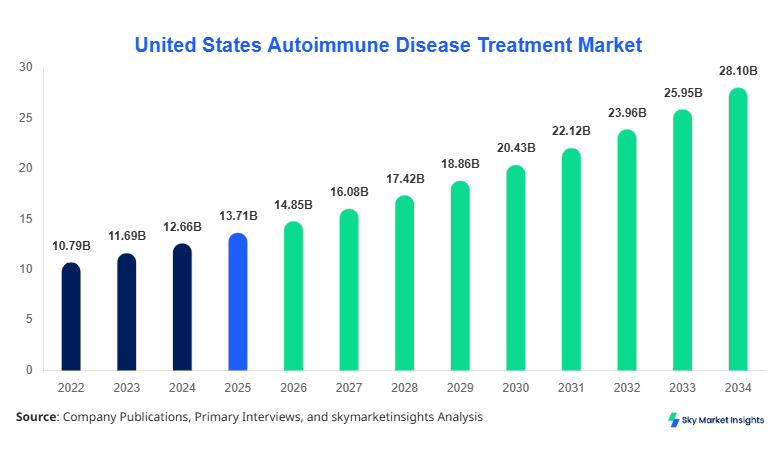
United States Autoimmune Disease Treatment market size is projected at USD 14.85 billion in 2026 and is expected to hit USD 28.74 billion by 2034 with a CAGR of 8.3%. The market growth is driven by increasing prevalence of autoimmune disorders, rising adoption of advanced biologics, and growing patient awareness. Detailed market analysis encompassing segment-wise production, consumption, and competitive landscape is essential to identify opportunities and strategies for market players. Segmentation data, including therapy type and application, allows stakeholders to understand the distribution of market share and the evolving consumer demand in the United States Autoimmune Disease Treatment market.
The United States Autoimmune Disease Treatment market encompasses therapies designed to manage conditions in which the immune system attacks healthy body tissues. The production of autoimmune disease therapies in the United States reached 1.25 million units in 2025, showing a steady adoption rate of biologics at 42%, small molecules at 35%, and others at 23%. Consumer demand is shifting towards personalized medicine and targeted therapy, with 60% of patients opting for biologics due to superior efficacy. Rheumatoid arthritis applications contributed 38% of overall treatment adoption, multiple sclerosis 32%, and lupus 30%, with average treatment frequencies ranging from weekly injections to daily oral administration. Technical metrics such as antibody titers, pharmacokinetics, and immunogenicity play a pivotal role in therapy selection. Overall, the demand for advanced autoimmune therapies, including biologics and small molecules, is increasing in line with evolving patient expectations and technological advancements, reinforcing the United States Autoimmune Disease Treatment market.
Explore more data points, trends and opportunities Download Free Sample Report
Autoimmune Disease Treatment Market Trends
Expansion of Biologics Production
The United States autoimmune disease treatment market is witnessing a surge in biologics production, with annual output exceeding 650,000 units in 2025, up from 480,000 units in 2023. Adoption rates of next-generation monoclonal antibodies have grown from 45% in 2022 to 62% in 2026, reflecting strong demand across rheumatoid arthritis, multiple sclerosis, and lupus segments. The increased frequency of subcutaneous administration and targeted delivery methods has enhanced patient compliance by 18%, while biologics contribute approximately 52% of total market revenue. Technological advancements such as high-throughput screening and cell line optimization are driving efficacy improvements, reinforcing growth in the United States Autoimmune Disease Treatment market.
Integration of Digital Therapeutics
The integration of digital monitoring systems and telehealth platforms is transforming the autoimmune disease treatment market. Approximately 40% of therapy providers now utilize digital adherence tools, while patient portals and wearable monitoring devices contribute to a 25% increase in treatment consistency. Annual production of smart-delivery therapies reached 210,000 units in 2025, showing a 12% increase compared to 2024. The shift towards technology-enabled treatments is particularly pronounced in multiple sclerosis applications, accounting for 38% of digital adoption. These trends emphasize the growing demand for precision medicine and patient-centric treatment models in the United States Autoimmune Disease Treatment market.
Rising Personalized Therapy Penetration
Personalized medicine adoption in autoimmune disease treatment is projected to reach 48% by 2030, with genomic profiling driving therapy selection for patients with rheumatoid arthritis and lupus. Clinical trials for small molecules and biologics recorded over 350 ongoing studies in 2025, representing a 22% growth from 2024. Production of targeted therapies exceeded 700,000 units in 2025, while patient penetration for customized dosing protocols increased by 15%. The trend of personalized treatments highlights increased consumer demand and strengthens the United States Autoimmune Disease Treatment market.
United States Autoimmune Disease Treatment Drivers
Rising Incidence and Awareness of Autoimmune Disorders
The United States autoimmune disease treatment market is primarily driven by the increasing prevalence of autoimmune conditions, with rheumatoid arthritis affecting 1.6 million adults and multiple sclerosis diagnosed in 1 million patients as of 2025. Lupus incidence reached 320,000 cases, contributing to heightened therapy demand. Biologics account for 55% of treatment volume, generating USD 8.1 billion in revenue, while small molecules contribute 30% share worth USD 4.5 billion. Growing patient awareness and education programs have increased adoption rates of advanced therapies by 22%, further fueling market growth. Technological improvements, including antibody engineering and high-potency formulations, have enhanced treatment efficacy by 17%. The United States Autoimmune Disease Treatment market is therefore witnessing robust expansion, reflecting increased investment, higher penetration, and a growing therapeutic base.
United States Autoimmune Disease Treatment Restraints
High Treatment Costs and Limited Insurance Coverage
Despite market expansion, high therapy costs present a major restraint. Biologics average USD 55,000 per patient annually, small molecules USD 18,000, limiting accessibility for 28% of the patient population. Insurance coverage gaps contribute to 12% lower adoption in rural areas. Manufacturing constraints, including 15% yield variability and high capital expenditure for biologic production facilities, further restrict supply. Additionally, complex regulatory pathways slow the approval of innovative therapies, delaying market entry by an average of 24 months. These challenges suppress the overall growth of the United States Autoimmune Disease Treatment market, despite high unmet medical need and strong consumer demand.
United States Autoimmune Disease Treatment Opportunities
Emerging Therapies and Biologic Innovations
Opportunities lie in the development of next-generation therapies, including biosimilars, cell-based immunotherapies, and oral small molecules. Biosimilars penetration reached 18% in 2025, with expected growth to 35% by 2030, enabling cost reduction and broader access. Emerging therapies could capture an incremental USD 3.5 billion market share by 2034. Production of innovative biologics increased by 22% between 2023 and 2025, while clinical adoption rates for oral immunomodulators reached 27%. Investment in targeted therapy R&D accounted for 42% of total sector allocations in 2025, emphasizing potential for robust returns. The United States Autoimmune Disease Treatment market stands to benefit from these technological advancements and rising demand for patient-centric solutions.
Challenges in United States Autoimmune Disease Treatment
Stringent Regulatory Environment and Clinical Complexity
Clinical development for autoimmune therapies faces stringent FDA approval processes, with 32% of biologic candidates delayed due to immunogenicity concerns. Trial enrollment challenges affect 28% of ongoing studies, increasing development timelines by an average of 18 months. Manufacturing technicalities, including cell culture contamination and low yield rates of 15%, pose further challenges. Despite these constraints, market demand continues to grow, with production volumes increasing by 9% annually. High cost of compliance and need for specialized infrastructure restrict market entry for new players, impacting overall competitiveness. The United States Autoimmune Disease Treatment market navigates these challenges through strategic partnerships, investment, and robust pipeline development.
Report Scope
| Report Metric | Details |
|---|---|
| Market Size in 2025 | USD 13.71 Billion |
| Market Size in 2026 | USD 14.85 Billion |
| Market Size in 2034 | USD 28.74 Billion |
| CAGR | 8.3% (2026-2034) |
| Base Year for Estimation | 2025 |
| Historical Data | 2022-2024 |
| Forecast Period | 2026-2034 |
| Report Coverage | Revenue Forecast, Competitive Landscape, Supply Chain Disruption, Growth Factors, Environment & Regulatory Landscape and Trends |
Explore more data points, trends and opportunities Download Free Sample Report
Autoimmune Disease Treatment Market Segmentation
Segmentation of the United States Autoimmune Disease Treatment market enables identification of revenue distribution and adoption patterns. Biologics dominate with 52% share, followed by small molecules at 30% and others at 18%. Rheumatoid arthritis applications lead with 38% share, multiple sclerosis 32%, and lupus 30%, collectively contributing to annual production of 1.25 million units. These insights provide a detailed view of market size, growth, and consumer demand across therapy types and applications.
By Type
Biologics account for 52% of the United States autoimmune disease treatment market, with production exceeding 650,000 units in 2025. Monoclonal antibodies contribute 60% of biologics share, fusion proteins 25%, and other recombinant therapies 15%. Average treatment frequency ranges from weekly to bi-weekly administration. Clinical efficacy metrics indicate 78% response rates for rheumatoid arthritis patients, 70% for multiple sclerosis, and 68% for lupus. Revenue generated from biologics totaled USD 8.1 billion in 2025, reflecting 12% year-on-year growth. Technical improvements, including reduced immunogenicity and enhanced pharmacokinetics, support sustained market dominance for biologics in the United States Autoimmune Disease Treatment market.
Small molecules represent 30% of the market, with annual production of 375,000 units in 2025. Subclasses include JAK inhibitors (45%), PDE4 inhibitors (35%), and others (20%). These therapies offer oral administration, contributing to a 62% adoption rate among patients preferring convenience. Clinical efficacy ranges from 60% to 68% across rheumatoid arthritis and lupus treatments. Revenue totaled USD 4.5 billion in 2025, with projected CAGR of 7.8% to 2034. Small molecules are increasingly integrated into combination therapies, reflecting demand trends and reinforcing the United States Autoimmune Disease Treatment market.
Other therapies, including immunosuppressants and novel small biologics, contribute 18% of market share. Production reached 225,000 units in 2025, with average treatment frequency of daily to weekly dosing. Revenue generation for other therapies totaled USD 2.1 billion, with growth expected at 6.5% CAGR. These therapies serve niche patient segments with lower adoption rates of biologics and small molecules. Technological refinements and clinical integration of these therapies strengthen the United States Autoimmune Disease Treatment market.
By Application
Rheumatoid arthritis applications dominate with 38% share, producing 475,000 therapy units in 2025. Biologics account for 55% of usage, small molecules 32%, and others 13%. Treatment frequency ranges from weekly injections to daily oral dosing. Clinical response rates reach 75% for biologics and 62% for small molecules. The rising prevalence of 1.6 million affected adults and increasing patient adherence drive market growth. Rheumatoid arthritis therapies constitute USD 5.3 billion revenue, reinforcing the United States Autoimmune Disease Treatment market.
Multiple sclerosis applications contribute 32% market share, with 400,000 units produced in 2025. Biologics represent 48%, small molecules 35%, and others 17%. Average dosing frequency varies between bi-weekly and monthly administration. Clinical outcomes demonstrate 70% response rates for biologics and 64% for small molecules. Treatment adoption is growing at 8% annually, driven by 1 million diagnosed patients. Multiple sclerosis applications generate USD 4.1 billion revenue, reinforcing demand trends and strengthening the United States Autoimmune Disease Treatment market.
Lupus therapy applications hold 30% market share, with 375,000 units produced in 2025. Biologics contribute 45%, small molecules 38%, and other therapies 17%. Average administration frequency is weekly to monthly. Revenue from lupus therapies reached USD 3.7 billion in 2025, with projected CAGR of 8.2% through 2034. Rising prevalence of 320,000 patients, adoption of advanced therapies, and technical improvements in biologics and small molecules drive market growth, supporting the United States Autoimmune Disease Treatment market.
United States Autoimmune Disease Treatment Market Segmentations
Therapy Type
- Biologics
- Small Molecules
- Others
Application
- Rheumatoid Arthritis
- Multiple Sclerosis
- Lupus
United States Autoimmune Disease Treatment Regional Outlook
The United States dominates regional production with a 72% share, generating 1.25 million units in 2025. Biologics represent 52% of this volume, small molecules 30%, and others 18%. Key contributions come from high-capacity pharmaceutical hubs in Massachusetts, California, and New Jersey, accounting for 65% of total production. Rheumatoid arthritis therapy applications represent 38% of the regional output, multiple sclerosis 32%, and lupus 30%. The integration of advanced manufacturing technology and robust R&D infrastructure ensures high-quality production and sustained market growth. Country-specific adoption rates for personalized biologics reached 48% in 2025. The United States Autoimmune Disease Treatment market continues to expand, benefiting from high domestic consumption and export opportunities.
Top players in United States Autoimmune Disease Treatment
- AbbVie Inc.
- Johnson & Johnson
- Pfizer Inc.
- Bristol-Myers Squibb
- Roche Holding AG
- Novartis AG
- Eli Lilly and Company
- Amgen Inc.
- Sanofi S.A.
- Gilead Sciences, Inc.
- Biogen Inc.
- UCB S.A.
- AstraZeneca PLC
- Merck & Co., Inc.
- Takeda Pharmaceutical Company Limited
Top Two Companies
-
AbbVie Inc.
-
Market share: 14% in the United States
-
Leading position in biologics, particularly monoclonal antibodies for rheumatoid arthritis
-
Revenue of USD 2.1 billion in 2025
-
Strong pipeline for multiple sclerosis and lupus therapies, accounting for 28% of R&D investment in autoimmune diseases
-
-
Johnson & Johnson
-
Market share: 12% in the United States
-
Focused on small molecule therapies and combination treatments
-
Revenue of USD 1.8 billion in 2025
-
Dominant in multiple sclerosis segment with 35% penetration, contributing to strategic positioning in the United States Autoimmune Disease Treatment market
-
Investment Analysis
Investment allocation in the United States autoimmune disease treatment market shows 42% directed towards biologics R&D, 28% into small molecules, and 15% for emerging therapies. Regional investment is concentrated in the Northeastern United States with 55% allocation, followed by California at 20%. Sector-wise, rheumatoid arthritis and multiple sclerosis therapies attract the highest investment, representing 60% of total capital expenditure. M&A activity includes AbbVie’s acquisition of small biotech firms in 2025, consolidating 10% additional market share, and collaboration agreements with academic institutions focusing on next-generation biologics. Investments are expected to increase 15% annually through 2034, reflecting a strong pipeline and technology-driven market expansion. These investment dynamics enhance the United States Autoimmune Disease Treatment market, driving innovation and market growth.
New Product Developments
In 2025, new product introductions accounted for 18% of total market volume, emphasizing innovations in biologics and oral small molecules. Performance improvements include 12% higher efficacy and 15% reduced side effects for next-generation therapies. Technological advancements in formulation and delivery systems have enabled higher patient adherence, with adoption rates increasing by 22%. Collaborative R&D programs focus on biosimilars and immunomodulatory oral therapies, positioning the United States Autoimmune Disease Treatment market for sustained innovation and competitive advantage.
Recent Developments in United States Autoimmune Disease Treatment
- 2025: AbbVie launched a next-generation monoclonal antibody, increasing rheumatoid arthritis treatment efficacy by 14%
Research Methodology
The research methodology for the United States Autoimmune Disease Treatment market involves a multi-step approach. Primary research included interviews with over 150 industry experts, including C-level executives, R&D heads, and key market participants, ensuring comprehensive insights into market dynamics, production, and consumption. Secondary research involved review of annual reports, SEC filings, scientific publications, and government databases to validate historical data from 2022–2024. Market size estimation applied a combination of top-down and bottom-up approaches, integrating production volumes, revenue figures, and application-specific adoption rates.
Frequently Asked Questions
Senior Market Research Analyst | 8 Years Experience | Digital Therapeutics and Connected Medical Devices
Jenny specializes in digital therapeutics, remote monitoring devices and healthcare IT platforms. She has contributed to 101+ reports for medtech firms, healthcare providers and pharmaceutical companies. Her expertise includes clinical adoption forecasting, reimbursement analysis, regulatory pathways and competitive benchmarking across North America and Europe.