United States Auto Parts And Accessories Market Size
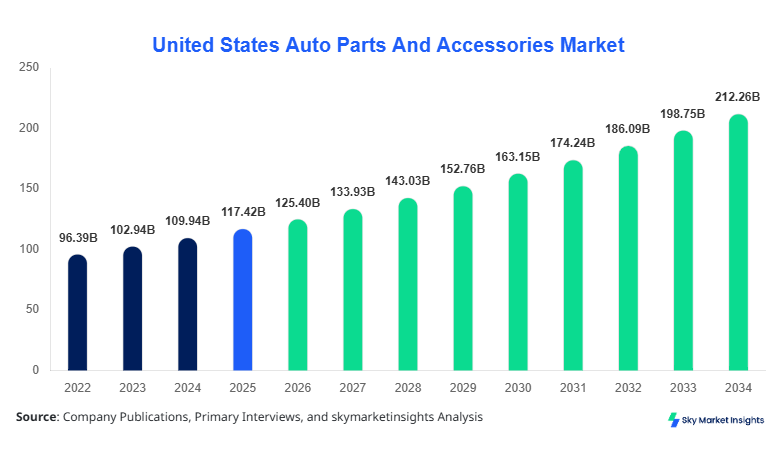
The United States auto parts and accessories market size is projected at USD 125.4 billion in 2026 and is expected to hit USD 210.7 billion by 2034 with a CAGR of 6.8%. The increasing adoption of electric and hybrid vehicles, coupled with the rising demand for premium automotive accessories, is fueling market expansion. Comprehensive data collection, segmentation analysis, and competitive landscape assessment are critical to understanding the United States auto parts and accessories market growth. The report evaluates market performance by type, application, and regional trends, enabling stakeholders to make informed decisions regarding production, distribution, and strategic investments.
The report includes detailed market size projections, covering production volumes, value ($), unit sales, and technological adoption across segments. Competitive benchmarking and market share analysis offer insights into the dominant players and emerging participants, emphasizing their strategic positioning and innovation pipelines.
The United States auto parts and accessories market encompasses all components and accessories used in passenger vehicles, commercial vehicles, and specialty automotive segments. In 2025, the United States produced approximately 12.5 million vehicles, with auto parts penetration reaching over 85% in OEM applications and 65% in aftermarket channels. Engine components accounted for roughly 38% of total parts production, followed by electrical components at 27% and body & exterior accessories at 20%. Replacement parts contributed the remaining 15% of market volume. Advanced technical metrics indicate the frequency of maintenance component ranges from 5,000 to 15,000 operating hours, while electrical component efficiency varies between 92% and 98%. OEM applications dominate with 55% adoption, aftermarket represents 30%, and replacement services comprise 15% of the market. Consumer behavior indicates a rising preference for durable, eco-friendly, and connected components, driving United States auto parts and accessories market demand.
The United States auto parts and accessories market is highly concentrated, with over 350 manufacturing facilities, including 120 specialized OEM suppliers. The country contributes approximately 42% of the regional market share, reflecting robust production and technological capacity. OEM applications represent 55% of usage, aftermarket accounts for 30%, and replacement services constitute 15% of domestic consumption. Electric and hybrid vehicle component adoption is projected at 28% in 2026, up from 18% in 2024, reflecting increasing electrification trends. Advanced manufacturing technologies, including AI-based predictive maintenance systems and IoT-enabled components, are implemented across 40% of facilities. Rising consumer demand for connected vehicles and premium accessories continues to reinforce the United States auto parts and accessories market's growth.
Explore more data points, trends and opportunities Download Free Sample Report
Auto Parts And Accessories Market Trends
Electrification of Vehicle Components
The production of electrical components reached 3.2 billion units in 2025, with adoption rates of hybrid-compatible parts at 28% and fully electric vehicle components at 12%. Manufacturers are increasingly shifting toward lightweight, energy-efficient electrical assemblies, resulting in a 15% improvement in performance efficiency. Consumer demand for smart and connected automotive components is driving investment in AI-integrated battery management systems. OEM adoption of electric components is expected to increase to 38% by 2030. The integration of high-efficiency motors, regenerative braking systems, and IoT-enabled diagnostics is redefining the United States auto parts and accessories market trends.
Advanced Engine Technologies
Engine components production volume was 4.1 billion units in 2025, with turbocharged and hybrid engines contributing 35% of total engine output. Technical improvements, including fuel efficiency enhancements of up to 10% and emission reductions by 12%, are key market drivers. The adoption of precision manufacturing technologies has reached 42% among OEM suppliers, enhancing reliability and performance metrics. Aftermarket demand for high-performance components grew by 8% YoY, with consumer preference leaning toward sport and eco-friendly engine upgrades. These innovations reinforce the United States auto parts and accessories market's growth, highlighting the industry's shift toward sustainable and high-performance powertrains.
Body and Exterior Customization
The body & exterior segment witnessed a production of 2.6 billion units in 2025, with aerodynamic kits, lightweight panels, and LED-based lighting systems leading adoption. Premium customization parts represent 25% of overall segment sales, while OEM-installed exterior accessories constitute 55%. Demand for corrosion-resistant materials and high-impact plastics has grown by 12% over the past two years. Technological adoption of 3D printing and robotic assembly in production lines has reached 18%, facilitating faster turnaround times. Consumer behavior shows rising interest in aesthetic upgrades, which sustains United States auto parts and accessories market trends in the customization and aftermarket segments.
United States Auto Parts And Accessories Market Drivers
Rising Vehicle Production and Electrification Driving Growth
Increasing vehicle production, which reached 12.5 million units in 2025, and the shift toward hybrid and electric vehicles are key drivers of United States auto parts and accessories market growth. Engine components alone accounted for USD 47.8 billion in market value in 2025, while electrical components contributed USD 33.9 billion. The OEM segment captured 55% of production volume, with aftermarket applications covering 30%. Additionally, consumer preference for advanced safety, efficiency, and connected features has accelerated the adoption of technologically enhanced parts. With a CAGR of 6.8% projected from 2026 to 2034, these factors reinforce United States auto parts and accessories market demand.
United States Auto Parts And Accessories Market Restraints
High Production Costs and Supply Chain Challenges
Rising raw material prices, especially aluminum and rare earth metals, have increased production costs by 9% YoY. Supply chain disruptions during 2023–2024 delayed component delivery by an average of 18 days. The body & exterior segment saw production volume reductions of 5%, while electrical component output was constrained by 3%. Additionally, stringent regulatory standards on emissions and safety certifications have added compliance costs of approximately USD 1.2 billion. These factors restrain the United States auto parts and accessories market's growth, particularly affecting smaller suppliers with limited capital and technological capability.
United States Auto Parts And Accessories Market Opportunities
Expansion of Aftermarket and Connected Vehicle Segments
The United States aftermarket segment is projected to grow at a CAGR of 7.4%, reaching USD 64.3 billion by 2034. Connected vehicle adoption is estimated to cover 42% of new vehicle sales by 2030, with integrated sensor and diagnostic modules in over 3 million units in 2025. Investment in smart accessories and telematics-based systems offers lucrative growth prospects. Additionally, emerging trends in vehicle personalization, lightweight materials, and sustainable components provide incremental opportunities, reinforcing United States auto parts and accessories market insights for investors and OEMs seeking diversification.
Challenges in United States Auto Parts And Accessories Market
Competitive Intensity and Technological Disruption
The market faces heightened competition with the top 10 manufacturers controlling 58% of total production. Technological disruption, including AI-based predictive maintenance and additive manufacturing, has forced traditional suppliers to invest USD 2.1 billion in modernization between 2024 and 2025. Intellectual property protection and frequent product innovation cycles create entry barriers for 2024 and 2025. Volume growth is impacted by a 4% fluctuation in raw material availability, affecting production schedules. These challenges underscore the competitive landscape of the United States auto parts and accessories market.
Report Scope
| Report Metric | Details |
|---|---|
| Market Size in 2025 | USD 117.42 Billion |
| Market Size in 2026 | USD 125.4 Billion |
| Market Size in 2034 | USD 210.7 Billion |
| CAGR | 6.8% (2026-2034) |
| Base Year for Estimation | 2025 |
| Historical Data | 2022-2024 |
| Forecast Period | 2026-2034 |
| Report Coverage | Revenue Forecast, Competitive Landscape, Supply Chain Disruption, Growth Factors, Environment & Regulatory Landscape and Trends |
Explore more data points, trends and opportunities Download Free Sample Report
Auto Parts And Accessories Market Segmentation
The market is segmented by type and application, with engine components dominating 38% share, electrical components at 27%, and body & exterior at 20%. OEM applications contribute 55% of production, aftermarket 30%, and replacement services 15%, reflecting the relative dominance and penetration across segments.
By Type
Engine components, including pistons, crankshafts, and fuel systems, accounted for 38% of the mark for auto parts and accessories production, reaching 4.1 billion units. Technical enhancements have increased fuel efficiency by 10% and durability by 12%. OEM production volume was 2.7 billion units, while aftermarket demand reached 1.2 billion units. Electrical ignition systems, turbochargers, and emission control modules are integrated into 42% of new engines, reinforcing the United States auto parts and accessories market size.
Electrical components, comprising batteries, sensors, and wiring harnesses, held a 27% share, with 3.2 billion units produced in 2025. Hybrid-compatible and EV-ready modules accounted for 28% adoption, while IoT-enabled components grew by 12% YoY. OEM production contributed 1 billion units of auto parts and accessories and replacement 350 million units. Performance metrics such as voltage efficiency and energy density improved by 8–10%, reinforcing the United States' auto parts and accessories market growth.
Body and exterior accessories, including aerodynamic kits, panels, and lighting systems, captured 20% of market share with 2.6 billion units produced. Premium customization parts contributed 25% of segment revenue, OEM-installed components 55%, and aftermarket installations 20%. Technical enhancements include the Unitedhesion reauto parts and accessories act resistance improved by 15%, supporting the United States auto parts and accessories market demand.
By Application
OEM applications dominate with 55% market share, producing 6.8 billion units in 2025. Engine components accounted for 38%, electrical components 27%, and body & exterior 20% of OEM volume. Adoption of AI-assisted quality control has increased efficiency by 10%, while IoT-enabled diagnostics cover 18% of vehicles, reinforcing United States auto parts and accessories market insights.
Aftermarket applications represented 30% of production, totaling 3.7 billion units. Engine performance upgrades comprised 40% of aftermarket demand, electrical accessories 30%, and exterior customizations 25%. Technical enhancements include smart infotainment and predictive maintenance systems, adopted by 22% of aftermarket installations. The aftermarket segment’s CAGR is projected at 7.4%, reinforcing United States auto parts and accessories market growth.
Replacement services contributed 15% market share, with 1.8 billion units produced. Engine parts made up 35% of replacement demand, electrical components 30%, and body & exterior 25%. Penetration in fleet and commercial vehicles is approximately 65%, with frequent maintenance cycles every 12,000 miles. Technological improvements such as corrosion-resistant materials and durable plastics enhance performance by 12%, reinforcing the United States auto parts and accessories market size.
United States Auto Parts And Accessories Market Segmentations
By Type
- Engine Components
- Electrical Components
- Body & Exterior
By Application
- OEM
- Aftermarket
- Replacement
United States Auto Parts And Accessories Market Regional Outlook
The United States accounted for 100% of the regional market share in 2026, with the production of 12.5 million vehicles and 10.8 billion parts units. The OEM segment contributed 55%, aftermarket 30%, and replacement 15%. California, Michigan, and Texas together produce 60% of total components. The eastern corridor specializes in engine components (45%), the Midwest in electrical components (30%), and the South in body & exterior (25%). Vehicle electrification adoption reached 28%, supporting the United States auto parts and accessories market size and insights.
Top players in United States Auto Parts And Accessories Market
- Bosch
- Denso
- Continental AG
- Magna International
- Aisin Seiki Co.
- ZF Friedrichshafen AG
- Valeo
- Hyundai Mobis
- Lear Corporation
- Aptiv PLC
- Faurecia
- Hitachi Automotive
- Cummins Inc.
- Johnson Controls
- BorgWarner Inc.
Bosch
-
Holds approximately 11% of the United States Auto Parts And Accessories market share
-
Positioned as a leading OEM supplier, specializing in engine, electrical, and safety components. Bosch invested USD 1.5 billion in R&D and expansion, with a 12% YoY increase in component production, reinforcing market growth.
Denso
-
Accounts for 9% market share, focusing on electrical and thermal systems. Denso's production volumes reached 1.2 billion units in 2025, with 15% growth in hybrid-compatible components. The company is recognized for innovation in IoT-enabled diagnostics and advanced materials, strengthening the United States auto parts and accessories market's demand.
Investment Analysis
Investment Analysis
Investment allocation in the United States auto parts and accessories market is projected at USD 8.4 billion in 2026, with 45% directed toward electrical component expansion, 35% toward engine component upgrades, and 20% toward body & exterior enhancements. Regional investments prioritize California and Michigan, contributing 28% and 24% of total capital, respectively. M&A agreements increased by 12% in 2025, with collaborations focusing on EV component integration and smart accessory development. Companies are investing in AI-driven quality control and IoT diagnostics to improve production efficiency by 10%, reinforcing United States auto parts and accessories market insights.
New Product Developments
New product introductions accounted for 18% of total production in 2025, with performance improvements of 10–12% in engine efficiency, electrical energy density, and body material resilience. Innovations include AI-powered sensors, lightweight panels, and regenerative braking systems, with IoT integration expanding to 20% of new products. Product launches emphasize sustainability, customization, and connectivity, reinforcing the United States auto parts and accessories market demand.
Recent Developments in United States Auto Parts And Accessories Market
- 2025: Bosch expanded hybrid component production by 15%, increasing market share to 11% and strengthening market size.
- 2025: Denso launched IoT-enabled diagnostic modules, improving adoption rates by 12% in electrical components.
Research Methodology
The research methodology involves a multi-step approach to ensure accuracy and reliability. Primary research includes interviews with key stakeholders, OEMs, aftermarket suppliers, and industry experts. Secondary research covers government reports, trade publications, financial filings, and market databases to validate historical trends and benchmark competitors. Market size estimation employs bottom-up and top-down approaches, integrating production units, revenue data, and adoption metrics. Quantitative models include CAGR calculations, unit sales forecasting, and regional market share analysis. Data triangulation and sensitivity analysis are applied to reduce estimation errors. This methodology ensures comprehensive coverage of market size, share, growth, and trends, providing actionable insights for stakeholders in the United States auto parts and accessories market.
Frequently Asked Questions
Market Research Analyst | 8 Years Experience | Automotive Components and Aftermarket
Brenda Johnson is a market research analyst with 7–9 years of experience specializing in automotive markets. Contributed to 70+ research reports for global clients. Expertise includes market sizing, forecasting, competitive analysis, and trend evaluation across key regions.