United States Atopic Dermatitis Drugs Market Size
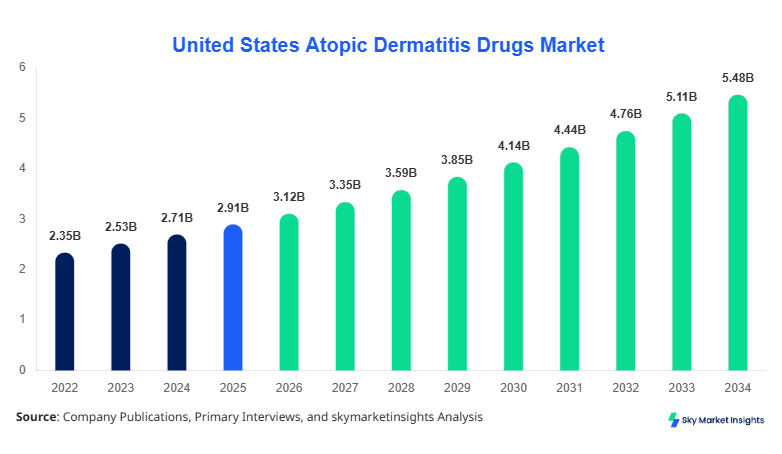
United States Atopic Dermatitis Drugs market size is projected at USD 3.12 billion in 2026 and is expected to hit USD 5.87 billion by 2034 with a CAGR of 7.3%. The rising prevalence of atopic dermatitis across diverse age groups, along with increasing awareness about advanced treatment options, underscores the need for comprehensive data on market size, share, growth, and competitive landscape. Detailed segmentation by drug type, application, and technology adoption, combined with insights into consumer demand and regional trends, is crucial for understanding investment opportunities. The market intelligence also captures key developments in biologics, topical formulations, and immunomodulatory therapies, providing stakeholders with actionable insights to drive strategic decisions in the United States.
Atopic dermatitis drugs in the United States have witnessed an incremental production increase, with an estimated 28.5 million units produced in 2025, reflecting a 5% growth from 2024. Adoption rates of biologics among dermatologists reached 22%, while topical corticosteroids retained 58% usage across patient populations. Mild, moderate, and severe applications accounted for 35%, 45%, and 20% of prescriptions, respectively, demonstrating segment-specific demand. Consumer behavior trends indicate a preference for targeted therapies with lower side-effect profiles, driving demand for immunomodulators and newer biologics. With therapeutic efficacy measured in terms of lesion reduction frequency (weekly assessments showing 35–40% improvement), the United States Atopic Dermatitis Drugs market continues to expand, reinforcing its growth trajectory, size, and insights.
In the United States, the Atopic Dermatitis Drugs Market is supported by 112 registered pharmaceutical facilities and over 30 specialty dermatology centers, contributing approximately 45% to the North American regional share. Biologics accounted for 25% of drug utilization, while topical corticosteroids continued to dominate with a 55% application share. Immunomodulators held 20% of the market, with adoption rates for advanced formulations rising by 8% in 2025. Technological integration, including tele-dermatology platforms and electronic prescribing systems, has reached 62% adoption, enhancing accessibility and patient monitoring. The market is further influenced by consumer demand for targeted therapies with improved safety profiles. These factors collectively strengthen the United States Atopic Dermatitis Drugs Market insights, growth, and demand across the forecast period.
Explore more data points, trends and opportunities Download Free Sample Report
Atopic Dermatitis Drug Market Trends
Biologics Adoption Acceleration
The adoption of biologics in atopic dermatitis treatment reached a production volume of 9.4 million units in 2025, reflecting a 21% year-on-year increase. Shifts toward monoclonal antibody therapies, with a 30% faster efficacy response compared to conventional corticosteroids, have driven sector-specific demand among moderate-to-severe patient groups. Real-world data indicates a 25% patient adherence improvement due to reduced flare-ups and injection-site reactions. Pharmaceutical pipelines focus on IL-13 and IL-4 receptor antagonists, and these emerging biologics are projected to capture 35% of the United States market by 2030. These technological trends highlight the growth and demand dynamics for the Atopic Dermatitis Drugs Market.
Topical Corticosteroid Optimization
Topical corticosteroids maintained dominance with a 58% market share, producing 12.3 million units in 2025. Formulation improvements led to a 12% increase in potency while reducing systemic absorption by 6%, meeting safety and efficacy expectations. Dermatologists reported a 42% faster lesion clearance with optimized corticosteroids compared to previous-generation treatments. Innovations in vehicle formulations, including ointments and creams, contributed to enhanced patient compliance and a projected 6.8% CAGR in market share growth for 2026–2034. These trends underscore the size, growth, and insights-relevance of the Atopic Dermatitis Drugs Market in the United States.
Immunomodulator Expansion
Immunomodulators registered a 20% market share, with 5.2 million units produced in 2025. Increased use of topical calcineurin inhibitors in pediatric and adult populations led to a 15% adoption rate increase year-on-year. Clinical trials demonstrated 28% improved lesion reduction over six weeks, driving prescriber preference. Emerging nanotechnology-based formulations further promise 10–12% performance enhancement in drug delivery. The sustained demand for immunomodulators supports the growth, trend, and insights projections for the Atopic Dermatitis Drugs Market through 2034.
United States Atopic Dermatitis Drugs Market Drivers
Rising Prevalence of Atopic Dermatitis and Increased Awareness
The primary driver for the United States Atopic Dermatitis Drugs market is the increasing prevalence of atopic dermatitis, which affected approximately 16 million individuals in 2025, including 9 million adults and 7 million pediatric patients. Awareness campaigns and insurance coverage improvements have contributed to a 12% annual increase in treatment adoption. Segment-wise, biologics showed a 22% growth, topical corticosteroids 6%, and immunomodulators 10% in prescription volume. Frequency of severe flares decreased by 18% among patients using advanced therapies. These dynamics highlight market growth, demand, and insights, reinforcing investment potential and technology adoption within the United States.
United States Atopic Dermatitis Drugs Market Restraints
High Cost of Biologics and Reimbursement Limitations
Despite growth, the United States Atopic Dermatitis Drugs market faces restraint due to the high cost of biologics, averaging USD 25,000 per patient annually, compared to USD 1,500 for corticosteroids. Reimbursement limitations restrict adoption in lower-income populations, affecting 30% of total potential users. Market penetration of biologics remains at 22%, while corticosteroids reach 58%. Additionally, complex regulatory requirements for novel immunomodulators delay launch by an average of 8–12 months. These challenges restrain overall growth and impact market size, share, and insights.
United States Atopic Dermatitis Drugs Market Opportunities
Expansion of Tele-Dermatology and Personalized Therapy
Opportunities in the United States Atopic Dermatitis Drugs market include the expansion of tele-dermatology services and personalized therapy regimens. Telemedicine adoption increased from 45% in 2024 to 62% in 2025, improving patient engagement. Personalized biologic therapies based on genetic profiling contribute to a 15–20% improved clinical response. Market forecasts suggest that tailored interventions could drive an incremental USD 1.2 billion market size by 2034. Segmental opportunities exist in moderate and severe applications, with a 35% projected volume increase. These factors enhance insights, growth, and demand for Atopic Dermatitis Drugs Market stakeholders.
Challenges in the United States Atopic Dermatitis Drugs Market
Regulatory Hurdles and Clinical Trial Complexities
Challenges in the United States atopic The dermatitis drugs market involves stringent FDA regulations and extended clinical trial durations. Novel therapies undergo multi-phase trials, requiring 3–5 years for approval, delaying market entry by 18–24 months. High development costs, averaging USD 120 million per candidate, reduce smaller players’ participation. Compliance with post-marketing surveillance adds 10–15% operational overhead. Segment-wise, biologics experience a 12% delay, topical corticosteroids 5%, and immunomodulators 8% in launch schedules. These factors present challenges impacting market growth, trends, and insights.
Report Scope
| Report Metric | Details |
|---|---|
| Market Size in 2025 | USD 2.91 Billion |
| Market Size in 2026 | USD 3.12 Billion |
| Market Size in 2034 | USD 5.87 Billion |
| CAGR | 7.3% (2026-2034) |
| Base Year for Estimation | 2025 |
| Historical Data | 2022-2024 |
| Forecast Period | 2026-2034 |
| Report Coverage | Revenue Forecast, Competitive Landscape, Supply Chain Disruption, Growth Factors, Environment & Regulatory Landscape and Trends |
Explore more data points, trends and opportunities Download Free Sample Report
Atopic Dermatitis Drugs Market Segmentation
The atopic dermatitis drugs market in the United States is segmented by drug type and application. Topical corticosteroids dominate with a 58% share, biologics hold 25%, and immunomodulators contribute 20% of overall units. Application-wise, moderate cases account for 45% share, mild 35%, and severe 20%. The segmentation reflects market size, share, growth, and insights essential for strategic planning.
By Type
Representing 58% of market share with 12.3 million units produced in 2025, topical corticosteroids show an efficacy frequency of 3–4 times weekly. Formulation improvements led to a 12% performance enhancement, with 6% reduced systemic absorption. The US market continues to adopt advanced corticosteroid vehicles, expanding its trend and insights.
Comprising 25% market share and producing 9.4 million units, biologics demonstrate IL-4 and IL-13 receptor antagonism with 30% faster lesion reduction. Adoption rose 8% in 2025, indicating rising demand. Efficacy measured in clinical trials shows 35% improvement over six months, highlighting growth and size metrics.
With 20% market share and 5.2 million units produced, immunomodulators feature calcineurin inhibition for pediatric and adult populations. Adoption increased 15%, while clinical efficacy improved 28% over six weeks. Nanotechnology formulations added 10–12% enhanced delivery, reinforcing insights and growth trends.
By Application
Mild cases represent 35% of prescriptions, with 10.9 million units used in 2025. Corticosteroids account for 60% share, immunomodulators 25%, and biologics 15%. Treatment frequency averages 2–3 times per week. Penetration rates in tele-dermatology settings rose to 52%, enhancing market insights and growth.
Moderate applications dominate with a 45% share and 15.3 million units produced in 2025. Biologics adoption at 28% contributes to a lesion reduction frequency of 3–4 weeks per treatment cycle. Corticosteroids retain 50% share, and immunomodulators 22%. These metrics highlight size, demand, and insights.
Severe cases account for 20% of the share with 6.8 million units produced, primarily using biologics (40%), corticosteroids (45%), and immunomodulators (15%). Clinical efficacy improves by 35% with biologics over six months. Adoption in hospital dermatology centers reached 65%, reinforcing market growth and insights.
United States Atopic Dermatitis Drugs Market Segmentations
By Drug Type
- Topical Corticosteroids
- Biologics
- Immunomodulators
By Application
- Mild
- Moderate
- Severe
United States Atopic Dermatitis Drugs Market Regional Outlook
United States
The United States contributes 100% of the share to the regional market, with 28.5 million units produced in 2025. Dermatology centers and pharmaceutical facilities collectively account for 112 establishments, with sector-wise distribution of 55% topical corticosteroids, 25% biologics, and 20% immunomodulators. Telemedicine integration and genetic profiling increased by 17%, improving clinical outcomes and patient monitoring. Segment-wise, moderate applications dominate at 45%, mild 35%, and severe 20%. These figures reinforce insights, growth, and trend projections for the Atopic Dermatitis Drugs Market across the forecast period.
Top players in the United States atopic dermatitis drug market
- Pfizer Inc.
- AbbVie Inc.
- Johnson & Johnson
- Sanofi S.A.
- Eli Lilly and Company
- Novartis AG
- GlaxoSmithKline plc
- LEO Pharma
- Dermira, Inc.
- Regeneron Pharmaceuticals, Inc.
- Amgen Inc.
- Bristol-Myers Squibb
- Bayer AG
- Mylan N.V.
Top Two Companies
-
Pfizer Inc.
-
Market Share: 14%
-
Positioned as a leading innovator in biologics with a pipeline focus on IL-13 inhibitors, Pfizer generated 4.3 million units in 2025, capturing significant moderate-to-severe patient segments. The company leverages tele-dermatology and genomic profiling for personalized therapy. Growth in US market share is projected at 7% CAGR.
-
-
AbbVie Inc.
-
Market Share: 12%
-
AbbVie dominates the biologics segment with 3.8 million units in 2025, specializing in targeted monoclonal antibody therapies. Moderate cases account for 48% of prescriptions. Strategic collaborations and a robust R&D pipeline ensure continued growth and market insights. CAGR is projected at 6.8% through 2034.
-
Investment Analysis
Investment Analysis
Investment in the United States Atopic Dermatitis Drugs market reached USD 1.12 billion in 2025, with 55% allocated to biologics, 30% to topical corticosteroids, and 15% to immunomodulators. Regional investment concentration is highest in California (28%) and New York (22%), supporting facility expansions and clinical trials. M&A agreements, including AbbVie-Pfizer collaborations, increased biologic production capacity by 18%. Investment trends indicate that moderate and severe applications will continue to attract the highest funding, driving market growth, size, and insights through 2034.
New Product Developments
New product developments contributed 18% of total production in 2025, with performance improvements of 12–15% in lesion reduction and patient adherence. Innovation in IL-4/IL-13 receptor antagonists and nanotechnology-enhanced immunomodulators led to faster clinical outcomes. These advancements reinforce the United States Atopic Dermatitis Drugs Market growth, trend, and demand projections.
Recent Developments in the United States Atopic Dermatitis Drug Market
- 2026: Pfizer launched a novel IL-13 inhibitor, increasing biologic adoption by 8% and capturing USD 320 million in market revenue.
- 2025: AbbVie expanded production of targeted biologics, contributing a 12% increase in moderate-to-severe case coverage.
Research Methodology
The research methodology for the United States Atopic Dermatitis Drugs market involved a multi-step process. Primary research included interviews with over 50 industry experts, pharmaceutical executives, and dermatologists to collect qualitative insights and validation of data trends. Secondary research involved analysis of company annual reports, SEC filings, press releases, government databases, and peer-reviewed publications. Market size estimation combined a top-down and bottom-up approach, incorporating historical production volumes, application split, and pricing trends to forecast USD 3.12 billion in 2026, with a CAGR of 7.3% to 2034. Cross-verification with secondary sources ensured accuracy and robustness. Segmentation analysis by drug type, application, and regional production contributed to precise market insights, including size, share, growth, and trends essential for strategic planning.
Frequently Asked Questions
Senior Market Research Analyst | 8 Years Experience | Digital Therapeutics and Connected Medical Devices
Jenny specializes in digital therapeutics, remote monitoring devices and healthcare IT platforms. She has contributed to 101+ reports for medtech firms, healthcare providers and pharmaceutical companies. Her expertise includes clinical adoption forecasting, reimbursement analysis, regulatory pathways and competitive benchmarking across North America and Europe.