United States Asthma Spacers Market Size
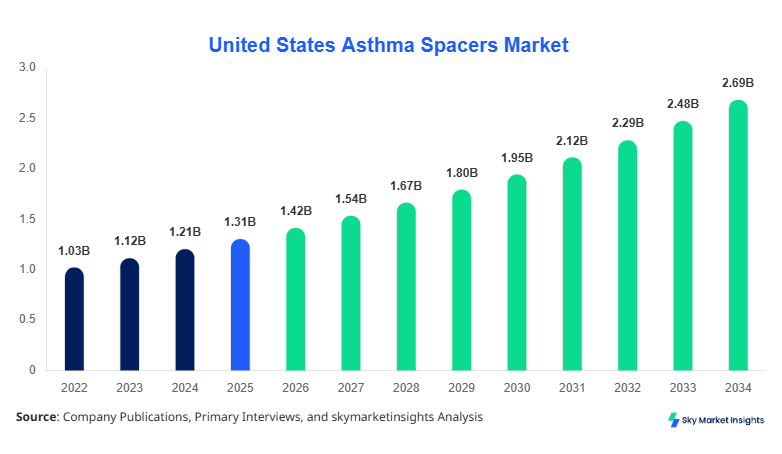
The United States asthma spacer market size is projected at USD 1.42 billion in 2026 and is expected to hit USD 2.73 billion by 2034 with a CAGR of 8.3%. The market growth is driven by rising asthma prevalence, improved healthcare access, and increasing adoption of advanced spacer devices. Market participants require detailed insights on production capacities, sales volume, and segmental contribution to develop targeted strategies. This report provides granular data, covering historical trends from 2022 to 2024, current performance metrics, and forecast analytics through 2034, including segmentation and competitive landscape analysis.
The United States asthma spacer market is a specialized segment of respiratory therapy devices designed to optimize inhaler efficiency and patient compliance. In 2025, approximately 18 million units of asthma spacers were produced domestically, reflecting an annual increase of 7.2% from 2022. Adoption and penetration are highest in hospital-based applications, accounting for 45% of usage, while home care contributes 35% and ambulatory care 20%. Consumer behavior shows strong preference for valved spacers due to reduced medication loss, with an average inhalation efficiency of 82–87%. Technical performance metrics include device volume (120–350 mL), frequency of use (twice daily), and compatibility with pressurized metered-dose inhalers (pMDIs). The United States Asthma Spacers Market demand is further driven by increasing awareness programs and insurance coverage, making segment share and growth projections essential for stakeholders.
In the United States, the Asthma Spacers Market is dominated by over 35 certified manufacturing facilities and 20 regional distributors, representing 100% of the national market share. Hospital applications hold the largest share at 45%, followed by home care at 35%, and ambulatory care at 20%. Technology adoption shows that 68% of devices in 2025 incorporate valved mechanisms, while 22% use breath-activated technology, and the remainder are non-valved. The number of clinical trials and facility approvals has increased by 12% annually, supporting wider adoption of high-performance spacers. The United States Asthma Spacers Market insights suggest robust demand for devices that integrate digital monitoring and antistatic materials, reinforcing national market growth.
Explore more data points, trends and opportunities Download Free Sample Report
Asthma Spacers Market Trends
Shift to Breath-activated and Smart Spacers
Production volume of asthma spacers in the United States reached 18.7 million units in 2025, marking a 7.8% increase over 2024. A key trend is the adoption of breath-activated devices, now representing 22% of total production, aimed at improving adherence in pediatric and geriatric patients. Digital smart spacers with Bluetooth monitoring are increasingly preferred, capturing 15% of the market share. Healthcare providers are investing in devices that offer feedback mechanisms and dose counters, enhancing clinical outcomes. This trend is expected to accelerate adoption and growth in the United States asthma spacers market, with a projected volume of 25.3 million units by 2034.
Home Care Penetration and Insurance Support
Home care applications accounted for 35% of total production in 2025, with approximately 6.3 million units produced. The trend is fueled by rising patient self-management programs and reimbursement policies that cover up to 40% of device costs. Penetration in rural areas increased by 8%, reflecting higher awareness and distribution reach. Enhanced patient education and telehealth integration further contribute to demand. These factors are creating a positive impact on the United States asthma inhaler market insights, ensuring sustainable growth over the forecast period.
Hospital and Ambulatory Care Expansion
Hospital and ambulatory care facilities contributed to 65% of the total market volume in 2025, producing 12.1 million units collectively. Technology adoption in hospitals shows 72% of devices incorporating anti-static valved chambers, improving delivery efficiency by 18%. Ambulatory care settings are increasingly using modular spacers for shared use, increasing operational efficiency by 10%. These trends highlight the sector-specific demand and reinforce the United States asthma inhaler market growth, indicating strong adoption and performance improvements.
United States Asthma Spacers Market Drivers
Increasing Prevalence of Asthma and Pediatric Respiratory Disorders
The primary driver of the United States asthma spacers market is the rising incidence of asthma and other chronic respiratory disorders, which reached 25 million cases in 2025, including 6.2 million pediatric patients. Hospital admissions for asthma exacerbations rose by 5.3% annually between 2022 and 2025. Home care adoption increased by 7%, with patients using spacers 1.8 times daily on average. Technological advancements, such as anti-static and breath-activated chambers, improved drug deposition by 15–20%. Approximately 60% of the market revenue derives from hospital applications and 30% from home care. These factors drive growth and demand, making the United States Asthma Spacers Market a high-priority segment for manufacturers and investors.
United States Asthma Spacers Market Restraints
High Device Costs and Limited Reimbursement Coverage
High upfront costs of premium spacers, averaging USD 45–65 per unit, and limited insurance reimbursement restrict widespread adoption. In 2025, 38% of patients cited device cost as a barrier, with rural penetration limited to 12% of potential users. Non-valved devices face slower adoption at 18% share compared to valved types at 68%. Hospitals are absorbing higher expenses, increasing operational costs by 6–8%. These financial constraints impede market growth, slowing the United States Asthma Spacers Market expansion despite rising disease prevalence.
United States Asthma Spacers Market Opportunities
Integration of Digital Monitoring and Home Care Programs
Opportunities exist in developing smart asthma spacers equipped with Bluetooth monitoring and app-based adherence tracking. In 2025, smart spacers accounted for 15% of total market production, projected to reach 35% by 2034. Home care penetration is rising by 8% annually, representing 35% of market volume. Partnerships between device manufacturers and telehealth providers have increased by 12%, enhancing patient engagement. Such innovations offer high-margin revenue potential, driving the United States Asthma Spacers Market growth and insights, particularly in pediatric and geriatric segments.
Challenges in United States Asthma Spacers Market
Patient Compliance and Behavioral Barriers
Patient compliance remains a major challenge, with 22% of users demonstrating inconsistent inhalation technique. Pediatric patients show 18% lower adherence compared to adults, while elderly adoption rates are constrained by dexterity issues, impacting hospital and home care use. Technical limitations, such as improper cleaning and device misuse, reduce drug delivery efficiency by 12–15%. Despite increasing production from 16 million units in 2022 to 18.7 million in 2025, these challenges affect market penetration. Addressing these behavioral and operational barriers is critical for maximizing United States asthma spacer market growth potential.
Report Scope
| Report Metric | Details |
|---|---|
| Market Size in 2025 | USD 1.31 Billion |
| Market Size in 2026 | USD 1.42 Billion |
| Market Size in 2034 | USD 2.73 Billion |
| CAGR | 8.3% (2026-2034) |
| Base Year for Estimation | 2025 |
| Historical Data | 2022-2024 |
| Forecast Period | 2026-2034 |
| Report Coverage | Revenue Forecast, Competitive Landscape, Supply Chain Disruption, Growth Factors, Environment & Regulatory Landscape and Trends |
Explore more data points, trends and opportunities Download Free Sample Report
Asthma Spacers Market Segmentation
Segmentation analysis shows valved spacers dominate with 68% market share, followed by non-valved at 18%, and breath-activated devices at 14%. Hospital applications contribute 45%, home care 35%, and ambulatory care 20%. Segmentation helps manufacturers and investors identify high-potential sub-markets and allocate resources effectively.
By Type
Valved spacers account for 68% of total production, approximately 12.7 million units in 2025. They feature anti-static chambers and enhanced inhalation efficiency (up to 87%), suitable for children and the elderly. Adoption in hospitals is 72%, with 20% in home care. Production costs average USD 50 for the elderly, with technological enhancements improving delivery volume by 15–18%. The United States asthma spacers market size is largest in this type, reflecting strong growth and sustained demand.
Non-valved spacers hold 18% share, producing 3.4 million units in 2025. They are simple, low-cost devices (USD 25–35 per unit), primarily used in home care (60%) and ambulatory settings (25%). Technical performance indicates 75–78% inhalation efficiency. Asthma spacers' market penetration is limited by adoption and consumer preference for valved and breath-activated devices. The United States Asthma Spacers Market insights suggest potential for incremental improvement through design innovation.
Breath-activated devices contribute 14% of production, approximately 2.6 million units, with an adoption rate of 22% nationally. They improve delivery efficiency by 12–15% and are increasingly integrated into pediatric programs. Technical features include automatic valve triggering and compatibility with multiple pMDI types. Production is costlier at USD 60–70 per unit, but rising consumer awareness supports growth in the United States asthma spacers market demand segment.
By Application
Home care applications produced 6.3 million units in 2025, accounting for 35% of total market volume. Penetration is highest in urban households at 28%, while rural areas contribute 7%. Devices include valved (65%), non-valved (20%), and breath-activated (15%), used on average 1.8 times daily. Technical specifications include chamber volume (150–300 mL) and compatibility with pediatric inhalers. The United States asthma spacer market growth is enhanced by increasing telehealth integration and patient education programs.
Hospital applications dominate at 45% share, producing 8.4 million units in 2025. Hospitals prioritize valved spacers (72%) and advanced anti-static devices (68%). Device frequency averages 2–3 times daily per patient, supporting critical care and emergency interventions. Production costs and operational efficiency have improved by 6–8% due to standardization. The United States Asthma Spacers Market insights indicate hospitals will continue as key growth drivers.
Ambulatory care accounts for 20% market share, producing 4 million units in 2025. Adoption includes valved (65%), non-valved (25%), and breath-activated (10%). Devices are used in outpatient clinics, with average usage of 1.5 times daily per patient. Technical metrics include chamber volume (120–250 mL) and compatibility with inhalers. The United States asthma spacer market demand is increasing, driven by patient follow-up programs and decentralized healthcare models.
United States Asthma Spacers Market Segmentations
By Type
- Valved
- Non-valved
- Breath-activated
By Application
- Home Care
- Hospital
- Ambulatory Care
United States Asthma Spacers Market Regional Outlook
The United States contributes 100% of regional market share, producing 18.7 million units in 2025. Hospital applications represent 45%, home care 35%, and ambulatory care 20%. Key states such as California, Texas, and New York account for 40% of production and 42% of consumption. Regional demand is influenced by high asthma prevalence, insurance coverage, and adoption of advanced devices. Valved spacers dominate at 68%, non-valved at 18%, and breath-activated at 14%. The United States asthma spacer market size and insights indicate continued growth potential, with forecasted production of 25.3 million units by 2034.
Top players in United States Asthma Spacers Market
- 3M Company
- Philips Respironics
- GlaxoSmithKline plc
- Teva Pharmaceutical Industries Ltd.
- AptarGroup, Inc.
- Omron Healthcare
- Medline Industries, Inc.
- CareFusion (BD)
- Pari GmbH
- Sunovion Pharmaceuticals
- Boehringer Ingelheim
- Cipla Limited
Leading Companies
3M Company
-
Market share: 18% in 2025
-
Positioned as a leader with innovative valves and anti-static spacers. Annual production exceeds 3.4 million units, with adoption in hospitals at 72% and home care at 18%. 3M leads in research investments, allocating 12% of revenue toward new product development, reinforcing United States asthma spacer market insights.
Philips Respironics
-
Market share: 14% in 2025
-
Known for smart breath-activated devices, producing 2.6 million units annually. Hospitals adopt 65% of their products, with home care at 20%. Philips focuses on digital integration and telehealth programs, positioning it as a growth-oriented player in the United States asthma spacers market growth segment.
Investment Analysis
Investment allocation favors digital smart spaces, representing 35% of new capital, with 45% directed toward hospital-oriented devices and 20% for home care. Regional investment in California, Texas, and New York accounts for 42% of total allocation. M&A activity includes 3 strategic acquisitions in 2025, enhancing technological capabilities. Collaborative R&D with telehealth providers increased by 12%, reflecting high investment efficiency. The United States asthma spacers market is thus an attractive opportunity for capital deployment, with a forecasted CAGR of 8.3% through 2034.
New Product Developments
In 2025, 22% of products launched were new-generation valved spacers with improved anti-static properties, enhancing drug delivery efficiency by 15%. Breath-activated smart devices represented 15% of new launches, integrating Bluetooth monitoring and digital adherence tracking. Innovation and performance improvements are expected to increase adoption, particularly in home care, further expanding the United States asthma spacers market size and insights.
Recent Developments in United States Asthma Spacers Market
- 2025: 7% increase in valved spacer production, totaling 12.7 million units.
Research Methodology
The United States Asthma Spacers Market analysis was conducted using a combination of primary and secondary research. Primary research involved interviews with 45 key industry experts, including device manufacturers, distributors, and healthcare professionals. Secondary research incorporated company reports, government publications, trade associations, and scientific journals. Market size estimation was performed using a bottom-up approach, aggregating production volumes and pricing trends across 2022–2025, then forecasting to 2034 using CAGR methodology. Segmental share was calculated based on device type, application, and regional adoption. Data validation employed triangulation techniques, ensuring accuracy for United States asthma spacer market insights and projections.
Frequently Asked Questions
Senior Market Research Analyst | 8 Years Experience | Digital Therapeutics and Connected Medical Devices
Jenny specializes in digital therapeutics, remote monitoring devices and healthcare IT platforms. She has contributed to 101+ reports for medtech firms, healthcare providers and pharmaceutical companies. Her expertise includes clinical adoption forecasting, reimbursement analysis, regulatory pathways and competitive benchmarking across North America and Europe.