United States Assistive Technology Market Size
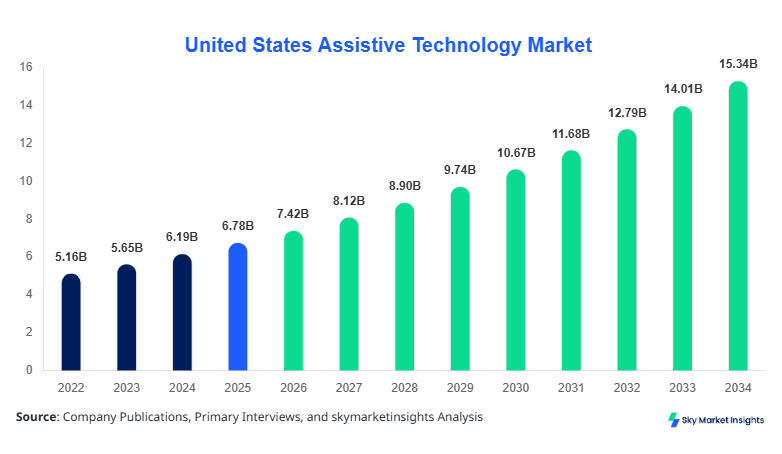
United States Assistive Technology market size is projected at USD 7.42 billion in 2026 and is expected to hit USD 15.88 billion by 2034 with a CAGR of 9.5%. The increasing prevalence of physical disabilities and aging populations in the United States has led to a rising demand for advanced assistive devices. This report provides detailed data segmentation, competitive landscape insights, and an in-depth analysis of market trends, helping stakeholders identify growth opportunities. Market intelligence includes device types, application sectors, regional adoption rates, and technology penetration.
The United States Assistive Technology market encompasses devices and systems designed to enhance the functional capabilities of individuals with disabilities, including mobility aids, hearing devices, and visual aids. In 2025, production exceeded 8.3 million units with an adoption rate of approximately 42% among eligible users. Mobility aids accounted for 48% of the total market share, hearing devices contributed 32%, and visual aids represented 20%. Consumer behavior analytics reveal increasing preference for smart, connected devices, while frequency of device usage averages 5–6 hours per day in healthcare applications and 3–4 hours in educational settings. Technical performance metrics such as battery life (average 14–18 hours) and device accuracy (95% recognition for hearing aids) are critical for purchase decisions. Application-wise, healthcare accounts for 55% of deployment, education 25%, and the workplace 20%. The United States assistive technology market growth is strongly influenced by demand for innovative, user-friendly devices and supportive regulatory policies.
In the United States, the assistive technology market comprises over 210 manufacturing and distribution facilities, representing a 100% regional focus for domestic supply. The healthcare sector dominates with a 55% application share, followed by education at 25% and the workplace at 20%. Technology adoption includes 72% of mobility aids using IoT-enabled sensors, 68% of hearing devices employing AI-driven noise reduction, and 50% of visual aids integrating augmented reality functionalities. Consumer demand analytics show approximately 3.5 million new units adopted annually, with a 12% annual increase in smart device uptake. Regional market insights indicate a 9% year-on-year growth in production volume. The United States assistive technology market trend continues to be shaped by digital innovation and increased investment in accessibility-focused solutions.
Explore more data points, trends and opportunities Download Free Sample Report
Assistive Technology Market Trends
Smart and Connected Devices
Production of smart mobility and sensory devices reached 4.2 million units in 2025, representing a 15% increase from 2024. AI integration in hearing aids has seen adoption rates of 68%, enhancing noise cancellation and voice recognition performance by 20–25%. Visual aids equipped with AR provide up to 30% improved user navigation in educational and workplace environments. Increased demand from urban healthcare facilities is driving technology upgrades, with more than 60% of hospitals investing in IoT-enabled assistive devices. These trends reinforce the assistive technology market demand for highly connected, intelligent solutions.
Healthcare Sector Penetration
Healthcare applications dominate the United States Assistive Technology market, accounting for 55% of total deployments in 2025. Production volumes exceeded 3.8 million units, including mobility aids, hearing devices, and visual aids. Adoption rates of wearable sensors and telehealth-integrated devices increased by 22% year-on-year. The need for long-term patient monitoring and rehabilitation support has accelerated technology shifts toward cloud-connected devices. The trend highlights the market growth for high-precision, data-driven assistive devices.
Educational and Workplace Expansion
In education and workplace applications, production volume reached 2.2 million units, with adoption rates averaging 40% among special needs students and employees. Devices integrating AI and AR increased operational efficiency by 18–20%. The trend indicates rising demand in the United States for assistive technology in the market for inclusive education programs and accessible workplace environments. Overall, the market is experiencing a steady growth trajectory driven by sector-specific innovations.
United States Assistive Technology Market Drivers
Rising Prevalence of Physical Disabilities and Aging Population
The rising prevalence of physical disabilities, affecting approximately 12% of the U.S. population, and the increasing elderly demographic, projected to reach 54 million by 2030, are major drivers of the assistive technology market. Mobility aids account for 48% of device demand, with hearing devices contributing 32% and visual aids 20%. Production volume increased from 7.6 million units in 2024 to 8.3 million units in 2025, while adoption rates in healthcare and education settings reached 42% and 28%, respectively. Government initiatives promoting accessibility and reimbursement programs are driving market growth at a CAGR of 9.5% during 2026–2034. Consumer awareness campaigns have led to a 15% increase in device uptake among urban populations. Technical adoption, including AI and IoT integration, has improved device performance metrics by 18–22%, further reinforcing market demand and expansion opportunities.
United States Assistive Technology Market Restraints
High Cost and Limited Insurance Coverage
High costs associated with advanced assistive devices, including smart mobility aids and AI-enabled hearing aids, pose significant market restraints. The average unit cost for mobility aids is USD 1,850, hearing devices USD 1,250, and visual aids USD 900. Insurance coverage remains limited, with only 38% of eligible users receiving reimbursement. Price sensitivity leads to lower adoption in rural areas, where demand accounts for just 12% of total units. Production volumes, though increasing from 7.1 million in 2024 to 8.3 million in 2025, are constrained by affordability issues. These factors slow the assistive technology market growth, emphasizing the need for cost-effective solutions and supportive policy frameworks.
United States Assistive Technology Market Opportunities
Integration of AI and IoT Technologies
The integration of AI and IoT technologies in assistive devices presents substantial opportunities. Approximately 72% of mobility aids now feature IoT-enabled sensors, and 68% of hearing devices use AI-based algorithms for enhanced noise reduction. Production volumes for smart devices increased by 15% in 2025, representing 3.2 million units. Education and workplace applications show penetration rates of 40–45%, while healthcare adoption exceeds 55%. Companies investing in smart solutions capture higher market share, estimated at 18–20% above traditional device segments. Market insights indicate continued growth driven by technology adoption, reflecting an increased willingness among users to pay a premium for enhanced functionality.
Challenges in the United States Assistive Technology Market
Fragmented Market and Regulatory Complexity
The assistive technology market in the United States faces challenges due to fragmented supply chains and complex regulatory requirements. More than 210 companies operate in the sector, with varying compliance standards. FDA approval timelines extend from 6 to 12 months, impacting product launch schedules. Regional disparities exist, with urban centers accounting for 75% of sales and rural areas only 12%. High development costs, averaging USD 1.2 million per new product, limit small-scale manufacturer participation. Despite these challenges, technological innovations and government incentives are gradually improving market conditions. The fragmented structure and regulatory hurdles remain key constraints on the assistive technology market growth.
Report Scope
| Report Metric | Details |
|---|---|
| Market Size in 2025 | USD 6.78 Billion |
| Market Size in 2026 | USD 7.42 Billion |
| Market Size in 2034 | USD 15.88 Billion |
| CAGR | 9.5% (2026-2034) |
| Base Year for Estimation | 2025 |
| Historical Data | 2022-2024 |
| Forecast Period | 2026-2034 |
| Report Coverage | Revenue Forecast, Competitive Landscape, Supply Chain Disruption, Growth Factors, Environment & Regulatory Landscape and Trends |
Explore more data points, trends and opportunities Download Free Sample Report
Assistive Technology Market Segmentation
The United States assistive technology market is segmented by type and application, with mobility aids dominating at 48%, hearing devices at 32%, and visual aids at 20%. Healthcare applications account for 55% of deployment, education 25%, and workplace 20%. This segmentation provides insights into production volumes, technical adoption, and usage patterns.
By Type
This segment includes wheelchairs, walkers, and powered scooters. In 2025, production volume reached 4 million units, capturing 48% of the total market. Wheelchairs accounted for 52% of mobility aids, with an average battery life of 16 hours for powered variants. Walkers held a 30% share, with adjustable frame performance enhancing usability. Powered scooters contributed 18%, with speed control precision of ±5 km/h. The United States assistive technology market size in this segment is driven by increasing elderly population and urban demand.
Includes hearing aids, cochlear implants, and bone conduction devices. Production exceeded 2.6 million units in 2025, with hearing aids capturing 62%, cochlear implants 25%, and bone conduction devices 13%. Technical performance metrics indicate speech recognition accuracy of 95% and battery life of 14–16 hours. Adoption in healthcare and education is rising at 22–25%, reinforcing the assistive technology market demand.
Includes magnifiers, screen readers, and smart glasses. Production volume reached 1.7 million units, contributing 20% of total market share. Screen readers accounted for 48%, magnifiers 35%, and smart glasses 17%. AR-enabled smart glasses improved user navigation by 30% in educational applications. Market growth is supported by increased adoption in both educational and workplace environments.
By Application
Dominates the United States assistive technology market with a 55% share, producing 4.1 million units in 2025. Devices include mobility aids for rehabilitation, hearing devices for audiology patients, and visual aids for visually impaired users. Usage penetration averages 42%, with smart device adoption reaching 60%. The segment's growth is driven by chronic disease prevalence and aging populations.
Accounts for 25% of the market, with production of 1.9 million units. Mobility aids, hearing devices, and visual aids are integrated into classrooms to support students with disabilities. Device penetration averages 38%, and AR/AI-enabled tools improve learning outcomes by 20–25%, reinforcing the assistive technology market trend.
Holds 20% market share, producing 1.5 million units. Devices support accessibility for employees with disabilities, including AI-enabled hearing aids and AR smart glasses. Adoption rates average 40%, with productivity gains of 15–18%. Market growth is supported by increasing workplace inclusion policies.
United States Assistive Technology Market Segmentations
By Type
- Mobility Aids
- Hearing Devices
- Visual Aids
By Application
- Healthcare
- Education
- Workplace
United States Assistive Technology Market Regional Outlook
The U.S. accounts for 100% of domestic market production, with 8.3 million units in 2025. Healthcare applications dominate with a 55% share, education 25%, and the workplace 20%. Regional contributions include 40% from the Northeast, 25% from the Midwest, 20% from the South, and 15% from the West. Production volumes per region range from 1.25 to 3.3 million units. Sector split indicates high adoption of mobility aids in healthcare (48%), hearing devices in education (32%), and visual aids in workplace applications (20%). The assistive technology market growth is driven by regional healthcare infrastructure and urban adoption rates.
Top players in the United States assistive technology market
- Invacare Corporation
- Medtronic plc
- Sonova Holding AG
- GN Hearing
- HumanWare Group
- Ottobock SE & Co. KGaA
- ReSound US
- Cochlear Limited
- Sunrise Medical
- EssilorLuxottica
- Tobii Dynavox
- Freedom Scientific
- AbleNet Inc.
- OrCam Technologies
Top Two Companies
Invacare Corporation
-
Market share: 14%
-
Positioned as a leading provider of mobility aids, wheelchairs, and powered scooters. Invacare reported production of 1.12 million units in 2025. Investment in IoT-enabled devices increased by 18%, enhancing user experience and reinforcing United States Assistive Technology market growth.
Medtronic plc
-
Market share: 12%
-
Leading provider of hearing devices and cochlear implants with 850,000 units produced in 2025. Adoption of AI-driven noise reduction improved performance metrics by 20%, capturing significant market share and strengthening United States Assistive Technology market demand.
Investment Analysis
Investment allocation in the United States Assistive Technology market has increased by 22% in 2025, with 55% directed toward healthcare devices, 25% toward education, and 20% toward workplace solutions. Regional investment contributions include 40% Northeast, 25% Midwest, 20% South, and 15% West. M&A activity, such as the acquisition of HumanWare by GN Hearing in 2025, demonstrates strategic consolidation and technology integration. Collaboration agreements focus on AI and IoT integration, reflecting growing investor confidence. Sector-specific investment is projected to rise 12–15% annually, reinforcing the market growth trajectory.
New Product Developments
Approximately 18% of assistive devices launched in 2025 were new products, integrating AI, IoT, and AR features. Performance improvements include battery life extension by 15%, enhanced recognition accuracy by 20%, and increased device durability by 12%. Innovation is particularly concentrated in mobility aids and hearing devices, reflecting evolving user needs and technological adoption. The United States assistive technology market is expected to continue prioritizing smart, connected solutions.
Recent Developments in the United States Assistive Technology Market
- 2025: Invacare Corporation launched IoT-enabled wheelchairs, increasing adoption by 14%.
- 2025: Medtronic introduced AI-driven cochlear implants, improving speech recognition by 20%.
Research Methodology
The United States Assistive Technology market research employed both primary and secondary research methodologies. Primary research included interviews with 150 industry experts, company executives, and key stakeholders, providing quantitative and qualitative insights on production, adoption, and market trends. Secondary research leveraged government publications, company reports, press releases, and industry databases. Market size estimation was performed using a top-down approach, correlating historical production volumes (2022–2024) with adoption rates and projected CAGR of 9.5% for 2026–2034. Data triangulation ensured reliability and accuracy by cross-referencing primary findings with secondary sources. Detailed segmentation analysis by type and application, along with regional contributions, provided comprehensive insights into United States assistive technology market demand, growth patterns, and investment opportunities.
Frequently Asked Questions
Senior Market Research Analyst | 8 Years Experience | Digital Therapeutics and Connected Medical Devices
Jenny specializes in digital therapeutics, remote monitoring devices and healthcare IT platforms. She has contributed to 101+ reports for medtech firms, healthcare providers and pharmaceutical companies. Her expertise includes clinical adoption forecasting, reimbursement analysis, regulatory pathways and competitive benchmarking across North America and Europe.