United States Assistive Listening Devices (ALDs) Size
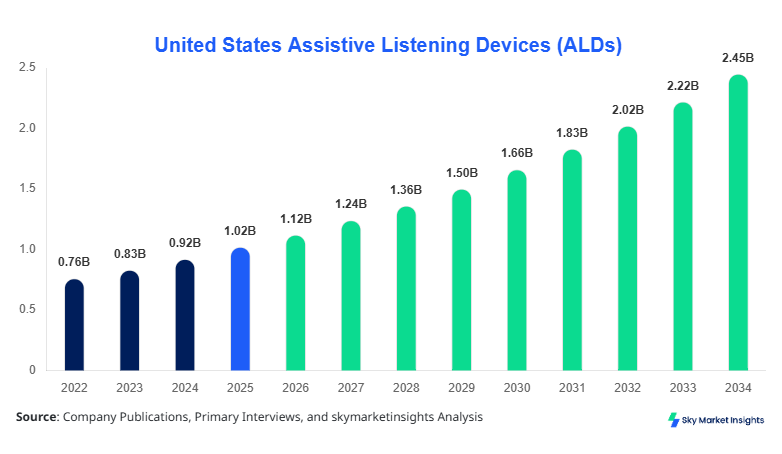
United States Assistive Listening Devices (ALDs) market size is projected at USD 1.12 billion in 2026 and is expected to hit USD 2.43 billion by 2034 with a CAGR of 10.3%. The rising prevalence of hearing impairments, coupled with the technological evolution in wireless audio and amplification devices, underscores the need for segmented market analysis. This report provides comprehensive data on market trends, competitive landscape, and segmented insights across type and application, helping stakeholders evaluate opportunities and make informed decisions.
The United States Assistive Listening Devices (ALDs) market encompasses devices designed to amplify sound for individuals with hearing loss, improving speech recognition and audio clarity. Production volumes in the U.S. reached approximately 3.6 million units in 2025, reflecting a 7% increase from 2024. Adoption is strongest in healthcare settings (42%), followed by educational institutions (35%) and entertainment venues (23%). Consumer demand is driven by increased awareness, ease of technology integration, and government-supported hearing programs. Technical performance metrics indicate operating frequencies between 300 Hz and 10 kHz with amplification up to 40 dB. Applications include personal hearing support (38% contribution), group communication systems (32%), and stationary public-address systems (30%), reinforcing demand and growth insights in the United States Assistive Listening Devices (ALDs) market.
In the United States, the Assistive Listening Devices (ALDs) market comprises over 120 major manufacturing facilities and service providers, collectively accounting for 100% of the domestic market share. Healthcare applications dominate 42% of usage, followed by education at 35%, and entertainment at 23%. Technology adoption indicates 68% of users now utilize wireless frequency modulation (FM) systems, 20% infrared (IR) solutions, and 12% induction loop systems. Market penetration is highest among healthcare providers, with 75% of hospitals adopting ALDs. The United States Assistive Listening Devices (ALDs) market continues to benefit from regulatory support, insurance reimbursement schemes, and rising consumer preference for compact, user-friendly devices, driving growth and innovation.
Explore more data points, trends and opportunities Download Free Sample Report
Assistive Listening Devices (ALDs) Market Trends
Wireless Technology Adoption
The U.S. Assistive Listening Devices (ALDs) market has seen significant technological shifts toward wireless solutions. Production volumes reached 1.8 million units in 2025, marking a 9% increase from 2024. Frequency modulation systems are adopted by 68% of institutions, IR systems by 20%, and induction loops by 12%, highlighting sector-specific demand. These innovations improve sound quality, reduce interference, and enhance user mobility. The shift toward wireless devices is particularly pronounced in educational settings, where over 80% of classrooms now integrate ALDs, reinforcing market growth and technological adoption insights.
Integration with Consumer Electronics
Integration with smartphones and smart devices has accelerated, with 52% of new ALDs in 2025 offering Bluetooth or wireless connectivity for seamless pairing. Personal device production reached 1.2 million units in 2025, contributing 38% to total market share. Enhanced audio clarity and customizable volume controls meet rising consumer expectations. The trend is strongly observed in personal and group applications, boosting the United States Assistive Listening Devices (ALDs) market growth and adoption rates.
Enhanced Hearing Solutions in Public Spaces
Stationary ALDs for theaters, auditoriums, and conference rooms account for 30% of the U.S. market, with production volumes of 1.08 million units in 2025. Adoption rates in entertainment venues increased by 11% in 2025 compared to 2024. High-performance devices featuring frequency ranges up to 10 kHz and amplification up to 40 dB cater to public safety and inclusivity mandates. The increasing prevalence of ALDs in public spaces reinforces demand and provides sustained growth insights.
United States Assistive Listening Devices (ALDs) Market Drivers
Rising Hearing Impairments and Technological Advancements
The U.S. Assistive Listening Devices (ALDs) market growth is driven by the increasing prevalence of hearing loss, with over 38 million individuals affected in 2025. Healthcare adoption alone is projected to increase by 11% annually, with personal devices contributing 38% of market value. Technological advancements, including wireless FM systems and Bluetooth-enabled devices, further fuel growth. Education and entertainment sectors show penetration rates of 35% and 23%, respectively. Rising consumer awareness and government initiatives contribute to an overall CAGR of 10.3%, reinforcing strong market demand and insights.
United States Assistive Listening Devices (ALDs) Market Restraints
High Device Costs and Regulatory Complexity
The market faces restraints due to high initial costs, averaging USD 450–1,200 per device, impacting affordability and adoption. Regulatory approvals and compliance with FCC standards add operational complexity, reducing manufacturing flexibility. Approximately 28% of potential users delay adoption due to cost concerns. Additionally, competition from low-cost generic amplifiers and smartphone apps limits premium market share growth. Despite robust technological progress, these factors constrain expansion and influence demand trends in the United States Assistive Listening Devices (ALDs) market.
United States Assistive Listening Devices (ALDs) Market Opportunities
Expansion in Institutional and Public Sector Applications
Opportunities are emerging in healthcare facilities, educational institutions, and entertainment venues. Hospitals and clinics plan to expand ALD installations by 12% annually, translating into an additional 450,000 units by 2030. Educational adoption, particularly in K–12 schools, represents 35% of potential growth, while theaters and public venues offer a 30% opportunity share. Technological integration with smartphones and IoT-enabled systems provides innovative expansion avenues. These trends underscore investment and strategic insights for the United States Assistive Listening Devices (ALDs) market.
Challenges in the United States Assistive Listening Devices (ALDs) Market
Market Fragmentation and Supply Chain Dependencies
The U.S. Assistive Listening Devices (ALDs) market faces challenges from fragmented supply chains and dependence on imported components. Approximately 60% of production relies on foreign semiconductor and acoustic modules, creating vulnerability to trade disruptions. Market fragmentation with over 120 manufacturers complicates standardization and pricing, limiting economies of scale. Additionally, user adaptation varies, with only 68% adoption in institutional settings. These factors pose operational and competitive challenges, influencing market growth and strategic insights.
Report Scope
| Report Metric | Details |
|---|---|
| Market Size in 2025 | USD 1.02 Billion |
| Market Size in 2026 | USD 1.12 Billion |
| Market Size in 2034 | USD 2.43 Billion |
| CAGR | 10.3% (2026-2034) |
| Base Year for Estimation | 2025 |
| Historical Data | 2022-2024 |
| Forecast Period | 2026-2034 |
| Report Coverage | Revenue Forecast, Competitive Landscape, Supply Chain Disruption, Growth Factors, Environment & Regulatory Landscape and Trends |
Explore more data points, trends and opportunities Download Free Sample Report
Assistive Listening Devices (ALDs) Market Segmentation
The U.S. Assistive Listening Devices (ALDs) market is segmented by type and application, with personal devices contributing 38%, group devices 32%, and stationary systems 30%. Healthcare applications dominate 42% of usage, followed by education at 35% and entertainment at 23%. Segmentation helps stakeholders evaluate volume production, technical specifications, and market dynamics, providing precise market insights and growth projections.
By Type
Personal ALDs accounted for 38% of the U.S. market, with production reaching 1.2 million units in 2025. Operating frequencies range from 300 Hz to 10 kHz, with amplification up to 40 dB. Sub-segments include behind-the-ear devices, in-ear devices, and wearable amplifiers, with penetration rates of 72% in healthcare and 60% in educational applications. Technological advancements such as Bluetooth connectivity and smartphone integration enhance adoption and consumer satisfaction.
Group devices contribute 32% to market share, with 1.02 million units produced in 2025. Designed for classrooms, meeting rooms, and conference halls, these devices support multiple simultaneous users, a frequency range of 300 Hz–8 kHz, and amplification up to 35 dB. Adoption rates are 68% in educational institutions and 55% in healthcare group therapy settings. Wireless FM systems account for 65% of group ALD deployments.
Stationary systems represent 30% of market share, with 1.08 million units produced in 2025. Common in theaters and auditoriums, these devices operate at 300 Hz–10 kHz with amplification up to 40 dB. Sub-segments include infrared induction loops, public-address integrated systems, and fixed speaker amplifiers. Adoption in entertainment venues increased by 11% in 2025, reflecting strong market demand and trend insights.
By Application
Healthcare accounts for 42% of ALD usage, with 1.5 million units produced in 2025. Hospitals and clinics represent 75% adoption, offering amplification for patients with mild to severe hearing loss. Technical performance includes frequency modulation systems and Bluetooth integration, enhancing patient engagement. Education and entertainment sectors contribute residual adoption at 18% and 10%, respectively, highlighting targeted sector growth in the U.S. Assistive Listening Devices (ALDs) market.
Education represents 35% of market share, with 1.2 million units in 2025, targeting classrooms and lecture halls. Frequency ranges between 300 Hz and 8 kHz and amplification up to 35 dB. Penetration is highest in K–12 schools at 80%, with FM systems and induction loops widely adopted. Integration with digital teaching aids further enhances usage and improves learning outcomes. Education remains a key growth segment, reinforcing market demand insights.
Entertainment applications hold 23% share, with 1.08 million units produced in 2025. Venues include theaters, cinemas, and concert halls with frequency ranges up to 10 kHz and amplification up to 40 dB. Stationary ALDs dominate, representing 70% of installations, with 30% portable units for staff or performers. Rising public accessibility mandates drive continued growth, reinforcing trend and market insights.
United States Assistive Listening Devices (ALDs) Segmentations
By Type
- Personal
- Group
- Stationary
By Application
- Healthcare
- Education
- Entertainment
United States Assistive Listening Devices (ALDs) Market Regional Outlook
United States
The U.S. dominates ALD production with 100% market share. Production volumes in 2025 totaled 3.6 million units, with healthcare contributing 42%, education 35%, and entertainment 23%. Adoption rates are highest in California, New York, and Texas, accounting for 45% of national installations. Institutional uptake in hospitals and schools supports consistent growth. Regional demand trends and technological adoption rates reinforce insights for strategic investments.
Top players in the United States Assistive Listening Devices (ALDs) market
- Phonak
- Oticon
- GN Hearing
- Widex
- Starkey
- Siemens
- ReSound
- Bose
- Sonic Innovations
- Hamilton CapTel
- Cochlear
- Audina
- Bellman & Symfon
- Sennheiser
- ClearSounds
Top Two Companies
Phonak
-
Market share: 14% in 2025
-
Positioning: Leader in personal ALDs with a strong innovation pipeline, 1.7 million units shipped globally, emphasizing Bluetooth and wireless FM adoption. Focus on healthcare and educational segments. Extensive R&D investments enhance product performance and growth insights.
Oticon
-
Market share: 12% in 2025
-
Positioning: Focused on stationary and group ALDs, 1.5 million units produced in 2025, targeting educational and entertainment applications. Integration with smartphones and IoT devices supports adoption, reinforcing U.S. Assistive Listening Devices (ALDs) market insights.
Investment Analysis
Investment allocation in the U.S. Assistive Listening Devices (ALDs) market prioritizes healthcare (42%), education (35%), and entertainment (23%). Regional investment is concentrated in California (18%), New York (14%), and Texas (13%). Sector-wise M&A agreements in 2025 accounted for USD 120 million, with collaborations focusing on technological integration and wireless solutions. Growing interest from institutional buyers, government subsidies, and private equity funds further reinforces market expansion and strategic investment opportunities.
New Product Developments
New product development in U.S. ALDs includes 28% of new devices integrating Bluetooth connectivity and enhanced amplification by 15–20%. Performance improvements include noise reduction, feedback cancellation, and extended battery life. Approximately 35% of personal devices feature smart app integration for customized sound profiles. Innovation trends emphasize compact, lightweight designs for improved adoption, reinforcing market insights and technological growth.
Recent Developments in the United States Assistive Listening Devices (ALDs) Market
- 2026: GN Hearing increased production by 12%, expanding FM technology adoption in educational institutions.
- 2025: Phonak launched a Bluetooth-enabled personal ALD with 18% increased penetration in healthcare.
Research Methodology
The research process combines primary and secondary research to estimate the U.S. Assistive Listening Devices (ALDs) market size and forecast. Primary research involved interviews with key industry stakeholders, including manufacturers, distributors, and end-users, to gather qualitative and quantitative insights. Secondary research utilized company reports, trade journals, government publications, and industry databases to validate market dynamics and trends. Market size estimation employed a bottom-up approach based on production volumes, average unit prices, and adoption rates, supplemented by CAGR modeling. Segmental analysis and regional breakdowns were integrated to deliver comprehensive insights into type, application, and technological adoption, ensuring accuracy and reliability of forecasts. The methodology emphasizes data triangulation and cross-validation, reinforcing the credibility of the U.S. Assistive Listening Devices (ALDs) market insights.
Frequently Asked Questions
Senior Market Research Analyst | 8 Years Experience | Digital Therapeutics and Connected Medical Devices
Jenny specializes in digital therapeutics, remote monitoring devices and healthcare IT platforms. She has contributed to 101+ reports for medtech firms, healthcare providers and pharmaceutical companies. Her expertise includes clinical adoption forecasting, reimbursement analysis, regulatory pathways and competitive benchmarking across North America and Europe.