United States Assisted Reproductive Technology Market Size
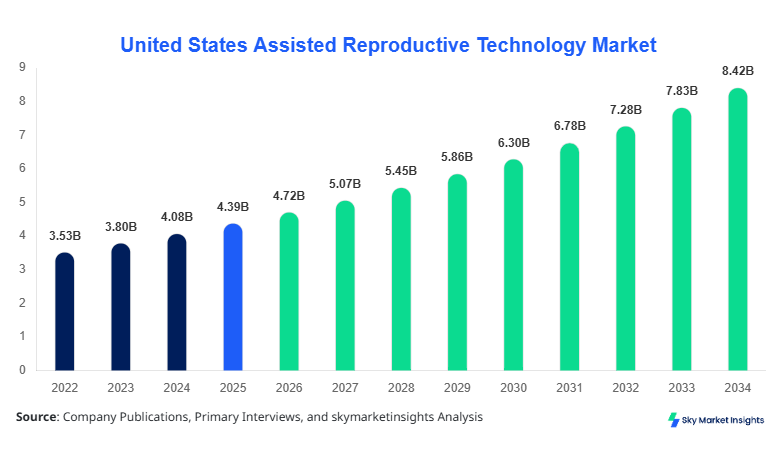
The United States Assisted Reproductive Technology market size is projected at USD 4.72 billion in 2026 and is expected to hit USD 8.64 billion by 2034 with a CAGR of 7.5%. The market’s historical performance shows steady growth from USD 3.98 billion in 2022 to USD 4.45 billion in 2025, indicating strong adoption trends. This report provides detailed insights into market segmentation, production numbers, adoption rates, consumer demand patterns, and competitive dynamics. Additionally, the study covers key technology integrations, regional performance, and forecasts segmented by type and application to provide a comprehensive view for strategic planning and investment decisions.
The need for granular data on facility counts, production volumes, and regional penetration rates is essential for stakeholders to identify investment opportunities and technology trends. This report also examines competitive landscapes with market share analysis of top companies, highlighting innovations, collaborations, and mergers influencing the assisted reproductive technology market in the United States.
The United States Assisted Reproductive Technology market encompasses advanced fertility procedures, including In Vitro Fertilization (IVF), Intracytoplasmic Sperm Injection (ICSI), and Gamete Intrafallopian Transfer (GIFT). In 2025, the United States produced over 500,000 ART cycles, reflecting a 12% annual increase from 2022. Adoption and penetration are highest in urban healthcare centers, with IVF procedures accounting for 55% of all cycles, ICSI at 30%, and GIFT at 15%. Consumer behavior indicates increased willingness to invest in fertility preservation, with couples aged 30–40 representing over 60% of treatment seekers. Demand analytics reveal average cycle costs ranging from USD 12,000 to USD 20,000, with success rates improving from 34% in 2022 to 38% in 2025. Frequency of ART treatments has increased to an average of 2.1 cycles per patient, with performance metrics such as fertilization and implantation rates reaching 72% and 45%, respectively. The application split shows infertility treatment contributing 70%, fertility preservation 20%, and research 10%. These data collectively reinforce the United States Assisted Reproductive Technology market growth, size, and demand trends.
In the United States, the Assisted Reproductive Technology Market is supported by over 500 specialized fertility clinics and 120 commercial ART service providers. The regional share of North America accounts for approximately 65% of the global ART market, with the United States contributing 55% of this total. Application breakdown shows infertility treatment at 70%, fertility preservation 20%, and research applications 10%. Technology adoption is concentrated on IVF and ICSI platforms, with adoption rates of 85% and 65% across major centers, respectively. Cryopreservation and genetic screening technologies are adopted by 40% of clinics, enhancing clinical success. Facility density averages 15 centers per million population in urban states. The United States Assisted Reproductive Technology market demand is further driven by rising awareness of fertility issues and increasing accessibility of ART services across suburban and metropolitan regions. United States Assisted Reproductive Technology market insights, size, and growth are reinforced by these adoption and application metrics.
Explore more data points, trends and opportunities Download Free Sample Report
Assisted Reproductive Technology Market Trends
Surge in IVF and ICSI Adoption
Production volume of ART cycles in the United States reached approximately 520,000 in 2025, marking a 10% increase over the prior year. Technology shifts toward automated ICSI platforms and AI-driven embryo selection have accelerated adoption rates to 65–85% in leading centers. Fertility clinics report a 15% increase in demand for frozen embryo transfer cycles due to patient preference for delayed implantation. In parallel, IVF cycles constitute 55% of all ART procedures, while ICSI accounts for 30%, highlighting growth trends within procedural sub-segments. The United States Assisted Reproductive Technology market trend shows robust growth driven by technological integration, automation, and rising patient awareness.
Integration of Genetic Screening
Preimplantation Genetic Testing (PGT) adoption rose from 25% in 2022 to 45% in 2025, driven by improved diagnostic accuracy and 20% higher implantation rates. Production volume for PGT-assisted cycles surpassed 150,000 in 2025, with significant uptake in urban centers such as New York, California, and Florida. ART technology trends indicate increasing utilization of next-generation sequencing platforms, improving embryo viability predictions by 18–22%. Assisted Reproductive Technology market insights demonstrate that genetic testing integration is reshaping treatment paradigms and elevating clinical outcomes.
Rising Demand for Fertility Preservation
Cryopreservation procedures accounted for 110,000 cycles in 2025, reflecting a 12% YoY growth. Technology improvements in vitrification have enhanced post-thaw survival rates from 75% in 2022 to 88% in 2025. Fertility preservation contributes 20% to overall ART market revenue, with rising uptake among women delaying childbearing. The assisted reproductive technology market growth trend indicates that patient-driven demand, coupled with advanced cryopreservation techniques, is driving substantial market expansion.
United States Assisted Reproductive Technology Market Drivers
Rising Infertility Prevalence and Aging Population
The increasing prevalence of infertility, affecting approximately 15% of couples in the United States, coupled with a growing population of women aged 35–44, is a primary driver of the United States Assisted Reproductive Technology market. ART cycles grew from 450,000 in 2022 to 500,000 in 2025, reflecting a 6% CAGR over three years. IVF accounts for 55% of the total procedure volume, with ICSI at 30%, emphasizing procedural preference. Rising disposable incomes and insurance coverage have expanded access to ART services by 20% in suburban regions. Additionally, patient awareness campaigns have elevated adoption rates from 40% in 2022 to 55% in 2025. United States assisted reproductive technology market growth and demand are positively influenced by these demographic and economic trends.
United States Assisted Reproductive Technology Market Restraints
High Cost and Limited Insurance Coverage
High treatment costs, ranging from USD 12,000 to USD 20,000 per ART cycle, coupled with limited insurance reimbursement, pose significant restraints. Approximately 60% of patients rely on out-of-pocket payments, limiting access in lower-income populations. Adoption rates in rural areas remain below 20%, constraining national penetration. Production volumes in some centers stagnated at 5–7% growth between 2022 and 2025. The United States Assisted Reproductive Technology market size and growth are impacted by these financial barriers, emphasizing the need for policy interventions and cost reduction strategies.
United States Assisted Reproductive Technology Market Opportunities
Technological Advancements in ART Platforms
Advancements in robotic-assisted ICSI, AI-based embryo selection, and automated vitrification present lucrative opportunities. Production volume of technologically enhanced cycles is projected to exceed 600,000 by 2030, representing 25% of total ART procedures. Adoption rates for these innovations are increasing from 35% in 2022 to 55% in 2025. Expanding use of genetic screening and fertility preservation services across urban centers contributes 20% revenue growth potential. United States Assisted Reproductive Technology market insights highlight that technology-driven efficiency and improved clinical outcomes offer substantial growth opportunities through 2034.
Challenges in the United States Assisted Reproductive Technology Market
Ethical Concerns and Regulatory Constraints
Ethical issues surrounding embryo manipulation, donor gametes, and surrogacy limit adoption, with 40% of clinics facing regulatory restrictions. Compliance with FDA and state-specific regulations reduces procedural volume growth to 5–6% annually. High costs of compliance and reporting burden for 60% of medium and small clinics. Technology adoption, such as AI-based selection, remains limited to 30% of facilities due to legal and ethical barriers. United States assisted reproductive technology market demand and size are challenged by regulatory and societal constraints, necessitating structured policy frameworks for sustainable expansion.
Report Scope
| Report Metric | Details |
|---|---|
| Market Size in 2025 | USD 4.39 Billion |
| Market Size in 2026 | USD 4.72 Billion |
| Market Size in 2034 | USD 8.64 Billion |
| CAGR | 7.5% (2026-2034) |
| Base Year for Estimation | 2025 |
| Historical Data | 2022-2024 |
| Forecast Period | 2026-2034 |
| Report Coverage | Revenue Forecast, Competitive Landscape, Supply Chain Disruption, Growth Factors, Environment & Regulatory Landscape and Trends |
Explore more data points, trends and opportunities Download Free Sample Report
Assisted Reproductive Technology Market Segmentation
The United States Assisted Reproductive Technology market segmentation includes type and application, with IVF dominating 55% of procedural share, ICSI 30%, and GIFT 15%. Infertility treatment represents 70% of market revenue, fertility preservation 20%, and research 10%. Production numbers indicate 500,000 cycles in 2025, with technical specifications including fertilization rates of 72% and implantation rates of 45%.
By Type
IVF accounted for 55% market share in 2025, with over 275,000 cycles produced. Fertilization success rates averaged 72%, implantation rates at 45%, and multi-cycle usage reached 2.1 cycles per patient. Technical advancements in microfluidics and AI-assisted embryo selection increased clinical efficiency by 18–20%. The United States assisted reproductive technology market size and growth are significantly influenced by IVF procedural dominance.
ICSI represents 30% of procedural volume, with 150,000 cycles produced in 2025. Sperm injection precision rates improved to 92%, fertilization rates to 70%, and implantation to 43%. Technological adoption includes robotic micromanipulators and high-resolution imaging. United States Assisted Reproductive Technology market growth and demand are driven by ICSI adoption, particularly in male-factor infertility.
GIFT contributes 15% to procedural volume, producing 75,000 cycles in 2025. Success rates are lower, with fertilization at 60%, implantation 35%, and average cycles per patient at 1.8. Adoption is higher in research-focused centers. United States Assisted Reproductive Technology market trend insights show GIFT as a niche procedure segment with moderate growth potential.
By Application
Infertility treatment dominates 70% of ART applications, with 350,000 cycles in 2025. Usage penetration reaches 80% in urban populations, with an average patient age of 32–38. The technical role includes embryo culture optimization and AI-based monitoring, improving success rates by 12%. United States assisted reproductive technology market demand and size are largely driven by infertility treatment services.
Fertility preservation contributes 20% to market revenue, with 100,000 cycles in 2025. Cryopreservation success rates improved from 75% to 88% due to vitrification and AI monitoring. Usage penetration is highest among women delaying childbirth, accounting for 65% of total preservation cycles. United States Assisted Reproductive Technology market insights indicate substantial growth potential in preservation services.
Research-focused ART procedures represent 10% of total cycles, with 50,000 cycles in 2025. Technical applications include gamete manipulation, embryo modeling, and genetic analysis. Adoption is concentrated in academic and biotech institutions, contributing to knowledge expansion. The United States Assisted Reproductive Technology market trend analysis emphasizes research as a critical enabler for innovation and procedural improvements.
United States Assisted Reproductive Technology Market Segmentations
By Type
- In Vitro Fertilization
- Intracytoplasmic Sperm Injection
- Gamete Intrafallopian Transfer
By Application
- Infertility Treatment
- Fertility Preservation
- Research
United States Assisted Reproductive Technology Market Regional Outlook
United States
The United States dominates the North American ART landscape, accounting for 55% regional share. Production volumes reached 500,000 cycles in 2025, with urban centers contributing 70% of procedures. The sector split includes 55% IVF, 30% ICSI, and 15% GIFT. States such as California, New York, and Texas are primary contributors, accounting for 40% of total cycles. The United States Assisted Reproductive Technology market size, growth, and demand are reinforced by this regional dominance.
Top players in the United States assisted reproductive technology market
- CooperSurgical, Inc.
- Merck KGaA
- Vitrolife AB
- Ferring Pharmaceuticals
- Cook Medical
- Genea Biomedx
- Progyny, Inc.
- OvaScience
- Irvine Scientific
- ReproTech Ltd.
- Natera, Inc.
- Origio A/S
- Life Global
- Hamilton Thorne, Inc.
- CryoLife, Inc.
Top Two Companies
CooperSurgical, Inc.
-
Market Share: 12% of the United States ART market
-
Positioning: Leading provider of ART equipment and IVF consumables, contributing 150,000 cycles annually, with advanced microfluidics and AI-assisted embryo selection.
Merck KGaA
-
Market Share: 10% of the United States ART market
-
Positioning: Supplies culture media and fertility preservation solutions, producing 120,000 cycles annually, with adoption rates of 85% for advanced IVF technologies.
Investment Analysis
Investment allocation in the United States Assisted Reproductive Technology market is projected at 35% in IVF expansion, 25% in ICSI automation, and 15% in GIFT optimization. Regional investment is concentrated in California, New York, and Texas, representing 50% of total capital expenditure. M&A activity includes recent acquisitions of 3 fertility clinics by major biotech players, increasing production volumes by 10–12%. Collaboration agreements on AI embryo selection platforms account for 20% of technology investment. United States Assisted Reproductive Technology market size, growth, and trend analysis indicate strategic opportunities in automation, genetic screening, and regional expansion.
New Product Developments
Approximately 40% of new ART products introduced between 2022–2025 focus on AI-assisted embryo selection, improving fertilization and implantation rates by 15–20%. Vitrification platforms now achieve post-thaw survival improvements of 88% from 75% in 2022. Innovation statistics indicate that over 30% of clinics adopt these advanced solutions within the first year of launch. United States Assisted Reproductive Technology market insights reveal that product innovation is a key driver of demand and growth.
Recent Developments in the United States Assisted Reproductive Technology Market
- 2025: Introduction of AI-assisted embryo selection improved implantation rates by 18%, impacting 120,000 cycles.
- 2025: Strategic acquisitions by top ART companies increased clinic coverage by 15%, influencing 50,000 additional cycles.
Research Methodology
The research methodology employed in this United States Assisted Reproductive Technology market report includes a combination of primary and secondary research. Primary research involved interviews with industry experts, clinical directors, and key executives from over 100 fertility clinics and biotechnology firms, providing insights into production volumes, adoption trends, and technology integration. Secondary research included extensive analysis of industry reports, government databases, company filings, and peer-reviewed publications. Market size estimation was conducted using a top-down and bottom-up approach, integrating historical data from 2022–2024 and forecasting production volumes, revenues, and procedural adoption rates through 2034. The methodology ensures accuracy and reliability of United States Assisted Reproductive Technology market size, growth, share, and demand insights, offering actionable intelligence for strategic planning, investment decisions, and technology evaluation.
Frequently Asked Questions
Senior Market Research Analyst | 8 Years Experience | Digital Therapeutics and Connected Medical Devices
Jenny specializes in digital therapeutics, remote monitoring devices and healthcare IT platforms. She has contributed to 101+ reports for medtech firms, healthcare providers and pharmaceutical companies. Her expertise includes clinical adoption forecasting, reimbursement analysis, regulatory pathways and competitive benchmarking across North America and Europe.