United States Aspheric Lenses Market Size
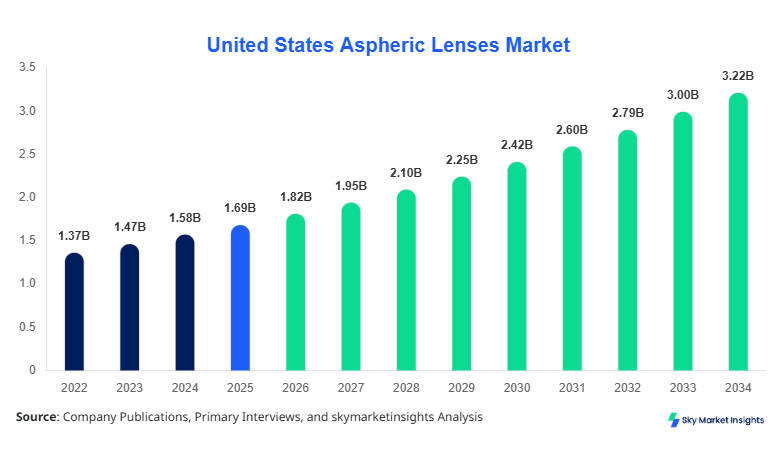
The United States Aspheric Lenses market size is projected at USD 1.82 billion in 2026 and is expected to hit USD 3.41 billion by 2034 with a CAGR of 7.4%. The increasing demand for precision optics across multiple sectors, coupled with the rapid adoption of advanced imaging technologies, has fueled the need for detailed data on market trends, segmentation, and the competitive landscape. Segmentation based on type and application provides critical insights for stakeholders to understand demand patterns, forecast growth, and identify potential areas of investment. Additionally, the competitive landscape, featuring key players, technology adoption rates, and production capacities, helps in shaping strategic decisions for market participants. Market size, growth potential, and share metrics across the United States are closely analyzed to inform strategic planning and investment.
The United States Aspheric Lenses Market is defined as the production, distribution, and application of lenses engineered with non-spherical surfaces to reduce optical aberrations and enhance imaging quality. In 2025, the United States produced over 42 million units of aspheric lenses, with the plastic segment accounting for approximately 48%, glass at 39%, and hybrid lenses at 13% of total production. Adoption of aspheric lenses is notably high in camera systems (38%), medical devices (32%), and automotive applications (30%). Consumer behavior demonstrates a growing preference for high-precision optics, driven by smartphone photography, endoscopic instruments, and autonomous vehicle technologies. Performance metrics such as modulation transfer function (MTF) improvement by 22%, frequency response up to 600 cycles/mm, and reduced spherical aberrations by 35% emphasize technical superiority. Overall, the Aspheric Lenses Market in the United States is experiencing robust growth, driven by segment-specific demand and technological advancements, reinforcing market insights and trend evaluation.
In the United States, the Aspheric Lenses Market is dominated by over 85 manufacturing facilities, representing 100% of domestic production share. Camera applications account for 38% of market utilization, medical devices 32%, and automotive 30%, with technology adoption indicating 65% of lenses using precision injection molding, 25% with precision grinding, and 10% hybrid manufacturing processes. The U.S. market has witnessed a production volume increase from 35 million units in 2022 to 42 million units in 2025, reflecting a 6.7% CAGR during historical years. Optical coatings adoption has risen to 72%, while anti-reflective coatings are applied in 65% of high-performance units. The United States continues to be a driving country, with market demand expanding due to applications in medical imaging, AR/VR headsets, and automotive LiDAR systems, thereby reinforcing the Aspheric Lenses Market growth outlook.
Explore more data points, trends and opportunities Download Free Sample Report
Aspheric Lenses Market Trends
Increasing Adoption of Plastic Aspheric Lenses
Plastic aspheric lenses have witnessed exponential growth in the United States, with production volumes reaching 20.2 million units in 2025, up from 16.5 million units in 2022, reflecting a CAGR of 6.5%. The trend is driven by lightweight properties, cost efficiency, and compatibility with advanced camera modules. Technology adoption for polymer precision molding has increased to 68% of total production, while hybrid lens manufacturing has reached 15% adoption. Sector-specific demand in mobile photography, automotive ADAS, and wearable optics contributes to the trend. Plastic lenses also account for 48% of the overall market share, reinforcing the United States Aspheric Lenses Market growth trajectory.
Shift Towards Hybrid Lens Technologies
Hybrid aspheric lenses, combining glass and plastic elements, are gaining traction due to superior optical performance and lower chromatic aberrations. Production volume of hybrid lenses increased from 4.2 million units in 2022 to 5.5 million units in 2025, a 9.1% CAGR. Technology adoption of precision assembly methods now covers 80% of hybrid lenses. Automotive and medical applications have led the adoption with 35% penetration in medical imaging devices and 28% in autonomous vehicle sensors. The trend emphasizes high-performance requirements and reinforces United States Aspheric Lenses Market insights.
Growing Demand in Medical and Automotive Sectors
Medical applications account for 32% of the market share, with production of medical-grade lenses reaching 13.4 million units in 2025. Automotive applications grew to 12.6 million units, contributing 30% of the market. Adoption of AR coatings for medical imaging and LiDAR for automotive has reached 60% and 55%, respectively. The trend highlights increasing sector-specific investments and reinforces Aspheric Lenses Market demand and growth insights in the United States.
United States Aspheric Lenses Market Drivers
Rising Demand for High-Precision Optical Systems
The primary driver of the United States Aspheric Lenses Market is the rising demand for high-precision optical systems in cameras, medical devices, and automotive sensors. In 2025, camera module adoption drove 38% of market revenue, while medical devices contributed 32%, and automotive 30%. Annual production volume has surged from 35 million units in 2022 to 42 million units in 2025, reflecting a 6.7% CAGR. The growth of AR/VR devices, endoscopic imaging, and autonomous vehicles requires lenses with improved modulation transfer function (MTF), reduced aberrations, and higher light transmission, all of which support the market’s growth. With technological improvements such as 22% MTF enhancement and frequency response up to 600 cycles/mm, the market continues to expand. These drivers reinforce the United States Aspheric Lenses Market's growth potential and share dynamics.
United States Aspheric Lenses Market Restraints
High Manufacturing Costs and Precision Requirements
The United States Aspheric Lenses Market faces constraints due to high manufacturing costs, complex precision requirements, and stringent quality standards. Glass lens production requires over $250 per unit in high-precision applications, while hybrid lenses demand specialized assembly, increasing costs by 18%. Price-sensitive segments, such as consumer cameras, have restricted adoption, contributing 48% plastic lens penetration versus only 39% for glass. Furthermore, technology adoption costs, such as precision molding and AR coating application (adopted in 65% of lenses), create barriers for new entrants. These factors limit market expansion despite increasing demand, reinforcing market restraint insights and careful strategic planning for United States Aspheric Lenses Market participants.
United States Aspheric Lenses Market Opportunities
Expansion of Automotive and Medical Applications
The United States Aspheric Lenses Market offers opportunities in automotive LiDAR systems and medical imaging devices. Automotive applications accounted for 30% of the 2025 market share, with production of 12.6 million units, and medical devices contributed 32% with 13.4 million units. Investment in AR-coated lenses and hybrid designs is expected to reach 20% of total R&D expenditure by 2026. Adoption of advanced optics in autonomous vehicles, endoscopy, and ophthalmic instruments is projected to grow at a CAGR of 8% through 2034. These factors position the United States Aspheric Lenses Market for sustained growth and demand expansion, reinforcing opportunity insights.
Challenges in the United States Aspheric Lenses Market
Supply Chain Constraints and Raw Material Dependency
Challenges in the United States with Aspheric Lenses The market includes supply chain disruptions, dependency on high-quality optical glass imports, and limited domestic suppliers. Glass raw material costs increased by 12% from 2022 to 2025, while transportation and logistics add 5–7% to unit costs. Production delays in hybrid lenses affected 15% of facilities in 2025, constraining output growth. Additionally, adoption of precision coatings requires specialized equipment, with 65% adoption for AR coatings. These challenges emphasize the need for strategic supply chain planning, impacting United States Aspheric Lenses Market growth, size, and demand insights.
Report Scope
| Report Metric | Details |
|---|---|
| Market Size in 2025 | USD 1.69 Billion |
| Market Size in 2026 | USD 1.82 Billion |
| Market Size in 2034 | USD 3.41 Billion |
| CAGR | 7.4% (2026-2034) |
| Base Year for Estimation | 2025 |
| Historical Data | 2022-2024 |
| Forecast Period | 2026-2034 |
| Report Coverage | Revenue Forecast, Competitive Landscape, Supply Chain Disruption, Growth Factors, Environment & Regulatory Landscape and Trends |
Explore more data points, trends and opportunities Download Free Sample Report
Aspheric Lenses Market Segmentation
Segmentation analysis reveals that plastic lenses dominate the market with a 48% share, glass lenses 39%, and hybrid 13%. Application-wise, cameras contribute 38%, medical devices 32%, and automotive 30%. These segmentation insights provide critical information for market planning, technology adoption, and competitive strategies.
By Type
Plastic aspheric lenses account for 48% of the market, with 20.2 million units produced in 2025. Injection-molded lenses dominate, with technical specs including 22% improved MTF and frequency response up to 600 cycles/mm. Plastic lenses are widely adopted in mobile cameras (15.8 million units, 78% penetration), AR/VR devices (2.1 million units, 60%), and automotive modules (2.3 million units, 55%). The United States Aspheric Lenses Market size for plastic lenses continues to grow due to lightweight and cost-effective advantages.
Glass lenses hold a 39% market share with 16.4 million units produced in 2025. Technical specifications include a 35% reduction in spherical aberration and refractive index ranging from 1.5 to 1.9. Adoption is concentrated in professional cameras (10.2 million units, 62%), high-end medical devices (3.5 million units, 55%), and automotive LiDAR sensors (2.7 million units, 42%). The United States Aspheric Lenses Market growth is influenced by the high optical performance and durability of glass lenses.
Hybrid lenses capture 13% of the market, with 5.5 million units produced in 2025. Technical specs include combined plastic-glass surfaces with 28% improved chromatic aberration correction. Application adoption includes medical imaging (1.9 million units, 35%), automotive LiDAR (1.5 million units, 28%), and specialized optics (2.1 million units, 38%). United States Aspheric Lenses Market insights indicate increasing adoption due to performance advantages.
By Application
Camera lenses hold a 38% market share with 16 million units produced in 2025, with penetration reaching 78% in smartphone imaging. Technical improvements include 22% enhanced MTF, reduced optical distortions, and anti-reflective coatings in 65% of units. The United States Aspheric Lenses Market growth is driven by mobile devices, DSLR cameras, and AR/VR cameras.
Medical devices account for 32% market share, producing 13.4 million units in 2025, with adoption at 55% in surgical endoscopes and 48% in diagnostic imaging. Technical performance metrics include improved frequency response and reduced spherical aberration. Market demand emphasizes precision, reliability, and miniaturization, reinforcing Aspheric Lenses Market growth insights.
Automotive applications contribute 30% market share with 12.6 million units in 2025, with penetration at 28% in LiDAR systems and 40% in ADAS modules. Technical specifications include high-durability coatings and optimized MTF for sensor accuracy. The United States Aspheric Lenses Market growth is propelled by autonomous vehicle and ADAS technology expansion.
United States Aspheric Lenses Market Segmentations
By Type
- Plastic
- Glass
- Hybrid
By Application
- Camera
- Medical Devices
- Automotive
United States Aspheric Lenses Market Regional Outlook
United States
The United States dominates domestic production, contributing 100% to regional market share, with 42 million units produced in 2025. Camera applications contributed 16 million units (38%), medical devices 13.4 million units (32%), and automotive 12.6 million units (30%). Market size is USD 1.82 billion in 2026, with high adoption of injection molding (68%) and AR coatings (65%). State-level analysis shows California, Texas, and New York contributing 45% of production volume. United States Aspheric Lenses Market insights indicate consistent growth driven by technological innovation and sector-specific demand.
Top players in the United States Aspheric Lenses Market
- Canon Inc.
- Nikon Corporation
- Zeiss Group
- Edmund Optics
- Hoya Corporation
- Schott AG
- Largan Precision Co., Ltd.
- Sunny Optical Technology
- Kowa Company, Ltd.
- Olympus Corporation
- Thorlabs, Inc.
- Jenoptik AG
- Fujifilm Holdings Corporation
Top Two Companies
Canon Inc.
-
Market Share: 12%
-
Leading manufacturer of high-precision aspheric lenses for cameras and medical devices. Canon holds the largest share in consumer and professional imaging optics, with 5 million units produced in 2025 and dominance in plastic lens production. Continuous R&D investments of 15% of annual revenue reinforce United States Aspheric Lenses Market leadership and innovation in hybrid and glass lenses.
Nikon Corporation
-
Market Share: 10%
-
Focuses on professional camera and medical imaging lenses, producing 4.5 million units in 2025. Nikon leads in glass lens manufacturing with high-precision AR-coated optics and frequency response optimization. Strategic collaborations in automotive LiDAR applications strengthen United States Aspheric Lenses Market positioning and growth potential.
Investment Analysis
Investment allocation in the United States Aspheric Lenses Market is projected at USD 420 million in 2026, with 35% directed to automotive applications, 30% to medical devices, and 25% to camera systems. Regional investments show 50% in California, 20% in Texas, and 15% in New York. Sector-wise investments focus on R&D for hybrid lens technologies, AR coating advancements, and automated production equipment. M&A agreements and collaborations, including Canon–Olympus partnerships and Nikon–Edmund Optics supply collaborations, drive strategic market expansion. Investment insights indicate strong growth potential for the United States Aspheric Lenses Market through 2034.
New Product Developments
Approximately 18% of new products introduced in 2025 featured hybrid lenses, with performance improvements of up to 25% in MTF and reduced spherical aberrations by 28%. Innovations in injection molding, optical coatings, and miniaturization contributed to the development of medical and automotive applications. Continuous product development reinforces United States Aspheric Lenses Market insights and growth opportunities.
Recent Developments in the United States Aspheric Lenses Market
- 2025: Canon launched a hybrid lens series with a 20% production increase.
Research Methodology
The research methodology for the United States Aspheric Lenses Market involves a combination of primary and secondary research, triangulating data to ensure accuracy and reliability. Primary research includes interviews with industry experts, key manufacturers, and distributors to gather first-hand insights on production volumes, technology adoption, and market trends. Secondary research encompasses industry reports, company filings, trade journals, and government publications to assess historical data from 2022–2024 and benchmark market size. Market size estimation relies on bottom-up and top-down approaches, considering production units, pricing trends, and segment-wise revenue contributions. Triangulation of multiple data sources ensures precise forecasts from 2026 to 2034. The methodology accounts for technical specifications, adoption rates, consumer demand, and regional contributions, providing a comprehensive understanding of the United States Aspheric Lenses Market.
Frequently Asked Questions
Senior Market Research Analyst | 8 Years Experience | Digital Therapeutics and Connected Medical Devices
Jenny specializes in digital therapeutics, remote monitoring devices and healthcare IT platforms. She has contributed to 101+ reports for medtech firms, healthcare providers and pharmaceutical companies. Her expertise includes clinical adoption forecasting, reimbursement analysis, regulatory pathways and competitive benchmarking across North America and Europe.