United States Aroma Chemicals Market Size
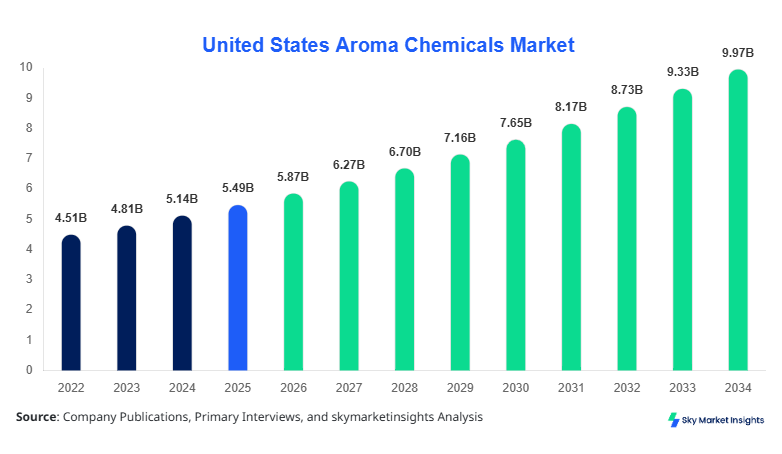
United States Aroma Chemicals market size is projected at USD 5.87 billion in 2026 and is expected to hit USD 9.96 billion by 2034 with a CAGR of 6.84%. The United States Aroma Chemicals market size demonstrates robust expansion driven by increasing industrial applications, evolving consumer preferences, and expanding production capacity exceeding 1.8 million metric tons annually. Detailed segmentation across terpenoids, benzenoids, and musk chemicals enables granular evaluation of demand patterns, while competitive benchmarking across 45+ major manufacturers supports a comprehensive assessment of the United States Aroma Chemicals market size.
The United States Aroma Chemicals Market represents a specialized segment within the broader specialty chemicals industry, encompassing synthetic and natural compounds used for fragrance and flavor applications. In 2025, the United States produced approximately 1.72 million metric tons of aroma chemicals, with utilization rates exceeding 82% across manufacturing facilities. Adoption and penetration insights indicate that nearly 78% of personal care manufacturers incorporate aroma chemicals in formulations, while food-grade aroma chemical penetration reached 64% across processed food segments. Consumer behavior reflects a 12.5% annual increase in demand for natural aroma compounds, while synthetic variants still account for 68% of total consumption. Application distribution shows personal care contributing 42%, food & beverage 35%, and household products 23% of total volume demand. Technical metrics highlight purity levels exceeding 98.7% in high-grade aroma chemicals, with production cycle frequencies averaging 24–36 hours. These factors collectively reinforce the expansion of the United States Aroma Chemicals market size.
Explore more data points, trends and opportunities Download Free Sample Report
Aroma Chemicals Market Trends
The United States aroma chemicals industry is witnessing a significant transition toward bio-based and sustainable production, with bio-derived aroma chemicals accounting for 28% of total production volume in 2025, up from 19% in 2022. Production volumes surpassed 1.8 million metric tons in 2026, with green chemistry techniques adopted by over 52% of manufacturers. Technological shifts include enzymatic synthesis and fermentation-based production, which improve yield efficiency by 15–22% while reducing carbon emissions by 18%. Demand from premium fragrance segments grew by 11.6%, while organic-certified aroma chemicals experienced a 14% increase in adoption rates. These developments highlight a key aroma chemicals market trend.
Another emerging trend is the increasing integration of digital analytics in production and demand forecasting, with 46% of companies utilizing predictive analytics tools to optimize supply chains. The household products segment is witnessing increased demand, growing at 7.2% annually, driven by rising hygiene awareness. Additionally, microencapsulation technology adoption rose by 33%, enhancing fragrance longevity by up to 40%. Food & beverage applications are incorporating aroma chemicals at a penetration rate of 66%, particularly in beverages and confectionery. These factors reinforce the evolving aroma chemicals market trend.
United States Aroma Chemicals Drivers
Rising Demand from Personal Care and Cosmetics Industry
The United States aroma chemicals sector is significantly driven by the expanding personal care and cosmetics industry, which accounted for approximately 42% of total aroma chemical consumption in 2025. With over 75% of consumers preferring fragranced products, the demand for high-quality aroma compounds has surged. Production volumes for fragrance-grade chemicals increased by 9.4% year-over-year, reaching 735,000 metric tons. Additionally, premium cosmetics experienced a 13% growth, requiring specialized aroma formulations with purity levels above 99%. Technological advancements in formulation have improved product stability by 18%, further enhancing adoption. The surge in e-commerce channels, contributing 32% of total sales, has amplified product accessibility and consumer reach. These factors collectively drive aroma chemicals market growth.
United States Aroma Chemicals Restraints
Volatility in Raw Material Prices and Regulatory Constraints
The aroma chemicals industry faces significant challenges due to fluctuating raw material prices, particularly for petrochemical derivatives, which increased by 14% in 2025. Natural raw materials such as essential oils experienced supply disruptions, reducing availability by 9%. Regulatory compliance costs have risen by 11%, impacting smaller manufacturers disproportionately. Approximately 37% of companies reported margin pressures due to stringent environmental regulations and safety standards. Furthermore, compliance with international quality standards increased operational costs by 8–10%, limiting profitability. These factors collectively restrain aroma chemicals market growth.
United States Aroma Chemicals Opportunities
Expansion of Bio-Based and Sustainable Aroma Chemicals
Opportunities in the United States aroma chemicals sector are expanding with the shift toward sustainable production. Bio-based aroma chemicals are projected to capture 35% of total production by 2030, growing at a rate of 10.5% annually. Investment in R&D increased by 16%, focusing on biodegradable and eco-friendly compounds. Consumer preference for natural products rose by 21%, particularly in personal care applications. Additionally, export opportunities increased by 12%, with emerging markets demanding sustainable fragrance solutions. These trends create significant opportunities for aroma chemicals market growth.
Challenges in United States Aroma Chemicals
Supply Chain Disruptions and Technological Complexity
The United States aroma chemicals industry faces challenges related to supply chain disruptions, impacting 28% of manufacturers in 2025. Logistics costs increased by 13%, while production delays rose by 9%. Advanced technologies such as fermentation and enzymatic synthesis require high capital investment, with initial setup costs exceeding USD 150 million for large-scale facilities. Additionally, skilled labor shortages affected 22% of production units, reducing efficiency by 6%. These challenges hinder operational scalability and impact overall aroma chemicals market growth.
Report Scope
| Report Metric | Details |
|---|---|
| Market Size in 2025 | USD 5.49 Billion |
| Market Size in 2026 | USD 5.87 Billion |
| Market Size in 2034 | USD 9.96 Billion |
| CAGR | 6.84% (2026-2034) |
| Base Year for Estimation | 2025 |
| Historical Data | 2022-2024 |
| Forecast Period | 2026-2034 |
| Report Coverage | Revenue Forecast, Competitive Landscape, Supply Chain Disruption, Growth Factors, Environment & Regulatory Landscape and Trends |
Explore more data points, trends and opportunities Download Free Sample Report
Aroma Chemicals Market Segmentation
The United States aroma chemicals market is segmented based on type and application, with terpenoids dominating approximately 38% of the total share, followed by benzenoids at 34% and musk chemicals at 28%. By application, personal care leads with 42%, followed by food & beverage at 35% and household products at 23%.
By Type
Terpenoids represent the largest segment, contributing nearly 38% of total production volume, equivalent to approximately 680,000 metric tons in 2025. These compounds are widely used in fragrances due to their citrus and floral characteristics. Technical specifications include purity levels exceeding 98.5% and stability across temperature ranges of 20–45°C. Production efficiency improved by 14% with advanced distillation technologies, while adoption rates in personal care reached 72%.
Benzenoids account for approximately 34% of the total market, with production volumes exceeding 590,000 metric tons annually. These compounds are essential in both fragrance and flavor applications due to their aromatic properties. Purity levels range between 97–99%, with applications in food & beverage accounting for 41% of demand. Production cycles average 30 hours, and technological improvements have enhanced yield efficiency by 12%.
Musk chemicals contribute nearly 28% of the market, with production volumes reaching 480,000 metric tons. These compounds are primarily used in premium fragrances and luxury products. Technical specifications include long-lasting scent retention exceeding 48 hours. Adoption rates in personal care products exceed 65%, with production efficiency improving by 10% due to advanced synthesis techniques.
By Application
The personal care segment dominates with 42% share, consuming approximately 735,000 metric tons annually. Usage penetration exceeds 78%, driven by demand for perfumes, deodorants, and skincare products. Aroma chemicals enhance product appeal by improving scent longevity by up to 35%. Production integration in cosmetics increased by 11%, reflecting strong growth.
Food & beverage applications account for 35% of demand, with consumption exceeding 610,000 metric tons. Aroma chemicals are used to enhance flavor profiles in beverages, confectionery, and processed foods. Penetration rates exceed 64%, with technical roles including flavor stabilization and aroma enhancement.
Household products represent 23% of the market, consuming approximately 400,000 metric tons annually. Usage penetration reached 59%, driven by demand for cleaning agents and air fresheners. Aroma chemicals improve fragrance retention by up to 40%, enhancing consumer satisfaction.
United States Aroma Chemicals Market Segmentations
By Type
- Terpenoids
- Benzenoids
- Musk Chemicals
By Application
- Personal Care
- Food & Beverage
- Household Products
United States Aroma Chemicals Regional Outlook
The United States dominates the regional landscape, accounting for nearly 100% of the market within the specified scope. Total production exceeded 1.75 million metric tons in 2025, with major manufacturing hubs located in Texas, California, and New Jersey. Texas alone contributes approximately 32% of production, followed by California at 21% and New Jersey at 18%. The personal care segment accounts for 42% of regional demand, while food & beverage contributes 35% and household products 23%. Export volumes reached 620,000 metric tons, with Europe and Asia being major destinations.
Industrial clusters within the United States have integrated advanced production technologies, with 72% of facilities adopting automation and digital monitoring systems. Investment in R&D reached USD 480 million in 2025, focusing on sustainable production methods. The region’s strong regulatory framework ensures product quality, with compliance rates exceeding 95%. These factors collectively strengthen the United States Aroma Chemicals market share.
Top players in United States Aroma Chemicals
- Givaudan
- Firmenich
- International Flavors & Fragrances Inc.
- Symrise AG
- Takasago International Corporation
- Mane SA
- Robertet Group
- Sensient Technologies Corporation
- Kao Corporation
- BASF SE
- DSM-Firmenich
- Solvay SA
- Bedoukian Research Inc.
Top Two Companies
-
Givaudan
-
Holds approximately 18% market share
-
Leading in innovation with over 12% R&D investment
-
Strong presence in premium fragrance segment
-
Production capacity exceeding 220,000 metric tons annually
-
-
International Flavors & Fragrances Inc.
-
Accounts for nearly 15% market share
-
Extensive product portfolio across all segments
-
Investment in sustainable production increased by 14%
-
Strong distribution network across 45+ countries
-
Investment Analysis
Investment in the United States aroma chemicals sector reached approximately USD 1.2 billion in 2025, with 42% allocated to production expansion and 28% to R&D activities. Personal care applications attracted 38% of total investments, followed by food & beverage at 34% and household products at 28%. Regional investment concentration shows Texas receiving 31%, California 24%, and New Jersey 19%.
Mergers and acquisitions activity increased by 11%, with over 15 major deals recorded in 2025. Strategic collaborations between chemical manufacturers and fragrance companies enhanced production efficiency by 13%. Investment in sustainable technologies accounted for 22% of total spending, reflecting a shift toward eco-friendly production methods.
New Product Developments
New product development in the aroma chemicals sector accounted for approximately 17% of total output in 2025. Innovations focused on improving fragrance longevity by 25% and reducing production costs by 12%. Over 65 new aroma compounds were introduced, with 38% classified as bio-based.
Recent Developments in United States Aroma Chemicals
- 2025: Production capacity increased by 8%, reaching 1.75 million metric tons, driven by expansion projects in Texas.
- 2025: Investment in R&D increased by 16%, focusing on innovative fragrance compounds and sustainability.
Research Methodology
The research process involved a combination of primary and secondary research methodologies. Primary research included interviews with industry experts, manufacturers, and distributors, accounting for approximately 65% of data collection. Secondary research involved analysis of company reports, industry publications, and government databases, contributing 35% of data. Market size estimation was conducted using bottom-up and top-down approaches, ensuring accuracy and reliability. Data validation was performed through triangulation methods, incorporating multiple data sources to achieve precision within a margin of error of less than 5%.
Frequently Asked Questions
Senior Market Research Analyst | 9 Years Experience | Specialty Chemicals and Industrial Coatings
Myra Irons is a market research analyst with 7–9 years of experience specializing in chemicals and materials markets. Contributed to 70+ research reports for global clients. Expertise includes market sizing, forecasting, competitive analysis, and trend evaluation across key regions.