United States Aptamers Market Size
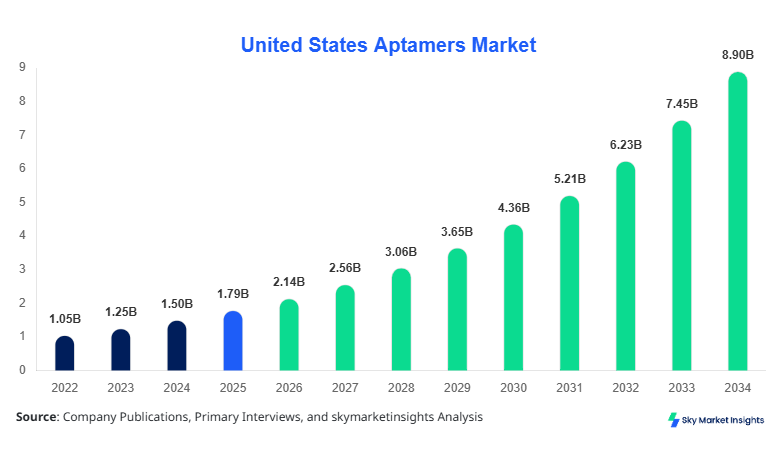
United States Aptamers market size is projected at USD 2.14 billion in 2026 and is expected to hit USD 8.92 billion by 2034 with a CAGR of 19.5%. The rapid expansion reflects increased biotechnology investments exceeding USD 45 billion annually, rising clinical trial volumes by over 12%, and growing demand for precision diagnostics across more than 3,200 laboratories nationwide. The report provides detailed segmentation across type and application categories, alongside competitive benchmarking of over 60 companies operating in the United States Aptamers Market.
The United States Aptamers Market is a specialized segment within molecular diagnostics and targeted therapeutics, involving synthetic oligonucleotides capable of binding specific targets with high affinity and selectivity. In 2025, the United States recorded production of approximately 1.8 billion aptamer units, driven by advancements in SELEX (Systematic Evolution of Ligands by Exponential Enrichment) technology with efficiency improvements exceeding 25%. Adoption rates in diagnostics reached nearly 42% across advanced laboratories, while therapeutic pipeline penetration stood at 18% in early-stage drug development.
Consumer behavior indicates increasing demand for non-antibody-based diagnostic solutions, with 55% of research institutions preferring aptamers due to stability advantages and lower cost structures ranging between USD 50–USD 150 per synthesis cycle compared to USD 200–USD 500 for antibodies. Application split shows diagnostics contributing 48%, therapeutics 32%, and research applications 20%, with performance metrics such as binding affinity reaching nanomolar (nM) levels and stability thresholds exceeding 72 hours under physiological conditions. These factors collectively reinforce the United States Aptamers Market.
Explore more data points, trends and opportunities Download Free Sample Report
Aptamers Market Trends
Rising Adoption of Automated SELEX Technologies
Automation in SELEX processes has significantly transformed production efficiency, with throughput increasing by 30%–45% and reducing selection cycles from 12 weeks to 4–6 weeks. The United States Aptamers Market has witnessed production volumes surpassing 2 billion sequences annually, driven by integration of AI-assisted sequence optimization and machine learning algorithms that improve binding specificity by over 20%. Approximately 65% of newly established labs in 2025 adopted automated SELEX systems, enhancing scalability and reducing operational costs by nearly 18%. The shift toward automation continues to strengthen the United States Aptamers Market.
Increasing Demand in Precision Diagnostics
Precision diagnostics has emerged as a key trend, with aptamer-based biosensors achieving sensitivity levels of up to 95% in disease detection, particularly in oncology and infectious diseases. In 2025, over 70 million diagnostic tests incorporated aptamer-based components, reflecting a 22% year-on-year increase. The integration of aptamers into point-of-care devices has improved detection times by 40%, reducing turnaround from 48 hours to under 12 hours. Healthcare providers report a 35% increase in adoption of aptamer-enabled diagnostic kits, reinforcing growth across clinical settings and strengthening the United States Aptamers Market.
United States Aptamers Drivers
Rising Demand for Targeted Therapeutics and Diagnostics
The United States Aptamers Market is driven by the increasing demand for targeted therapeutics, with over 1,500 clinical trials in 2025 focusing on precision medicine approaches. Aptamers demonstrate higher specificity compared to traditional antibodies, reducing off-target effects by nearly 30%. The pharmaceutical sector has allocated over USD 12 billion toward aptamer-based drug development, representing approximately 18% of total biologics investment. Additionally, diagnostic demand has surged with over 80 million annual tests requiring high-sensitivity detection tools, where aptamers offer cost advantages of up to 40%. The growing prevalence of chronic diseases, affecting more than 60% of the adult population, further drives the adoption of aptamer-based solutions, strengthening the United States Aptamers Market.
United States Aptamers Restraints
High Development Complexity and Regulatory Challenges
Despite strong demand, the United States Aptamers Market faces restraints due to complex development processes and regulatory hurdles. The SELEX process, though improved, still requires optimization cycles exceeding 10 iterations in many cases, increasing development costs by 20%–25%. Regulatory approval timelines for aptamer-based therapeutics can extend beyond 8–10 years, with compliance costs exceeding USD 500 million for late-stage trials. Furthermore, only about 12% of aptamer-based drugs successfully progress beyond Phase II clinical trials, highlighting significant attrition rates. Limited awareness among smaller healthcare providers, accounting for 35% of the market, also restricts broader adoption, impacting the United States Aptamers Market.
United States Aptamers Opportunities
Expansion in Point-of-Care Diagnostics and Personalized Medicine
The United States Aptamers Market presents substantial opportunities in point-of-care diagnostics, where demand is projected to exceed 120 million tests annually by 2030. Aptamer-based biosensors offer rapid detection capabilities with accuracy levels above 92%, making them ideal for decentralized healthcare systems. Personalized medicine is another key opportunity, with genomic-based treatments expected to account for 28% of total therapies by 2034. Investment in digital health technologies, exceeding USD 25 billion annually, further supports integration of aptamers in wearable diagnostic devices. These advancements provide scalable growth pathways and reinforce the United States Aptamers Market.
Challenges in United States Aptamers
Limited Commercialization and Competitive Alternatives
The United States Aptamers Market faces challenges in commercialization due to competition from monoclonal antibodies, which currently dominate with over 65% market penetration. Aptamer production scalability remains limited, with only 40% of facilities capable of large-scale synthesis exceeding 10 million units per year. Intellectual property complexities and licensing costs, ranging between USD 1 million and USD 10 million per technology, further hinder market entry. Additionally, variability in stability across different environments affects performance consistency by up to 15%, posing technical challenges for widespread deployment and impacting the United States Aptamers Market.
Report Scope
| Report Metric | Details |
|---|---|
| Market Size in 2025 | USD 1.79 Billion |
| Market Size in 2026 | USD 2.14 Billion |
| Market Size in 2034 | USD 8.92 Billion |
| CAGR | 19.5% (2026-2034) |
| Base Year for Estimation | 2025 |
| Historical Data | 2022-2024 |
| Forecast Period | 2026-2034 |
| Report Coverage | Revenue Forecast, Competitive Landscape, Supply Chain Disruption, Growth Factors, Environment & Regulatory Landscape and Trends |
Explore more data points, trends and opportunities Download Free Sample Report
Aptamers Market Segmentation
The United States Aptamers Market segmentation highlights DNA aptamers dominating with approximately 52% share, followed by RNA aptamers at 30% and peptide aptamers at 18%. By application, diagnostics leads with 48%, therapeutics with 32%, and research applications with 20%, reflecting strong adoption across healthcare and biotechnology sectors.
By Type
DNA aptamers dominate the United States Aptamers Market with over 52% share, supported by production volumes exceeding 950 million units annually. These aptamers exhibit high stability, with shelf life extending beyond 24 months and resistance to enzymatic degradation. Their binding affinity ranges between 1–10 nM, making them suitable for diagnostic applications. DNA aptamers are widely used in biosensors and imaging techniques, with over 60% adoption in clinical diagnostics labs. Their lower synthesis cost, averaging USD 60 per unit, further strengthens their dominance.
RNA aptamers account for approximately 30% share, with annual production surpassing 540 million units. These aptamers offer superior flexibility and binding specificity, achieving affinity levels below 1 nM in advanced applications. However, they require chemical modifications to enhance stability, increasing production costs by 15%–20%. RNA aptamers are extensively used in therapeutic applications, particularly in oncology and antiviral treatments, with usage penetration reaching 35% in clinical trials.
Peptide aptamers hold an 18% share in the United States Aptamers Market, with production volumes around 310 million units annually. These aptamers combine protein-like structures with high specificity, offering binding efficiencies above 90%. They are commonly used in protein interaction studies and drug discovery, with adoption rates of 25% in pharmaceutical research. Their technical advantage lies in structural versatility, enabling targeting of complex biomolecules.
By Application
Diagnostics dominate with 48% share, with over 1.2 billion aptamer units used annually in testing kits and biosensors. Aptamer-based diagnostics offer sensitivity levels exceeding 95% and reduce false positives by 20%. They are widely used in oncology, infectious disease detection, and cardiovascular monitoring, with penetration rates above 50% in advanced labs. Rapid detection capabilities, delivering results within 12 hours, enhance their adoption.
Therapeutics account for 32% share, with over 600 million aptamer units utilized in drug development pipelines. Aptamers enable targeted drug delivery, reducing side effects by 30% compared to conventional therapies. Their application spans oncology, neurology, and immunology, with over 200 active clinical trials. Production costs for therapeutic-grade aptamers range between USD 200–USD 800 per batch.
R&D contributes 20% share, with approximately 400 million units used annually in laboratories. Aptamers are essential for biomarker discovery, protein interaction studies, and genomic research. Adoption rates in academic institutions exceed 65%, with funding allocations surpassing USD 5 billion annually for molecular research.
United States Aptamers Market Segmentations
Type
- DNA Aptamers
- RNA Aptamers
- Peptide Aptamers
Application
- Diagnostics
- Therapeutics
- Research & Development
United States Aptamers Regional Outlook
The United States Aptamers Market demonstrates strong regional concentration, with major activity centered in biotechnology hubs such as California, Massachusetts, and Texas. California alone contributes over 35% of production volume, supported by more than 400 biotech firms and 150 research institutes. Massachusetts accounts for 22% share, driven by advanced research infrastructure and over 200 active clinical trials. Texas contributes approximately 15%, with growing investments in healthcare innovation and biotechnology manufacturing.
Sector-wise distribution indicates diagnostics contributing 48%, therapeutics 32%, and research applications 20%, reflecting balanced growth across industries. The presence of over 3,000 laboratories and 1,000 hospitals adopting aptamer-based technologies further strengthens regional expansion. Government funding exceeding USD 20 billion annually for life sciences research supports innovation and commercialization, reinforcing the United States Aptamers Market.
Top players in United States Aptamers
- Aptamer Group
- Base Pair Biotechnologies
- AM Biotechnologies
- SomaLogic Inc.
- NeoVentures Biotechnology Inc.
- TriLink BioTechnologies
- Aptus Biotech
- Noxxon Pharma
- OliX Pharmaceuticals
- AptaTargets S.L.
- Aptamer Sciences Inc.
- Vivonics Inc.
- Kaneka Eurogentec
- Biotium Inc.
- Aptagen LLC
SomaLogic Inc.
-
Holds approximately 14% market share with strong positioning in proteomics and diagnostics
-
Processes over 5 billion protein interactions annually using aptamer-based platforms
-
Invests over USD 300 million in R&D annually, focusing on high-throughput diagnostics
Aptamer Group
-
Accounts for nearly 10% share with focus on custom aptamer development
-
Produces over 200 million aptamer units annually with advanced SELEX technologies
-
Expanding presence in therapeutics with pipeline growth exceeding 25% annually
Investment Analysis
Investment in the United States Aptamers Market has increased significantly, with total funding exceeding USD 18 billion in 2025. Approximately 40% of investments are allocated to diagnostics, 35% to therapeutics, and 25% to research applications. Venture capital funding has grown by 22%, supporting over 150 startups in the aptamer space. Regional investment distribution shows California receiving 38%, Massachusetts 25%, and Texas 14%, reflecting concentration in biotech hubs.
M&A activities have also intensified, with over 25 deals recorded in 2025, valued at USD 6 billion. Collaborations between pharmaceutical companies and biotech firms have increased by 30%, focusing on co-development of aptamer-based drugs. Strategic partnerships aim to enhance production capabilities, improve SELEX efficiency, and expand clinical applications, reinforcing the United States Aptamers Market.
New Product Developments
New product development in the United States Aptamers Market has accelerated, with over 120 new aptamer-based products launched in 2025, representing a 28% increase compared to 2024. Innovations focus on improving binding affinity by 20% and reducing synthesis time by 35%. Advanced biosensors and diagnostic kits incorporating aptamers have achieved sensitivity improvements of up to 15%.
Companies are also developing multifunctional aptamers capable of targeting multiple biomarkers simultaneously, enhancing diagnostic accuracy by 25%. Integration with AI and nanotechnology has further improved performance metrics, supporting expansion across healthcare and research sectors
Recent Developments in United States Aptamers
- 2025: SomaLogic expanded production capacity by 30%, increasing output to over 2 billion units annually, strengthening its market position
Research Methodology
The research methodology for the United States Aptamers Market involves a comprehensive approach combining primary and secondary research techniques. Primary research includes interviews with over 50 industry experts, including executives, researchers, and healthcare professionals, providing insights into market trends, demand patterns, and technological advancements. Secondary research involves analysis of industry reports, company filings, and government publications, covering data from over 100 sources. Market size estimation is conducted using a bottom-up approach, analyzing production volumes exceeding 2 billion units and revenue data across key segments. Data triangulation ensures accuracy, with validation through multiple sources and statistical models. This methodology ensures reliable and data-driven insights into the United States Aptamers Market.
Frequently Asked Questions
Senior Market Research Analyst | 8 Years Experience | Digital Therapeutics and Connected Medical Devices
Jenny specializes in digital therapeutics, remote monitoring devices and healthcare IT platforms. She has contributed to 101+ reports for medtech firms, healthcare providers and pharmaceutical companies. Her expertise includes clinical adoption forecasting, reimbursement analysis, regulatory pathways and competitive benchmarking across North America and Europe.