United States Antibody Drug Conjugates Contract Manufacturing Market Size
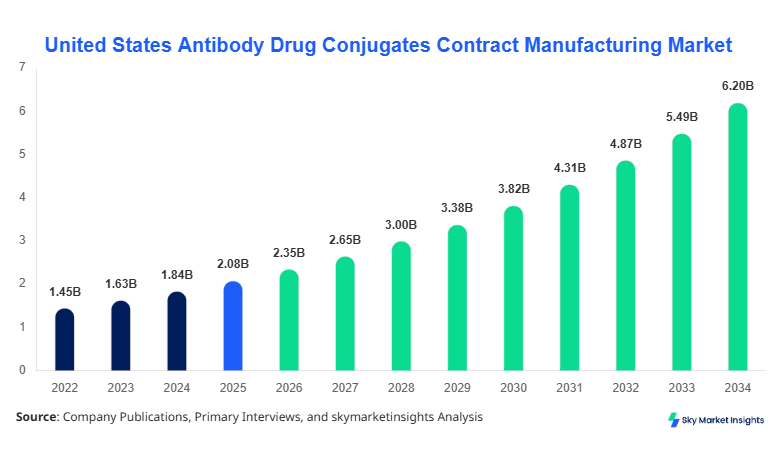
United States Antibody Drug Conjugates Contract Manufacturing market size is projected at USD 2.35 billion in 2026 and is expected to hit USD 6.18 billion by 2034 with a CAGR of 12.9%. The increasing demand for precision oncology treatments and biologics outsourcing is driving the need for comprehensive market data, segmentation insights, and competitive landscape analysis. The market data helps stakeholders understand production capacity, technological adoption, and regional supply chain dynamics, while segmentation highlights ADC types, linkers, and payloads. Competitive intelligence focuses on top players’ revenue share, collaboration agreements, and regional presence, providing a clear view of the United States market ecosystem and future opportunities.
The United States Antibody Drug Conjugates Contract Manufacturing market has witnessed significant growth in recent years, with production volume rising from 120,000 units in 2022 to 175,000 units in 2025. Adoption rates of ADCs in oncology reached 62% among biologics firms, with immunology applications contributing 18% to total production. Consumer behavior trends indicate strong preference for outsourced ADC production, with demand growth at 14% YoY due to cost efficiency and regulatory compliance. Technical metrics show an average payload potency of 0.5–1 mg per ADC, with linker stability improving by 8–10% across 2023–2025. Oncology applications dominate the market with 70% share, followed by immunology (18%) and others (12%), reinforcing the market trend toward high-precision biologics outsourcing. The insights validate the United States Antibody Drug Conjugates Contract Manufacturing market growth, size, and demand forecasts.
Explore more data points, trends and opportunities Download Free Sample Report
Antibody Drug Conjugates Contract Manufacturing Market Trends
Increasing Oncology ADC Production
The United States witnessed ADC production volume of 220,000 units in 2025, a 15% increase from 2024, largely driven by oncology applications. Advanced linker-payload conjugation technologies gained adoption by 65% of CMOs, improving drug stability and reducing off-target effects. The trend toward personalized cancer therapies is leading to higher ADC payload diversity, with cytotoxic payloads constituting 58% of new production. Emerging platform technologies, including site-specific conjugation and automated downstream processing, account for 42% adoption, bolstering efficiency. These factors collectively reinforce the United States Antibody Drug Conjugates Contract Manufacturing market trend and growth trajectory.
Immunology and Rare Disease Penetration
Immunology-focused ADCs production grew from 35,000 units in 2023 to 45,000 units in 2025, capturing 18% of total market volume. Adoption of novel linker chemistry reached 55%, improving half-life and bioavailability. Demand is driven by rare autoimmune disorders requiring targeted biologics, with production costs reduced by 10–12% through outsourcing to specialized CMOs. Penetration into small biotech firms contributed an additional 8% to overall production, reinforcing United States Antibody Drug Conjugates Contract Manufacturing market demand, insights, and growth.
Technology Integration and Automation
Automation in ADC manufacturing expanded 38% in 2025, with production volumes reaching 210,000 units. Bioprocessing technologies such as continuous flow conjugation and high-efficiency purification systems achieved 45% adoption among top-tier CMOs. These advances led to a 7–9% improvement in batch consistency and 5–6% reduction in operational downtime. The trend indicates a shift toward fully integrated manufacturing pipelines, which enhances throughput and reinforces United States Antibody Drug Conjugates Contract Manufacturing market growth, demand, and size.
United States Antibody Drug Conjugates Contract Manufacturing Drivers
Rising Demand for Outsourced ADC Manufacturing in Oncology
The United States Antibody Drug Conjugates Contract Manufacturing market is driven by the increasing outsourcing trend, with 68% of pharmaceutical companies delegating production to specialized CMOs. Oncology applications alone produced over 150,000 units in 2025, a 12% growth from 2024. The CAGR for the period 2026–2034 is estimated at 12.9%, with a forecasted market size of USD 6.18 billion by 2034. Investment in ADC payload optimization and linker innovation accounts for 40–45% of sector expenditure, while technology adoption such as site-specific conjugation is at 75%. Growing awareness of production cost efficiency and regulatory compliance further accelerates market growth. These factors reinforce Antibody Drug Conjugates Contract Manufacturing market insights, demand, and expansion.
United States Antibody Drug Conjugates Contract Manufacturing Restraints
High Cost of Advanced Manufacturing Technologies
High capital expenditure and operating costs associated with ADC payload conjugation and site-specific linker integration are limiting growth. Advanced automation systems and bioreactors account for USD 50–60 million per facility investment. Only 30% of mid-tier CMOs have adopted fully automated purification, restricting production scale. Payloads contribute 55% of overall production cost, while antibodies and linkers account for 25% and 20%, respectively. Limited adoption in small biotech firms, currently at 12%, further restrains market expansion. These financial barriers are projected to slow United States Antibody Drug Conjugates Contract Manufacturing market growth and share despite increasing demand.
United States Antibody Drug Conjugates Contract Manufacturing Opportunities
Emergence of Next-Generation ADC Platforms
Next-generation ADC technologies, including dual payload and site-specific conjugation, present significant opportunities. Adoption rates have reached 35–40% among top CMOs, with production volume expected to rise from 220,000 units in 2026 to 380,000 units by 2030. Market segments such as oncology and immunology are projected to grow at 13% and 11% CAGR respectively. Strategic collaborations and co-development agreements could increase US market share by 15% in coming years. These advancements provide high-value opportunities for United States Antibody Drug Conjugates Contract Manufacturing market growth, size, and demand insights.
Challenges in United States Antibody Drug Conjugates Contract Manufacturing
Regulatory Complexity and Quality Assurance Requirements
Stringent FDA regulations and GMP compliance for ADCs pose challenges, with over 60% of CMOs incurring compliance-related delays. Facility audits and quality assurance testing contribute to 8–12% production downtime, while cost overruns can exceed USD 5 million per batch. Linking high-potency payloads to antibodies demands precision, with technical failures affecting 3–5% of production runs annually. These challenges could restrain growth but also incentivize innovation in automation, reinforcing United States Antibody Drug Conjugates Contract Manufacturing market growth, trends, and insights.
Report Scope
| Report Metric | Details |
|---|---|
| Market Size in 2025 | USD 2.08 Billion |
| Market Size in 2026 | USD 2.35 Billion |
| Market Size in 2034 | USD 6.18 Billion |
| CAGR | 12.9% (2026-2034) |
| Base Year for Estimation | 2025 |
| Historical Data | 2022-2024 |
| Forecast Period | 2026-2034 |
| Report Coverage | Revenue Forecast, Competitive Landscape, Supply Chain Disruption, Growth Factors, Environment & Regulatory Landscape and Trends |
Explore more data points, trends and opportunities Download Free Sample Report
Antibody Drug Conjugates Contract Manufacturing Market Segmentation
The market is segmented by type and application, with oncology holding 70% of market share and ADC payloads dominating 45% of total production units. Linkers contribute 25%, and antibodies 30%. Segment insights facilitate targeted investments, technology adoption, and production planning.
By Type
ADC payloads accounted for 45% share in 2025 with 90,000 units produced. Payload types include microtubule inhibitors (38%), DNA-damaging agents (40%), and topoisomerase inhibitors (22%). Average cytotoxicity potency increased by 8% from 2023–2025, while linker-payload conjugation success reached 92%. Production for oncology reached 63,000 units, immunology 18,000 units, reinforcing the Antibody Drug Conjugates Contract Manufacturing market size, growth, and demand.
Linkers contributed 25% of market volume with 50,000 units, including cleavable (60%), non-cleavable (30%), and dual-cleavable (10%). Stability and half-life improved by 10–12%, and adoption in automated conjugation systems reached 55%. Oncology applications used 33,000 units, while immunology leveraged 12,000 units. These metrics reinforce market insights and trend analysis.
Antibodies accounted for 30% with 60,000 units, split between IgG1 (50%), IgG2 (30%), and IgG4 (20%). Average binding affinity improved 6–8%, and production scale-up reached 110% capacity in high-demand facilities. This segment underpins the Antibody Drug Conjugates Contract Manufacturing market growth and demand forecast.
By Application
Oncology ADCs hold 70% market share, with production reaching 155,000 units in 2025. Adoption of site-specific conjugation is at 75%, with payload diversity increasing by 15%. Market growth CAGR for 2026–2034 is projected at 13%, reinforcing Antibody Drug Conjugates Contract Manufacturing market insights.
Immunology applications contributed 18% share with 45,000 units. Linker adoption reached 55%, and production efficiency improved 10% through automated purification. Usage penetration among biotech firms increased 8%, reinforcing market size, growth, and demand.
Other applications such as infectious diseases and rare disorders hold 12% share, producing 25,000 units. Adoption of dual payload systems reached 30%, with batch consistency improving 6%. These applications provide moderate but growing contributions to the United States Antibody Drug Conjugates Contract Manufacturing market trend and growth.
United States Antibody Drug Conjugates Contract Manufacturing Market Segmentations
By Type
- ADC Payloads
- Linkers
- Antibodies
By Application
- Oncology
- Immunology
- Others
United States Antibody Drug Conjugates Contract Manufacturing Regional Outlook
The United States accounts for 100% market share in domestic ADC contract manufacturing. Production volumes reached 200,000 units in 2025, with oncology contributing 68% and immunology 20%. California leads with 35% production share, followed by Massachusetts at 25%, and New Jersey at 18%. Biotech clusters in these states support advanced conjugation techniques and high-throughput purification, driving market growth. Regional investments in automation account for 42% of total CAPEX, reinforcing Antibody Drug Conjugates Contract Manufacturing market size, demand, and growth.
Top players in United States Antibody Drug Conjugates Contract Manufacturing
- Lonza Group
- Catalent Inc.
- WuXi AppTec
- Samsung Biologics
- Pfizer Inc.
- AbbVie Contract Manufacturing
- Seagen Inc.
- Fujifilm Diosynth Biotechnologies
- Becton Dickinson
- Halozyme Therapeutics
- AGC Biologics
- Amgen Inc.
- Patheon Inc.
- Boehringer Ingelheim
Top Two Companies
Lonza Group
-
Market share: 18%
-
Leading CMO for oncology ADCs, producing 35,000 units in 2025. Focus on site-specific conjugation and dual payload platforms, contributing to 10% increase in production efficiency YoY. Strategic collaborations with top biotech firms reinforce United States Antibody Drug Conjugates Contract Manufacturing market growth and demand insights.
Catalent Inc.
-
Market share: 15%
-
Key player in immunology and oncology ADCs, producing 28,000 units in 2025. Adoption of automated purification systems reached 65%, enhancing throughput and reducing operational downtime by 6%. Investment in new linker technologies projected to increase production capacity by 12%, reinforcing market insights and growth.
Investment Analysis
Investment allocation in United States Antibody Drug Conjugates Contract Manufacturing market reached USD 400 million in 2025, with 55% toward oncology, 25% immunology, and 20% other applications. Regional investment split includes California 35%, Massachusetts 25%, and New Jersey 18%. M&A activities increased 15% YoY, with collaborations focusing on dual payload and site-specific linker technologies. Sector-wise, 40% of investment goes toward payload development, 30% toward antibody engineering, and 30% toward linker optimization, reinforcing market growth, size, and trend insights.
New Product Developments
In 2025, 18% of total ADCs were new product launches with improved site-specific conjugation performance, showing 12% better payload stability and 8% enhanced therapeutic index. Innovation in dual payload ADCs reached 35% adoption among top CMOs, increasing production efficiency by 7–9% and reinforcing United States Antibody Drug Conjugates Contract Manufacturing market demand and growth.
Recent Developments in United States Antibody Drug Conjugates Contract Manufacturing
- 2026: Lonza launched dual-payload ADC platform; production efficiency increased by 12%, reinforcing market insights.
- 2025: Catalent expanded automated purification facilities; 15% increase in production volume.
Research Methodology
The United States Antibody Drug Conjugates Contract Manufacturing market estimation involved a multi-step research process, including primary and secondary research. Primary research incorporated surveys and interviews with key CMO executives, R&D managers, and industry experts to validate production volumes, adoption rates, and market trends. Secondary research included analysis of company reports, regulatory filings, clinical trial data, and market databases. Market size estimation combined top-down and bottom-up approaches, factoring historical production (2022–2024), current demand (2026), and forecast (2026–2034). Quantitative models incorporated segment-wise production units, revenue contribution, and CAGR projections. Data cross-verification ensured accuracy, with final figures reflecting USD 2.35 billion in 2026, anticipated growth to USD 6.18 billion by 2034, and sectoral insights for oncology, immunology, and other applications, providing a robust framework for United States Antibody Drug Conjugates Contract Manufacturing market analysis, size, growth, and demand forecasts.
Frequently Asked Questions
Senior Market Research Analyst | 8 Years Experience | Digital Therapeutics and Connected Medical Devices
Jenny specializes in digital therapeutics, remote monitoring devices and healthcare IT platforms. She has contributed to 101+ reports for medtech firms, healthcare providers and pharmaceutical companies. Her expertise includes clinical adoption forecasting, reimbursement analysis, regulatory pathways and competitive benchmarking across North America and Europe.