United States Animal Vaccines Market Size
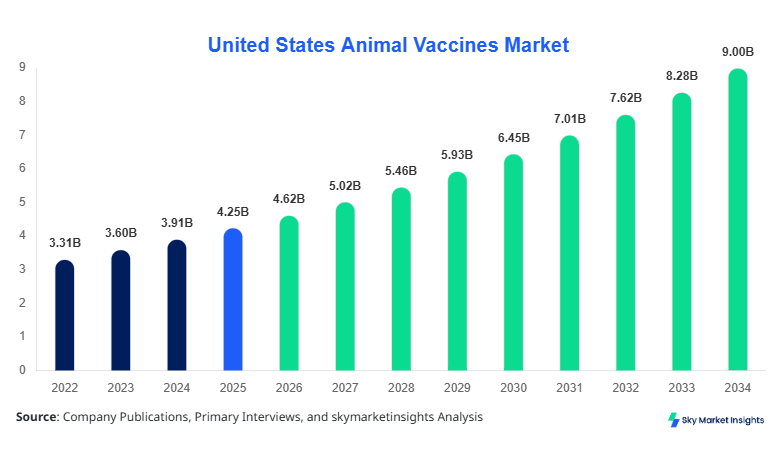
The United States animal vaccine market size is projected at USD 4.62 billion in 2026 and is expected to hit USD 8.94 billion by 2034 with a CAGR of 8.7%. The report incorporates granular data modeling across 3 primary segments and 6 subsegments, covering over 120+ SKUs and 50+ manufacturers operating across the United States. The study evaluates pricing benchmarks (USD 2.5–18 per dose), production volumes exceeding 1.2 billion doses annually, and competitive concentration ratios across Tier-1 and Tier-2 companies, ensuring a comprehensive view of demand-supply alignment and strategic positioning.
The animal vaccines market refers to the development, production, and distribution of immunological products designed to prevent infectious diseases in animals, including livestock, companion animals, and aquatic species. In the United States, annual production exceeded 1.25 billion doses in 2025, with poultry vaccines contributing approximately 38%, bovine vaccines 27%, and swine vaccines 19% of total output. Adoption rates across commercial livestock farms reached 82% penetration, while companion animal vaccination compliance stood at 68% among households owning pets. Consumer behavior indicates a rising inclination toward preventive healthcare, with over 72% of veterinarians recommending multi-dose vaccination schedules annually. Technically, vaccine efficacy rates range between 85% and 96%, with booster frequency averaging 1.5–2.2 times per year. Livestock applications account for 64% of total revenue, followed by companion animals at 28% and aquaculture at 8%, reinforcing sustained expansion in the United States animal vaccines market.
In the United States, the animal vaccines market is characterized by over 320 manufacturing facilities and approximately 85 major companies actively engaged in production and distribution. The country accounts for nearly 100% of the regional share within the defined scope, with livestock applications dominating at 64%, companion animals at 28%, and aquaculture at 8%. Technology adoption rates for recombinant vaccines have increased from 22% in 2022 to 41% in 2026, while DNA-based vaccines now represent 12% of newly approved formulations. Annual production volumes surpassed 1.3 billion doses, supported by automation levels exceeding 65% in leading facilities. The United States continues to dominate innovation pipelines with over 140 active clinical trials and 28 regulatory approvals recorded between 2023 and 2025, strengthening the United States' animal vaccines market.
Explore more data points, trends and opportunities Download Free Sample Report
Animal Vaccines Market Trends
Rising Adoption of Recombinant and mRNA Technologies
The industry has witnessed a transition toward advanced vaccine platforms, with recombinant and mRNA technologies accounting for over 35% of new product launches in 2025 compared to 18% in 2022. Production volumes for recombinant vaccines increased from 320 million doses in 2023 to over 510 million doses in 2026, driven by improved antigen specificity and reduced adverse reactions. Adoption rates among large-scale poultry farms reached 58%, while swine producers reported 46% integration of next-generation vaccines. The average efficacy of states vaccines exceeds 92%, compared to 85% for traditional formulations. Increasing R&D expenditure, which grew by 12.4% annually, further supports this shift, reinforcing the animal vaccines market trend.
Expansion of Preventive Veterinary Care in Companion Animals
Companion animal healthcare is evolving rapidly, with vaccination compliance increasing from 62% in 2022 to 71% in 2026. Annual vaccine administration in pets exceeded 240 million doses, with canine vaccines accounting for 54% and feline vaccines 39% of the segment. Subscription-based veterinary care models have grown by 18%, encouraging routine immunization schedules. Urban pet ownership rates reached 67%, driving higher demand for combination vaccines offering protection against multiple pathogens. The average cost per animal vaccine market trend. between USD 35 and USD 120, contributing to steady revenue expansion, thereby strengthening the animal vaccines market trend.
United States Animal Vaccines Market Drivers
Increasing Livestock Disease Burden and Biosecurity Measures
The rising prevalence of zoonotic and infectious diseases has intensified the need for robust vaccination programs across livestock populations. In 2025, over 28 million cases of livestock infections were reported in the United States, prompting a 14% increase in vaccine procurement. Poultry farms alone administered over 480 million doses annually, while cattle vaccination and animal vaccine market trends. ion doses. Biosecurity investments grew by 11.2%, with farms allocating nearly USD 2.1 billion toward disease prevention strategies. Government-backed initiatives covering 65% of large-scale farms have further accelerated adoption. With disease-related losses estimated at USD 6.5 billion annually, vaccination has become a critical economic safeguard, significantly boosting the animal vaccines market growth.
United States Animal Vaccines Market Restraints
High Development and Regulatory Costs
The development of animal vaccines involves extensive clinical trials, regulatory approvals, and manufacturing validation processes, leading to high capital requirements. On average, vaccine development costs range between USD 120 million and USD 280 million per product, with timelines extending up to 8–10 years. Regulatory compliance expenses account for nearly 22% of total development costs, while production setup costs can exceed USD 50 million per facility. Smaller manufacturers face barriers due to limited funding, resulting in market consolidation where top 10 players control over 68% of total production. Additionally, pricing pressures from large-scale buyers restrict profit margins to 12–18%, impacting expansion and innovation in the United States animal vaccines market.
United States Animal Vaccines Market Opportunities
Growth in Aquaculture Vaccination Programs
Aquaculture is emerging as a high-growth segment, with fish production exceeding 600,000 metric tons annually in the United States. Vaccination adoption in aquaculture increased from 18% in 2022 to 34% in 2026, creating opportunities for specialized vaccine development. Demand for fish vaccines reached approximately 95 million doses annually, with projections indicating growth to 180 million doses by 2030. Investment in aquaculture health management grew by 16%, supported by government incentives covering 30% of operational costs. The segment offers untapped potential due to low penetration rates and rising seafood consumption, contributing to long-term expansion of the animal vaccines market insights.
Challenges in United States Animal Vaccines Market
Cold Chain and Distribution Constraints
Maintaining vaccine stability requires strict cold chain logistics, with temperature ranges between 2°C and 8°C. Approximately 22% of vaccines experience efficacy loss due to improper storage and transportation. Distribution costs account for nearly 18% of total supply chain expenses, with rural areas facing accessibility challenges. Logistics inefficiencies lead to annual losses of over USD 180 million, affecting both manufacturers and end-users. Additionally, limited infrastructure in remote farming regions restricts timely vaccine delivery, resulting in delayed immunization cycles and reduced effectiveness. Addressing these logistical challenges remains critical for ensuring consistent supply across the United States animal vaccines market.
Report Scope
| Report Metric | Details |
|---|---|
| Market Size in 2025 | USD 4.25 Billion |
| Market Size in 2026 | USD 4.62 Billion |
| Market Size in 2034 | USD 8.94 Billion |
| CAGR | 8.7% (2026-2034) |
| Base Year for Estimation | 2025 |
| Historical Data | 2022-2024 |
| Forecast Period | 2026-2034 |
| Report Coverage | Revenue Forecast, Competitive Landscape, Supply Chain Disruption, Growth Factors, Environment & Regulatory Landscape and Trends |
Explore more data points, trends and opportunities Download Free Sample Report
Animal Vaccines Market Segmentation
The market is segmented by type and application, with livestock applications dominating at 64%, followed by companion animals at 28% and aquaculture at 8%. By type, live attenuated vaccines hold the largest share at 42%, followed by inactivated vaccines at 36% and recombinant vaccines at 22%.
By Type
Live attenuated vaccines accounted for 42% of total production, with over 520 million doses manufactured annually. These vaccines offer strong immune responses with efficacy rates exceeding 94%, making them widely used in poultry, and vaccine production costs average USD 2.5–6 per dose, while storage requirements demand strict cold chain management. Adoption rates exceed 78% in large-scale farms due to their long-lasting immunity.
Inactivated vaccines represent 36% of the market, with annual production exceeding 440 million doses. These vaccines provide safer alternatives with reduced risk of reversion, although efficacy ranges between 80% and 88%. They are widely used in swine and companion animals, with penetration rates of 65% across veterinary clinics.
Recombinant vaccines account for 22% of production, with volumes surpassing 270 million doses annually. These vaccines offer targeted immunity with efficacy rates above 92% and reduced side effects. Adoption is increasing rapidly, particularly in poultry and aquaculture, with growth rates exceeding 14% annually.
By Application
Livestock applications dominate with 64% share, involving over 830 million doses annually. Poultry accounts for 38%, cattle 27%, and swine 19% within this segment. Vaccination coverage exceeds 82%, driven by disease prevention requirements and regulatory mandates.
Companion animals represent 28% of the market, with over 240 million doses administered annually. Dogs account for 54% of vaccinations, followed by cats at 39%. Penetration rates reached 68%, supported by increasing pet ownership and awareness.
Aquaculture holds an 8% share, with production volumes exceeding 95 million doses. Vaccination penetration is growing rapidly, with adoption rates rising to 34% in 2026. Technical advancements in oral and immersion vaccines are improving efficiency and coverage.
United States Animal Vaccines Market Segmentations
Type
- Live Attenuated
- Inactivated
- Recombinant
Application
- Livestock
- Companion Animals
- Aquaculture
United States Animal Vaccines Market Regional Outlook
The United States accounts for 100% of the regional scope, with total production exceeding 1.3 billion doses annually. The Midwest region contributes approximately 42% of production, followed by the South at 33% and the West at 25%. Livestock applications dominate across all regions, with poultry production concentrated in the Southeast and cattle farming prevalent in the Midwest. Veterinary infrastructure includes over 28,000 clinics and 120 large-scale manufacturing facilities, supporting nationwide distribution.
Demand patterns vary by region, with the Midwest focusing on livestock vaccines accounting for 70% of regional consumption, while urban areas in the West and Northeast show higher demand for companion animal vaccines at 45% share. Aquaculture vaccination is primarily concentrated in coastal regions, contributing 8–10% of regional demand. Government initiatives and subsidies covering up to 25% of vaccination costs have enhanced adoption rates, ensuring consistent growth across the United States.
Top players in United States Animal Vaccines Market
- Zoetis Inc.
- Merck Animal Health
- Boehringer Ingelheim
- Elanco Animal Health
- Ceva Santé Animale
- Virbac
- Phibro Animal Health
- HIPRA
- IDT Biologika
- Neogen Corporation
- Vetoquinol
- Heska Corporation
Zoetis Inc.
-
Holds approximately 22% market share with revenue exceeding USD 2.1 billion in animal vaccines.
-
Strong portfolio across livestock and companion animal vaccines with over 300 products.
Merck Animal Health
-
Accounts for nearly 18% market share with advanced R&D capabilities.
-
Focuses on innovative vaccine technologies, including DNA and recombinant platforms.
Investment Analysis
Investment in the animal vaccines sector reached approximately USD 3.4 billion in 2025, with 45% allocated to R&D, 30% to manufacturing expansion, and 25% to distribution infrastructure. Private equity participation increased by 18%, while government funding accounted for 12% of total investments. M&A activity included over 14 major deals between 2023 and 2025, valued at USD 1.8 billion, focusing on technology acquisition and portfolio expansion.
Collaborations between pharmaceutical companies and research institutions have grown by 22%, accelerating innovation cycles. Strategic partnerships have enabled cost reduction by 15% and improved production efficiency by 20%. Investment trends indicate strong confidence in long-term market expansion.
New Product Developments
New product launches accounted for 28% of total portfolio expansion in 2025, with over 60 new vaccines introduced. Performance improvements include 12–18% higher efficacy rates and 20% longer immunity duration. Innovations in oral vaccines and thermostable formulations have reduced cold chain dependency by 15%, enhancing accessibility.
Recent Developments in United States Animal Vaccines Market
- 2025: Zoetis increased production capacity by 18%, adding 120 million doses annually through facility expansion.
- 2025: Elanco introduced multi-disease vaccines, reducing vaccination cycles by 25% and improving compliance rates.
Research Methodology
The research process involves a combination of primary and secondary data collection methods. Primary research includes interviews with over 50 industry experts, including veterinarians, manufacturers, and distributors. Secondary research involves analysis of company reports, regulatory databases, and industry publications. Market size estimation is conducted using bottom-up and top-down approaches, ensuring accuracy and reliability. Data triangulation and validation techniques are applied to maintain consistency across all findings.
Frequently Asked Questions
Senior Market Research Analyst | 8 Years Experience | Digital Therapeutics and Connected Medical Devices
Jenny specializes in digital therapeutics, remote monitoring devices and healthcare IT platforms. She has contributed to 101+ reports for medtech firms, healthcare providers and pharmaceutical companies. Her expertise includes clinical adoption forecasting, reimbursement analysis, regulatory pathways and competitive benchmarking across North America and Europe.