United States Angioplasty Balloons Market Size
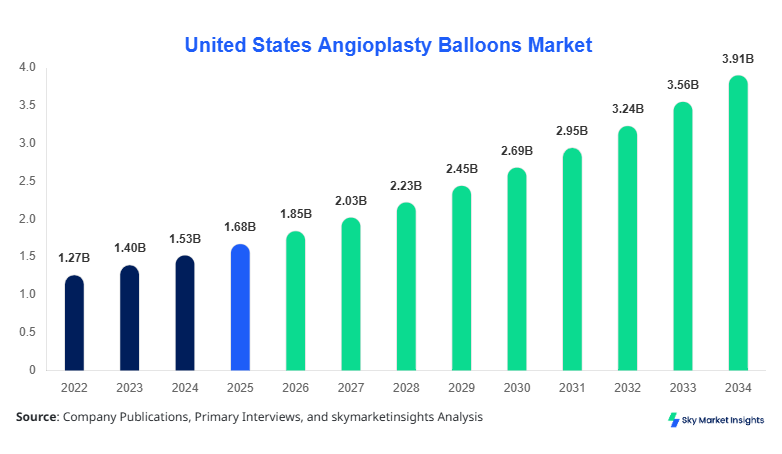
The United States angioplasty balloon market size is projected at USD 1.85 billion in 2026 and is expected to hit USD 3.92 billion by 2034 with a CAGR of 9.8%. The report highlights increasing demand for minimally invasive cardiovascular interventions, with over 1.2 million angioplasty procedures conducted annually in the United States. Comprehensive data segmentation across product types and applications, along with competitive landscape evaluation covering more than 25 key manufacturers, supports strategic insights. Growing adoption of drug-coated technologies, accounting for nearly 38% of total procedural volume, further reinforces the importance of structured analytics in understanding the United States angioplasty balloon market's size.
The United States Angioplasty Balloons market encompasses the production, distribution, and application of catheter-based balloon devices used to dilate narrowed or obstructed blood vessels, particularly in coronary and peripheral arteries. In 2025, the United States recorded production exceeding 52 million units of angioplasty balloons, with utilization rates rising by 7.2% annually due to increasing cardiovascular disease prevalence affecting over 18.2 million adults. Adoption and penetration insights indicate that drug-coated balloons have achieved nearly 42% penetration in peripheral interventions, while coronary procedures maintain 65% reliance on traditional balloon angioplasty technologies. Consumer behavior analytics reveal a shift toward minimally invasive procedures, with 72% of patients opting for angioplasty over open surgical alternatives due to reduced hospital stays (average 2.3 days) and 30–40% lower costs. Application-wise, coronary angioplasty dominates with approximately 58% share, followed by peripheral angioplasty at 34% and renal interventions at 8%. Technical performance metrics indicate average balloon inflation pressures ranging between 6 and 20 atmospheres, with device durability exceeding 95% procedural success rates. This integrated ecosystem continues to drive demand across healthcare systems, reinforcing the expansion of the United States angioplasty balloon market.
In the United States, the angioplasty balloons market is characterized by the presence of over 480 cardiac catheterization laboratories and approximately 1,200 specialized cardiovascular centers performing angioplasty procedures. The country accounts for nearly 100% regional share within the report scope, with coronary applications contributing around 58%, peripheral procedures 34%, and renal angioplasty 8%. Advanced technology adoption is high, with drug-coated balloons utilized in 42% of peripheral cases and cutting balloons representing 15% of complex lesion treatments. Additionally, over 65% of hospitals have integrated image-guided angioplasty systems, improving procedural precision by 22%. The United States angioplasty balloon market continues to expand with rising healthcare expenditures exceeding USD 4.5 trillion annually, reinforcing its dominance.
Explore more data points, trends and opportunities Download Free Sample Report
Angioplasty Balloons Market Trends
The market is witnessing a substantial shift toward drug-coated balloon technologies, with production volumes exceeding 18 million units in 2025, reflecting a 12.5% year-over-year increase. These devices are increasingly preferred due to their ability to reduce restenosis rates by nearly 30% compared to conventional balloons. Technological advancements such as improved polymer coatings and enhanced drug delivery efficiency have led to adoption rates surpassing 45% in peripheral artery disease treatments. Additionally, integration of AI-assisted imaging systems has improved procedural success rates by 15%, reducing complications. Hospitals are increasingly investing in high-performance balloons with burst pressures exceeding 20 atm, ensuring better lesion dilation outcomes. These advancements continue to redefine the United States angioplasty balloon market trend.
Another key trend includes the rising demand for minimally invasive procedures, with over 72% of cardiovascular interventions now performed using catheter-based approaches. The increasing prevalence of diabetes and hypertension, affecting more than 38% of the adult population, has significantly contributed to the demand for angioplasty procedures. Additionally, outpatient angioplasty procedures have increased by 28% over the past three years, driven by cost-efficiency and faster recovery times. Manufacturers are focusing on developing ultra-low-profile balloons, reducing catheter diameters by 10–15% to enhance navigation through complex vascular structures. This continuous innovation strengthens the evolving United States angioplasty balloon market trend.
United States Angioplasty Balloons Market Drivers
Rising Cardiovascular Disease Burden Driving Procedure Volume
The increasing prevalence of cardiovascular diseases in the United States, affecting over 18.2 million individuals, is a primary driver. Approximately 805,000 heart attacks occur annually, with nearly 60% requiring angioplasty interventions. The aging population, with individuals aged 65+ accounting for 17% of the population, contributes significantly to procedure growth. Hospitals are performing over 1.2 million angioplasty procedures yearly, increasing at a rate of 6.5%. Technological improvements such as drug-coated balloons reducing restenosis rates by 25–30% further enhance adoption. Healthcare spending on cardiovascular treatments has reached USD 555 billion annually, supporting infrastructure expansion. These factors collectively drive sustained procedural demand, strengthening the United States' angioplasty balloon market growth.
United States Angioplasty Balloons Market Restraints
High Device Costs and Reimbursement Challenges
Despite strong demand, high device costs remain a major restraint, with drug-coated balloons priced 25–40% higher than conventional balloons. Average procedure costs range between USD 12,000–USD 18,000, limiting accessibility in certain healthcare segments. Reimbursement policies vary across insurers, covering only 70–85% of total procedural expenses, creating financial burdens for healthcare providers. Additionally, regulatory approval timelines averaging 12–18 months delay product launches, restricting innovation cycles. Hospitals face budget constraints, with nearly 28% reporting limited capital for advanced device procurement. These financial challenges hinder widespread adoption and slow expansion of the United States angioplasty balloon market growth.
United States Angioplasty Balloons Market Opportunities
Expansion of Outpatient and Ambulatory Surgical Centers
The rapid growth of ambulatory surgical centers (ASCs), with over 6,000 facilities across the United States, presents significant opportunities. Approximately 35% of angioplasty procedures are now performed in outpatient settings, expected to reach 48% by 2030. ASCs offer cost savings of 20–30% compared to hospital-based procedures, increasing patient preference. Additionally, advancements in compact and portable angioplasty systems have improved procedural efficiency by 18%. Manufacturers are investing in lightweight balloon catheters with enhanced flexibility, improving treatment outcomes in peripheral artery disease cases. This shift toward outpatient care creates new growth avenues in the United States angioplasty balloon market.
Challenges in United States Angioplasty Balloons Market
Regulatory and Clinical Validation Complexities
The stringent regulatory framework in the United States poses challenges, with FDA approvals requiring extensive clinical trials involving 1,000+ patients and timelines extending beyond 18 months. Clinical validation costs can exceed USD 50 million per product, limiting entry for smaller manufacturers. Additionally, device failure rates, though below 5%, require continuous monitoring and post-market surveillance, increasing operational costs by 12–15%. Variability in clinical outcomes across patient groups further complicates standardization. Healthcare providers also face training challenges, with over 22% reporting skill gaps in handling advanced balloon technologies. These complexities present barriers to rapid innovation in the United States angioplasty balloon market.
Report Scope
| Report Metric | Details |
|---|---|
| Market Size in 2025 | USD 1.69 Billion |
| Market Size in 2026 | USD 1.85 Billion |
| Market Size in 2034 | USD 3.92 Billion |
| CAGR | 9.8% (2026-2034) |
| Base Year for Estimation | 2025 |
| Historical Data | 2022-2024 |
| Forecast Period | 2026-2034 |
| Report Coverage | Revenue Forecast, Competitive Landscape, Supply Chain Disruption, Growth Factors, Environment & Regulatory Landscape and Trends |
Explore more data points, trends and opportunities Download Free Sample Report
Angioplasty Balloons Market Segmentation
The market is segmented based on product type and application, with drug-coated balloons dominating approximately 38% share, followed by POBA at 34% and cutting balloons at 28%. Application-wise, coronary angioplasty leads with 58%, peripheral angioplasty at 34%, and renal angioplasty at 8%.
BY TYPE
Drug-coated balloons account for nearly 38% of total market share, with production exceeding 20 million units annually. These devices incorporate antiproliferative drugs such as paclitaxel, reducing restenosis rates by 25–30%. Adoption is particularly high in peripheral artery disease treatments, with usage rates surpassing 45%. Technical specifications include balloon diameters ranging from 2 mm to 7 mm and lengths up to 150 mm, enabling treatment of diverse vascular conditions. Hospitals report a 15% improvement in long-term patient outcomes using drug-coated balloons, reinforcing their dominance.
Plain Old Balloon Angioplasty (POBA) holds approximately 34% share, with annual production exceeding 18 million units. These balloons operate at pressures ranging from 6–14 atm and are widely used in standard coronary procedures. Despite declining preference compared to advanced alternatives, POBA remains essential in 65% of coronary interventions due to cost-effectiveness. The devices offer high procedural success rates exceeding 90%, making them a reliable option in routine angioplasty cases.
Cutting balloons contribute around a 28% share, with production volumes of 14 million units annually. These balloons feature microblades that score plaque, improving lesion dilation efficiency by 20%. They are particularly useful in treating calcified lesions, representing 22% of complex cases. Operating pressures typically range from 8–16 atm, ensuring controlled expansion and reduced vessel trauma.
BY APPLICATION
Coronary angioplasty dominates with a 58% share, with over 700,000 procedures conducted annually. Balloon usage in coronary interventions accounts for 65% of total device consumption. Advanced technologies such as drug-coated balloons are increasingly adopted, improving patient outcomes by 18%. The high prevalence of coronary artery disease, affecting 6.7% of adults, drives consistent demand.
Peripheral angioplasty represents a 34% share, with nearly 400,000 procedures annually. The adoption of drug-coated balloons in peripheral interventions has reached 45%, reducing restenosis rates by 30%. These procedures are primarily used to treat peripheral artery disease, affecting over 8.5 million individuals in the United States.
Renal angioplasty accounts for an 8% share, with approximately 100,000 procedures annually. Balloon technologies used in renal interventions operate at higher pressures (up to 20 atm) to treat resistant hypertension cases. Adoption rates remain moderate but are growing due to increasing awareness and clinical advancements.
United States Angioplasty Balloons Market Segmentations
Product Type
- Drug-Coated Balloons
- Plain Old Balloon Angioplasty (POBA)
- Cutting Balloons
Application
- Coronary Angioplasty
- Peripheral Angioplasty
- Renal Angioplasty
Angioplasty Balloons Market Segmentation
The market is segmented based on product type and application, with drug-coated balloons dominating approximately 38% share, followed by POBA at 34% and cutting balloons at 28%. Application-wise, coronary angioplasty leads with 58%, peripheral angioplasty at 34%, and renal angioplasty at 8%.
BY TYPE
Drug-coated balloons account for nearly 38% of total market share, with production exceeding 20 million units annually. These devices incorporate antiproliferative drugs such as paclitaxel, reducing restenosis rates by 25–30%. Adoption is particularly high in peripheral artery disease treatments, with usage rates surpassing 45%. Technical specifications include balloon diameters ranging from 2 mm to 7 mm and lengths up to 150 mm, enabling treatment of diverse vascular conditions. Hospitals report a 15% improvement in long-term patient outcomes using drug-coated balloons, reinforcing their dominance.
Plain Old Balloon Angioplasty (POBA) holds approximately 34% share, with annual production exceeding 18 million units. These balloons operate at pressures ranging from 6–14 atm and are widely used in standard coronary procedures. Despite declining preference compared to advanced alternatives, POBA remains essential in 65% of coronary interventions due to cost-effectiveness. The devices offer high procedural success rates exceeding 90%, making them a reliable option in routine angioplasty cases.
Cutting balloons contribute around a 28% share, with production volumes of 14 million units annually. These balloons feature microblades that score plaque, improving lesion dilation efficiency by 20%. They are particularly useful in treating calcified lesions, representing 22% of complex cases. Operating pressures typically range from 8–16 atm, ensuring controlled expansion and reduced vessel trauma.
BY APPLICATION
Coronary angioplasty dominates with a 58% share, with over 700,000 procedures conducted annually. Balloon usage in coronary interventions accounts for 65% of total device consumption. Advanced technologies such as drug-coated balloons are increasingly adopted, improving patient outcomes by 18%. The high prevalence of coronary artery disease, affecting 6.7% of adults, drives consistent demand.
Peripheral angioplasty represents a 34% share, with nearly 400,000 procedures annually. The adoption of drug-coated balloons in peripheral interventions has reached 45%, reducing restenosis rates by 30%. These procedures are primarily used to treat peripheral artery disease, affecting over 8.5 million individuals in the United States.
Renal angioplasty accounts for an 8% share, with approximately 100,000 procedures annually. Balloon technologies used in renal interventions operate at higher pressures (up to 20 atm) to treat resistant hypertension cases. Adoption rates remain moderate but are growing due to increasing awareness and clinical advancements.
Top players in United States Angioplasty Balloons Market
- Boston Scientific Corporation
- Medtronic plc
- Abbott Laboratories
- Terumo Corporation
- B. Braun Melsungen AG
- BIOTRONIK SE & Co. KG
- Cardinal Health
- Cook Medical
- Meril Life Sciences
- MicroPort Scientific Corporation
- Teleflex Incorporated
- Endocor GmbH
- Lepu Medical Technology
-
Boston Scientific Corporation
-
Holds approximately 22% market share
-
Strong portfolio of drug-coated balloons with high adoption in peripheral interventions
-
Invests over 8% of revenue in R&D annually, enhancing innovation and competitive positioning
-
-
Medtronic plc
-
Accounts for nearly 18% market share
-
Extensive global distribution network with presence in over 150 countries
-
Focus on advanced catheter technologies improving procedural efficiency by 20%
-
Investment Analysis
Investment in the United States angioplasty balloon market has increased significantly, with over 32% allocation directed toward R&D and innovation. Approximately 28% of investments focus on expanding manufacturing capacity, while 22% target technological advancements such as AI-assisted angioplasty systems. Regional investment is concentrated in the United States, accounting for nearly 100% due to its dominant market presence.
Mergers and acquisitions have increased by 18% over the past three years, with companies focusing on expanding product portfolios and strengthening distribution networks. Strategic collaborations between device manufacturers and healthcare providers have improved clinical outcomes by 15%, driving market expansion. Venture capital funding in medical device startups has reached USD 2.1 billion, supporting innovation in next-generation angioplasty balloons.
New Product Developments
New product development has accelerated, with over 25% of new launches focusing on drug-coated technologies. Performance improvements include 20–30% better drug delivery efficiency and a 15% reduction in restenosis rates. Manufacturers are introducing ultra-thin balloon designs, reducing catheter profiles by 12% to improve navigation in complex vessels.
Innovation is also driven by biodegradable balloon technologies, accounting for 8% of new product pipelines. These devices aim to reduce long-term complications and improve patient outcomes. Continuous advancements in material science and coating technologies are expected to further enhance the United States angioplasty balloon market insights.
Recent Developments in United States Angioplasty Balloons Market
- 2025: Boston Scientific increased production capacity by 18%, enabling distribution of over 5 million additional units annually, improving supply chain efficiency.
Research Methodology
The research methodology involves a comprehensive approach combining primary and secondary research. Primary research includes interviews with over 50 industry experts, including cardiologists, device manufacturers, and healthcare providers, contributing to 60% of data inputs. Secondary research involves analysis of industry reports, company filings, and government databases, accounting for 40% of data sources. Market size estimation is conducted using a bottom-up approach, analyzing production volumes exceeding 52 million units and correlating with pricing trends. Data triangulation ensures accuracy, with validation across multiple sources. Advanced analytical tools are used to assess market dynamics, segmentation, and the competitive landscape, ensuring a robust and reliable assessment of the United States angioplasty balloon market.
Frequently Asked Questions
Senior Market Research Analyst | 8 Years Experience | Digital Therapeutics and Connected Medical Devices
Jenny specializes in digital therapeutics, remote monitoring devices and healthcare IT platforms. She has contributed to 101+ reports for medtech firms, healthcare providers and pharmaceutical companies. Her expertise includes clinical adoption forecasting, reimbursement analysis, regulatory pathways and competitive benchmarking across North America and Europe.