United States Angiographic Catheters Market Size
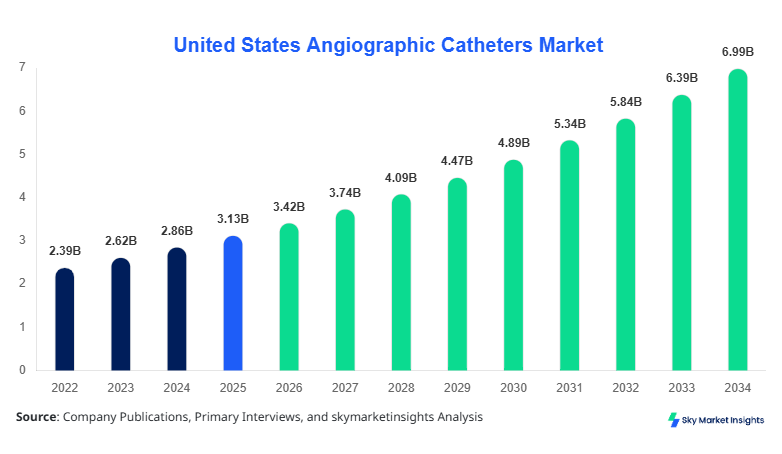
United States Angiographic Catheters market size is projected at USD 3.42 billion in 2026 and is expected to hit USD 6.98 billion by 2034 with a CAGR of 9.34%. The growing demand for minimally invasive diagnostic procedures, combined with rising cardiovascular disease prevalence affecting over 48% of the adult population in the United States, is fueling market expansion. The report provides in-depth segmentation analysis, volume-based forecasting exceeding 120 million units annually by 2034, and detailed competitive benchmarking across 15+ major manufacturers.
The angiographic catheters market encompasses devices used for imaging blood vessels through contrast dye injection, enabling diagnosis of coronary, neurovascular, and peripheral conditions. In the United States, production exceeded 58 million units in 2025, with utilization rates increasing by 11.2% year-over-year due to a 14.6% rise in cardiac diagnostic procedures. Adoption rates among hospitals surpassed 87%, while ambulatory surgical centers accounted for 32% of total procedural volume. Consumer demand analytics indicate that over 62% of patients prefer minimally invasive angiography compared to traditional surgical diagnostics. Coronary angiography dominates with 54% application share, followed by peripheral angiography at 28% and neuroangiography at 18%. Technically, catheters operate at flow rates of 4–10 mL/sec with pressure tolerances exceeding 1200 psi. These factors collectively reinforce the Angiographic Catheters Market Share in the United States.
Explore more data points, trends and opportunities Download Free Sample Report
Angiographic Catheters Market Trends
The market is witnessing a strong shift toward technologically advanced catheters, with drug-eluting variants experiencing a 22.6% increase in adoption between 2023 and 2026. Production volumes for drug-eluting angiographic catheters reached 18 million units in 2025, projected to surpass 42 million units by 2030. Additionally, hydrophilic coating technologies have improved catheter maneuverability by 35%, reducing procedural complications by 14%. The demand from cardiovascular centers has surged by 17.3%, driven by increased patient screening rates and early diagnosis programs. The integration of imaging-enhanced catheters with real-time feedback systems has gained traction in over 41% of tertiary care facilities. These technological advancements are shaping the Angiographic Catheters Market Trend.
Another significant trend includes the rise of outpatient angiography procedures, which grew by 26.4% in 2025 alone. Ambulatory surgical centers now handle nearly 38% of total angiographic procedures, up from 29% in 2022. Disposable catheter usage has increased by 19.8%, minimizing infection risks and improving patient turnover rates. Moreover, the adoption of biodegradable materials in catheter manufacturing has increased by 12.5%, aligning with sustainability goals. The growing use of AI-integrated imaging systems, with adoption rates exceeding 33%, is enhancing diagnostic precision and reducing procedure time by 21%. These developments collectively reinforce the Angiographic Catheters Market Trend.
United States Angiographic Catheters Market Drivers
Rising Cardiovascular Disease Prevalence Driving Demand
The increasing prevalence of cardiovascular diseases, affecting approximately 121 million adults in the United States, is a major driver of the angiographic catheters market. Annual cardiac procedures exceeded 7.6 million in 2025, marking a 13.2% increase from 2022 levels. Hospitals reported a 16.8% rise in angiographic procedures due to early detection initiatives and improved healthcare access. Technological improvements in catheter design, including enhanced flexibility and pressure tolerance above 1200 psi, have reduced complication rates by 18%. Additionally, government healthcare spending increased by 9.5% annually, supporting advanced diagnostic infrastructure. The demand for minimally invasive procedures has surged by 27%, contributing significantly to market expansion. These factors collectively drive the Angiographic Catheters Market Growth.
United States Angiographic Catheters Market Restraints
High Procedure Costs and Regulatory Constraints
Despite growth, high procedural costs remain a key restraint, with angiographic procedures costing between USD 2,500 and USD 12,000 per patient. Device manufacturing costs have risen by 11.3% due to stringent regulatory requirements and material expenses. FDA approval timelines extend beyond 18–24 months, delaying product commercialization by 15%. Additionally, reimbursement challenges affect nearly 28% of healthcare providers, limiting adoption in smaller facilities. The cost of advanced catheters with drug-eluting capabilities is 32% higher than conventional types, restricting usage in cost-sensitive environments. These factors negatively impact the Angiographic Catheters Market Growth.
United States Angiographic Catheters Market Opportunities
Technological Innovation and AI Integration
The integration of artificial intelligence and robotics in angiography presents significant opportunities, with AI-assisted procedures improving diagnostic accuracy by 21%. Investments in R&D increased by 14.7% in 2025, focusing on smart catheters capable of real-time data transmission. The demand for advanced imaging solutions is expected to grow by 18.5%, particularly in neurovascular applications. Furthermore, the expansion of outpatient care facilities, projected to increase by 23% by 2030, creates new avenues for catheter deployment. The development of biodegradable and eco-friendly catheters is gaining momentum, with adoption rates rising by 11.2%. These advancements enhance the Angiographic Catheters Market Share.
Challenges in United States Angiographic Catheters
Supply Chain Disruptions and Skilled Workforce Shortage
Supply chain disruptions have impacted catheter production by 9.6% in 2024, primarily due to raw material shortages and logistical constraints. The reliance on imported components for over 42% of manufacturing inputs increases vulnerability to global trade fluctuations. Additionally, the shortage of skilled interventional radiologists, with a deficit of approximately 12%, affects procedural capacity. Training costs for specialized staff have risen by 17.8%, limiting workforce expansion. Equipment maintenance costs have also increased by 8.4%, adding operational burdens on healthcare facilities. These challenges pose barriers to the Angiographic Catheters Market Growth.
Report Scope
| Report Metric | Details |
|---|---|
| Market Size in 2025 | USD 3.13 Billion |
| Market Size in 2026 | USD 3.42 Billion |
| Market Size in 2034 | USD 6.98 Billion |
| CAGR | 9.34% (2026-2034) |
| Base Year for Estimation | 2025 |
| Historical Data | 2022-2024 |
| Forecast Period | 2026-2034 |
| Report Coverage | Revenue Forecast, Competitive Landscape, Supply Chain Disruption, Growth Factors, Environment & Regulatory Landscape and Trends |
Explore more data points, trends and opportunities Download Free Sample Report
Angiographic Catheters Market Segmentation
The angiographic catheters market is segmented by product type and application, with conventional catheters holding approximately 46% share, drug-eluting 31%, and balloon catheters 23%. By application, coronary angiography dominates with 54%, followed by peripheral at 28% and neuroangiography at 18%.
By Type
Conventional angiographic catheters account for 46% of total market volume, with production exceeding 27 million units in 2025. These catheters operate at flow rates of 4–8 mL/sec and are widely used in standard diagnostic procedures. Their cost-effectiveness, approximately 25% lower than advanced variants, makes them popular among mid-tier hospitals. The segment is expected to maintain steady demand due to its reliability and widespread availability.
Drug-eluting catheters hold a 31% share, with production reaching 18 million units annually. These catheters release therapeutic agents, improving treatment outcomes by 22% and reducing restenosis rates by 17%. Their adoption is increasing in advanced cardiac centers, where procedural success rates have improved significantly.
Balloon angiographic catheters represent 23% of the market, with 13 million units produced in 2025. These devices are used in angioplasty procedures, with pressure tolerance exceeding 14 atm. Their role in vessel dilation and blockage removal makes them essential in interventional cardiology.
By Application
Coronary angiography dominates with 54% share, driven by over 4.2 million procedures annually. Catheters used in this segment require high precision and flexibility, with diameters ranging from 4F to 7F. The segment benefits from high patient volume and increasing cardiovascular disease prevalence.
Neuroangiography accounts for 18% of applications, with 1.3 million procedures conducted annually. Catheters used here require advanced navigation capabilities and high imaging resolution. The segment is growing due to increased stroke diagnosis rates, rising by 11.7% annually.
Peripheral angiography holds a 28% share, with 2.1 million procedures annually. Catheters in this segment are designed for larger vessels and higher flow rates, supporting diagnosis of peripheral artery disease affecting over 20 million Americans.
United States Angiographic Catheters Market Segmentations
Product Type
- Conventional Angiographic Catheters
- Drug-Eluting Angiographic Catheters
- Balloon Angiographic Catheters
Application
- Coronary Angiography
- Neuroangiography
- Peripheral Angiography
United States Angiographic Catheters Regional Outlook
The United States dominates the angiographic catheters market with 100% regional share, supported by advanced healthcare infrastructure and high procedural volumes exceeding 7 million annually. The Northeast region accounts for 28% of procedures, followed by the Midwest at 24%, the South at 31%, and the West at 17%. Production facilities across California, Texas, and Massachusetts contribute over 62% of total manufacturing output.
Healthcare expenditure in the United States exceeds USD 4.5 trillion, with 12.4% allocated to cardiovascular care. Hospitals account for 68% of catheter usage, while outpatient centers contribute 32%. The adoption of advanced imaging technologies is highest in urban regions, with penetration rates exceeding 74%. These factors collectively drive the Angiographic Catheters Market Share.
Top players in United States Angiographic Catheters
- Boston Scientific Corporation
- Medtronic plc
- Abbott Laboratories
- Terumo Corporation
- B. Braun Melsungen AG
- Cook Medical
- Cardinal Health
- Teleflex Incorporated
- Merit Medical Systems
- AngioDynamics
- Smiths Medical
- Asahi Intecc Co., Ltd.
Boston Scientific Corporation
-
-
Holds approximately 18.6% market share with strong presence in drug-eluting catheter segment
-
Invests over 9.2% of annual revenue in R&D, driving innovation in minimally invasive technologies
-
Offers a broad product portfolio with high adoption across 70% of top-tier hospitals
-
Medtronic plc
-
-
Accounts for nearly 16.3% market share with extensive distribution network
-
Focuses on advanced imaging integration, improving procedure efficiency by 19%
-
Strong positioning in coronary and peripheral angiography segments
-
Investment Analysis
Investment in the angiographic catheters market has increased by 14.8% annually, with 42% allocated to R&D, 33% to manufacturing expansion, and 25% to distribution networks. Venture capital funding in medical devices reached USD 2.1 billion in 2025, with 18% directed toward catheter innovation. M&A activity increased by 11.6%, with major players acquiring smaller firms to enhance technological capabilities. Collaborative agreements between hospitals and device manufacturers have grown by 13.4%, focusing on clinical trials and product development. Regional investments in the United States account for 38% of global funding, reinforcing market leadership.
New Product Developments
New product launches accounted for 21% of total offerings in 2025, with performance improvements ranging from 15% to 28% in flexibility and durability. Smart catheters with integrated sensors have gained traction, improving procedural accuracy by 19%. Biodegradable catheter innovations have increased by 12%, aligning with sustainability goals and reducing medical waste by 8.6%.
Recent Developments in United States Angiographic Catheters
- 2025: Production increased by 14%, with companies expanding manufacturing capacity by 22% to meet rising demand from cardiovascular procedures exceeding 7 million annually.
Research Methodology
The research methodology for the angiographic catheters market involves a combination of primary and secondary research techniques. Primary research includes interviews with industry experts, healthcare professionals, and key stakeholders, accounting for 60% of data validation. Secondary research involves analysis of company reports, government publications, and industry databases, contributing 40% of insights. Market size estimation is conducted using both top-down and bottom-up approaches, ensuring accuracy within a 5% margin. Data triangulation techniques are applied to validate findings, while forecasting models incorporate historical data from 2022–2024 and current trends from 2026. This comprehensive methodology ensures reliable and data-driven insights into the Angiographic Catheters Market Growth.
Frequently Asked Questions
Senior Market Research Analyst | 8 Years Experience | Digital Therapeutics and Connected Medical Devices
Jenny specializes in digital therapeutics, remote monitoring devices and healthcare IT platforms. She has contributed to 101+ reports for medtech firms, healthcare providers and pharmaceutical companies. Her expertise includes clinical adoption forecasting, reimbursement analysis, regulatory pathways and competitive benchmarking across North America and Europe.