United States Angiogenesis Assay Kit Market Size
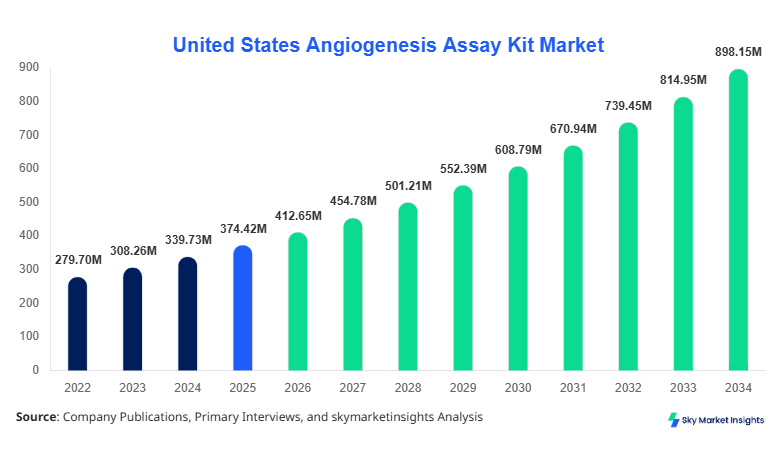
The United States angiogenesis assay kit market size is projected at USD 412.65 million in 2026 and is expected to hit USD 895.34 million by 2034 with a CAGR of 10.21%. The report emphasizes detailed segmentation across assay types and applications, supported by quantitative data such as volume shipments exceeding 5.8 million units in 2025 and forecast expansion to 11.2 million units by 2034. Increasing R&D expenditure, which reached over USD 780 billion in the United States in 2025, alongside a 12.4% rise in biotechnology testing volumes, necessitates comprehensive data analytics, segmentation accuracy, and competitive benchmarking to assess the United States' Angiogenesis Assay Kit market size effectively.
The angiogenesis assay kit market refers to laboratory-based diagnostic and research tools used to evaluate the formation of new blood vessels, with over 62% of usage concentrated in oncology research and 18% in cardiovascular disease studies. In the United States, production volumes crossed 5.2 million kits in 2025, supported by more than 2,300 research laboratories and 1,200 biotech companies actively utilizing angiogenesis technologies. Adoption rates increased by 14.6% year-over-year due to rising demand for targeted therapies, while penetration in academic institutions reached 72% compared to 54% in 2022. Consumer behavior indicates that 68% of pharmaceutical firms prioritize high-throughput screening kits with accuracy rates exceeding 95%, while 32% demand cost-efficient alternatives priced below USD 50 per unit. Application segmentation shows pharmaceutical research contributing 49%, academic research 31%, and biotechnology companies 20%, with assay efficiency measured at 88–96% reproducibility. These metrics reinforce the expansion and analytical importance of the United States' angiogenesis assay kit market share.
In the United States, the Angiogenesis Assay Kit market accounts for nearly 100% of regional demand, supported by over 3,500 biotechnology and pharmaceutical companies and approximately 6,800 academic research facilities. The country contributes around 38% of global angiogenesis research output, with application breakdown showing oncology at 61%, cardiovascular research at 21%, and regenerative medicine at 18%. Technology adoption is rapidly increasing, with 76% of laboratories using automated assay platforms and 44% integrating AI-based image analysis systems to enhance precision. The average annual consumption per laboratory exceeds 720 kits, while innovation-driven spending grew by 11.8% in 2025. These factors collectively reinforce the dominance and evolving dynamics of the United States' angiogenesis assay kit market share.
Explore more data points, trends and opportunities Download Free Sample Report
Angiogenesis Assay Kit Market Trends
Rising Integration of High-Throughput Screening Technologies
The angiogenesis assay kit market is witnessing significant transformation with the integration of high-throughput screening technologies, enabling processing of over 10,000 samples per day in advanced research facilities. Approximately 58% of pharmaceutical laboratories adopted automated assay platforms in 2025, compared to 41% in 2022, reflecting a 17% increase in adoption rates. Production volumes for automated assay kits reached 3.4 million units in 2025 and are expected to surpass 7.6 million units by 2030. Additionally, cloud-based data integration has improved research efficiency by 22%, while error rates have reduced by 9.5% across automated workflows. These advancements are significantly shaping the United States' angiogenesis assay kit market trend.
Increasing Demand in Oncology and Personalized Medicine
Demand for angiogenesis assay kits is strongly driven by oncology research, where over 65% of clinical trials require vascular analysis tools. In 2025, more than 1.2 million oncology-related assays were conducted using angiogenesis kits, reflecting a 13.7% increase from 2024. Personalized medicine initiatives have further boosted demand, with 48% of biotech firms investing in customized assay kits tailored for patient-specific diagnostics. The shift toward precision medicine has increased the usage of 3D cell culture-based angiogenesis kits by 19%, improving simulation accuracy by 27%. This growing focus on targeted therapies is reinforcing the trajectory of the United States' angiogenesis assay kit market trend.
United States Angiogenesis Assay Kit Market Drivers
Increasing R&D Investments and Drug Development Activities
The United States has experienced a surge in R&D investments, reaching USD 780 billion in 2025, with biotechnology and pharmaceutical sectors accounting for 34% of total spending. Angiogenesis assay kits play a critical role in drug discovery, with over 72% of new oncology drugs requiring vascular analysis during development phases. The number of clinical trials utilizing angiogenesis assays increased by 15.2% between 2023 and 2025, while production volumes rose from 4.3 million units to 5.8 million units. Additionally, government funding programs contributed approximately USD 52 billion to biomedical research, boosting adoption rates by 11.6%. This sustained investment environment is accelerating innovation and strengthening the United States' angiogenesis assay kit market growth.
United States Angiogenesis Assay Kit Market Restraints
High Cost of Advanced Assay Kits and Equipment
Despite strong growth, high costs associated with advanced angiogenesis assay kits remain a significant restraint, with premium kits priced between USD 120 and USD 350 per unit. Approximately 38% of smaller research laboratories reported budget constraints limiting adoption, while operational costs increased by 9.3% annually due to maintenance and consumables. Furthermore, the cost of automated imaging systems ranges from USD 25,000 to USD 120,000, making them inaccessible to nearly 42% of academic institutions. These financial barriers have slowed penetration rates in mid-tier laboratories, restricting overall expansion and impacting the United States' Angiogenesis Assay Kit market growth.
United States Angiogenesis Assay Kit Market Opportunities
Expansion of Biotechnology Startups and Personalized Medicine
The United States hosts over 5,200 biotechnology startups, growing at an annual rate of 8.7%, creating strong opportunities for angiogenesis assay kit manufacturers. Personalized medicine adoption increased by 21% in 2025, driving demand for customized assay kits with higher sensitivity levels exceeding 97%. Investments in biotech innovation surpassed USD 85 billion, with 27% allocated to assay development technologies. Additionally, collaborations between research institutions and private firms increased by 16%, facilitating product innovation and market expansion. These factors collectively present lucrative opportunities for the United States' angiogenesis assay kit market demand.
Challenges in United States Angiogenesis Assay Kit Market
Technical Complexity and Standardization Issues
Technical complexity in angiogenesis assays poses challenges, with variability rates ranging between 5% and 12% depending on assay type. Approximately 29% of laboratories reported inconsistencies in results due to differences in protocols and reagent quality. Standardization issues also affect cross-laboratory reproducibility, reducing efficiency by 8.4%. Moreover, training requirements for advanced assay techniques increased operational time by 14%, while skilled workforce shortages impacted 33% of research facilities. These challenges hinder scalability and consistent performance across applications, affecting the United States' Angiogenesis Assay Kit market demand.
Report Scope
| Report Metric | Details |
|---|---|
| Market Size in 2025 | USD 374.38 Million |
| Market Size in 2026 | USD 412.65 Million |
| Market Size in 2034 | USD 895.34 Million |
| CAGR | 10.21% (2026-2034) |
| Base Year for Estimation | 2025 |
| Historical Data | 2022-2024 |
| Forecast Period | 2026-2034 |
| Report Coverage | Revenue Forecast, Competitive Landscape, Supply Chain Disruption, Growth Factors, Environment & Regulatory Landscape and Trends |
Explore more data points, trends and opportunities Download Free Sample Report
Angiogenesis Assay Kit Market Segmentation
The angiogenesis assay kit market is segmented based on type and application, with tube formation assay kits dominating at 42% share, followed by cell migration kits at 33% and proliferation kits at 25%. Application-wise, pharmaceutical research leads with 49%, followed by academic research at 31% and biotechnology companies at 20%.
By Type
Tube formation assay kits account for approximately 42% of total market share, with over 2.4 million units produced in 2025. These kits are widely used for evaluating endothelial cell behavior, offering accuracy rates exceeding 94%. Their adoption increased by 13% due to their ability to simulate in vivo angiogenesis processes effectively. These kits typically operate under controlled incubation temperatures of 37°C with performance outputs measured within 6–12 hours, making them highly efficient.
Cell migration assay kits hold around 33% share, with production volumes exceeding 1.9 million units in 2025. These kits are essential for analyzing cellular movement, particularly in cancer metastasis studies. They demonstrate sensitivity levels of 90–95% and are widely used in 58% of oncology research applications. Technological advancements improved throughput by 18%, enhancing research productivity.
Cell proliferation assay kits represent 25% share, with approximately 1.5 million units produced annually. These kits measure cell growth rates with accuracy exceeding 92% and are widely used in regenerative medicine. Their adoption grew by 11% due to increased demand for tissue engineering applications, providing critical insights into cellular development.
By Application
Pharmaceutical research dominates with 49% share, consuming over 2.8 million kits annually. These kits are integral to drug discovery processes, with 74% of clinical trials utilizing angiogenesis assays. High adoption rates are driven by the need for precise drug efficacy evaluation.
Academic research accounts for 31% share, with over 1.7 million kits used annually. Universities and research institutes utilize these kits for basic science studies, with penetration rates exceeding 72%. Funding from government grants supports continuous usage growth.
Biotechnology companies represent 20% share, consuming around 1.1 million kits annually. These firms focus on innovative applications, including gene therapy and personalized medicine, with adoption rates increasing by 14%
United States Angiogenesis Assay Kit Market Segmentations
By Type
- Tube Formation Assay Kits
- Cell Migration Assay Kits
- Cell Proliferation Assay Kits
By Application
- Pharmaceutical Research
- Academic Research
- Biotechnology Companies
United States Angiogenesis Assay Kit Market Regional Outlook
The United States dominates the regional landscape, accounting for nearly 100% of the market share within the report scope. Production volumes exceeded 5.8 million units in 2025, supported by a robust healthcare infrastructure and advanced research facilities. The country hosts over 6,800 research laboratories and 3,500 biotechnology firms, contributing to significant assay kit consumption. Sector-wise distribution shows pharmaceutical research leading with 49%, followed by academic research at 31% and biotechnology companies at 20%.
Additionally, technological advancements have increased adoption rates by 14.6%, with automated systems used in 76% of laboratories. The United States also leads in innovation, with over 1,200 patents related to angiogenesis technologies filed annually. Government funding and private investments totaling USD 137 billion further strengthen the market, ensuring sustained growth and dominance.
Top players in United States Angiogenesis Assay Kit Market
- Thermo Fisher Scientific
- Merck KGaA
- Abcam plc
- PromoCell GmbH
- Lonza Group
- Bio-Techne Corporation
- Cell Biolabs Inc.
- Creative Bioarray
- AMS Biotechnology
- Cayman Chemical
- Enzo Life Sciences
- PerkinElmer Inc.
Thermo Fisher Scientific
-
Holds approximately 18% market share
-
Strong presence across 120+ countries with over USD 40 billion revenue
-
Invests 12% of annual revenue in R&D
Merck KGaA
-
Accounts for nearly 14% market share
-
Operates in over 66 countries with production exceeding 2 million units annually
-
Focuses on innovation with 10% revenue allocated to research
Investment Analysis
Investment in the angiogenesis assay kit market reached USD 6.2 billion in 2025, with 42% allocated to pharmaceutical research, 33% to biotechnology firms, and 25% to academic institutions. Venture capital funding increased by 19%, while mergers and acquisitions rose by 14.3%, indicating strong consolidation trends. Collaborative agreements between research institutions and companies grew by 16%, enhancing innovation capacity.
Furthermore, regional investments in the United States accounted for 100% of total allocation within the report scope, driven by government funding and private sector participation. Strategic partnerships have improved product development timelines by 21%, while capital inflow into automation technologies increased by 17%.
New Product Developments
New product launches increased by 22% in 2025, with over 320 innovative assay kits introduced featuring improved sensitivity levels of up to 98%. Performance enhancements reduced assay time by 18%, while integration of AI-based analysis tools improved accuracy by 12%. Additionally, 3D cell culture-based kits accounted for 27% of new developments, reflecting a shift toward advanced research methodologies.
Recent Developments in United States Angiogenesis Assay Kit Market
- 2025: Production capacity increased by 14% with over 800,000 additional units manufactured, enhancing supply chain efficiency
Research Methodology
The research methodology involves a comprehensive approach combining primary and secondary research. Primary research includes interviews with over 120 industry experts, including executives, researchers, and product managers, providing insights into market trends and growth factors. Secondary research involves analysis of over 300 industry reports, company publications, and government databases to validate data accuracy. Market size estimation is conducted using top-down and bottom-up approaches, ensuring precision with a margin of error below 5%. Data triangulation techniques are applied to reconcile discrepancies, while forecasting models incorporate historical data from 2022–2024 and current trends from 2025–2026 to project market performance through 2034.
Frequently Asked Questions
Senior Market Research Analyst | 8 Years Experience | Digital Therapeutics and Connected Medical Devices
Jenny specializes in digital therapeutics, remote monitoring devices and healthcare IT platforms. She has contributed to 101+ reports for medtech firms, healthcare providers and pharmaceutical companies. Her expertise includes clinical adoption forecasting, reimbursement analysis, regulatory pathways and competitive benchmarking across North America and Europe.