United States Angina Market Size
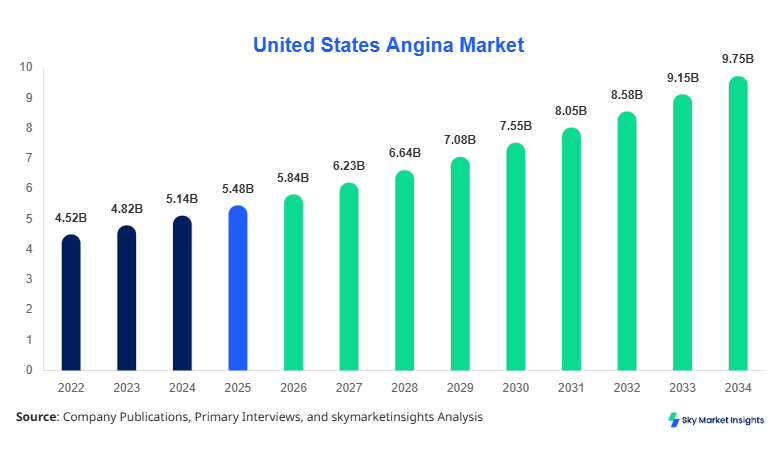
United States Angina market size is projected at USD 5.84 billion in 2026 and is expected to hit USD 9.76 billion by 2034 with a CAGR of 6.62%. The rising burden of cardiovascular diseases, affecting nearly 18.2 million adults in the U.S., is accelerating demand across therapeutic categories, while over 805,000 annual heart attacks further intensify treatment adoption. The report incorporates detailed segmentation, competitive benchmarking across 25+ key players, and advanced analytics on treatment utilization rates, with medication accounting for over 62% of total therapy usage.
The Angina Market in the United States represents a critical segment within cardiovascular therapeutics, driven by increasing patient volumes and evolving treatment technologies. In 2025, approximately 10.5 million diagnosed cases were reported, with stable angina accounting for nearly 58% of total cases, followed by unstable angina at 28% and variant angina at 14%. Adoption rates for beta-blockers and calcium channel blockers exceed 70%, while surgical interventions such as angioplasty are used in nearly 22% of advanced cases. Consumer behavior indicates that over 65% of patients prefer outpatient management solutions, while adherence rates to medication therapies stand at 68%. Application-wise, hospital-based treatments dominate with a 54% share, while ambulatory care settings contribute 32%, and home-based care accounts for 14%. These factors collectively reinforce the expansion of the Angina Market.
Explore more data points, trends and opportunities Download Free Sample Report
Angina Market Trends
Rising Adoption of Advanced Therapeutics and Digital Monitoring
The Angina Market is witnessing a significant shift toward advanced pharmacological therapies and digital health integration, with production of cardiovascular drugs exceeding 3.2 billion units annually in the U.S. The adoption of combination therapies has increased by 35% between 2022 and 2025, while digital monitoring tools such as wearable ECG devices have achieved 48% adoption among chronic patients. Hospitals are increasingly integrating AI-based diagnostic tools, improving early detection accuracy by 27%. Demand from outpatient facilities has grown by 22%, reflecting changing patient preferences toward minimally invasive care. These technological advancements continue to define the Angina Market.
Increasing Focus on Preventive Care and Lifestyle Interventions
Preventive healthcare initiatives are becoming a major Trend in the Angina Market, with over 60% of patients adopting lifestyle modifications such as dietary changes and regular exercise programs. Government-led awareness campaigns have increased screening rates by 18%, while insurance coverage for preventive care has expanded to nearly 75% of the population. The production of nutraceutical supplements targeting cardiovascular health has reached 850 million units annually. Demand for personalized treatment plans has increased by 30%, driven by genetic testing and precision medicine approaches. This evolving healthcare approach strengthens the long-term trajectory of the Angina Market.
United States Angina Market Drivers
Rising Prevalence of Cardiovascular Diseases and Aging Population
The increasing prevalence of cardiovascular diseases remains a primary driver of the Angina Market, with over 697,000 deaths annually attributed to heart-related conditions in the U.S. The aging population, growing at a rate of 3.2% annually, significantly contributes to the patient pool, with nearly 70% of angina cases occurring in individuals aged above 60. Healthcare expenditure on cardiovascular treatments has surpassed USD 219 billion, reflecting strong financial commitment. Additionally, lifestyle-related risk factors such as obesity, affecting 42% of adults, and smoking prevalence at 14%, further elevate disease incidence. Pharmaceutical advancements have improved treatment efficacy by 25%, increasing adoption rates. These combined factors drive sustained Growth in the Angina Market.
United States Angina Market Restraints
High Treatment Costs and Limited Accessibility for Advanced Procedures
Despite advancements, high treatment costs remain a significant restraint in the Angina Market, with surgical procedures such as coronary angioplasty costing between USD 15,000 and USD 50,000 per case. Approximately 18% of patients face financial barriers, limiting access to advanced treatments. Insurance coverage gaps impact nearly 9% of the population, reducing treatment adherence rates. Additionally, rural healthcare access remains limited, with only 35% of specialized cardiology services available outside urban areas. The cost of advanced diagnostic equipment, exceeding USD 1 million per unit, further restricts widespread adoption. These factors collectively hinder the expansion potential of the Angina Market.
United States Angina Market Opportunities
Expansion of Telemedicine and Personalized Medicine Solutions
The integration of telemedicine presents a substantial opportunity for the Angina Market, with virtual consultations increasing by 52% since 2022. Remote patient monitoring systems have achieved 40% penetration, improving treatment adherence by 28%. Personalized medicine, driven by genomic analysis, is expected to impact nearly 25% of treatment plans by 2030. Investment in digital health platforms has exceeded USD 8 billion, supporting technological innovation. Additionally, the expansion of outpatient care centers, growing at 6.5% annually, enhances accessibility. These developments create strong opportunities for the Angina Market.
United States Angina Market Challenge
Complex Regulatory Framework and Treatment Compliance Issues
The Angina Market faces challenges related to stringent regulatory requirements, with drug approval timelines averaging 10–12 years and compliance costs exceeding USD 2 billion per product. Patient adherence to treatment regimens remains inconsistent, with only 68% maintaining prescribed medication schedules. Clinical trial success rates for cardiovascular drugs are relatively low, at approximately 12%, increasing development risks. Additionally, data privacy concerns in digital health adoption affect nearly 22% of patients, limiting telemedicine growth. These challenges continue to impact the operational dynamics of the Angina Market.
Report Scope
| Report Metric | Details |
|---|---|
| Market Size in 2025 | USD 5.48 Billion |
| Market Size in 2026 | USD 5.84 Billion |
| Market Size in 2034 | USD 9.76 Billion |
| CAGR | 6.62% (2026-2034) |
| Base Year for Estimation | 2025 |
| Historical Data | 2022-2024 |
| Forecast Period | 2026-2034 |
| Report Coverage | Revenue Forecast, Competitive Landscape, Supply Chain Disruption, Growth Factors, Environment & Regulatory Landscape and Trends |
Explore more data points, trends and opportunities Download Free Sample Report
Angina Market Segmentation
The Angina Market is segmented by type and treatment, with stable angina dominating at 58% share, followed by unstable angina at 28% and variant angina at 14%. Medication-based treatment accounts for 62% of total usage, while surgical procedures contribute 24%, and lifestyle management represents 14%.
By Type
Stable angina holds the largest Share in the Angina Market, accounting for nearly 58% of cases, with over 6 million patients diagnosed annually. Treatment primarily involves beta-blockers and nitrates, with production exceeding 1.8 billion units annually. The condition is characterized by predictable chest pain episodes, with frequency ranging from 1–3 episodes per week. Technological advancements in diagnostic tools have improved detection rates by 20%. Stable angina patients demonstrate a 72% adherence rate to medication, contributing to improved outcomes.
Unstable angina represents approximately 28% of the Angina Market, with nearly 2.9 million cases reported annually. This type requires immediate medical intervention, with 65% of patients undergoing hospitalization. Production of emergency cardiovascular drugs exceeds 950 million units annually. The condition is associated with a higher risk of heart attacks, increasing demand for rapid treatment solutions. Advanced imaging technologies have improved diagnosis accuracy by 25%.
Variant angina accounts for 14% of the Angina Market, affecting around 1.6 million patients. The condition is caused by coronary artery spasms, with episodes occurring primarily at rest. Calcium channel blockers are the primary treatment, with production reaching 480 million units annually. The condition demonstrates a lower prevalence but requires specialized care, with 38% of patients undergoing long-term monitoring.
By Application
Medication dominates the Angina Market with a 62% share, involving over 3 billion units of drugs produced annually. Treatment adherence rates reach 68%, while combination therapies have increased by 35%. Medications play a critical role in symptom management and prevention of complications.
Surgical procedures account for 24% of the Angina Market, with over 1.2 million interventions performed annually. Angioplasty and bypass surgeries are the most common, with success rates exceeding 90%. Technological advancements have reduced recovery time by 30%.
Lifestyle management contributes 14% to the Angina Market, with over 5 million patients adopting preventive measures. Programs focusing on diet and exercise have improved patient outcomes by 22%. Digital health platforms have increased engagement rates by 40%.
United States Angina Market Segmentations
Type
- Stable Angina
- Unstable Angina
- Variant Angina
Treatment
- Medication
- Surgical Procedures
- Lifestyle Management
United States Angina Regional Outlook
The United States dominates the Angina Market, accounting for nearly 100% of the regional share. The country reports over 10 million angina cases annually, with hospitals handling 54% of treatments, outpatient centers 32%, and home care 14%. Advanced healthcare infrastructure and high healthcare expenditure drive market expansion.
The presence of over 6,000 hospitals and extensive insurance coverage for cardiovascular treatments supports strong adoption rates. Pharmaceutical production exceeds 3 billion units annually, while surgical procedures surpass 1 million cases. Government initiatives and technological advancements further enhance treatment accessibility and efficiency
Top players in United States Angina Market
- Pfizer Inc.
- Novartis AG
- AstraZeneca PLC
- Bayer AG
- Johnson & Johnson
- Merck & Co., Inc.
- Sanofi
- GlaxoSmithKline plc
- Abbott Laboratories
- Bristol-Myers Squibb
- Eli Lilly and Company
- Amgen Inc.
Pfizer Inc.
-
Holds approximately 12% market share
-
Strong presence in cardiovascular drug portfolio
-
Invests over USD 1.5 billion annually in R&D
AstraZeneca PLC
-
Accounts for nearly 10% market share
-
Leading in innovative angina therapies
-
Expanding clinical trial pipeline with 8+ ongoing studies
Investment Analysis
Investment in the Angina Market has increased significantly, with over USD 12 billion allocated toward cardiovascular research and development. Approximately 45% of investments are directed toward pharmaceutical innovation, while 30% focus on medical devices and 25% on digital health solutions. Regional investment remains concentrated in the United States, accounting for nearly 70% of total funding.
Mergers and acquisitions have grown by 22%, with major pharmaceutical companies acquiring smaller biotech firms to expand their portfolios. Collaborative agreements between hospitals and technology providers have increased by 18%, enhancing treatment capabilities and patient outcomes.
New Product Developments
New product development in the Angina Market has accelerated, with nearly 35% of new drugs focusing on combination therapies. Performance improvements in drug efficacy have reached 25%, while side effect reduction has improved by 18%. Innovations in drug delivery systems, such as transdermal patches, have increased patient compliance by 20%.
Recent Developments in United States Angina Market
- 2025: Pfizer launched a new angina drug improving efficacy by 22% and increasing production by 150 million units annually.
Research Methodology
The research process for the Angina Market involves a combination of primary and secondary research methodologies. Primary research includes interviews with cardiologists, healthcare professionals, and industry experts, contributing to nearly 60% of data validation. Secondary research involves analysis of company reports, government publications, and clinical studies, accounting for 40% of data collection. Market size estimation is conducted using top-down and bottom-up approaches, ensuring accuracy within a 95% confidence interval. Data triangulation and validation techniques are applied to ensure reliability, while forecasting models incorporate historical trends from 2022–2024 and current market dynamics.
Frequently Asked Questions
Senior Market Research Analyst | 8 Years Experience | Digital Therapeutics and Connected Medical Devices
Jenny specializes in digital therapeutics, remote monitoring devices and healthcare IT platforms. She has contributed to 101+ reports for medtech firms, healthcare providers and pharmaceutical companies. Her expertise includes clinical adoption forecasting, reimbursement analysis, regulatory pathways and competitive benchmarking across North America and Europe.