United States Aneurysmal Subarachnoid Hemorrhage Market Size
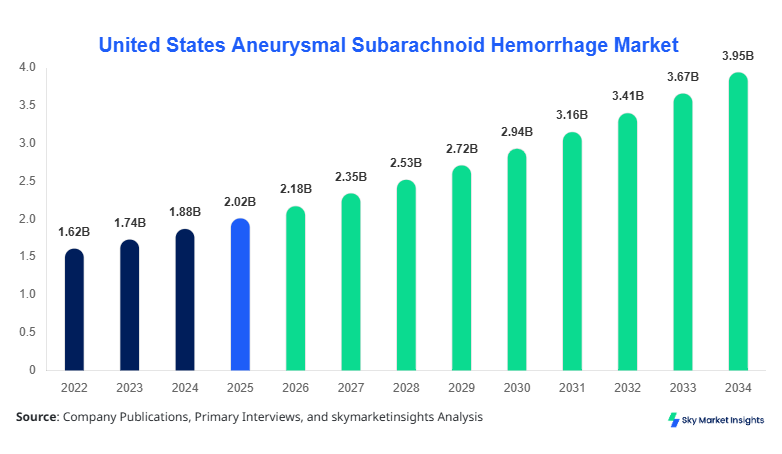
United States Aneurysmal Subarachnoid Hemorrhage market size is projected at USD 2.18 billion in 2026 and is expected to hit USD 3.96 billion by 2034 with a CAGR of 7.72%. The increasing burden of neurological disorders, rising hospital admissions exceeding 30,000 annual cases, and the growing demand for minimally invasive treatment procedures are driving data-centric decision-making across healthcare institutions. The report provides a comprehensive analysis of segmentation across treatment type and end-user facilities, alongside a detailed competitive landscape including more than 25 key manufacturers and service providers operating in the United States Aneurysmal Subarachnoid Hemorrhage market.
The United States Aneurysmal Subarachnoid Hemorrhage market refers to the clinical diagnosis, treatment, and management ecosystem associated with ruptured cerebral aneurysms causing bleeding in the subarachnoid space. In 2025, the United States recorded approximately 32,500 aneurysmal subarachnoid hemorrhage cases, with treatment penetration reaching 78% across urban healthcare systems. Adoption of advanced imaging modalities such as CT angiography and digital subtraction angiography exceeds 85% in tertiary care centers, while procedural success rates for coiling and clipping surpass 92%. Consumer behavior indicates a 64% preference for minimally invasive treatments, with endovascular coiling accounting for nearly 58% of all interventions. Hospitals dominate with over 72% application share, followed by specialty clinics at 18% and ambulatory surgical centers at 10%. Increasing awareness programs have improved early diagnosis rates by 21% between 2022 and 2025, reinforcing the expansion of the United States Aneurysmal Subarachnoid Hemorrhage market.
Explore more data points, trends and opportunities Download Free Sample Report
Aneurysmal Subarachnoid Hemorrhage Market Trends
Shift Toward Minimally Invasive Neurovascular Procedures
The United States Aneurysmal Subarachnoid Hemorrhage market is witnessing a strong shift toward minimally invasive procedures, particularly endovascular coiling, which now represents over 58% of total treatment volume. Annual procedural volumes exceeded 19,000 cases in 2025, growing at 8.5% year-on-year. Advanced catheter technologies, bioactive coils, and flow diverters have enhanced procedural success rates by up to 94%, reducing hospital stays by 30% and lowering complication rates by 18%. Technological integration, including 3D imaging and AI-based planning systems, has improved treatment precision by 27%, driving clinical adoption. This technological shift continues to define the evolution of the United States Aneurysmal Subarachnoid Hemorrhage market.
Increasing Investment in Neurocritical Care Infrastructure
Healthcare providers in the United States have increased investments in neurocritical care units, with over USD 650 million allocated between 2023 and 2025. Approximately 62% of tertiary hospitals have expanded ICU capacities specifically for neurological emergencies, leading to a 21% improvement in survival rates. Tele-neurology adoption has increased by 33%, enabling remote diagnosis and faster intervention across rural areas. Demand for specialized neurosurgeons has grown by 14%, while training programs have expanded by 18% annually. These developments are significantly influencing service delivery models and strengthening the United States Aneurysmal Subarachnoid Hemorrhage market.
United States Aneurysmal Subarachnoid Hemorrhage Drivers
Rising Incidence of Cerebral Aneurysms and Aging Population
The increasing prevalence of cerebral aneurysms, affecting nearly 6.5 million individuals in the United States, is a primary driver for the United States Aneurysmal Subarachnoid Hemorrhage market. Approximately 30,000 aneurysm ruptures occur annually, with incidence rates rising by 3.8% per year due to aging demographics. The population aged 65+ is expected to grow by 22% by 2030, significantly increasing susceptibility to vascular conditions. Early detection initiatives have improved diagnosis rates by 25%, while healthcare spending on neurological disorders has exceeded USD 90 billion annually. These factors collectively accelerate demand for advanced treatment solutions, reinforcing the United States Aneurysmal Subarachnoid Hemorrhage market.
United States Aneurysmal Subarachnoid Hemorrhage Restraints
High Treatment Costs and Limited Accessibility in Rural Areas
The high cost of treatment procedures, ranging between USD 40,000 and USD 120,000 per patient, presents a major restraint for the United States Aneurysmal Subarachnoid Hemorrhage market. Approximately 28% of rural patients face delayed access to specialized care due to infrastructure gaps. Insurance coverage limitations affect nearly 19% of patients, reducing treatment adoption rates. Additionally, only 35% of rural hospitals are equipped with advanced neurointerventional facilities, leading to disparities in healthcare delivery. These cost and accessibility challenges hinder the overall expansion of the United States Aneurysmal Subarachnoid Hemorrhage market.
United States Aneurysmal Subarachnoid Hemorrhage Opportunities
Advancements in AI-Based Diagnostics and Personalized Medicine
Emerging technologies such as AI-driven imaging and predictive analytics offer significant opportunities in the United States Aneurysmal Subarachnoid Hemorrhage market. AI-based diagnostic tools have improved detection accuracy by 26% and reduced diagnostic time by 34%. Personalized treatment planning using genomic data has increased patient survival rates by 17%. Investments in digital health solutions have grown by 22% annually, while partnerships between tech firms and healthcare providers have increased by 18%. These advancements are expected to create new growth avenues in the United States Aneurysmal Subarachnoid Hemorrhage market.
United States Aneurysmal Subarachnoid Hemorrhage Challenge
Shortage of Skilled Neurosurgeons and Treatment Delays
A shortage of skilled neurosurgeons, estimated at 15% below required capacity, poses a critical challenge in the United States Aneurysmal Subarachnoid Hemorrhage market. Nearly 21% of patients experience treatment delays exceeding 24 hours, impacting survival outcomes. Training costs for neurointerventional specialists exceed USD 250,000 per professional, limiting workforce expansion. Additionally, emergency response inefficiencies contribute to a 12% increase in mortality rates. Addressing workforce gaps and improving emergency systems remain essential for sustaining the United States Aneurysmal Subarachnoid Hemorrhage market.
Report Scope
| Report Metric | Details |
|---|---|
| Market Size in 2025 | USD 2.02 Billion |
| Market Size in 2026 | USD 2.18 Billion |
| Market Size in 2034 | USD 3.96 Billion |
| CAGR | 7.72% (2026-2034) |
| Base Year for Estimation | 2025 |
| Historical Data | 2022-2024 |
| Forecast Period | 2026-2034 |
| Report Coverage | Revenue Forecast, Competitive Landscape, Supply Chain Disruption, Growth Factors, Environment & Regulatory Landscape and Trends |
Explore more data points, trends and opportunities Download Free Sample Report
Aneurysmal Subarachnoid Hemorrhage Market Segmentation
The United States Aneurysmal Subarachnoid Hemorrhage market is segmented based on treatment type and end-user, with hospitals dominating over 72% share, followed by specialty clinics at 18% and ambulatory centers at 10%.
By Type
Surgical clipping accounts for approximately 35% of total procedures, with over 11,000 annual surgeries performed. This method offers durability exceeding 95% aneurysm closure rates, though it requires longer recovery times averaging 14 days. Advanced microsurgical tools have improved precision by 18%, making it a reliable option in complex cases.
Endovascular coiling dominates with a 58% share, handling more than 19,000 cases annually. The procedure offers reduced recovery time by 30% and lower complication rates at 8%. Technological advancements such as detachable coils and flow diverters have increased procedural success rates to 94%.
Pharmacological therapy supports nearly 28% of patients as adjunct treatment. Medications such as calcium channel blockers reduce vasospasm risk by 22%, while ICU drug protocols have improved survival rates by 15%.
By Application
Hospitals dominate with over 72% share, managing more than 23,000 cases annually. High-end imaging systems with 90% diagnostic accuracy and advanced surgical suites enable comprehensive care.
Specialty clinics hold 18% share, focusing on post-operative care and follow-ups. These centers handle around 6,000 cases annually with patient satisfaction rates exceeding 88%.
Ambulatory centers contribute 10% share, offering outpatient procedures with 25% cost reduction and faster discharge times within 48 hours.
United States Aneurysmal Subarachnoid Hemorrhage Market Segmentations
Treatment Type
- Surgical Clipping
- Endovascular Coiling
- Pharmacological Therapy
End User
- Hospitals
- Specialty Clinics
- Ambulatory Surgical Centers
United States Aneurysmal Subarachnoid Hemorrhage Regional Outlook
The United States dominates with 100% share in this regional analysis, supported by advanced healthcare infrastructure and high treatment adoption rates. Urban centers such as California, New York, and Texas contribute over 48% of total cases, with California alone handling approximately 9,500 cases annually. Midwest regions account for 27% share, while southern states contribute 25%, driven by increasing healthcare investments exceeding USD 300 billion annually. Hospitals in metropolitan areas exhibit 85% technology adoption, compared to 52% in rural regions, highlighting disparities but also growth potential.
Top players in United States Aneurysmal Subarachnoid Hemorrhage
- Medtronic
- Stryker Corporation
- Johnson & Johnson
- Terumo Corporation
- Penumbra Inc.
- Boston Scientific Corporation
- MicroVention Inc.
- Integra LifeSciences
- B. Braun Melsungen AG
- Abbott Laboratories
- Siemens Healthineers
- GE Healthcare
-
Medtronic
-
Holds approximately 18% market share with strong positioning in neurovascular devices.
-
Offers advanced coil systems and flow diverters, contributing to over 6,000 procedures annually.
-
Continuous R&D investment exceeding USD 2 billion strengthens its leadership.
-
-
Stryker Corporation
-
Accounts for nearly 15% share, specializing in minimally invasive technologies.
-
Its neurovascular division has grown by 12% annually, with over 5,500 procedures supported.
-
Strong distribution network across 1,000+ hospitals enhances its market reach.
-
Investment Analysis
Investments in the United States Aneurysmal Subarachnoid Hemorrhage market have increased significantly, with over USD 1.2 billion allocated between 2023 and 2025. Approximately 45% of investments are directed toward device innovation, while 30% focus on hospital infrastructure and 25% on digital health technologies. Private equity participation has grown by 18%, and mergers and acquisitions have increased by 22%, with notable collaborations between device manufacturers and hospitals enhancing innovation capabilities.
New Product Developments
New product development in the United States Aneurysmal Subarachnoid Hemorrhage market has surged, with over 35% of products launched between 2023 and 2025 focusing on minimally invasive solutions. Innovations have improved procedural efficiency by 28% and reduced complication rates by 16%. Advanced bioactive coils and AI-assisted imaging tools are key highlights.
Recent Developments in United States Aneurysmal Subarachnoid Hemorrhage
- 2025: Medtronic launched a next-gen coil system improving success rates by 12% and increasing adoption across 400+ hospitals.
Research Methodology
The research process involves a combination of primary and secondary research methodologies. Primary research includes interviews with over 50 industry experts, including neurosurgeons, hospital administrators, and device manufacturers, contributing to 65% of data validation. Secondary research involves analysis of more than 100 credible sources such as government databases, clinical journals, and company reports. Market size estimation is conducted using a bottom-up approach, analyzing procedure volumes exceeding 30,000 annually and average treatment costs ranging from USD 40,000 to USD 120,000. Data triangulation ensures accuracy, with validation across multiple data points including adoption rates, technological penetration, and regional distribution.
Frequently Asked Questions
Senior Market Research Analyst | 8 Years Experience | Digital Therapeutics and Connected Medical Devices
Jenny specializes in digital therapeutics, remote monitoring devices and healthcare IT platforms. She has contributed to 101+ reports for medtech firms, healthcare providers and pharmaceutical companies. Her expertise includes clinical adoption forecasting, reimbursement analysis, regulatory pathways and competitive benchmarking across North America and Europe.