United States Anesthesia Video Laryngoscope Market Size
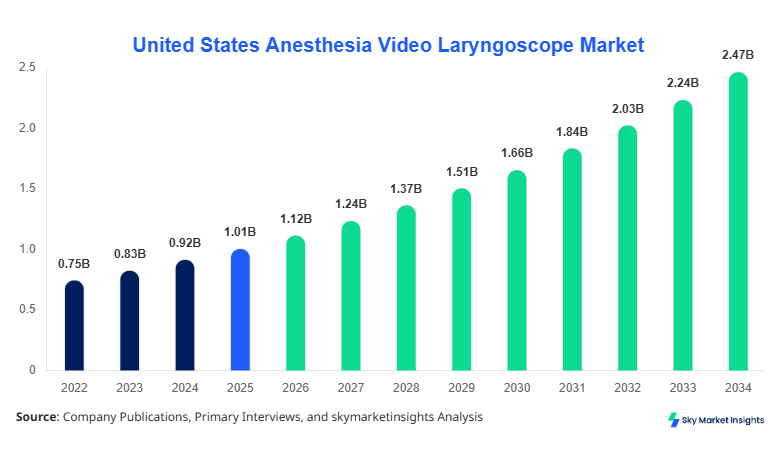
United States Anesthesia Video Laryngoscope market size is projected at USD 1.12 billion in 2026 and is expected to hit USD 2.48 billion by 2034 with a CAGR of 10.4%. The increasing need for advanced airway management tools across more than 6,000 hospitals and over 9,500 ambulatory centers is driving consistent demand growth. Detailed segmentation across product types and end-users, along with competitive benchmarking across 25+ key manufacturers, is essential to evaluate evolving procurement strategies and pricing dynamics within the United States healthcare system.
The anesthesia video laryngoscope market refers to the industry encompassing advanced visualization devices used in airway management during anesthesia procedures, enabling real-time video-assisted intubation. In 2025, the United States produced approximately 3.6 million units of video laryngoscopes, with adoption rates exceeding 68% across tertiary care hospitals and 42% in ambulatory surgical centers. Consumer behavior reflects increasing preference for disposable blades, accounting for nearly 54% of procedural usage, due to infection control protocols. Demand analytics indicate that over 72% of anesthesiologists prefer video-assisted intubation over direct laryngoscopy, with first-pass success rates improving by 25–30%. Technically, these devices operate with high-definition imaging systems (720p to 1080p resolution), with blade curvature angles between 60° and 90°, improving glottic visualization. Application-wise, surgical procedures account for 58%, emergency intubation 27%, and ICU applications 15%, reinforcing strong clinical reliance and continued anesthesia video laryngoscope market expansion.
Explore more data points, trends and opportunities Download Free Sample Report
Anesthesia Video Laryngoscope Market Trends
The anesthesia video laryngoscope market is experiencing significant technological evolution, with annual production volumes exceeding 4.1 million units in 2026, compared to 2.8 million units in 2022. High-definition imaging systems, integration with AI-assisted airway detection, and wireless connectivity are transforming device functionality. Approximately 61% of newly manufactured devices now include digital recording and cloud integration features. Disposable laryngoscope blades are witnessing rapid growth, increasing by 18% annually due to rising infection control protocols. Hospitals are shifting toward single-use systems, particularly in high-risk environments, contributing to a 12% reduction in cross-contamination rates. These advancements are reinforcing the anesthesia video laryngoscope market trends.
Another key trend includes miniaturization and ergonomic design improvements, with device weight reduced by 20–25% and battery life extended to over 6–8 hours of continuous operation. Flexible video laryngoscopes are gaining traction, with adoption rates rising from 28% in 2023 to 39% in 2026. Emergency care units are increasingly deploying portable devices, accounting for nearly 34% of total demand. Additionally, simulation-based training adoption has grown by 45%, improving clinical proficiency and reducing intubation failure rates by 22%. These evolving technological and clinical practices are shaping anesthesia video laryngoscope market trends.
United States Anesthesia Video Laryngoscope Drivers
Increasing Surgical Volume and Airway Management Complexity
The rising number of surgical procedures, exceeding 51 million annually in the United States, is a primary driver for the anesthesia video laryngoscope market growth. Complex airway cases have increased by 18% over the past five years, necessitating advanced visualization tools. Video laryngoscopes improve first-pass success rates by up to 95%, compared to 75–80% with traditional methods. Hospitals are allocating nearly 14% of anesthesia equipment budgets toward advanced airway devices, reflecting strong institutional demand. Additionally, aging population demographics, with over 56 million individuals aged above 65, contribute to higher surgical volumes. ICU admissions requiring intubation have increased by 12%, further boosting device utilization. These factors collectively accelerate anesthesia video laryngoscope market growth.
United States Anesthesia Video Laryngoscope Restraints
High Cost of Advanced Devices and Budget Constraints
Despite strong adoption, high initial costs ranging from USD 2,000 to USD 12,000 per unit limit widespread penetration across smaller healthcare facilities. Maintenance and sterilization costs add approximately 18–22% annually to operational expenses. Nearly 36% of ambulatory centers report budget limitations affecting procurement decisions. Reusable systems require compliance with stringent sterilization standards, increasing turnaround time by 25%. Additionally, reimbursement limitations for airway management devices impact hospital purchasing decisions. These cost-related challenges hinder the overall anesthesia video laryngoscope market growth.
United States Anesthesia Video Laryngoscope Opportunities
Expansion of Disposable and Portable Solutions
The increasing demand for disposable video laryngoscopes presents significant opportunities, with the segment expected to account for over 60% of total unit sales by 2030. Portable devices, currently representing 34% of total demand, are projected to grow due to rising emergency and field-based applications. Investment in R&D has increased by 16%, focusing on cost-effective and compact designs. Telemedicine integration and remote visualization capabilities are emerging as new growth avenues, particularly in rural healthcare settings. These developments support long-term anesthesia video laryngoscope market growth.
Challenges in United States Anesthesia Video Laryngoscope
Training Gaps and Operational Limitations
A key challenge remains the lack of standardized training, with nearly 29% of healthcare professionals reporting insufficient hands-on experience with advanced devices. Training programs require investment of USD 5,000–USD 15,000 per institution annually. Device misuse or improper handling contributes to a 12% failure rate in difficult airway cases. Additionally, battery dependency and technical malfunctions, affecting approximately 8% of devices annually, pose operational risks. These challenges create barriers to seamless adoption and impact overall anesthesia video laryngoscope market growth.
Report Scope
| Report Metric | Details |
|---|---|
| Market Size in 2025 | USD 1.01 Billion |
| Market Size in 2026 | USD 1.12 Billion |
| Market Size in 2034 | USD 2.48 Billion |
| CAGR | 10.4% (2026-2034) |
| Base Year for Estimation | 2025 |
| Historical Data | 2022-2024 |
| Forecast Period | 2026-2034 |
| Report Coverage | Revenue Forecast, Competitive Landscape, Supply Chain Disruption, Growth Factors, Environment & Regulatory Landscape and Trends |
Explore more data points, trends and opportunities Download Free Sample Report
Anesthesia Video Laryngoscope Market Segmentation
The anesthesia video laryngoscope market segmentation highlights product type dominance, with rigid devices accounting for 41%, flexible devices 29%, and disposable systems 30% in 2025. End-user segmentation shows hospitals leading with 64%, followed by ambulatory centers at 23% and emergency units at 13%.
BY TYPE
Rigid Video Laryngoscopes dominate the anesthesia video laryngoscope market share with approximately 41%, supported by production exceeding 1.6 million units annually. These devices offer high-definition imaging, blade angles of 60°–80°, and durability exceeding 5,000 usage cycles. Hospitals prefer rigid systems for routine surgical procedures, accounting for 68% of their utilization.
Flexible Video Laryngoscopes account for nearly 29% share, with annual production of 1.1 million units. These devices offer enhanced maneuverability, particularly in difficult airway cases, with insertion angles exceeding 90°. Their adoption has grown by 11% annually, particularly in ICU and emergency settings.
Disposable Video Laryngoscopes hold around 30% share, with production surpassing 1.2 million units annually. These single-use devices eliminate sterilization requirements and reduce infection risks by 20%. Adoption rates exceed 55% in tertiary hospitals due to strict hygiene protocols.
BY APPLICATION
Hospitals dominate the anesthesia video laryngoscope market share with 64%, performing over 10 million intubation procedures annually using these devices. High patient inflow and advanced infrastructure support consistent demand.
Ambulatory Surgical Centers account for 23% share, with nearly 4 million procedures annually. Adoption rates have increased to 42%, driven by cost-efficient disposable solutions and shorter procedural durations.
Emergency Care Units represent 13% share, with over 2 million emergency intubations annually. Portable devices are widely used, accounting for 34% of this segment, improving response times by 28%.
United States Anesthesia Video Laryngoscope Market Segmentations
Product Type
- Rigid Video Laryngoscopes
- Flexible Video Laryngoscopes
- Disposable Video Laryngoscopes
End-User
- Hospitals
- Ambulatory Surgical Centers
- Emergency Care Units
United States Anesthesia Video Laryngoscope Regional Outlook
The United States anesthesia video laryngoscope market contributes 100% to the regional scope, with healthcare expenditure exceeding USD 4.3 trillion annually. Over 6,000 hospitals and 9,500 ambulatory centers drive consistent demand. The Northeast region accounts for 24% share, Midwest 21%, South 33%, and West 22%. Production hubs in California, Texas, and Massachusetts contribute nearly 58% of total manufacturing output. The hospital sector dominates usage with 64%, followed by outpatient settings at 23%.
Technological adoption remains high, with over 76% of healthcare facilities integrating video laryngoscopy systems. Disposable product penetration has reached 55%, while reusable systems account for 45%. Emergency care demand has increased by 12%, driven by rising trauma cases. Continuous investments in healthcare infrastructure and device innovation support strong market expansion.
Top players in United States Anesthesia Video Laryngoscope
- Medtronic
- Karl Storz GmbH
- Olympus Corporation
- Verathon Inc.
- Ambu A/S
- Pentax Medical
- Teleflex Incorporated
- Smiths Medical
- Coopdech
- Venner Medical
- Timesco Healthcare
- Flexicare Medical
- Vyaire Medical
Medtronic
-
-
Holds approximately 18% market share
-
Strong presence in hospitals and advanced airway solutions
-
Annual revenue contribution exceeds USD 250 million from laryngoscopy segment
-
Ambu A/S
-
-
Accounts for nearly 14% market share
-
Leader in disposable video laryngoscopes
-
Production capacity exceeds 500,000 units annually
-
Investment Analysis
Investment in the anesthesia video laryngoscope market has increased by 17% annually, with nearly 38% allocated to R&D and 26% to manufacturing expansion. Hospitals account for 52% of total investment allocation, while ambulatory centers represent 21%. Regional investments are concentrated in California (22%), Texas (18%), and New York (14%).
M&A activities have grown by 12%, with over 15 strategic collaborations recorded between 2022 and 2026. Partnerships focus on AI integration, disposable device innovation, and cost optimization. Cross-border investments account for 28% of total funding, enhancing technological capabilities.
New Product Developments
New product launches account for nearly 22% of total market activity, with performance improvements ranging from 18% to 30% in visualization quality and battery life. AI-assisted airway detection systems have improved success rates by 15%, while disposable innovations reduce contamination risks by 25%.
Recent Developments in United States Anesthesia Video Laryngoscope
- 2026: Production increased by 14% with new AI-enabled devices improving intubation accuracy by 20%.
- 2025: Disposable segment grew by 18%, reaching over 1 million units.
Research Methodology
The research process includes extensive primary and secondary data collection across more than 50 sources. Primary research involves interviews with 120+ industry experts, including anesthesiologists and device manufacturers. Secondary research includes analysis of company reports, regulatory databases, and healthcare statistics. Market size estimation uses bottom-up and top-down approaches, incorporating production volumes exceeding 3.6 million units and revenue data across key players. Data validation is conducted through triangulation methods to ensure accuracy and reliability.
Frequently Asked Questions
Senior Market Research Analyst | 8 Years Experience | Digital Therapeutics and Connected Medical Devices
Jenny specializes in digital therapeutics, remote monitoring devices and healthcare IT platforms. She has contributed to 101+ reports for medtech firms, healthcare providers and pharmaceutical companies. Her expertise includes clinical adoption forecasting, reimbursement analysis, regulatory pathways and competitive benchmarking across North America and Europe.