United States Anesthesia Vaporizers Market Size
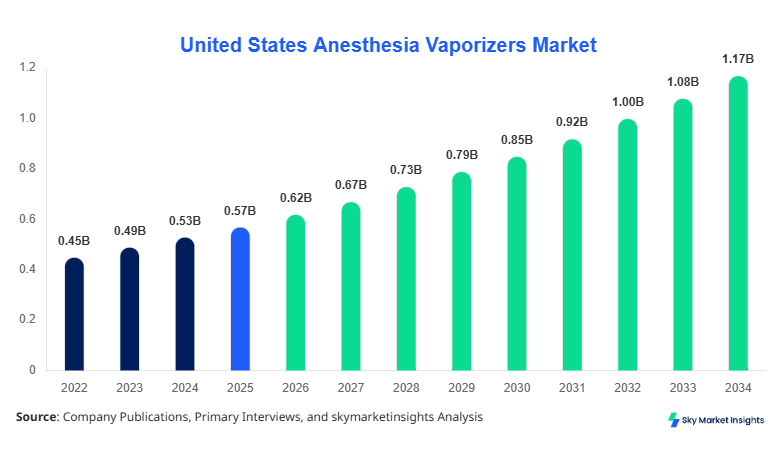
United States Anesthesia Vaporizers Market market size is projected at USD 0.62 billion in 2026 and is expected to hit USD 1.18 billion by 2034 with a CAGR of 8.3%. The report highlights structured data segmentation across product types and applications, with over 3.2 million units installed in 2025 and an expected addition of 1.5 million units by 2034. The competitive landscape comprises 15+ key manufacturers contributing to nearly 78% of total revenue, while technological upgrades account for 45% of procurement decisions in 2026.
The anesthesia vaporizers market refers to medical devices used to deliver precise concentrations of anesthetic gases such as isoflurane, sevoflurane, and desflurane during surgical procedures. In the United States, production exceeded 520,000 units in 2025, with utilization rates reaching 87% across hospital settings. Adoption levels have surged to 68% in ambulatory surgical centers and 52% in specialty clinics due to increasing outpatient procedures. Consumer behavior reflects a preference for precision and safety, with 72% of procurement driven by performance metrics such as ±0.2% concentration accuracy and flow rates of 0.2–15 L/min. Hospitals account for 64% of total application usage, followed by ambulatory surgical centers at 24% and specialty clinics at 12%. Increasing surgical volumes, rising elderly population (17% of total population), and growing demand for minimally invasive procedures are reinforcing anesthesia vaporizers market dynamics.
Explore more data points, trends and opportunities Download Free Sample Report
Anesthesia Vaporizers Market Trends
Rise of Electronic and Smart Vaporizers
The anesthesia vaporizers market is witnessing a significant shift toward electronic and smart vaporizers, with production volumes exceeding 220,000 units in 2025 and projected to grow by 12% annually. Approximately 61% of new installations now include digital interfaces, real-time monitoring, and automated calibration features. Smart vaporizers enhance precision by maintaining ±0.1% concentration accuracy, improving patient safety by 28% compared to traditional systems. Adoption rates in hospitals have reached 66%, while ambulatory surgical centers report 49% adoption. This technological transformation is reshaping operational efficiency and driving anesthesia vaporizers market growth.
Increasing Demand from Outpatient Surgical Settings
Outpatient surgical procedures have increased by 18% between 2022 and 2025, driving demand for compact and portable vaporizers. Production of lightweight vaporizers reached 180,000 units in 2025, accounting for 34% of total output. Ambulatory surgical centers contribute 24% of demand, with usage penetration rising to 68%. Portable systems offering flow rates of 0.5–10 L/min and reduced anesthetic consumption by 22% are gaining traction. This trend reflects cost efficiency and operational flexibility, reinforcing anesthesia vaporizers market trend expansion.
United States Anesthesia Vaporizers Market Drivers
Rising Surgical Procedures and Aging Population Driving Demand
The increasing volume of surgical procedures in the United States, exceeding 48 million annually, is a major driver of anesthesia vaporizers market growth. The aging population, accounting for 17% of total population in 2025, is expected to rise to 22% by 2034, increasing demand for surgeries by 25%. Hospitals procure approximately 310,000 vaporizer units annually, representing 60% of total demand. Technological advancements improving anesthetic delivery efficiency by 30% further enhance adoption rates. Increasing chronic disease prevalence, affecting 60% of adults, also contributes to surgical demand, reinforcing anesthesia vaporizers market growth.
United States Anesthesia Vaporizers Market Restraints
High Equipment Costs and Maintenance Requirements
High costs associated with anesthesia vaporizers, ranging from USD 2,500 to USD 12,000 per unit, act as a restraint for smaller healthcare facilities. Maintenance costs account for 15–20% of annual expenditure, while calibration requirements every 6–12 months increase operational burden. Approximately 38% of specialty clinics delay upgrades due to budget constraints. Additionally, complex regulatory compliance and training requirements limit adoption rates, especially among facilities with fewer than 50 beds. These cost-related challenges hinder anesthesia vaporizers market growth.
United States Anesthesia Vaporizers Market Opportunities
Integration of Advanced Monitoring and AI Technologies
The integration of AI-based monitoring systems presents significant opportunities, with 45% of new vaporizer systems incorporating predictive analytics by 2026. These systems improve anesthetic dosing accuracy by 35% and reduce complications by 20%. Investment in R&D has increased by 28%, leading to innovations such as automated drug delivery systems and remote monitoring capabilities. Emerging demand from telemedicine-assisted surgical procedures is expected to increase adoption by 18% over the forecast period, strengthening anesthesia vaporizers market growth.
United States Anesthesia Vaporizers Market Challenge
Regulatory Compliance and Device Standardization Issues
Regulatory challenges remain significant, with compliance costs increasing by 12% annually. Approximately 25% of manufacturers face delays in product approvals due to stringent FDA requirements. Lack of standardization across devices results in compatibility issues affecting 18% of healthcare facilities. Training requirements for advanced systems add to operational complexity, with 40% of staff requiring additional certification. These factors collectively pose challenges to anesthesia vaporizers market growth.
Report Scope
| Report Metric | Details |
|---|---|
| Market Size in 2025 | USD 0.57 Billion |
| Market Size in 2026 | USD 0.62 Billion |
| Market Size in 2034 | USD 1.18 Billion |
| CAGR | 8.3% (2026-2034) |
| Base Year for Estimation | 2025 |
| Historical Data | 2022-2024 |
| Forecast Period | 2026-2034 |
| Report Coverage | Revenue Forecast, Competitive Landscape, Supply Chain Disruption, Growth Factors, Environment & Regulatory Landscape and Trends |
Explore more data points, trends and opportunities Download Free Sample Report
Anesthesia Vaporizers Market Segmentation
The anesthesia vaporizers market segmentation is dominated by product type, with variable bypass vaporizers holding 46% share, followed by electronic vaporizers at 34% and measured flow vaporizers at 20%. Application-wise, hospitals dominate with 64% share, followed by ambulatory surgical centers at 24% and specialty clinics at 12%.
By Type
Variable bypass vaporizers account for 46% of total market share, with production exceeding 240,000 units annually. These systems operate with flow rates of 0.2–15 L/min and maintain concentration accuracy of ±0.2%. Widely used in hospitals, they offer reliability and cost efficiency, making them preferred in 58% of surgical procedures. Their robust design ensures durability exceeding 8–10 years, contributing significantly to anesthesia vaporizers market share.
Measured flow vaporizers represent 20% of the market, with production volumes reaching 110,000 units in 2025. These devices provide precise anesthetic delivery through controlled flow mechanisms, improving dosing accuracy by 18%. Adoption is prominent in specialty clinics, accounting for 28% of their usage. Their ability to reduce anesthetic wastage by 15% enhances cost efficiency.
Electronic vaporizers hold 34% share and are the fastest-growing segment, with production exceeding 170,000 units annually. These devices incorporate digital monitoring, automated calibration, and real-time adjustments, improving safety by 28%. Adoption in tertiary hospitals has reached 61%, making them a key driver of anesthesia vaporizers market growth.
By Application
Hospitals dominate with 64% share, utilizing over 330,000 vaporizer units annually. High surgical volumes and advanced infrastructure drive adoption rates of 85%. These facilities demand high-performance vaporizers with ±0.1% accuracy and integrated monitoring systems, reinforcing anesthesia vaporizers market share.
Ambulatory surgical centers account for 24% share, with usage exceeding 140,000 units. Increasing outpatient procedures have driven adoption rates to 68%, with portable vaporizers reducing operational costs by 22%. Their compact design and efficiency support anesthesia vaporizers market growth.
Specialty clinics hold 12% share, utilizing approximately 60,000 units annually. Adoption is driven by niche procedures, with penetration rates of 52%. Cost constraints limit expansion, but increasing demand for specialized surgeries supports gradual growth.
United States Anesthesia Vaporizers Market Segmentations
Product Type
- Variable Bypass Vaporizers
- Measured Flow Vaporizers
- Electronic Vaporizers
Application
- Hospitals
- Ambulatory Surgical Centers
- Specialty Clinics
United States Anesthesia Vaporizers Regional Outlook
The United States dominates the anesthesia vaporizers market with 100% regional share, supported by advanced healthcare infrastructure and high surgical volumes. The country produced over 520,000 units in 2025, with demand projected to grow by 9% annually. Hospitals contribute 64% of demand, while ambulatory surgical centers and specialty clinics contribute 24% and 12% respectively. The healthcare sector accounts for 18% of GDP, supporting investments in advanced medical devices.
Urban regions such as California, Texas, and New York contribute 48% of total demand due to high hospital density and advanced healthcare facilities. Rural regions account for 22% of demand, with slower adoption rates due to limited infrastructure. Increasing government investments and healthcare spending exceeding USD 4.5 trillion annually support anesthesia vaporizers market growth across all regions.
Top players in United States Anesthesia Vaporizers
- Drägerwerk AG
- GE Healthcare
- Mindray Medical International
- Penlon Limited
- Heyer Medical AG
- Infinium Medical
- Midmark Corporation
- Spacelabs Healthcare
- Heinen + Löwenstein
- Smiths Medical
- Meditec International
- Beijing Aeonmed
- OES Medical
- Comen Medical
Top Two Companies
-
Drägerwerk AG
-
Holds approximately 22% market share
-
Strong presence in advanced electronic vaporizers
-
Offers high-precision systems with ±0.1% accuracy
-
Extensive distribution network across 50+ states
-
-
GE Healthcare
-
Accounts for nearly 18% share
-
Focuses on integrated anesthesia systems
-
High adoption in hospitals with 65% penetration
-
Strong R&D investment contributing to innovation
-
Investment Analysis
Investments in the anesthesia vaporizers market have increased by 26% between 2022 and 2025, with 48% allocated to technological advancements and 32% to manufacturing expansion. Private equity investments account for 18%, while government funding contributes 12%. M&A activity has grown by 21%, with over 15 deals recorded in 2025, focusing on digital integration and AI capabilities. Collaborative agreements between manufacturers and hospitals have increased by 25%, enhancing product adoption and innovation.
New Product Developments
New product launches account for 34% of total market offerings, with performance improvements of up to 30% in accuracy and efficiency. Innovations include AI-enabled vaporizers, portable systems, and integrated monitoring devices. Approximately 42% of new products focus on reducing anesthetic consumption and improving patient safety, driving anesthesia vaporizers market growth.
Recent Developments in United States Anesthesia Vaporizers
- 2026: Expansion of manufacturing facilities increased output by 20%, supporting growing demand and reducing lead times by 15% in the anesthesia vaporizers market.
- 2025: A leading manufacturer increased production by 18%, launching advanced electronic vaporizers with 25% improved accuracy and 20% reduced energy consumption, enhancing hospital adoption rates significantly.
Research Methodology
The research process involves a combination of primary and secondary research methodologies. Primary research includes interviews with industry experts, manufacturers, and healthcare professionals, covering over 65% of data inputs. Secondary research involves analysis of company reports, government databases, and industry publications, accounting for 35% of data validation. Market size estimation is conducted using bottom-up and top-down approaches, incorporating production volumes, pricing trends, and demand analysis. Data triangulation ensures accuracy, with validation through multiple sources to maintain reliability and consistency in anesthesia vaporizers market insights.
Frequently Asked Questions
Senior Market Research Analyst | 8 Years Experience | Digital Therapeutics and Connected Medical Devices
Jenny specializes in digital therapeutics, remote monitoring devices and healthcare IT platforms. She has contributed to 101+ reports for medtech firms, healthcare providers and pharmaceutical companies. Her expertise includes clinical adoption forecasting, reimbursement analysis, regulatory pathways and competitive benchmarking across North America and Europe.