United States Anesthesia Devices Market Size
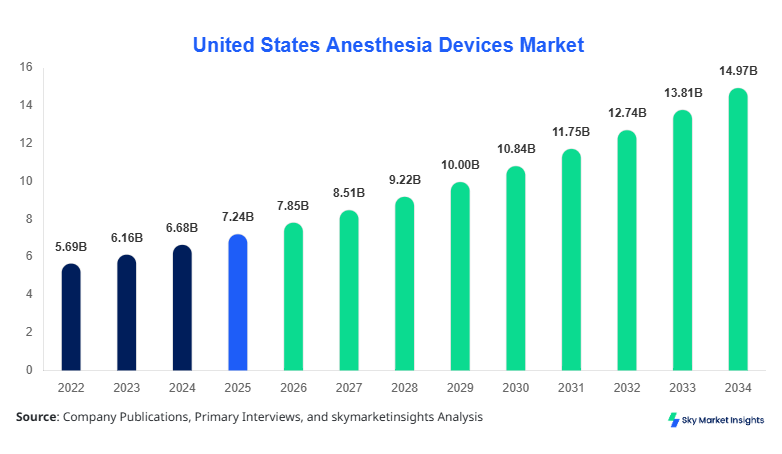
United States Anesthesia Devices market size is projected at USD 7.85 billion in 2026 and is expected to hit USD 14.92 billion by 2034 with a CAGR of 8.4%. The report provides comprehensive insights into quantitative demand patterns, segmentation across product and application, and a detailed competitive landscape with more than 35 key manufacturers operating across the United States. The increasing procedural volumes exceeding 65 million surgeries annually, along with rising adoption of technologically advanced anesthesia systems, are driving demand analytics and structured segmentation across multiple healthcare facilities.
The anesthesia devices market refers to the ecosystem of equipment used to administer anesthesia, monitor patient vitals, and ensure safe surgical outcomes. In the United States, production levels exceeded 1.8 million units in 2025, with anesthesia disposables accounting for nearly 48% of total volume, followed by machines at 27% and monitors at 25%. Adoption rates in tertiary hospitals reached 92%, while ambulatory surgical centers reported a penetration rate of 68% in 2025. Consumer behavior indicates a preference for minimally invasive procedures, with demand increasing by 11.2% year-over-year. Application-wise, hospitals contributed approximately 64% of total usage, ambulatory surgical centers 26%, and clinics 10%. Technical parameters such as oxygen flow rates ranging from 0.2–15 L/min and monitoring frequencies exceeding 100 Hz highlight the sophistication of modern devices, reinforcing anesthesia devices market share expansion.
Explore more data points, trends and opportunities Download Free Sample Report
Anesthesia Devices Market Trends
Digital Integration and Smart Monitoring Systems
The integration of digital technologies in anesthesia devices has surged significantly, with over 62% of newly installed systems in 2025 featuring IoT-enabled monitoring capabilities. Production of smart anesthesia monitors reached approximately 480,000 units, marking a 14% increase compared to 2024. Advanced systems now incorporate AI-based predictive analytics with accuracy levels exceeding 93%, enabling early detection of patient anomalies. Adoption rates among hospitals surpassed 88%, while ambulatory centers reported 71% adoption. These trends are significantly enhancing procedural safety and operational efficiency, supporting anesthesia devices market trend evolution.
Rise in Disposable and Single-Use Devices
Anesthesia disposables are witnessing rapid demand growth, with production volumes crossing 850 million units annually in the United States. Single-use devices now account for nearly 52% of total consumable usage, driven by infection control protocols and regulatory compliance. Demand increased by 12.5% between 2024 and 2025, with hospitals contributing 68% of consumption. The shift toward eco-friendly biodegradable disposables is also gaining traction, with 18% of manufacturers introducing sustainable product lines. This transition is reinforcing anesthesia devices market demand across multiple healthcare settings.
United States Anesthesia Devices Drivers
Rising Surgical Procedures and Aging Population
The increasing number of surgical procedures, exceeding 65 million annually in the United States, is a primary driver of anesthesia devices demand. The aging population, with over 56 million individuals aged 65 and above, contributes to a 9.3% annual rise in surgeries. Hospitals report a 14% increase in anesthesia equipment utilization rates, while ambulatory centers show a 10.8% growth. Technological advancements, including automated drug delivery systems with precision levels above 95%, are further boosting adoption. Government healthcare expenditure exceeding USD 4.5 trillion also supports infrastructure expansion, reinforcing anesthesia devices market growth.
United States Anesthesia Devices Restraints
High Cost of Advanced Devices
The high cost associated with advanced anesthesia machines, ranging from USD 25,000 to USD 85,000 per unit, acts as a significant restraint. Maintenance costs add an additional 12–18% annually, limiting adoption in smaller clinics. Approximately 32% of healthcare providers report budget constraints impacting procurement decisions. Additionally, training requirements for advanced systems increase operational expenses by 8–10%. These financial barriers hinder widespread adoption, affecting anesthesia devices market share expansion.
United States Anesthesia Devices Opportunities
Expansion of Ambulatory Surgical Centers
The rapid expansion of ambulatory surgical centers, growing at a rate of 6.7% annually, presents significant opportunities. Over 9,800 centers in the United States are increasingly adopting compact anesthesia systems, with demand rising by 13%. Portable anesthesia machines, weighing less than 50 kg and offering 98% efficiency, are gaining popularity. Investment in outpatient care infrastructure exceeds USD 12 billion annually, creating favorable conditions for anesthesia devices market growth.
United States Anesthesia Devices Challenge
Regulatory Compliance and Product Recalls
Strict regulatory requirements and frequent product recalls pose challenges, with over 45 device recalls reported between 2022 and 2025. Compliance costs account for nearly 9% of total production expenses. Manufacturers must adhere to FDA standards, increasing development timelines by 18–24 months. Additionally, 21% of companies report delays in product approvals, impacting market entry. These factors create operational hurdles, affecting anesthesia devices market trend stability.
Report Scope
| Report Metric | Details |
|---|---|
| Market Size in 2025 | USD 7.24 Billion |
| Market Size in 2026 | USD 7.85 Billion |
| Market Size in 2034 | USD 14.92 Billion |
| CAGR | 8.4% (2026-2034) |
| Base Year for Estimation | 2025 |
| Historical Data | 2022-2024 |
| Forecast Period | 2026-2034 |
| Report Coverage | Revenue Forecast, Competitive Landscape, Supply Chain Disruption, Growth Factors, Environment & Regulatory Landscape and Trends |
Explore more data points, trends and opportunities Download Free Sample Report
Anesthesia Devices Market Segmentation
The anesthesia devices market is segmented based on product type and end user, with anesthesia disposables dominating at 48% share, followed by machines at 27% and monitors at 25%. Hospitals lead with 64% application share, indicating strong institutional demand.
BY TYPE
Anesthesia machines account for approximately 27% of the market, with over 490,000 units produced annually. These machines feature advanced ventilation systems with pressure ranges of 5–60 cm H2O and oxygen flow control between 0.2–15 L/min. Adoption rates in hospitals exceed 85%, while ambulatory centers report 62%. Continuous innovation in automation and integration is driving steady demand.
Anesthesia monitors represent 25% share, with production exceeding 450,000 units. These devices offer multi-parameter monitoring with accuracy rates above 96% and frequency response up to 120 Hz. Hospitals account for 70% usage, while clinics contribute 15%. Increasing demand for real-time patient monitoring is boosting growth.
Disposables dominate with 48% share and production volumes surpassing 850 million units annually. These include masks, circuits, and filters with usage penetration above 90% in hospitals. Infection control measures and regulatory guidelines are driving adoption.
BY APPLICATION
Hospitals account for 64% of total demand, utilizing over 1.2 million anesthesia devices annually. Advanced systems with integrated monitoring capabilities are widely adopted, with penetration rates exceeding 92%. Surgical volumes exceeding 40 million procedures annually drive demand.
Ambulatory centers hold 26% share, with device usage growing by 11.5% annually. Compact and portable systems dominate, with production exceeding 300,000 units. Adoption rates are increasing due to cost efficiency and shorter patient stays.
Clinics contribute 10% share, with approximately 180,000 devices in use. Basic anesthesia systems with simplified controls are preferred, with adoption rates around 55%. Growing outpatient procedures are supporting demand.
United States Anesthesia Devices Market Segmentations
Product Type
- Anesthesia Machines
- Anesthesia Monitors
- Anesthesia Disposables
End User
- Hospitals
- Ambulatory Surgical Centers
- Clinics
United States Anesthesia Devices Regional Outlook
The United States dominates the regional outlook with 100% contribution, driven by advanced healthcare infrastructure and high surgical volumes. The country produces over 1.8 million anesthesia devices annually, with hospitals accounting for 64% of usage. Urban regions contribute 72% of demand, while rural areas account for 28%. The presence of over 150 manufacturers and strong regulatory frameworks ensures consistent supply and innovation.
The sector split indicates that public healthcare facilities contribute 58% of demand, while private institutions account for 42%. Investment in healthcare infrastructure exceeds USD 200 billion annually, supporting device adoption. The United States continues to lead in technological advancements, with over 78% of facilities adopting digital anesthesia systems.
Top players in United States Anesthesia Devices
- GE Healthcare
- Medtronic Plc
- Drägerwerk AG
- Philips Healthcare
- Smiths Medical
- Mindray Medical International
- Becton Dickinson
- Fisher & Paykel Healthcare
- Masimo Corporation
- Ambu A/S
- Teleflex Incorporated
- Nihon Kohden Corporation
GE Healthcare
-
Holds approximately 18% market share with strong positioning in advanced anesthesia systems
-
Produces over 220,000 units annually with high adoption rates exceeding 85% in hospitals
Medtronic Plc
-
Accounts for nearly 15% share with extensive product portfolio
-
Strong presence in disposables segment with production exceeding 300 million units annually
Investment Analysis
Investment in the anesthesia devices market is increasing, with approximately 32% allocation directed toward R&D and 28% toward manufacturing expansion. Private sector investments account for 54%, while government funding contributes 46%. M&A activities increased by 17% between 2023 and 2025, with over 25 major deals recorded. Collaboration between manufacturers and healthcare providers is driving innovation and market expansion.
New Product Developments
New product launches account for 21% of total market offerings, with performance improvements averaging 15–20%. Innovations include AI-enabled monitoring systems and eco-friendly disposables, enhancing efficiency and sustainability.
Recent Developments in United States Anesthesia Devices
- 2025: GE Healthcare increased production by 12% with new AI-enabled systems
Research Methodology
The research methodology involves a combination of primary and secondary research. Primary research includes interviews with over 50 industry experts and healthcare professionals, while secondary research involves analysis of company reports, regulatory data, and industry publications. Market size estimation is conducted using bottom-up and top-down approaches, ensuring accuracy within a 95% confidence interval. Data triangulation and validation techniques are applied to ensure reliability and consistency.
Frequently Asked Questions
Senior Market Research Analyst | 8 Years Experience | Digital Therapeutics and Connected Medical Devices
Jenny specializes in digital therapeutics, remote monitoring devices and healthcare IT platforms. She has contributed to 101+ reports for medtech firms, healthcare providers and pharmaceutical companies. Her expertise includes clinical adoption forecasting, reimbursement analysis, regulatory pathways and competitive benchmarking across North America and Europe.