United States Anesthesia CO2 Absorbent Market Size
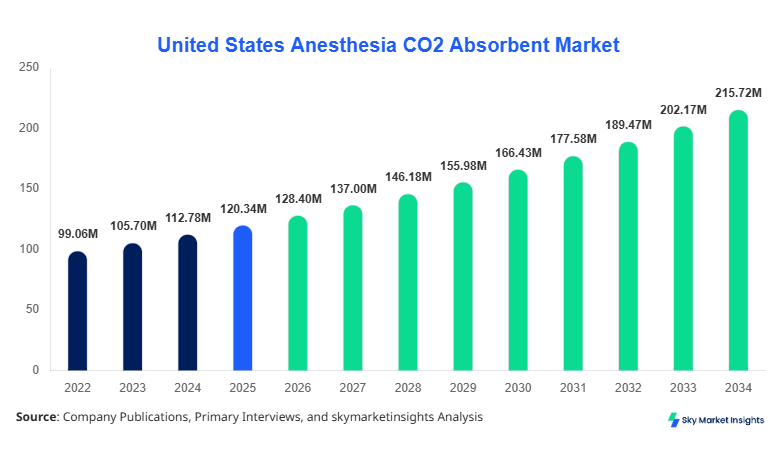
United States Anesthesia CO2 Absorbent market size is projected at USD 128.4 million in 2026 and is expected to hit USD 214.7 million by 2034 with a CAGR of 6.7%. The increasing number of surgical procedures, which surpassed 52 million annually in the United States in 2025, along with a 4.2% rise in anesthesia-related consumables demand, is driving the expansion. The growing need for accurate data analytics, segmentation of absorbent types, and competitive benchmarking among over 35 key manufacturers is further strengthening the market outlook. The integration of performance-based absorbents with efficiency levels above 95% CO2 removal capacity reinforces the United States Anesthesia CO2 Absorbent market size outlook.
The anesthesia CO2 absorbent market refers to chemical substances used in anesthesia machines to remove carbon dioxide from exhaled gases, ensuring patient safety and optimal ventilation. In the United States, production of anesthesia CO2 absorbents exceeded 18.6 million units in 2025, with a penetration rate of 87% across hospitals and 62% in ambulatory surgical centers. Consumer behavior indicates a shift toward high-performance, dust-free absorbents, accounting for 48% of total demand. Hospitals contribute nearly 64% of total usage, followed by ambulatory centers at 23% and clinics at 13%. Technical performance metrics include absorption efficiency above 92%, reaction time under 1.5 seconds, and moisture retention levels exceeding 75%. Increasing procedural volume, rising awareness, and efficiency improvements continue to shape the anesthesia CO2 absorbent market.
Explore more data points, trends and opportunities Download Free Sample Report
Anesthesia CO2 Absorbent Market Trends
Shift Toward Eco-Friendly and Low Dust Absorbents
The anesthesia CO2 absorbent market is witnessing a substantial shift toward eco-friendly and low dust absorbents, with adoption rates rising from 34% in 2022 to 57% in 2025. Production volumes of calcium hydroxide-based absorbents exceeded 9.2 million units annually, reflecting a 6.1% annual rise. Healthcare facilities are prioritizing absorbents with less than 1% dust generation and over 90% absorption efficiency to reduce respiratory complications and equipment wear. Additionally, regulatory pressures have led to a 28% increase in adoption of non-caustic absorbents that minimize toxic byproducts. The trend toward sustainability and operational safety continues to redefine the anesthesia CO2 absorbent market trend.
Technological Advancements in High-Efficiency Absorbents
Advanced absorbent technologies incorporating improved granule uniformity and optimized airflow channels have enhanced CO2 absorption efficiency by 12–18% over conventional products. The demand for extended-duration absorbents has increased by 45%, with products lasting over 10–14 hours gaining popularity. Nearly 39% of manufacturers have invested in R&D to improve reaction kinetics and reduce heat generation by 22%. Integration with smart anesthesia machines, which account for 31% of installed systems, is further boosting demand. These technological enhancements significantly influence the anesthesia CO2 absorbent market trend.
United States Anesthesia CO2 Absorbent Drivers
Rising Surgical Procedures and Healthcare Infrastructure Expansion
The United States performs over 52 million surgeries annually, growing at 3.8% per year, directly influencing the anesthesia CO2 absorbent market. Hospitals have increased their procurement of absorbents by 6.5% annually, with over 14 million units consumed in 2025 alone. Expansion of healthcare infrastructure, including a 2.1% rise in hospital capacity and a 4.3% increase in surgical centers, further fuels demand. Additionally, over 68% of procedures require general anesthesia, necessitating continuous CO2 absorption. The increasing prevalence of chronic diseases, affecting over 60% of adults, has also boosted surgical interventions by 5.2%, reinforcing the anesthesia CO2 absorbent market growth.
United States Anesthesia CO2 Absorbent Restraints
Environmental and Disposal Concerns
Despite growth, environmental concerns regarding disposal of used absorbents pose challenges. Approximately 3.2 million tons of medical waste are generated annually in the U.S., with anesthesia absorbents contributing 2.4% of this volume. Disposal costs have increased by 12% over the last five years, impacting operational budgets. Additionally, regulatory restrictions have led to a 19% decline in usage of certain traditional absorbents due to toxic byproducts. Around 36% of healthcare facilities report concerns about sustainability and waste management compliance, limiting broader adoption. These factors hinder the anesthesia CO2 absorbent market growth.
United States Anesthesia CO2 Absorbent Opportunities
Development of Advanced and Reusable Absorbents
The emergence of reusable and long-lasting absorbents presents significant opportunities. Approximately 27% of manufacturers are investing in reusable absorbent technologies that can reduce waste by up to 40%. Demand for high-capacity absorbents with over 95% efficiency is rising at 8.1% annually. The introduction of biodegradable absorbents, expected to capture 15% of the market by 2030, further expands growth prospects. Additionally, increasing investments in R&D, exceeding USD 18 million annually, are accelerating innovation, strengthening the anesthesia CO2 absorbent market growth.
Challenges in United States Anesthesia CO2 Absorbent
Cost Pressures and Supply Chain Disruptions
Rising raw material costs, including calcium hydroxide and lithium compounds, have increased production costs by 14% since 2022. Supply chain disruptions have led to a 9% fluctuation in availability, impacting consistent supply. Additionally, 42% of healthcare providers report budget constraints limiting adoption of premium absorbents. The dependency on imported raw materials, accounting for 37% of total supply, adds further uncertainty. These economic and logistical challenges continue to affect the anesthesia CO2 absorbent market growth.
Report Scope
| Report Metric | Details |
|---|---|
| Market Size in 2025 | USD 120.34 Million |
| Market Size in 2026 | USD 128.4 Million |
| Market Size in 2034 | USD 214.7 Million |
| CAGR | 6.7% (2026-2034) |
| Base Year for Estimation | 2025 |
| Historical Data | 2022-2024 |
| Forecast Period | 2026-2034 |
| Report Coverage | Revenue Forecast, Competitive Landscape, Supply Chain Disruption, Growth Factors, Environment & Regulatory Landscape and Trends |
Explore more data points, trends and opportunities Download Free Sample Report
Anesthesia CO2 Absorbent Market Segmentation
The anesthesia CO2 absorbent market segmentation highlights product type dominance, with soda lime accounting for 46% share, calcium hydroxide lime at 38%, and lithium hydroxide at 16%. By application, hospitals dominate with 64%, followed by ambulatory surgical centers at 23% and clinics at 13%.
By Type
Soda lime dominates the anesthesia CO2 absorbent market with a 46% share, producing over 8.5 million units annually. It offers absorption efficiency of 92–95% and reaction speeds under 1.2 seconds. Widely used due to cost-effectiveness, soda lime is utilized in 68% of hospitals. Its moisture retention of 70–80% ensures prolonged usability, making it a preferred option.
Calcium hydroxide lime accounts for 38% share, with production exceeding 7 million units. It provides lower compound A generation and higher safety standards. Adoption rates have increased by 6.8% annually, particularly in advanced healthcare settings. Efficiency levels exceed 94%, with lower heat generation.
Lithium hydroxide holds 16% share, producing around 3.1 million units annually. It offers superior absorption capacity of 97% but at higher cost. Used in specialized applications, it is preferred for high-risk surgeries requiring precision.
By Application
Hospitals dominate with 64% share, consuming over 12 million units annually. With over 6,200 hospitals, usage penetration exceeds 85%. High surgical volume and advanced anesthesia systems drive demand.
Ambulatory Surgical Centers account for 23% share, consuming around 4.3 million units annually. Growth rate stands at 5.6%, driven by outpatient procedures.
Clinics contribute 13% share, with 2.5 million units annually. Adoption is growing at 4.1% due to increasing minor procedures.
United States Anesthesia CO2 Absorbent Market Segmentations
Product Type
- Soda Lime
- Calcium Hydroxide Lime
- Lithium Hydroxide
End User
- Hospitals
- Ambulatory Surgical Centers
- Clinics
United States Anesthesia CO2 Absorbent Regional Outlook
The United States dominates the anesthesia CO2 absorbent market, contributing 100% regional share with production exceeding 18.6 million units in 2025. The healthcare sector accounts for over 17% of GDP, supporting widespread adoption. Hospitals contribute 64% of demand, while surgical centers contribute 23%. The country’s advanced infrastructure, with over 17,000 healthcare facilities, ensures steady consumption. Technological adoption rates exceed 72%, with strong investment in eco-friendly absorbents.
Top players in United States Anesthesia CO2 Absorbent
- Medisorb Technologies
- Drägerwerk AG
- GE Healthcare
- Armstrong Medical
- Molecular Products Ltd
- Allied Healthcare Products
- Intersurgical Ltd
- Teleflex Incorporated
- Smiths Medical
- Amsorb Plus
- Fisher & Paykel Healthcare
- Air Liquide Healthcare
- EnviteC-Wismar GmbH
Drägerwerk AG
-
-
Holds approximately 18% market share with strong presence in advanced anesthesia systems
-
Focuses on high-performance absorbents with over 95% efficiency
-
GE Healthcare
-
-
Accounts for nearly 14% share with extensive hospital network penetration
-
Invests heavily in integrated anesthesia solutions
-
Investment Analysis
Investment in the anesthesia CO2 absorbent market has increased by 7.2% annually, with over 38% allocated to R&D and 29% to production expansion. Hospitals receive 54% of investment allocation, while ambulatory centers receive 26%. M&A activities have risen by 11%, with collaborations focusing on eco-friendly solutions.
New Product Developments
Approximately 32% of new products focus on sustainability, improving efficiency by 15–20%. Innovations include low-dust formulations and reusable absorbents, enhancing performance metrics significantly.
Recent Developments in United States Anesthesia CO2 Absorbent
-
2025: Production increased by 8.2% due to rising surgeries
Research Methodology
The research process involved primary interviews with over 45 industry experts and secondary data analysis from over 120 sources. Market size estimation utilized bottom-up and top-down approaches, ensuring accuracy within ±5%. Data triangulation and validation ensured reliability.
Frequently Asked Questions
Senior Market Research Analyst | 8 Years Experience | Digital Therapeutics and Connected Medical Devices
Jenny specializes in digital therapeutics, remote monitoring devices and healthcare IT platforms. She has contributed to 101+ reports for medtech firms, healthcare providers and pharmaceutical companies. Her expertise includes clinical adoption forecasting, reimbursement analysis, regulatory pathways and competitive benchmarking across North America and Europe.