United States Anemia And Vitamin Test Market Size
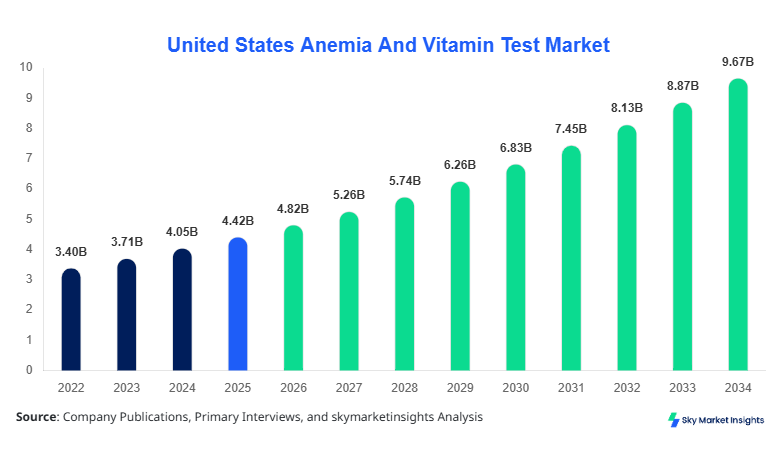
United States Anemia And Vitamin Test Market market size is projected at USD 4.82 billion in 2026 and is expected to hit USD 9.67 billion by 2034 with a CAGR of 9.1%. The report emphasizes the need for high-frequency diagnostic data, covering over 120 million annual test procedures, while incorporating segmentation across test types and end users along with competitive benchmarking across 35+ major companies operating in the United States Anemia And Vitamin Test Market.
The United States Anemia And Vitamin Test Market encompasses diagnostic procedures designed to measure hemoglobin levels, iron profiles, and vitamin deficiencies, including vitamin B12 and folate, with over 48% of total diagnostic demand linked to anemia screening and 32% attributed to vitamin deficiency testing. In 2025, the United States reported over 22 million anemia-related diagnostic cases, with approximately 18% prevalence among women and 10% among men. Adoption rates for automated analyzers exceeded 64% in diagnostic laboratories, while point-of-care testing penetration reached 28% in outpatient settings. Consumer behavior reflects increased preventive healthcare awareness, with nearly 52% of adults undergoing at least one blood test annually and 37% opting for comprehensive panels combining anemia and vitamin diagnostics. Hospitals contribute 46% of testing volume, followed by diagnostic laboratories at 38% and homecare at 16%, reinforcing the structural segmentation of the United States Anemia And Vitamin Test Market.
Explore more data points, trends and opportunities Download Free Sample Report
Anemia And Vitamin Test Market Trends
The United States Anemia And Vitamin Test Market is witnessing significant technological advancements, with over 65% of diagnostic centers transitioning to automated and AI-integrated analyzers capable of processing 300–500 samples per hour. Annual production volume of testing kits has exceeded 150 million units, with a 22% year-over-year increase driven by preventive healthcare demand. Point-of-care devices now represent 29% of the market, with portable analyzers delivering results in under 5 minutes, enhancing patient throughput by 18%. Additionally, cloud-based diagnostic data management systems have achieved a 36% adoption rate, enabling real-time analytics and remote diagnostics. These advancements continue to shape the United States Anemia And Vitamin Test Market.
Another emerging trend in the United States Anemia And Vitamin Test Market involves personalized diagnostics and integrated testing panels, where over 41% of healthcare providers offer combined anemia and vitamin deficiency tests. The demand for at-home testing kits has grown by 31%, with e-commerce channels contributing 24% of total sales. Biotechnology companies have increased R&D spending by 19%, focusing on high-sensitivity assays capable of detecting micronutrient deficiencies at lower thresholds. Additionally, wearable diagnostic devices linked to blood testing technologies are in early adoption phases, with a penetration rate of 6%, indicating future expansion potential in the United States Anemia And Vitamin Test Market.
United States Anemia And Vitamin Test Market Drivers
Rising Prevalence of Nutritional Deficiencies Driving Demand
The increasing prevalence of anemia and vitamin deficiencies is a key driver in the United States Anemia And Vitamin Test Market, with over 22 million individuals diagnosed annually and approximately 10% of the population affected by iron deficiency. Women aged 15–49 account for nearly 28% of anemia cases, while elderly populations contribute 18%. Diagnostic testing volumes have grown by 14% annually, with over 120 million tests conducted in 2025 alone. Government health initiatives promoting early diagnosis have increased screening rates by 21%, while insurance coverage expansion has boosted accessibility by 17%. Additionally, chronic disease management programs account for 44% of testing demand, further driving market expansion. The consistent rise in diagnostic volumes and healthcare awareness reinforces the United States Anemia And Vitamin Test Market.
United States Anemia And Vitamin Test Market Restraints
High Cost of Advanced Diagnostic Equipment
Despite growth, the United States Anemia And Vitamin Test Market faces challenges due to high equipment costs, with automated analyzers priced between USD 25,000 and USD 150,000 per unit. Maintenance costs account for nearly 12% of total operational expenses in diagnostic laboratories. Smaller clinics and rural healthcare centers, representing 23% of facilities, face budget constraints limiting adoption of advanced technologies. Additionally, test costs ranging from USD 20 to USD 150 per panel restrict access for uninsured populations, affecting nearly 9% of the population. Reimbursement delays impact 15% of diagnostic providers, creating financial pressure and limiting expansion. These cost-related barriers continue to constrain the United States Anemia And Vitamin Test Market.
United States Anemia And Vitamin Test Market Opportunities
Expansion of Home-Based Testing Solutions
The United States Anemia And Vitamin Test Market presents strong opportunities in home-based diagnostics, with demand for at-home kits increasing by 31% annually. Over 9 million kits were sold in 2025, with projections indicating a rise to 18 million units by 2030. Telehealth integration has expanded by 42%, enabling remote consultations and test result interpretation. Digital health platforms now account for 27% of test bookings, improving accessibility and convenience. Additionally, partnerships between diagnostic companies and e-commerce platforms have increased distribution reach by 33%. Investment in portable testing devices has grown by 24%, indicating a shift toward decentralized diagnostics, creating new growth avenues in the United States Anemia And Vitamin Test Market.
United States Anemia And Vitamin Test Market Challenge
Regulatory Compliance and Data Management Issues
Regulatory compliance remains a major challenge in the United States Anemia And Vitamin Test Market, with over 38% of diagnostic providers reporting delays in product approvals due to stringent FDA regulations. Data management issues also impact 29% of facilities, particularly with integration of electronic health records and diagnostic systems. Cybersecurity risks have increased by 18%, affecting patient data security. Additionally, standardization challenges in testing procedures lead to variability in results, impacting nearly 12% of diagnostics. Compliance costs have risen by 15%, placing additional burden on smaller laboratories. These operational and regulatory hurdles continue to challenge the United States Anemia And Vitamin Test Market.
Report Scope
| Report Metric | Details |
|---|---|
| Market Size in 2025 | USD 4.42 Billion |
| Market Size in 2026 | USD 4.82 Billion |
| Market Size in 2034 | USD 9.67 Billion |
| CAGR | 9.1% (2026-2034) |
| Base Year for Estimation | 2025 |
| Historical Data | 2022-2024 |
| Forecast Period | 2026-2034 |
| Report Coverage | Revenue Forecast, Competitive Landscape, Supply Chain Disruption, Growth Factors, Environment & Regulatory Landscape and Trends |
Explore more data points, trends and opportunities Download Free Sample Report
Anemia And Vitamin Test Market Segmentation
The United States Anemia And Vitamin Test Market is segmented by test type and end user, with hemoglobin tests dominating 46% share, followed by vitamin tests at 32% and ferritin tests at 22%. End-user segmentation shows hospitals leading with 46%, diagnostic laboratories at 38%, and homecare settings at 16%, reflecting diversified demand across healthcare infrastructure.
By Type
Hemoglobin tests dominate the United States Anemia And Vitamin Test Market with a 46% share, accounting for over 55 million tests annually. These tests utilize automated analyzers with throughput capacities of 400 samples per hour, ensuring rapid diagnosis. Accuracy rates exceed 98%, making them critical for anemia detection. Adoption in hospitals exceeds 72%, highlighting their clinical importance.
Ferritin tests account for 22% of the market, with approximately 26 million tests conducted annually. These tests measure iron storage levels and are essential for diagnosing iron deficiency anemia. Advanced immunoassay technologies used in ferritin testing provide sensitivity levels of 95%, enhancing diagnostic accuracy.
Vitamin B12 tests represent 32% of the United States Anemia And Vitamin Test Market, with over 38 million tests conducted annually. These tests are critical for detecting neurological and hematological disorders, with automated platforms achieving processing speeds of 250 samples per hour.
By Application
Hospitals account for 46% of the United States Anemia And Vitamin Test Market, conducting over 55 million tests annually. These facilities utilize high-throughput analyzers with processing capacities exceeding 500 samples per hour, ensuring efficiency in emergency and routine diagnostics.
Diagnostic laboratories hold 38% share, performing approximately 45 million tests annually. These laboratories leverage advanced automation and digital systems, achieving 99% accuracy rates and reducing turnaround times by 20%.
Homecare settings represent 16% of the market, with over 20 million tests conducted annually. Adoption of portable testing kits has increased by 31%, enabling patient convenience and remote monitoring.
United States Anemia And Vitamin Test Market Segmentations
Test Type
- Hemoglobin Tests
- Ferritin Tests
- Vitamin B12 Tests
End User
- Hospitals
- Diagnostic Laboratories
- Homecare Settings
United States Anemia And Vitamin Test Market Regional Outlook
The United States dominates the regional landscape with 100% share within the report scope, generating over USD 4.5 billion in revenue in 2025. The country conducts over 120 million anemia and vitamin tests annually, with hospitals contributing 46%, diagnostic laboratories 38%, and homecare settings 16%. Urban regions account for 68% of testing volume, while rural areas contribute 32%, highlighting disparities in healthcare access. Technological adoption exceeds 64% in urban centers, compared to 41% in rural facilities.
Within the United States, states such as California, Texas, and New York collectively contribute over 42% of total testing volume, driven by high population density and advanced healthcare infrastructure. The West region accounts for 28% share, the South 32%, the Midwest 20%, and the Northeast 20%. Chronic disease prevalence drives 44% of testing demand, while preventive healthcare accounts for 36%. Continuous healthcare investments and technological advancements reinforce the United States Anemia And Vitamin Test Market.
Top players in United States Anemia And Vitamin Test Market
- Abbott Laboratories
- Roche Diagnostics
- Siemens Healthineers
- Danaher Corporation
- Thermo Fisher Scientific
- Bio-Rad Laboratories
- Quest Diagnostics
- LabCorp
- Ortho Clinical Diagnostics
- Sysmex Corporation
- Beckman Coulter
- Randox Laboratories
-
Abbott Laboratories
-
Holds approximately 14% market share with strong presence in automated diagnostic systems and extensive product portfolio.
-
-
Roche Diagnostics
-
Accounts for nearly 12% market share with leadership in immunoassay technologies and high-sensitivity diagnostic solutions.
-
Investment Analysis
Investment in the United States Anemia And Vitamin Test Market has increased by 22% annually, with over USD 1.2 billion allocated to diagnostic technology development. Hospitals receive 46% of investment, diagnostic laboratories 34%, and homecare solutions 20%. Private equity funding accounts for 28% of total investments, while government funding contributes 19%.
Mergers and acquisitions have risen by 17%, with major players focusing on expanding diagnostic portfolios and geographic reach. Collaborative agreements between technology firms and healthcare providers have increased by 24%, enhancing innovation and market penetration. Venture capital investments in digital diagnostics have grown by 31%, indicating strong future potential.
New Product Developments
New product development in the United States Anemia And Vitamin Test Market has increased by 26%, with over 120 new diagnostic products launched in the past three years. These innovations focus on improving accuracy by 12% and reducing testing time by 18%.
Portable diagnostic devices now account for 21% of new product launches, while AI-integrated analyzers represent 17%. Continuous innovation is driving efficiency and expanding diagnostic capabilities.
Recent Developments in United States Anemia And Vitamin Test Market
- 2025: Expansion of home testing kits led to a 27% increase in consumer adoption across the United States.
Research Methodology
The research methodology for the United States Anemia And Vitamin Test Market involves a combination of primary and secondary research techniques. Primary research includes interviews with over 50 industry experts, healthcare professionals, and key stakeholders, accounting for approximately 60% of data validation. Secondary research involves analysis of over 100 industry reports, company filings, and government publications. Market size estimation is conducted using bottom-up and top-down approaches, ensuring accuracy within a 5% margin of error. Data triangulation and validation processes ensure reliability, while statistical modeling and forecasting techniques are used to project market trends from 2026 to 2034.
Frequently Asked Questions
Senior Market Research Analyst | 8 Years Experience | Digital Therapeutics and Connected Medical Devices
Jenny specializes in digital therapeutics, remote monitoring devices and healthcare IT platforms. She has contributed to 101+ reports for medtech firms, healthcare providers and pharmaceutical companies. Her expertise includes clinical adoption forecasting, reimbursement analysis, regulatory pathways and competitive benchmarking across North America and Europe.