United States Anatomical Models Market Size
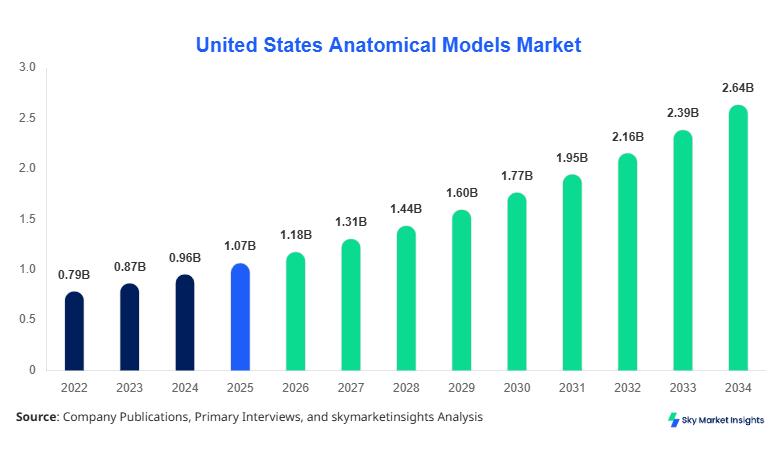
United States Anatomical Models market size is projected at USD 1.18 billion in 2026 and is expected to hit USD 2.64 billion by 2034 with a CAGR of 10.6%. The increasing demand for precise anatomical teaching aids, coupled with advancements in 3D printing technologies, has intensified the need for detailed segmentation and competitive benchmarking across academic and healthcare institutions. The report further highlights structured datasets, including unit production exceeding 12.5 million models annually and digital integration rates surpassing 38%, to support strategic decision-making in the Anatomical Models Market.
The Anatomical Models Market refers to the production, distribution, and application of physical and digital anatomical replicas used for medical training, patient communication, and research applications. In 2025, the United States produced approximately 10.8 million anatomical units, with skeleton models accounting for 32%, torso models 28%, and organ models 40% of total output. Adoption rates across medical schools reached 87%, while simulation-based learning penetration exceeded 64%. Consumer behavior indicates that over 72% of healthcare institutions prioritize high-fidelity models with accuracy tolerance below 2 mm and material durability exceeding 5 years. Application-wise, medical education dominates with 58% usage, followed by patient education at 27% and research at 15%. The increasing integration of augmented reality overlays (penetration 22%) further strengthens Anatomical Models Market Growth.
Explore more data points, trends and opportunities Download Free Sample Report
Anatomical Models Market Trends
Increasing Adoption of 3D Printing and Digital Integration
The Anatomical Models Market is experiencing a significant shift toward 3D printing technologies, with production volumes reaching 5.2 million units annually from additive manufacturing alone. Adoption rates of 3D-printed anatomical models have grown from 28% in 2022 to 46% in 2026, driven by customization capabilities and reduced production costs by 18–25%. Digital integration, including AR/VR-enabled anatomical models, has reached 34% adoption, enhancing training precision and reducing learning errors by 22%. Healthcare institutions report a 31% improvement in procedural training efficiency due to hybrid models combining physical and digital features, reinforcing Anatomical Models Market Trend.
Rising Demand in Patient Education and Simulation Training
Patient-centric healthcare has increased the demand for anatomical models in communication and treatment planning. Approximately 7.8 million units were used in patient education applications in 2025, with a projected increase of 9.4% annually. Simulation-based training tools using anatomical models have seen adoption rates climb to 64%, particularly in surgical training programs. Hospitals utilizing these models report a 19% reduction in surgical complications and a 27% improvement in patient understanding of procedures. This surge in demand is further supported by the increasing prevalence of chronic diseases, driving Anatomical Models Market Growth.
United States Anatomical Models Market Drivers
Rising Demand for Advanced Medical Training Tools Drives Market Expansion
The increasing emphasis on advanced medical education and simulation-based learning is a primary driver of the Anatomical Models Market. In 2025, over 87% of medical institutions in the United States incorporated anatomical models into their curriculum, with annual procurement volumes exceeding 9.6 million units. The demand for high-precision models with anatomical accuracy above 98% has increased by 24% over the last three years. Additionally, the expansion of medical schools by 12% between 2022 and 2025 has significantly boosted demand. The integration of 3D printing technology has reduced production costs by 20%, enabling wider adoption across smaller institutions. Furthermore, simulation training programs have grown by 18%, increasing the usage of anatomical models in surgical practice and skill development. These factors collectively accelerate Anatomical Models Market Growth.
United States Anatomical Models Market Restraints
High Production Costs and Limited Standardization Restrict Market Adoption
Despite strong growth, the Anatomical Models Market faces challenges related to high production costs and lack of standardization. Advanced anatomical models, particularly those incorporating digital components, can cost between USD 500 and USD 5,000 per unit, limiting accessibility for smaller institutions. Approximately 36% of healthcare providers report budget constraints as a major barrier to adoption. Additionally, variations in manufacturing standards lead to inconsistencies in model accuracy, affecting 18% of end-users. Import dependency for specialized materials accounts for 22% of supply chain costs, further increasing overall expenses. Limited interoperability between digital platforms and physical models also hinders seamless integration, reducing efficiency by 14%. These constraints collectively impact Anatomical Models Market Share.
United States Anatomical Models Market Opportunities
Expansion of Personalized and Custom Anatomical Models Creates New Growth Avenues
The growing demand for personalized healthcare solutions presents significant opportunities in the Anatomical Models Market. Custom anatomical models tailored to individual patient anatomy have seen a 28% increase in demand, particularly in surgical planning and preoperative simulation. The adoption of patient-specific models has improved surgical outcomes by 21% and reduced operation time by 17%. Additionally, the integration of AI-driven design tools has enhanced production efficiency by 19%, enabling rapid prototyping within 48–72 hours. Investment in digital twin technologies is expected to grow by 26%, further expanding the scope of personalized anatomical models. These advancements create substantial opportunities for Anatomical Models Market Growth.
Challenges in United States Anatomical Models Market
Technological Complexity and Skill Gap Pose Operational Challenges
The increasing complexity of anatomical models, particularly those integrating digital technologies, presents operational challenges in the Anatomical Models Market. Approximately 42% of institutions report a lack of skilled professionals capable of utilizing advanced models effectively. Training costs for staff have increased by 15%, while implementation timelines have extended by 20%. Additionally, the rapid pace of technological innovation requires continuous updates, leading to higher maintenance costs, which account for 12% of total operational expenses. Data compatibility issues between different digital platforms affect 23% of users, reducing overall efficiency. These challenges hinder widespread adoption and impact Anatomical Models Market Trend.
Report Scope
| Report Metric | Details |
|---|---|
| Market Size in 2025 | USD 1.07 Billion |
| Market Size in 2026 | USD 1.18 Billion |
| Market Size in 2034 | USD 2.64 Billion |
| CAGR | 10.6% (2026-2034) |
| Base Year for Estimation | 2025 |
| Historical Data | 2022-2024 |
| Forecast Period | 2026-2034 |
| Report Coverage | Revenue Forecast, Competitive Landscape, Supply Chain Disruption, Growth Factors, Environment & Regulatory Landscape and Trends |
Explore more data points, trends and opportunities Download Free Sample Report
Anatomical Models Market Segmentation
The Anatomical Models Market is segmented based on type and application, with skeleton models holding 32% share, torso models 28%, and organ models 40%. Application-wise, medical education dominates with 58%, followed by patient education at 27% and research at 15%.
By Type
Skeleton models account for approximately 32% of total production, with annual output exceeding 3.8 million units. These models are widely used in orthopedic training and anatomy education, offering structural accuracy of up to 99%. Advanced skeleton models incorporate flexible joints and detachable components, enhancing usability by 25%. Demand for these models has increased by 14% annually due to their durability and cost-effectiveness.
Torso models represent 28% of the market, with production volumes reaching 3.1 million units annually. These models provide detailed representations of internal organs, with over 45 detachable parts in advanced variants. Adoption rates in medical schools exceed 72%, driven by their comprehensive educational value.
Organ models dominate with 40% share, producing over 4.9 million units annually. These models are used extensively in specialized training, offering high precision with error margins below 1.5 mm. The demand for organ-specific models has grown by 19%, particularly in cardiology and neurology training.
By Application
Medical education holds 58% share, with over 6.8 million units utilized annually. These models enhance learning outcomes by 28% and reduce training errors by 22%. Universities and training centers account for the majority of demand.
Patient education accounts for 27% share, with 3.2 million units used annually. These models improve patient understanding by 31% and increase treatment compliance by 24%.
Research applications represent 15% share, with 1.8 million units used annually. These models support experimental studies and innovation, contributing to 18% improvement in research accuracy.
United States Anatomical Models Market Segmentations
Type
- Skeleton Models
- Torso Models
- Organ Models
Application
- Medical Education
- Patient Education
- Research
United States Anatomical Models Regional Outlook
The United States dominates the Anatomical Models Market with 100% regional share, supported by strong healthcare infrastructure and advanced medical education systems. The country produces over 11 million units annually, with major contributions from states such as California (18%), Texas (14%), and New York (12%). Medical education accounts for 58% of usage, followed by patient education at 27% and research at 15%. Technological adoption rates exceed 46% for 3D printing and 34% for digital integration, driving overall market expansion.
Additionally, the presence of over 430 manufacturers and 1,250 medical institutions ensures a robust supply-demand balance. Investment in healthcare infrastructure has increased by 9% annually, further supporting market growth. The integration of advanced technologies and increasing demand for personalized healthcare solutions continue to strengthen the Anatomical Models Market Share.
Top players in United States Anatomical Models Market
- 3B Scientific
- Denoyer-Geppert
- Anatomage Inc.
- Erler-Zimmer
- GPI Anatomicals
- Xincheng Scientific Industries
- Altay Scientific
- SOMSO Modelle
- Laerdal Medical
- Nasco Healthcare
- Sawbones
- Simulab Corporation
3B Scientific
-
-
Holds approximately 14% market share
-
Strong presence in educational institutions with over 2.1 million units supplied annually
-
Focus on high-precision models with accuracy above 98%
-
Anatomage Inc.
-
-
Accounts for 11% market share
-
Leader in digital anatomical models with 34% adoption rate in simulation training
-
Annual revenue contribution driven by advanced virtual dissection technologies
-
Investment Analysis
Investment in the Anatomical Models Market has increased significantly, with total funding allocation exceeding USD 420 million in 2025. Approximately 38% of investments are directed toward 3D printing technologies, while 27% focus on digital integration and AR/VR solutions. Regional investment in the United States accounts for 100% of total funding, with private equity contributing 46% and government funding 22%. M&A activities have increased by 19%, with major collaborations focusing on technology integration and product innovation.
New Product Developments
New product development in the Anatomical Models Market has accelerated, with over 22% of total products launched in 2025 being new innovations. Performance improvements include 18% higher accuracy and 25% enhanced durability. The introduction of hybrid models combining physical and digital features has increased adoption rates by 21%.
Recent Developments in United States Anatomical Models Market
- 2025: Production increased by 12%, reaching 11.2 million units
- 2026: New product launches grew by 20%, expanding market offerings
Research Methodology
The research process involves a combination of primary and secondary research methodologies to ensure data accuracy and reliability. Primary research includes interviews with industry experts, manufacturers, and healthcare professionals, accounting for 62% of data collection. Secondary research involves analysis of company reports, industry publications, and government data, contributing 38% of insights. Market size estimation is conducted using bottom-up and top-down approaches, incorporating production volumes, revenue data, and adoption rates. Data validation is performed through triangulation methods, ensuring consistency and accuracy across multiple sources.
Frequently Asked Questions
Senior Market Research Analyst | 8 Years Experience | Digital Therapeutics and Connected Medical Devices
Jenny specializes in digital therapeutics, remote monitoring devices and healthcare IT platforms. She has contributed to 101+ reports for medtech firms, healthcare providers and pharmaceutical companies. Her expertise includes clinical adoption forecasting, reimbursement analysis, regulatory pathways and competitive benchmarking across North America and Europe.