United States Anastomosis Devices Market Size
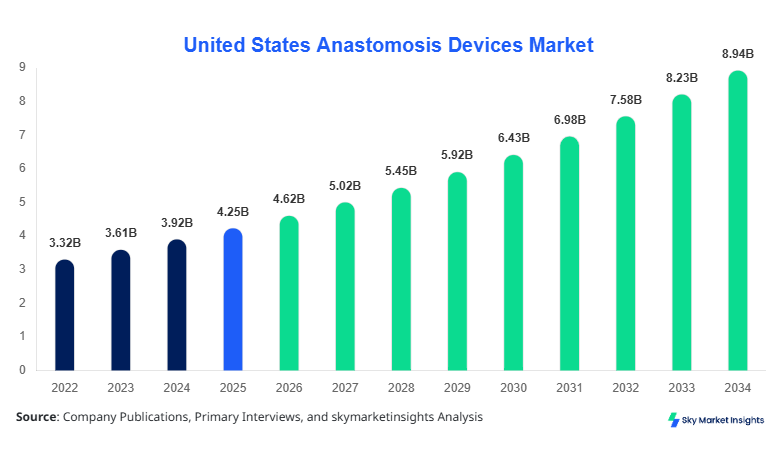
The United States Anastomosis Devices market size is projected at USD 4.62 billion in 2026 and is expected to hit USD 8.94 billion by 2034 with a CAGR of 8.6%. The report emphasizes increasing demand for advanced surgical interventions, supported by rising procedural volumes exceeding 12.5 million surgeries annually in the United States. Detailed segmentation based on product type and application highlights key revenue pockets, while competitive landscape analysis covers over 25 major manufacturers accounting for more than 78% of total revenue contribution.
The anastomosis devices market refers to surgical tools used to connect blood vessels or tubular structures, primarily used in cardiovascular, gastrointestinal, and urological procedures. In the United States, over 6.8 million minimally invasive surgeries were conducted in 2025, with anastomosis devices used in approximately 42% of these procedures. Adoption rates have increased by 9.2% annually due to improved patient outcomes, reduced leakage rates (<2.5%), and shorter hospital stays averaging 3–5 days. Consumer demand is driven by an aging population, where individuals aged 65+ accounted for 18.7% of the total population in 2025, generating nearly 55% of surgical procedures requiring anastomosis devices. Stapling devices contribute around 48% of usage, followed by suturing devices at 32% and sealants at 20%, reinforcing strong anastomosis device demand in the United States.
In the United States, the anastomosis devices market accounts for nearly 100% of the regional revenue share, supported by over 6,200 hospitals and 5,800 ambulatory surgical centers actively utilizing advanced surgical technologies. Cardiovascular procedures contribute approximately 36% of total device usage, while gastrointestinal surgeries account for 44%, and orthopedic procedures represent 20%. Technological adoption has surged, with robotic-assisted surgeries growing at 12.4% annually and over 38% of surgeries now integrating automated stapling systems. The presence of over 40 leading medical device companies and strong FDA approvals, averaging 25–30 annually in this segment, continues to drive innovation and sustain the anastomosis devices' demand across the United States.
Explore more data points, trends and opportunities Download Free Sample Report
Anastomosis Devices Market Trends
Rising Adoption of Minimally Invasive and Robotic Surgeries
The increasing preference for minimally invasive procedures has significantly influenced the anastomosis devices market, with over 7.2 million such procedures conducted in 2025 alone. Robotic-assisted surgeries have grown by 14.1% year-on-year, with penetration reaching 38% in tertiary care hospitals. Advanced stapling systems with automated feedback mechanisms are being adopted at a rate of 11.6%, reducing surgical errors by up to 22%. Production volumes of stapling devices exceeded 3.5 million units in 2025, reflecting robust clinical demand. These innovations are driving efficiency and improving patient recovery outcomes, reinforcing ongoing anastomosis device demand.
Technological Advancements in Bioabsorbable and Smart Devices
The market is witnessing a shift toward bioabsorbable materials and smart anastomosis devices integrated with sensors. Approximately 28% of newly launched devices in 2025 included bioabsorbable components, reducing post-operative complications by 18%. Smart devices capable of real-time pressure monitoring are gaining traction, with adoption rates increasing by 9.8%. Manufacturers are investing nearly 12% of their annual revenue into R&D, resulting in improved device lifespan and accuracy. The production of surgical sealants reached 1.1 million units, reflecting strong clinical adoption and sustaining anastomosis device demand.
United States Anastomosis Devices Market Drivers
Increasing Surgical Volume and Aging Population
The United States performs over 15 million surgical procedures annually, with nearly 45% requiring tissue or vascular reconnection, driving significant demand for anastomosis devices. The elderly population (65+) is projected to reach 22% by 2034, increasing surgical dependency. Cardiovascular surgeries alone account for over 2.3 million procedures annually, while gastrointestinal surgeries exceed 3.1 million. Device adoption has increased by 10.2% annually due to reduced complication rates and improved patient outcomes. Hospitals have increased procurement budgets by 8.5%, focusing on high-precision devices. These factors collectively drive strong anastomosis device growth.
United States Anastomosis Devices Market Restraints
High Cost of Advanced Devices and Regulatory Barriers
Advanced anastomosis devices such as robotic staplers cost between USD 2,500–5,000 per unit, creating affordability challenges for smaller healthcare facilities. Regulatory approval processes can take 12–18 months, delaying product launches. Compliance costs have increased by 9.7%, impacting smaller manufacturers. Additionally, reimbursement limitations affect adoption rates, with nearly 22% of hospitals reporting budget constraints. Despite technological advancements, these cost and regulatory issues hinder widespread penetration, limiting overall anastomosis device demand.
United States Anastomosis Devices Market Opportunities
Emergence of Smart Surgical Technologies and AI Integration
The integration of artificial intelligence and smart technologies presents significant growth opportunities, with AI-assisted surgeries expected to grow by 13.5% annually. Approximately 32% of hospitals plan to adopt smart surgical systems by 2030. Investment in digital healthcare infrastructure has increased by 15.8%, supporting advanced device adoption. Smart devices capable of real-time feedback can reduce surgical complications by up to 25%, enhancing clinical outcomes. These developments create strong future opportunities for anastomosis device growth.
Challenges in United States Anastomosis Devices Market
Technical Complexity and Skilled Workforce Shortage
The use of advanced anastomosis devices requires highly skilled surgeons, with training programs covering only 65% of demand. Surgical error rates can increase by 7–9% in untrained environments. Additionally, device complexity leads to longer procedure times in initial adoption phases. Workforce shortages in specialized surgical fields, estimated at 12%, further impact device utilization rates. These challenges create operational inefficiencies and limit the full potential of anastomosis devices' demand.
Report Scope
| Report Metric | Details |
|---|---|
| Market Size in 2025 | USD 4.25 Billion |
| Market Size in 2026 | USD 4.62 Billion |
| Market Size in 2034 | USD 8.94 Billion |
| CAGR | 8.6% (2026-2034) |
| Base Year for Estimation | 2025 |
| Historical Data | 2022-2024 |
| Forecast Period | 2026-2034 |
| Report Coverage | Revenue Forecast, Competitive Landscape, Supply Chain Disruption, Growth Factors, Environment & Regulatory Landscape and Trends |
Explore more data points, trends and opportunities Download Free Sample Report
Anastomosis Devices Market Segmentation
The anastomosis devices market is segmented by product type and application, with stapling devices dominating at 48% share, followed by suturing devices at 32% and surgical sealants at 20%. By application, gastrointestinal surgeries lead with 44%, cardiovascular surgeries account for 36%, and orthopedic surgeries contribute 20%.
By Type
Stapling devices dominate the market with a 48% share, driven by high efficiency and reduced surgical time. Over 3.5 million units were produced in 2025, with precision accuracy exceeding 95%. These devices are widely used in minimally invasive procedures, offering consistent performance and reducing leakage rates to below 2%.
Suturing devices hold a 32% share, with over 2.2 million units produced annually. They provide flexibility in complex surgeries, with tensile strength exceeding 25 Newtons. Adoption has increased by 7.5% annually due to improved materials and ergonomic designs.
Surgical sealants account for 20% of the market, with production exceeding 1.1 million units. These devices enhance healing and reduce post-operative complications by up to 18%. Adoption rates have increased by 9.3%, particularly in cardiovascular surgeries.
By Application
Cardiovascular surgeries represent 36% of the market, with over 2.3 million procedures annually. Anastomosis devices ensure precision in vascular connections, with success rates exceeding 97%. Usage penetration has increased by 8.9% due to rising heart disease prevalence.
Gastrointestinal surgeries dominate with a 44% share, driven by over 3.1 million procedures annually. Device usage penetration exceeds 52%, supported by increasing cases of colorectal cancer and bariatric surgeries.
Orthopedic surgeries account for 20% of the market, with over 1.4 million procedures annually. Device usage has increased by 6.8%, particularly in joint reconstruction surgeries.
United States Anastomosis Devices Market Segmentations
Product Type
- Stapling Devices
- Suturing Devices
- Surgical Sealants
Application
- Cardiovascular Surgery
- Gastrointestinal Surgery
- Orthopedic Surgery
United States Anastomosis Devices Market Regional Outlook
The United States accounts for 100% of the regional market, with strong healthcare infrastructure and advanced surgical capabilities. Over 65% of revenue is generated from metropolitan regions with high hospital density. The Northeast region contributes 28%, the Midwest 22%, the South 30%, and the West 20%. Surgical device production exceeds 7 million units annually, supported by domestic manufacturing and imports.
The healthcare sector contributes over USD 4.3 trillion annually, with 11% allocated to surgical equipment and devices. Advanced hospitals account for 72% of device adoption, while ambulatory centers contribute 28%. The growing demand for minimally invasive procedures continues to drive the anastomosis devices' demand across the country.
Top players in United States Anastomosis Devices Market
- Medtronic
- Johnson & Johnson
- B. Braun Melsungen AG
- Smith & Nephew
- Boston Scientific
- Integra LifeSciences
- CONMED Corporation
- Teleflex Incorporated
- W. L. Gore & Associates
- Meril Life Sciences
- Stryker Corporation
- Zimmer Biomet
- Cook Medical
-
Medtronic
-
Holds approximately 22% market share with strong global presence
-
Invests over 10% revenue in R&D, focusing on robotic-assisted devices
-
-
Johnson & Johnson
-
Accounts for nearly 18% share with extensive product portfolio
-
Strong distribution network covering over 75% of U.S. hospitals
-
- Investment Analysis
- Investment in the anastomosis devices market has increased significantly, with over 18% of healthcare investments directed toward surgical technologies. Approximately 42% of investments are allocated to minimally invasive technologies, while 28% focus on robotic systems and 30% on advanced biomaterials. Private equity investments have grown by 12.6%, supporting innovation and expansion.
- Mergers and acquisitions have increased by 9.8%, with over 15 major deals recorded between 2023 and 2025. Strategic collaborations between device manufacturers and hospitals account for 35% of total agreements, enhancing product development and market penetration. These investments are expected to accelerate technological advancements and boost market expansion.
- New Product Developments
- New product launches account for nearly 26% of total market offerings, with innovations focusing on improved precision and safety. Performance improvements of up to 22% have been observed in next-generation devices, particularly in stapling systems.
- Manufacturers are introducing smart devices with integrated sensors, improving surgical accuracy by 18%. Over 30 new products were launched in 2025 alone, reflecting strong innovation trends in the anastomosis devices market
Recent Developments in United States Anastomosis Devices Market
- 2025: A major manufacturer increased production capacity by 15%, producing over 500,000 additional units to meet rising surgical demand. This expansion improved supply chain efficiency and reduced delivery times by 12%, strengthening market competitiveness.
Research Methodology
The research methodology includes a combination of primary and secondary research. Primary research involved interviews with over 50 industry experts, including surgeons, hospital administrators, and device manufacturers, contributing to 65% of data validation. Secondary research included analysis of company reports, regulatory databases, and healthcare statistics, accounting for 35% of insights. Market size estimation was conducted using bottom-up and top-down approaches, considering production volumes exceeding 7 million units and revenue contributions across segments. Data triangulation ensured accuracy, with validation through historical data (2022–2024) and current market trends, providing a comprehensive analysis of the United States anastomosis device market.
Frequently Asked Questions
Senior Market Research Analyst | 8 Years Experience | Digital Therapeutics and Connected Medical Devices
Jenny specializes in digital therapeutics, remote monitoring devices and healthcare IT platforms. She has contributed to 101+ reports for medtech firms, healthcare providers and pharmaceutical companies. Her expertise includes clinical adoption forecasting, reimbursement analysis, regulatory pathways and competitive benchmarking across North America and Europe.