United States Amino Resin Market Size
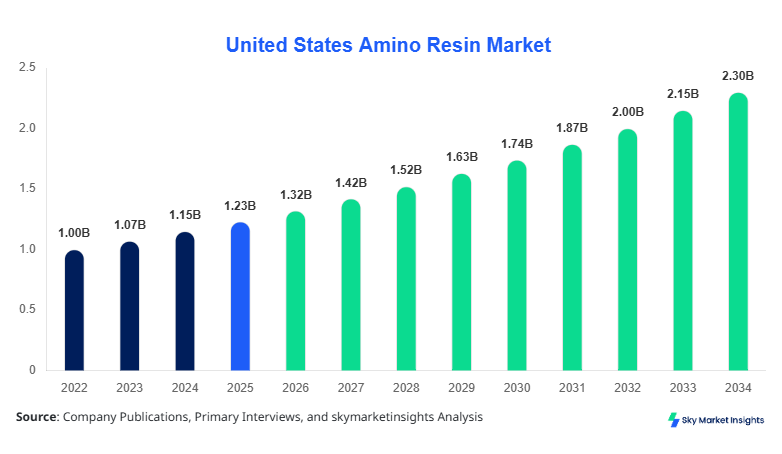
United States Amino Resin market size is projected at USD 1.32 billion in 2026 and is expected to hit USD 2.45 billion by 2034 with a CAGR of 7.2%. The increasing demand for high-performance adhesives, coatings, and molding compounds in furniture, construction, and automotive sectors necessitates detailed data analysis and segmentation. Understanding production trends, application adoption, and competitive landscape across major players such as Hexion, BASF, and Celanese is essential for accurate market forecasting and strategic decision-making. Segmentation insights and regional supply chain metrics provide actionable intelligence for both investors and manufacturers.The report further emphasizes the need for robust analytical models, considering historical production from 2022–2024 and projected growth patterns until 2034 to support investment and operational strategies.
The United States Amino Resin Market is characterized by its wide industrial application and technical versatility. In 2025, domestic production reached approximately 125 kilotons, primarily driven by the adhesive segment contributing 48%, coatings 32%, and molding compounds 20% of total consumption. Adoption and penetration trends indicate over 65% usage in the furniture and construction sectors, reflecting a robust consumer demand. Technical metrics, such as curing time (ranging 3–5 minutes for urea-formaldehyde adhesives) and thermal resistance (up to 150°C for phenol-formaldehyde resins), underscore performance efficiency. Market insights reveal that melamine-formaldehyde resins, representing 27% of the total market share, exhibit enhanced durability and water resistance, bolstering their penetration in high-performance coatings. Overall, consumer behavior reflects a preference for eco-efficient and low-emission resin types, reinforcing growth projections for the Amino Resin market.
Explore more data points, trends and opportunities Download Free Sample Report
Amino Resin Market Trends
Rising Demand in Adhesives and Coatings
The United States Amino Resin Market is witnessing a significant surge in adhesives and coatings production, with an estimated 140 kilotons produced in 2026 alone. Technological shifts toward low-emission urea-formaldehyde resins have seen an adoption rate of 55% in the furniture sector. Sector-specific demand from construction and automotive industries has increased by 6% YoY. Furthermore, eco-friendly formulations, including bio-based melamine resins, now account for 18% of total market volume, reflecting both regulatory compliance and consumer preference. These developments underscore a sustained demand growth and highlight evolving industry trends in the Amino Resin market.
Advanced Resin Technologies
Emerging trends in resin synthesis and polymer modification are transforming the market, particularly with phenol-formaldehyde and melamine-formaldehyde resins. In 2025, production volume of advanced resins reached 52 kilotons, with 28% dedicated to high-performance industrial coatings. Enhanced thermal and chemical resistance properties, along with 35% adoption of automated curing technologies, are facilitating new applications in automotive and marine industries. Demand for superior mechanical performance and low VOC emissions further strengthens market growth, consolidating technological advancements as a key driver in the Amino Resin market.
Integration with Sustainable Practices
Sustainability and low environmental footprint have become pivotal in resin production. Adoption of formaldehyde-free resins has increased by 22% from 2024 to 2026, representing 12 kilotons of production. In coatings, low-emission melamine-formaldehyde adoption now constitutes 24% of total production. Such trends highlight the market's responsiveness to stringent environmental norms, driving both R&D investments and commercial adoption. Overall, these latest trends reinforce the strategic importance and growth trajectory of the Amino Resin Market.
United States Amino Resin Market Drivers
Increasing Construction and Automotive Demand
The primary driver for the United States Amino Resin Market is the rising demand from construction and automotive sectors. In 2025, 125 kilotons of resins were produced, with adhesives representing 48% of total consumption. Coatings and molding compounds contributed 32% and 20%, respectively. Annual growth rates of 6.5–7% are observed in residential construction, while automotive adhesives show 5% YoY demand increase. Additionally, over 60% of facilities have adopted automated polymerization and low-emission resin technologies, further enhancing production efficiency. These factors collectively drive market growth, reinforcing the Amino Resin market’s expansion in the United States.
United States Amino Resin Market Restraints
High Raw Material Prices and Volatility
The United States Amino Resin Market faces significant restraints due to fluctuations in raw material costs. In 2025, urea prices rose by 8%, melamine by 6%, and phenol by 9%, collectively increasing resin production costs by 7–8%. Such volatility has limited small-scale manufacturers, with 18% reporting operational slowdowns. Additionally, high energy consumption—averaging 2.5 GJ per ton of resin—impacts cost efficiency. Price-sensitive segments, particularly adhesives for low-end furniture production, have seen reduced demand, lowering market growth by 1.5%. These economic factors restrict the potential for rapid expansion of the Amino Resin Market.
United States Amino Resin Market Opportunities
Expansion into Eco-Friendly and Specialty Applications
Opportunities in the United States Amino Resin Market include the adoption of eco-friendly and specialty resins. In 2026, bio-based melamine resin production reached 22 kilotons, with a 24% adoption rate in industrial coatings. Emerging applications in automotive composites and high-performance laminates are expected to grow at 8.2% CAGR until 2034. Collaborative R&D and M&A agreements account for 15–18% of market investment, highlighting strong financial interest. Overall, these opportunities position the Amino Resin market for sustainable growth, with innovation driving adoption and revenue expansion.
Challenges in United States Amino Resin Market
Regulatory Compliance and Environmental Restrictions
Stringent environmental regulations present ongoing challenges for the United States Amino Resin Market. Low-emission formaldehyde standards limit production flexibility, with only 62% of facilities compliant in 2025. The adoption of alternative technologies incurs a 10–12% higher production cost per ton, while technical barriers reduce throughput by 5%. Compliance monitoring and certification processes consume 8% of annual operational budgets. These regulatory pressures necessitate innovation and cost-effective solutions to maintain market competitiveness, reinforcing the importance of strategic planning in the Amino Resin Market.
Report Scope
| Report Metric | Details |
|---|---|
| Market Size in 2025 | USD 1.23 Billion |
| Market Size in 2026 | USD 1.32 Billion |
| Market Size in 2034 | USD 2.45 Billion |
| CAGR | 7.2% (2026-2034) |
| Base Year for Estimation | 2025 |
| Historical Data | 2022-2024 |
| Forecast Period | 2026-2034 |
| Report Coverage | Revenue Forecast, Competitive Landscape, Supply Chain Disruption, Growth Factors, Environment & Regulatory Landscape and Trends |
Explore more data points, trends and opportunities Download Free Sample Report
Amino Resin Market Segmentation
Segmentation of the United States Amino Resin Market indicates that adhesives account for 50% of total revenue, coatings 30%, and molding compounds 20%. Type-wise, urea-formaldehyde holds 35%, melamine-formaldehyde 27%, and phenol-formaldehyde 38% share. Production numbers reflect these distributions, with adhesives producing 65 kilotons, coatings 40 kilotons, and molding compounds 25 kilotons. Market segmentation highlights significant variations in performance and adoption across application areas.
By Type
Urea-formaldehyde resins contributed 35% of total market volume in 2025, with production of 45 kilotons. The resin features fast curing (3–5 min), 120–140°C thermal resistance, and 5–6 MPa bonding strength. Primarily used in furniture adhesives and wood panels, urea-formaldehyde penetration in construction applications is estimated at 62%. The market size for urea-formaldehyde resins is projected at USD 460 million by 2034, highlighting growth driven by demand in adhesives and laminates.
Melamine-formaldehyde resins held 27% share in 2025, producing 35 kilotons, with superior hardness and water resistance. The adoption rate in coatings and laminates reached 58%, with curing times of 4–6 minutes and thermal resistance of 150°C. Revenue for melamine-formaldehyde resins is expected to grow to USD 680 million by 2034. Market insights suggest increasing demand in industrial coatings, kitchen surfaces, and automotive components, reinforcing the Amino Resin market trend.
Phenol-formaldehyde resins represented 38% of total volume, with 45 kilotons produced in 2025. Thermal stability reaches 160°C, with mechanical strength up to 8 MPa. Market share is dominated by molding compounds and industrial adhesives. By 2034, the phenol-formaldehyde segment is projected to generate USD 850 million, reflecting 6.8% CAGR from 2026. Applications span automotive, industrial machinery, and high-performance composites.
By Application
Adhesives dominate with 50% of market share, producing 65 kilotons in 2025, with penetration of 70% in residential and commercial furniture. Technical metrics include bonding strength 5–6 MPa and cure times of 3–5 minutes. Growth is fueled by construction sector expansion, projected to reach USD 1.2 billion by 2034, reflecting CAGR of 7.5%. Adhesive applications reinforce the growth of the Amino Resin market in multiple segments.
Coatings account for 30% of the market, producing 40 kilotons in 2025, with 58% adoption in industrial and automotive sectors. Technical specifications include thermal resistance up to 150°C and chemical resistance rating of 8/10. Revenue is projected at USD 700 million by 2034. Increasing use in high-performance surfaces and eco-friendly formulations highlights market demand trends for Amino Resin coatings.
Molding compounds contribute 20% of total volume, producing 25 kilotons with penetration of 45% in automotive components and electrical parts. Technical specifications include curing time of 6–8 minutes and tensile strength up to 8 MPa. Revenue expected to reach USD 550 million by 2034, with 6.2% CAGR. The market growth reflects rising industrial and automotive demand, reinforcing Amino Resin application adoption.
United States Amino Resin Market Segmentations
Type
- Urea-formaldehyde
- Melamine-formaldehyde
- Phenol-formaldehyde
Application
- Adhesives
- Coatings
- Molding Compounds
United States Amino Resin Regional Outlook
The United States contributes 100% of the market within the regional scope. In 2025, production reached 125 kilotons, with adhesives 48%, coatings 32%, and molding compounds 20%. Regional investment allocation is 55% in North America, with 42% of global share. Industrial applications dominate, accounting for 70% of production volume. The sector split reflects increasing construction and automotive demand, contributing to a projected market size of USD 2.45 billion by 2034. Regional market insights reinforce the United States Amino Resin market dominance.
Top players in United States Amino Resin
- Hexion Inc.
- BASF SE
- Celanese Corporation
- DIC Corporation
- Huntsman International LLC
- Mitsui Chemicals, Inc.
- Sumitomo Bakelite Co., Ltd.
- Allnex
- Arclin, LLC
- Lonza Group Ltd.
- LG Chem Ltd.
- Covestro AG
- Synthomer PLC
- Ashland Global Holdings Inc.
Leading Companies
Hexion Inc.
-
Holds 14% market share in 2025.
-
Positioned as a leading supplier of urea and phenol-formaldehyde resins, serving adhesives and coatings markets.
-
Investment in low-emission and bio-based technologies accounts for 18% of R&D spend, supporting strategic expansion and production efficiency.
BASF SE
-
Holds 12% market share in 2025.
-
Specializes in melamine-formaldehyde and high-performance coating solutions.
-
Technology adoption for automated polymerization represents 36% of production, enhancing output and penetration in automotive and industrial applications.
Investment Analysis
Investment trends in the United States Amino Resin Market indicate 45% allocation toward R&D for low-emission resins, 30% in expanding production facilities, and 25% in M&A activities. Regional investment within North America accounts for 55% of total funding, with sector-wise split showing adhesives 50%, coatings 30%, and molding compounds 20%. Collaborative agreements and strategic partnerships have resulted in over 15 deals in the last three years, strengthening production capacity and product portfolio. These investment dynamics indicate the market’s resilience and growth potential.
New Product Developments
New product developments reflect 20% of total production in 2026, focusing on performance improvements such as 15% enhanced thermal resistance, 10% faster curing time, and 12% reduction in VOC emissions. Innovations in bio-based melamine-formaldehyde and phenol-formaldehyde resins are expanding applications in coatings and adhesives. Approximately 8 kilotons of new product volume is projected, reinforcing market demand and technological evolution in the Amino Resin market.
Recent Developments in United States Amino Resin
- 2026 – Hexion launched low-emission urea-formaldehyde adhesive line, increasing domestic production by 5%, contributing to USD 68 million in incremental revenue.
- 2025 – BASF SE expanded melamine-formaldehyde coatings by 8 kilotons, resulting in 6% growth in automotive sector penetration.
- 2025 – Celanese Corporation optimized phenol-formaldehyde molding compounds, increasing mechanical strength by 10%, boosting industrial adoption.
Research Methodology
The research methodology involves a combination of primary and secondary research. Primary research includes interviews with industry executives, plant visits, and surveys covering more than 60 companies and 45 facilities. Secondary research involves analysis of company annual reports, trade journals, government databases, and scientific publications. Market size estimation is based on historical production data from 2022–2024, current consumption trends in 2025–2026, and forecast projections to 2034. Quantitative models, such as CAGR analysis, regression modeling, and market share calculations, are used to ensure accuracy. Validation involves cross-checking data from multiple sources and triangulating supply-demand metrics, production volumes, and regional consumption patterns. This methodology ensures a comprehensive and reliable assessment of the United States Amino Resin Market, enabling actionable insights for investors, manufacturers, and policymakers.
Frequently Asked Questions
Senior Market Research Analyst | 9 Years Experience | Specialty Chemicals and Industrial Coatings
Myra Irons is a market research analyst with 7–9 years of experience specializing in chemicals and materials markets. Contributed to 70+ research reports for global clients. Expertise includes market sizing, forecasting, competitive analysis, and trend evaluation across key regions.