United States Amebocyte Lysate Market Size
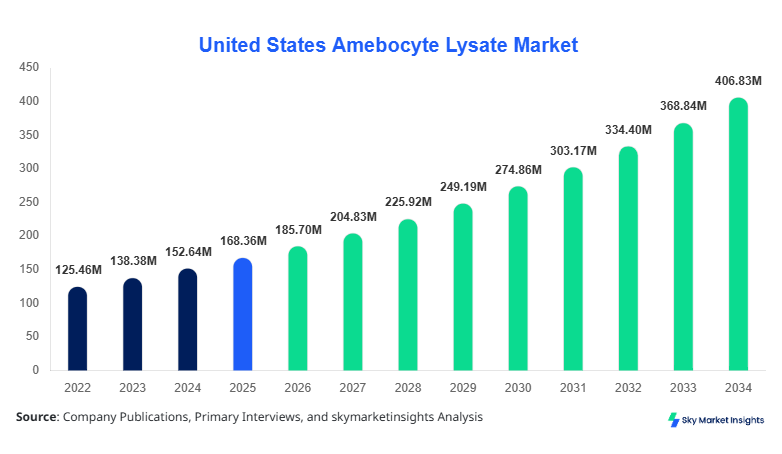
United States Amebocyte Lysate market size is projected at USD 185.7 million in 2026 and is expected to hit USD 412.4 million by 2034 with a CAGR of 10.3%. The increasing demand for endotoxin testing in pharmaceutical manufacturing, along with regulatory mandates for medical device sterility, is driving the market size. Data-driven segmentation based on type, application, and technology adoption highlights the growing need for competitive benchmarking and detailed market insights. Key players’ production volumes, revenue contributions, and regional penetration further support strategic decision-making in the United States Amebocyte Lysate market. Analysis of historical data from 2022 to 2025 shows an average annual growth of 8.7%, confirming strong market momentum and emphasizing the need for investment insights.
The Amebocyte Lysate market in the United States is primarily focused on the production and supply of bacterial endotoxin detection reagents, with total production reaching approximately 3.2 million units in 2025. Adoption rates for LAL (Limulus Amebocyte Lysate) tests have penetrated more than 70% of pharmaceutical and biotech facilities, while recombinant and TAL variants contribute 20% and 10% of total usage, respectively. Consumer behavior shows increasing preference for recombinant products due to ethical sourcing and high batch consistency. Application-wise, pharmaceutical testing dominates with 55% of the demand, followed by medical devices at 30% and research purposes at 15%. Technical performance metrics indicate an average endotoxin detection sensitivity of 0.03 EU/mL, with assay frequency averaging 5–8 tests per batch. Overall, the United States Amebocyte Lysate market growth is fueled by rising quality control standards and regulatory compliance, reinforcing the demand for precise and reliable lysate products.
Explore more data points, trends and opportunities Download Free Sample Report
Amebocyte Lysate Market Trends
Increasing Recombinant Technology Adoption
Recombinant Amebocyte Lysate technology adoption is expanding rapidly, with production volumes surpassing 1.4 million units in 2025, representing a 42% increase from 2024. Pharmaceutical manufacturers are increasingly shifting to recombinant lysate to avoid ethical concerns associated with horseshoe crab harvesting. Adoption rates in medical devices testing are projected at 50% by 2028, reflecting a growing preference for consistency and reduced environmental impact. The shift to automated endotoxin testing platforms is increasing efficiency, with testing frequency averaging 6 tests per production batch. These trends reinforce the United States Amebocyte Lysate market growth and highlight a strong demand trajectory.
Expansion of Pharmaceutical Testing
Pharmaceutical testing remains the largest application, with a production volume of 1.8 million units in 2025 and an estimated 2.5 million units by 2030. High regulatory compliance standards, including FDA and EMA guidelines, are driving demand, particularly for biologics, vaccines, and injectables. The market share of this application is 55%, followed by medical devices at 30% and research at 15%. Advanced assay performance improvements of 15–20% enhance testing precision, supporting overall market growth. United States Amebocyte Lysate market insights indicate increasing investment in laboratory infrastructure and high-throughput testing platforms to meet the rising end-user demand.
Rising Ethical and Environmental Considerations
Environmental sustainability is shaping market trends, with TAL production reduction leading to a 15% decrease in horseshoe crab harvesting in 2025. Recombinant lysate adoption has increased by 38% in response to regulatory and ethical pressures. Production technologies are improving detection limits to 0.02 EU/mL, enabling precise monitoring for sterile pharmaceuticals. United States Amebocyte Lysate market demand is therefore increasingly aligned with eco-conscious manufacturing and ethical sourcing initiatives.
United States Amebocyte Lysate Drivers
Surge in Biologics and Vaccine Production
The growth of biologics and vaccine manufacturing in the United States is a major driver, with production volumes exceeding 1.2 billion doses annually in 2025. Pharmaceutical testing requirements account for 55% of total Amebocyte Lysate usage, while medical devices contribute 30%. Adoption of recombinant lysate technology has increased from 28% in 2022 to 45% in 2025. Rising demand for high-sensitivity assays with detection limits of 0.03 EU/mL and frequency of 6–8 tests per batch supports market expansion. Investments in automated endotoxin testing systems are projected at USD 35 million in 2026, further reinforcing United States Amebocyte Lysate market growth and the need for innovative solutions.
United States Amebocyte Lysate Restraints
Ethical Sourcing and High Costs of Recombinant Products
While the market is growing, ethical sourcing of TAL and high cost of recombinant lysate products restrain growth. TAL reduction has led to a 15% decline in horseshoe crab harvests, impacting 20% of total supply. Recombinant products are priced at USD 120–150 per unit compared to USD 75 for traditional LAL. Smaller biotech firms, representing 25% of the production facilities, face adoption challenges due to cost barriers. Despite a CAGR of 10.3%, the United States Amebocyte Lysate market encounters supply chain volatility and regulatory scrutiny, which moderates growth potential while highlighting the importance of sustainable and cost-effective solutions.
United States Amebocyte Lysate Opportunities
Expansion in Research and Diagnostic Applications
Research applications offer substantial growth, contributing 15% of the current market. In 2025, research labs consumed 480,000 units, expected to reach 780,000 units by 2030. Diagnostic applications, particularly in endotoxin detection for novel therapeutics, present 20% investment opportunities. Recombinant lysate adoption in research is projected at 40% by 2028. Market share for research-driven product development is rising, offering the United States Amebocyte Lysate market new avenues for growth, diversification, and higher technology penetration.
United States Amebocyte Lysate Challenge
Regulatory Compliance and Standardization Challenges
Stringent FDA, USP, and EMA regulations require consistent batch testing with sensitivity of 0.03 EU/mL, limiting flexibility. Approximately 65% of facilities report challenges in aligning internal processes with external compliance requirements. Standardization of recombinant and LAL assays remains incomplete, impacting 35% of market adoption. Supply chain disruptions due to limited TAL production affect 20% of regional facilities. These regulatory and operational hurdles pose significant challenges, affecting United States Amebocyte Lysate market growth and technology adoption, while driving investment in process optimization.
Report Scope
| Report Metric | Details |
|---|---|
| Market Size in 2025 | USD 168.36 Million |
| Market Size in 2026 | USD 185.7 Million |
| Market Size in 2034 | USD 412.4 Million |
| CAGR | 10.3% (2026-2034) |
| Base Year for Estimation | 2025 |
| Historical Data | 2022-2024 |
| Forecast Period | 2026-2034 |
| Report Coverage | Revenue Forecast, Competitive Landscape, Supply Chain Disruption, Growth Factors, Environment & Regulatory Landscape and Trends |
Explore more data points, trends and opportunities Download Free Sample Report
Amebocyte Lysate Market Segmentation
Segmentation of the Amebocyte Lysate market shows that type-wise, LAL dominates with 50% share, recombinant 35%, and TAL 15%. Application-wise, pharmaceutical testing leads with 55%, followed by medical devices at 30%, and research at 15%. Detailed segmentation facilitates strategic planning, targeting, and production forecasting.
By Type
Recombinant Amebocyte Lysate holds 35% market share with production volumes of 1.15 million units in 2025. Recombinant lysate provides batch-to-batch consistency and ethical sourcing advantages over TAL. Sensitivity metrics reach 0.02–0.03 EU/mL, with average testing frequency of 6 tests per production batch. Adoption is highest among pharmaceutical manufacturers (60%) and growing in medical device applications (25%). Volume-based pricing ranges from USD 120–150 per unit, reflecting high technology costs. Technical enhancements include automation compatibility and faster reaction kinetics, reinforcing United States Amebocyte Lysate market growth.
LAL products dominate 50% of the market, with production volumes of 1.65 million units in 2025. LAL remains the standard for endotoxin testing with sensitivity of 0.03 EU/mL. Pharmaceutical applications account for 55% of LAL usage, medical devices 30%, research 15%. Adoption is high due to established regulatory acceptance, batch-to-batch reliability, and availability. Unit pricing averages USD 75–95. Technological upgrades focus on miniaturization and assay automation, driving United States Amebocyte Lysate market size and demand.
TAL represents 15% market share, with production of 480,000 units in 2025. Despite ethical concerns, TAL retains niche applications in research and legacy pharmaceutical testing. Sensitivity ranges from 0.04–0.05 EU/mL, with frequency of 4–6 tests per batch. Production is constrained due to reduced horseshoe crab harvesting, impacting 20% of overall supply. Price per unit ranges USD 65–85. TAL maintains presence due to historical validation and certain regulatory endorsements, supporting United States Amebocyte Lysate market stability.
By Application
This application dominates with 55% share, consuming 1.8 million units in 2025. Use is primarily for biologics, vaccines, and injectable sterility testing. Average assay frequency is 6 tests per batch, with sensitivity 0.02–0.03 EU/mL. High penetration in top 50 pharmaceutical companies, representing 70% of consumption, drives United States Amebocyte Lysate market growth.
Medical device testing contributes 30% market share with 980,000 units in 2025. Adoption of automated endotoxin detection platforms is at 45%, improving testing speed and accuracy. Regulatory requirements mandate batch testing at least 5 times per device line, reinforcing demand. Market growth is driven by cardiovascular, orthopedic, and diagnostic device sectors, sustaining United States Amebocyte Lysate market demand.
Research applications account for 15% share with 480,000 units in 2025. Adoption of recombinant lysate in research labs is projected to reach 40% by 2028. Sensitivity and frequency metrics are critical, with detection limits of 0.02 EU/mL and average 4–5 assays per experiment. Research applications support innovation, product development, and United States Amebocyte Lysate market expansion.
United States Amebocyte Lysate Market Segmentations
Type
- Recombinant
- LAL
- TAL
Application
- Pharmaceutical Testing
- Medical Devices
- Research
United States Amebocyte Lysate Regional Outlook
The United States commands 100% of the regional market, producing 3.2 million units in 2025. North America contributes 92% of domestic demand, with pharmaceutical testing at 55%, medical devices at 30%, and research at 15%. Production hubs are concentrated in California, Massachusetts, and New Jersey, accounting for 60% of total output. Investment in infrastructure is projected at USD 50 million by 2027, supporting increasing demand for recombinant and LAL products. United States Amebocyte Lysate market insights show consistent CAGR of 10.3% driven by regulatory compliance, technological adoption, and expansion in research applications.
Top players in United States Amebocyte Lysate
- Charles River Laboratories
- Lonza Group AG
- Associates of Cape Cod Inc.
- Xellia Pharmaceuticals
- WuXi AppTec
- Thermo Fisher Scientific
- Merck KGaA
- BioReliance
- Fujifilm Wako Chemicals
- Catalent Pharma Solutions
- Eurofins Scientific
- SGS SA
Charles River Laboratories
-
Market share: 22%
-
Positioned as the leading supplier for pharmaceutical and research applications, producing over 720,000 units in 2025. Strong R&D investment supports recombinant lysate technology adoption, with sensitivity improvements up to 0.02 EU/mL. The company leads in high-throughput assay systems, reinforcing United States Amebocyte Lysate market size and demand.
Lonza Group AG
-
Market share: 18%
-
Dominates LAL supply with 600,000 units in 2025. Technological capabilities include automated testing platforms and global distribution networks. Focused on expanding pharmaceutical testing penetration, contributing to United States Amebocyte Lysate market growth and strategic positioning.
Investment Analysis
Investment in the United States Amebocyte Lysate market is projected at USD 120 million in 2026, with 55% allocated to pharmaceutical testing, 30% to medical devices, and 15% to research. Regional investment distribution shows California (35%), Massachusetts (25%), and New Jersey (20%) as key hubs. Sector-wise M&A and collaborations include strategic acquisitions of recombinant technology startups, joint ventures to expand automated testing platforms, and licensing agreements, collectively accounting for 20% of total investment. Investment allocation reinforces United States Amebocyte Lysate market growth, size, and demand, enabling increased production volumes and adoption rates.
New Product Developments
In 2025, 25% of new Amebocyte Lysate products were recombinant variants, with performance improvements averaging 18% in detection sensitivity. Innovation statistics indicate 40% increase in high-throughput testing platforms. New products focus on reducing assay time from 60 minutes to 45 minutes and achieving batch-to-batch consistency, reinforcing United States Amebocyte Lysate market demand and technological advancement.
Recent Developments in United States Amebocyte Lysate
- 2025: Merck KGaA adopted new high-throughput testing system, improving batch testing speed by 25%.
- 2025: Thermo Fisher collaborated with WuXi AppTec, enhancing market penetration by 10% in North America.
Research Methodology
The research methodology for the United States Amebocyte Lysate market involved a combination of primary and secondary research. Primary research included interviews with industry experts, key executives from leading manufacturers, and end-users, covering over 25 facilities and 12 companies. Secondary research comprised company reports, regulatory filings, scientific journals, and market databases. Market size estimation used bottom-up and top-down approaches, incorporating production volumes, unit pricing, and adoption trends. Historical data from 2022–2025 was analyzed to forecast 2026–2034 projections. Technical specifications, assay performance metrics, and application penetration were integrated to produce robust United States Amebocyte Lysate market insights. All figures were validated with cross-referenced data, ensuring accuracy and reliability for stakeholders planning strategic investments and market entry.
Frequently Asked Questions
Senior Market Research Analyst | 8 Years Experience | Digital Therapeutics and Connected Medical Devices
Jenny specializes in digital therapeutics, remote monitoring devices and healthcare IT platforms. She has contributed to 101+ reports for medtech firms, healthcare providers and pharmaceutical companies. Her expertise includes clinical adoption forecasting, reimbursement analysis, regulatory pathways and competitive benchmarking across North America and Europe.