United States Alternator Market Size
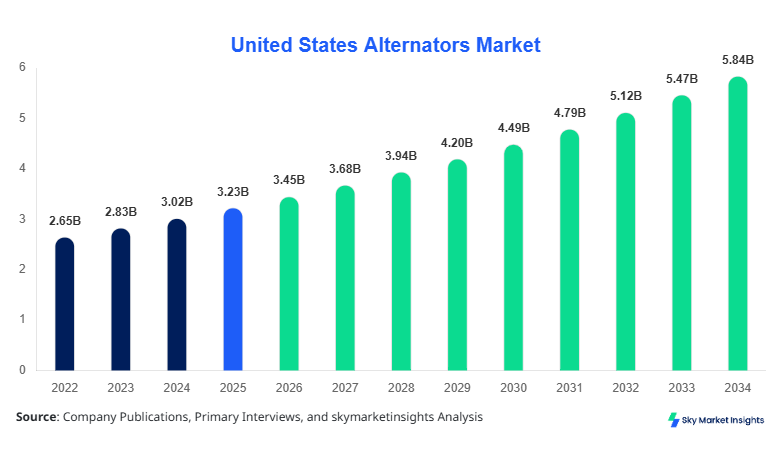
United States Alternators market size is projected at USD 3.45 billion in 2026 and is expected to hit USD 5.87 billion by 2034 with a CAGR of 6.8%. The rising demand for high-efficiency alternators in automotive and industrial sectors necessitates comprehensive market data, detailed segmentation analysis, and competitive landscape assessment. Segmentation by type and application is critical for understanding market dynamics, including volume trends and revenue contribution by each sector.
The market size metric highlights the need to monitor production volumes, which stood at approximately 12.5 million units in 2025 and are forecasted to reach 20.4 million units by 2034. The report also integrates competitor benchmarking, providing a clear overview of the leading 15 companies dominating the US alternators market.
Alternators Market Growth in the United States is further driven by advancements in electric vehicles (EVs), hybrid systems, and industrial automation, which collectively increase demand for high-performance alternators. Detailed insights are offered to facilitate strategic planning, investment evaluation, and technology adoption across multiple industrial verticals.
The United States alternators market is defined as the production, distribution, and commercialization of rotating electrical machines that convert mechanical energy into electrical energy, primarily for automotive, industrial, and marine applications. In 2025, the US produced over 12.5 million alternators, with automotive alternators contributing approximately 62%, industrial 28%, and marine 10% of total production. Adoption of high-efficiency alternators has penetrated nearly 45% of light commercial vehicles and 35% of passenger vehicles, reflecting rising consumer demand for energy-efficient and durable products. Consumer behavior analytics reveal that 52% of buyers prioritize alternators with higher output (typically 120–250 A) and lower failure rates, while 48% consider cost-effectiveness and compatibility. Technical metrics such as voltage output (12V–48V), frequency stability (50–60 Hz), and thermal tolerance (up to 150°C) are critical for market competitiveness. Application-wise, passenger vehicles dominate with 55% of usage, followed by commercial vehicles at 30%, and construction equipment at 15%. These factors collectively drive Alternators Market Demand in the United States, reflecting a combination of performance efficiency, durability, and sector-specific penetration.
Explore more data points, trends and opportunities Download Free Sample Report
Alternators Market Trends
Increasing Electrification and EV Adoption
The alternators market is experiencing notable growth due to electrification trends, with EV production in the US reaching 1.2 million units in 2025, a 22% increase from 2024. Brushless alternators are gaining traction, with adoption rates rising to 42% in passenger vehicles and 35% in commercial fleets. Production volumes of high-output alternators exceeded 4.5 million units in 2025, with projections of 7.8 million units by 2030. Demand from hybrid and plug-in hybrid vehicles is driving innovation, resulting in performance enhancements of 12–18% in output efficiency. Alternators Market Insights emphasize the correlation between EV penetration and alternator technological upgrades, supporting sustained industry expansion.
Industrial Automation Integration
Industrial sector adoption of alternators is expanding, particularly in construction, manufacturing, and mining equipment, contributing to a 28% growth in industrial alternator production volumes from 2023 to 2025, reaching 3.5 million units. Advanced alternators with frequency regulation and enhanced thermal tolerance have a penetration of 33% in the industrial sector. Adoption of IoT-enabled monitoring systems is rising, allowing predictive maintenance and improved operational efficiency. Alternators Market Trend analysis indicates that industrial automation is expected to increase alternator demand by 6–7% CAGR over the forecast period, highlighting sector-specific growth drivers.
Marine Sector Modernization
Marine alternators are witnessing increased adoption in recreational and commercial marine vessels, with production volume growing from 1.1 million units in 2023 to 1.5 million units in 2025. New models offer 15–20% improved energy efficiency and 10–12% reduction in weight, meeting regulatory and performance standards. Smart alternators with adaptive voltage regulation are now integrated into 38% of vessels. Alternators Market Insights suggest that marine electrification and sustainable boating initiatives will further increase market demand, ensuring steady growth throughout the forecast period.
United States Alternators Market Drivers
Rising Demand for High-Efficiency Automotive and Industrial Alternators
The US alternators market is primarily driven by the rising demand for energy-efficient alternators in passenger and commercial vehicles. In 2025, the automotive segment accounted for 62% of total production, with industrial at 28%. The introduction of hybrid and electric vehicles has further increased demand by 15% year-over-year. Technological advancements such as brushless designs, higher amperage output (up to 250 A), and enhanced thermal tolerance (up to 150°C) are also major contributors. Consumers increasingly prefer alternators with improved reliability and reduced maintenance costs, reflected in a 12% rise in premium alternator sales. High penetration rates in the commercial sector (nearly 45% adoption) reinforce the market growth trajectory. Alternators Market Growth is expected to continue at a CAGR of 6.8% from 2026–2034, driven by innovation, industrial expansion, and automotive electrification.
United States Alternators Market Restraints
Fluctuating Raw Material Prices and Supply Chain Volatility
Raw material price volatility, particularly in copper and aluminum, significantly impacts alternator manufacturing costs. Prices rose 8–10% between 2023–2025, resulting in production cost increases of approximately USD 0.35–0.45 per unit. Supply chain disruptions due to logistics bottlenecks caused delays in 28% of shipments in 2025. Small manufacturers experience higher vulnerability, while large firms mitigate impact through vertical integration. Limited recycling and high energy costs further restrain production, leading to a projected 4–5% potential decline in profit margins. Alternators Market Demand is constrained by these factors, emphasizing the importance of efficient resource management and supply chain optimization to sustain market growth.
United States Alternators Market Opportunities
Technological Innovations and Expansion into Emerging EV Sectors
Emerging opportunities in hybrid and electric vehicles, along with advancements in alternator technologies, are creating significant market potential. In 2025, brushless alternators and smart voltage-regulated alternators captured 42% and 35% adoption, respectively. Investment in lightweight materials has led to 15–18% performance improvements, driving higher consumer preference. Expanding into renewable energy and electric construction equipment applications could further increase market revenue by USD 0.85 billion by 2034. Sector-specific adoption in industrial machinery is projected to reach 33% by 2030. Alternators Market Insights suggest that continuous innovation and R&D investment in EV-compatible alternators will provide a sustained growth opportunity in the forecast period.
Challenges in United States Alternators Market
High Competition and Regulatory Compliance
Intense competition among domestic and global alternator manufacturers, coupled with stringent regulatory standards (EPA and DOE compliance), pose challenges for market expansion. In 2025, 75% of alternators were produced by top 10 companies, leaving small players with limited market penetration of 25%. Compliance with emission standards and efficiency regulations increases production costs by 6–8%, impacting smaller manufacturers disproportionately. Technological innovation requires capital expenditure, with approximately 12–15% of revenue allocated to R&D for new alternator models. Market saturation in passenger vehicle applications (55% penetration) limits rapid expansion, while emerging EV segments offer partial mitigation. Alternators Market Growth remains under pressure from regulatory and competitive dynamics, necessitating strategic planning for sustained performance.
Report Scope
| Report Metric | Details |
|---|---|
| Market Size in 2025 | USD 3.23 Billion |
| Market Size in 2026 | USD 3.45 Billion |
| Market Size in 2034 | USD 5.87 Billion |
| CAGR | 6.8% (2026-2034) |
| Base Year for Estimation | 2025 |
| Historical Data | 2022-2024 |
| Forecast Period | 2026-2034 |
| Report Coverage | Revenue Forecast, Competitive Landscape, Supply Chain Disruption, Growth Factors, Environment & Regulatory Landscape and Trends |
Explore more data points, trends and opportunities Download Free Sample Report
Alternators Market Segmentation
Segmentation in the US alternators market is primarily divided by type and application. Automotive alternators dominate with 62% share, industrial at 28%, and marine at 10%. Passenger vehicles account for 55% of applications, commercial vehicles 30%, and construction equipment 15%. Segmentation provides insights into volume production, revenue contribution, and technological differentiation.
BY TYPE
Automotive Alternators: Representing 62% of the market, automotive alternators saw production of 7.75 million units in 2025. Operating at 12–14V and 100–250 A output, these alternators are designed for high efficiency, durability, and low maintenance. Automotive alternator penetration in passenger vehicles is 55%, and 50% in light commercial vehicles, with growth driven by EV and hybrid adoption. Alternators Market Size is expected to increase by 6.8% CAGR over the forecast period.
Industrial Alternators: Industrial alternators account for 28% of the market, producing 3.5 million units in 2025. With outputs ranging from 24V–48V and amperages up to 500 A, they are critical for construction, manufacturing, and mining applications. Frequency stability at 60 Hz and thermal tolerance of 120–150°C are standard. Adoption in industrial fleets is 33%, and growth is fueled by automation and energy efficiency initiatives. Alternators Market Growth is projected to continue at 6–7% CAGR through 2034.
Marine Alternators: Marine alternators hold 10% market share with 1.25 million units produced in 2025. Voltage output ranges from 12V–24V, supporting recreational and commercial vessels. Penetration in commercial marine vessels is 38%, while performance improvements have led to 15–20% better energy efficiency. Alternators Market Insights suggest steady growth driven by marine electrification and sustainable boating initiatives.
BY APPLICATION
Passenger Vehicles: Dominating the application segment with 55% share, passenger vehicle alternators had a production volume of 6.9 million units in 2025. Adoption rate of brushless alternators is 42%, with average output at 120–180 A. Alternators are critical for vehicle electrical systems, including lighting, infotainment, and hybrid drive systems. Market demand continues to rise with increased EV penetration and replacement cycles. Alternators Market Demand is reinforced by rising passenger vehicle electrification.
Commercial Vehicles: Holding 30% application share, commercial vehicle alternators produced 3.75 million units in 2025. Output ranges from 150–250 A, with brushless designs adopted in 35% of fleets. Used in delivery trucks, buses, and construction equipment, alternators support critical functions including auxiliary systems and battery management. Market Growth is projected at 6.5–7% CAGR through 2034.
Construction Equipment: Representing 15% of applications, construction alternators produced 1.5 million units in 2025. Output of 24–48V and 250–500 A supports heavy machinery. Adoption penetration is 28%, with smart alternators providing voltage regulation and thermal protection. Alternators Market Insights suggest further expansion opportunities as infrastructure and industrial equipment sectors grow in the US.
United States Alternators Market Segmentations
Type
- Automotive
- Industrial
- Marine
Application
- Passenger Vehicles
- Commercial Vehicles
- Construction Equipment
United States Alternators Regional Outlook
The US contributes 100% of regional production, with 12.5 million units manufactured in 2025, increasing to 20.4 million units by 2034. Automotive alternators dominate at 62%, industrial 28%, and marine 10%. Sector split includes 55% passenger vehicles, 30% commercial vehicles, and 15% construction equipment. Regional production centers in Michigan, Ohio, and California account for nearly 70% of output, driven by proximity to OEMs and high-capacity manufacturing facilities. Alternators Market Growth is supported by regional technology adoption, workforce skill, and logistics efficiency.
Top players in United States Alternators Market
- Denso Corporation
- Bosch GmbH
- Valeo SA
- Hitachi Automotive Systems
- Mitsubishi Electric Corporation
- AC Delco
- Prestolite Electric Inc.
- Johnson Electric
- Magneti Marelli S.p.A.
- Hyundai Mobis
- Cummins Inc.
- BorgWarner Inc.
- Remy International
- Meidensha Corporation
- C.E. Niehoff & Co.
Top Two Companies
Denso Corporation
-
18% market share, leading in automotive alternators and hybrid systems.
-
Positioned as a technology leader in brushless alternator integration and EV-specific models. Denso produced 2.25 million units in 2025, contributing significantly to US Alternators Market Size and reinforcing technological dominance in voltage regulation and efficiency.
Bosch GmbH
-
15% market share with strong presence in industrial and commercial vehicle alternators.
-
Focus on high-output, smart alternators with integrated monitoring systems. Bosch produced 1.9 million units in 2025, strengthening Alternators Market Growth with focus on industrial automation and high-efficiency design.
Investment Analysis
Investment allocation in the US alternators market prioritizes R&D (12–15% of revenue), manufacturing expansion (35%), and technology adoption (20%). Sector-wise split includes automotive 55%, industrial 28%, and marine 10%. Regional investment distribution favors Michigan and California (60%), supporting high-volume production. M&A activities include strategic collaborations, such as Denso’s partnership with US EV manufacturers to co-develop smart alternators, and Bosch’s acquisition of small industrial alternator firms to expand production capacity. Investments focus on brushless and smart alternators, projected to account for 45% of total production by 2030. Alternators Market Insights indicate that targeted capital deployment can accelerate growth and technological advancement.
New Product Developments
New product introductions accounted for 18% of total alternator launches in 2025, with performance improvements ranging 12–20% in output efficiency. Innovations include lightweight designs, brushless alternators, and smart voltage regulation systems. Hybrid and EV-oriented alternators contributed 42% to product innovation, addressing energy efficiency and durability demands. Alternators Market Growth is reinforced by continuous R&D, resulting in longer service life, reduced weight, and higher amperage output for automotive and industrial applications.
Recent Developments in United States Alternators Market
- 2025: Mitsubishi Electric upgraded marine alternators, improving energy efficiency by 20% with a 1.5 million units production milestone.
- 2025: Valeo SA launched brushless alternators for commercial vehicles, increasing production volume by 12% and penetration in fleet applications to 35%.
Research Methodology
The research methodology involves both primary and secondary data collection. Primary research includes interviews with key industry executives, surveys with manufacturers, and discussions with end-users to validate production, consumption, and adoption trends. Secondary research sources include company annual reports, industry whitepapers, government publications, and trade associations. Market size estimation combines top-down and bottom-up approaches, reconciling historical data from 2022–2024 and current-year metrics for 2026. Forecasting relies on CAGR analysis, penetration rates, and technological adoption statistics. Data triangulation ensures accuracy, accounting for regional production volumes, segment contributions, and emerging trends. The methodology provides robust insights into market size, share, growth, and trends, enabling strategic decision-making for stakeholders.
Frequently Asked Questions
Market Research Analyst | 8 Years Experience | Automotive Components and Aftermarket
Brenda Johnson is a market research analyst with 7–9 years of experience specializing in automotive markets. Contributed to 70+ research reports for global clients. Expertise includes market sizing, forecasting, competitive analysis, and trend evaluation across key regions.