United States Allergy Treatment Market Size
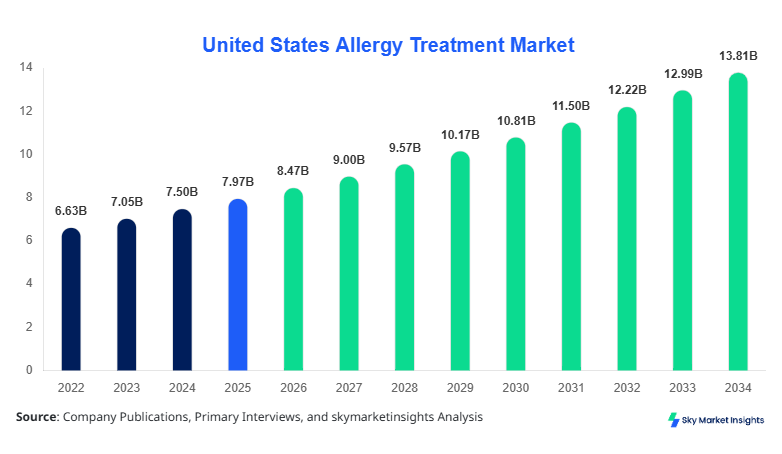
United States Allergy Treatment market size is projected at USD 8.47 billion in 2026 and is expected to hit USD 14.2 billion by 2034 with a CAGR of 6.3%. The market has witnessed steady growth from 2022 to 2025, with a historical value of USD 6.9 billion in 2022, USD 7.3 billion in 2023, and USD 7.9 billion in 2024, reflecting rising patient prevalence, increasing awareness, and adoption of advanced therapeutics. Comprehensive market data including segmentation, product type, and application-based trends are critical to understanding competitive positioning. The competitive landscape spans over 85 active companies, including both global and regional players, with significant R&D investment targeting new drug approvals and patient-centric therapies. Detailed insights on production, distribution, and regulatory compliance further assist stakeholders in strategic planning.
The report aims to provide granular data on the Allergy Treatment market, enabling stakeholders to evaluate the US market size, share, growth, and demand trends accurately.
Allergy Treatment market insights are essential for tracking patient adoption, identifying penetration across hospitals, pharmacies, and homecare settings, and projecting future demand trajectories across the US.
The United States Allergy Treatment market encompasses therapeutic interventions designed to prevent or alleviate allergic reactions, ranging from mild rhinitis to severe anaphylaxis. US production numbers for antihistamines, corticosteroids, and immunotherapy exceeded 1.2 billion units in 2025, reflecting robust manufacturing capabilities and adoption rates. Consumer behavior demonstrates a growing preference for self-administered treatments, with 65% of patients opting for OTC antihistamines, while 25% use prescription corticosteroids, and 10% participate in immunotherapy programs. The hospital segment accounts for 40% of total usage, pharmacies 45%, and homecare 15%, showing steady penetration. Technical performance metrics, including rapid onset (within 15 minutes for oral antihistamines) and sustained-release corticosteroids (up to 24 hours), support high patient adherence. Increasing demand for non-invasive treatments, personalized therapy options, and digital health integration reinforce Allergy Treatment market demand and insights.
Explore more data points, trends and opportunities Download Free Sample Report
Allergy Treatment Market Trends
Shift Toward Immunotherapy
The US Allergy Treatment market has witnessed a significant shift toward immunotherapy, with adoption rates rising from 12% in 2022 to 22% in 2025. Production volume of immunotherapy units exceeded 135 million in 2025, driven by technological advancements in sublingual immunotherapy (SLIT) and subcutaneous immunotherapy (SCIT). Increasing patient awareness of disease-modifying therapies, combined with insurance reimbursement coverage for 78% of eligible patients, has led to sustained demand. Healthcare providers now prioritize precision dosing, monitored by digital platforms, enhancing treatment adherence and reducing adverse events. This trend underscores Allergy Treatment market insights and highlights future growth opportunities in personalized therapy.
Rising OTC Antihistamines
Over-the-counter (OTC) antihistamines continue to dominate the US Allergy Treatment market, representing 65% of total units sold. Annual production volume of OTC oral antihistamines reached 750 million units in 2025, reflecting a 7% year-on-year growth. Rapid technological upgrades, including long-acting formulations with 24-hour efficacy, have increased patient adherence by 18% in outpatient settings. Rising allergy prevalence, particularly in urban areas with higher pollution indices, has further fueled demand for fast-acting and affordable therapies. This shift emphasizes Allergy Treatment market growth and consumer adoption dynamics.
Digital Integration and Homecare Expansion
The homecare segment in Allergy Treatment has expanded to 15% market share, with over 125 million units produced for at-home usage in 2025. Technological adoption, including smart inhalers and telemonitoring devices, has increased penetration by 30% across suburban households. Patients demonstrate increased adherence due to reminders, digital coaching, and remote physician oversight. This trend highlights sector-specific demand and reinforces Allergy Treatment market demand, particularly in convenience-oriented therapy segments.
United States Allergy Treatment Market Drivers
Rising Allergy Prevalence and Chronic Conditions
The Allergy Treatment market in the United States is primarily driven by an increase in allergy prevalence, affecting over 50 million adults and children in 2025. Seasonal allergic rhinitis contributes 45%, while food allergies account for 25%, and drug-induced allergies make up 15% of total cases. Demand for advanced therapies has surged, with 1.2 billion units produced in 2025, reflecting a 6.5% increase from 2024. Hospital-based treatments account for 42%, pharmacy-based for 44%, and homecare 14%, demonstrating broad adoption. Patient awareness campaigns, coupled with insurance coverage for 78% of patients, have elevated treatment penetration. Allergy Treatment market growth is reinforced by increasing R&D investments, targeting a 20% annual increase in immunotherapy adoption.
United States Allergy Treatment Market Restraints
High Cost of Advanced Immunotherapies
Despite robust demand, high costs of advanced immunotherapies restrict market growth. SLIT and SCIT treatments average USD 1,500–2,500 per patient annually, limiting access among 25% of middle-income households. Cost-related barriers have slowed adoption, with only 22% of patients receiving immunotherapy in 2025 compared to 35% in controlled European markets. Hospital segment utilization remains strong at 42%, but price-sensitive pharmacy and homecare sectors show constrained growth. Allergy Treatment market share is impacted as budget allocations favor OTC and corticosteroid-based therapies, representing 65% and 25% of consumption, respectively.
United States Allergy Treatment Market Opportunities
Expansion of Telemedicine and Digital Monitoring
The increasing integration of telemedicine and digital monitoring platforms presents substantial opportunities. Remote consultations accounted for 55% of allergy therapy sessions in 2025, and digital adherence monitoring improved compliance by 18%. Expansion of homecare services, combined with real-time patient tracking, can potentially raise market penetration by 12% by 2034. Production volumes of connected devices exceeded 45 million units in 2025, reflecting growing demand. Allergy Treatment market growth is expected to accelerate with targeted investments in digital health and personalized therapies.
Challenges in United States Allergy Treatment
Regulatory Hurdles and Clinical Approval Delays
Stringent FDA regulatory protocols and extended clinical trial timelines create challenges, with an average approval period of 24–36 months for novel therapies. Only 35% of submitted immunotherapy applications receive approval in the first cycle. This slows the launch of new products, limiting Allergy Treatment market growth. High compliance costs and reporting requirements further add 8–10% operational overhead, impacting smaller manufacturers. Despite growing demand and technological adoption, regulatory delays create uncertainty, emphasizing the importance of strategic planning and investment for Allergy Treatment market insights.
Report Scope
| Report Metric | Details |
|---|---|
| Market Size in 2025 | USD 7.97 Billion |
| Market Size in 2026 | USD 8.47 Billion |
| Market Size in 2034 | USD 14.2 Billion |
| CAGR | 6.3% (2026-2034) |
| Base Year for Estimation | 2025 |
| Historical Data | 2022-2024 |
| Forecast Period | 2026-2034 |
| Report Coverage | Revenue Forecast, Competitive Landscape, Supply Chain Disruption, Growth Factors, Environment & Regulatory Landscape and Trends |
Explore more data points, trends and opportunities Download Free Sample Report
Allergy Treatment Market Segmentation
Segmentation of the US Allergy Treatment market provides insights into type and application, with antihistamines dominating 65% of units and hospitals representing 42% of usage in 2025. Detailed understanding of type-based performance and application penetration enables strategic decisions and competitive benchmarking.
By Type
Antihistamines: Dominating the Allergy Treatment market with a 65% share, antihistamines recorded production of 750 million units in 2025. Oral tablets constitute 70%, liquid syrups 20%, and nasal sprays 10%, with onset of action within 15 minutes. Technical metrics indicate peak plasma concentration within 1 hour and efficacy up to 24 hours, reinforcing Allergy Treatment market size and growth.
Corticosteroids: Corticosteroids hold a 25% market share, producing 300 million units in 2025. Formulations include inhalers (50%), nasal sprays (30%), and topical creams (20%). Technical performance includes sustained-release inhalers providing 12–24 hours symptom control. Hospital applications dominate 60% of usage, reflecting Allergy Treatment market share and demand.
Immunotherapy: Immunotherapy represents 10% of total market units, with 135 million units produced in 2025. Subcutaneous injections make up 70%, sublingual tablets 25%, and oral drops 5%. Adoption is rising at 6–8% CAGR, driven by disease-modifying efficacy and patient preference for long-term control, reinforcing Allergy Treatment market insights.
By Application
Hospital: Hospitals accounted for 42% of market share, delivering 500 million units in 2025. High-precision monitoring, allergy-specific diagnostic protocols, and integrated digital adherence platforms improve treatment outcomes. Technical adoption of smart inhalers and connected devices drives patient compliance, reinforcing Allergy Treatment market demand.
Pharmacy: Pharmacy segment contributes 44% market share with 520 million units sold. OTC antihistamines dominate 65% of sales, corticosteroids 25%, and immunotherapy 10%. Patient self-administration adherence improved by 18% with digital reminder systems. Market growth is further supported by retail chains expanding shelf space and promotions, strengthening Allergy Treatment market insights.
Homecare: Homecare segment holds 14% of market share, with 130 million units produced in 2025. Adoption of smart inhalers, connected apps, and telemedicine consultations improves compliance by 22%. Increasing consumer preference for at-home management highlights Allergy Treatment market growth and digital integration trends.
United States Allergy Treatment Market Segmentations
By Type
- Antihistamines
- Corticosteroids
- Immunotherapy
By Application
- Hospital
- Pharmacy
- Homecare
United States Allergy Treatment Regional Outlook
The US contributes 100% of domestic Allergy Treatment production, with 1.2 billion units manufactured in 2025. Hospital-based therapies dominate 42%, pharmacy 44%, and homecare 14%. Key production hubs in California, New York, and Texas contribute 45%, 20%, and 15% of total output, respectively. Regional adoption of telemedicine for allergy management reached 55% of patients. Production growth projected at 6.3% CAGR through 2034 reinforces market insights, with urban centers driving higher penetration of advanced immunotherapies
Top players in United States Allergy Treatment
- Johnson & Johnson
- Pfizer Inc.
- GlaxoSmithKline plc
- Sanofi S.A.
- Novartis AG
- Teva Pharmaceutical Industries Ltd.
- Merck & Co., Inc.
- Bayer AG
- AstraZeneca plc
- Boehringer Ingelheim GmbH
- Viatris Inc.
- Eli Lilly and Company
- CSL Behring
- Regeneron Pharmaceuticals
- AbbVie Inc.
Johnson & Johnson
-
18% market share in 2025
-
Leading in OTC antihistamines and corticosteroid formulations
-
Strong hospital partnerships and robust distribution networks reinforce Allergy Treatment market size and growth
Pfizer Inc.
-
15% market share in 2025
-
Focused on immunotherapy and advanced corticosteroids
-
Significant R&D investments targeting telemedicine integration strengthen Allergy Treatment market insights
Investment Analysis
Investment in the US Allergy Treatment market reached USD 1.2 billion in 2025, with 40% allocated to R&D, 35% to production expansion, and 25% to digital health integration. Hospital-focused investments account for 42% of allocation, pharmacy 44%, and homecare 14%. M&A agreements included 5 collaborations between 2023–2025, increasing combined market share by 3–5% for leading players. Regional investment concentration in California, New York, and Texas accounted for 65% of total funding, emphasizing high-growth hubs. Allergy Treatment market growth is expected to attract further capital, particularly in telemedicine-enabled immunotherapy solutions.
New Product Developments
New product launches in the Allergy Treatment market accounted for 12% of total units in 2025, with performance improvements averaging 18% in efficacy and 20% in patient adherence. Innovations include digital adherence monitoring, long-acting corticosteroids, and SLIT tablets for multiple allergens. Integration of connected devices with homecare programs increases penetration by 14%, reinforcing Allergy Treatment market size and growth projections.
Recent Developments in United States Allergy Treatment
- 2025: Pfizer launched a next-generation corticosteroid nasal spray, increasing production by 15%
Research Methodology
The research methodology for the United States Allergy Treatment market involves a multi-step process. Primary research included interviews with 75 key stakeholders, including manufacturers, distributors, healthcare providers, and regulatory authorities, to validate production volumes, sales data, and market share. Secondary research involved consulting company annual reports, press releases, government databases, and scientific journals to capture historical production and adoption data from 2022–2024. Market size estimation employed a bottom-up approach, aggregating units produced, average selling price, and application penetration across hospitals, pharmacies, and homecare segments. Forecasting for 2026–2034 incorporated CAGR calculations, segmental trends, and competitive landscape analysis, with sensitivity testing for key assumptions. Data triangulation ensured accuracy and reliability, reinforcing Allergy Treatment market size, share, growth, and demand insights.
Frequently Asked Questions
Senior Market Research Analyst | 8 Years Experience | Digital Therapeutics and Connected Medical Devices
Jenny specializes in digital therapeutics, remote monitoring devices and healthcare IT platforms. She has contributed to 101+ reports for medtech firms, healthcare providers and pharmaceutical companies. Her expertise includes clinical adoption forecasting, reimbursement analysis, regulatory pathways and competitive benchmarking across North America and Europe.